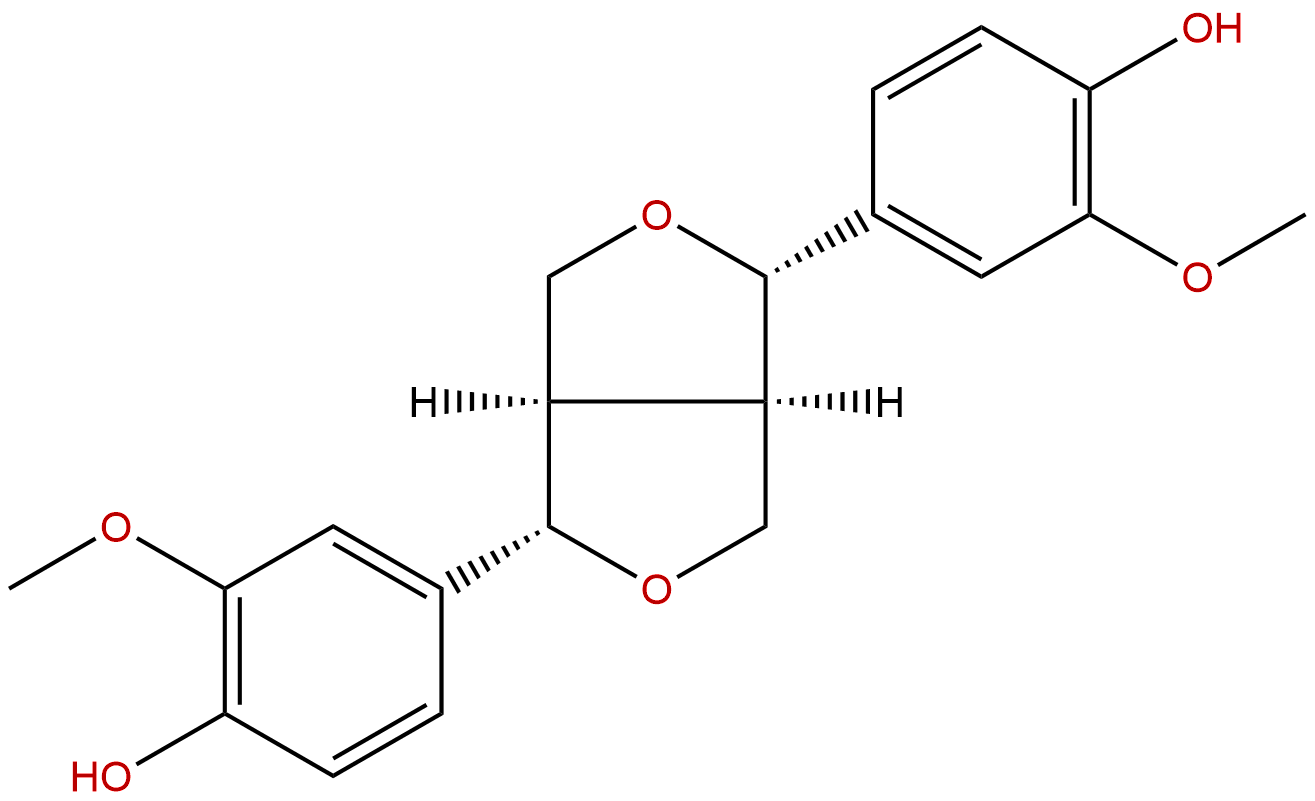


Product name: (+)-Pinoresinol
Synonym name:
Catalogue No.: BP1789
Cas No.: 487-36-5
Formula: C20H22O6
Mol Weight: 358.39
Botanical Source:
Physical Description: Powder
Type of Compound: Lignans
Purity: 95%~99%
Analysis Method: HPLC-DAD or/and HPLC-ELSD
Identification Method: Mass, NMR
Packing: Brown vial or HDPE plastic bottle
Storage: Store in a well closed container, protected from air and light. Put into refrigerate or freeze for long term storage.
Whenever possible, you should prepare and use solutions on the same day. However, if you need to make up stock solutions in advance, we recommend that you store the solution as aliquots in tightly sealed vials at -20℃. Generally, these will be useable for up to two weeks.
The product could be supplied from milligrams to grams, up to kilograms
Inquire for bulk scale.
Descriptions:
Pinoresinol , among plant lignans, has the strongest antiinflammatory properties by acting on the NF-κB signaling pathway in human intestinal Caco-2 cells.[1]
Pinoresinol-Rich Olives has chemopreventive, anticancer and anti-Inflammatory effects.[2]
Pinoresinol, a lignan of wide distribution in plants, is found to occur as a minor component in the defensive secretion produced by glandular hairs of caterpillars of the cabbage butterfly, Pieris rapae, serves for defense in a caterpillar.[3]
Pinoresinol can ameliorate CCl4-induced acute liver injury, and this protection is likely due to anti-oxidative activity and down-regulation of inflammatory mediators through inhibition of NF-kappaB and activating protein 1 (AP-1).[4]
(+)-Pinoresinol possesses fungicidal activities and therapeutic potential as an antifungal agent for the treatment of fungal infectious diseases in humans.[5]
References:
[1] During A, Debouche C, Raas T, et al. J Nut, 2012, 142(10):1798-805.
[2] Ricciardiello L, Boland C R, Romano M, et al. US 20090048187 A1[P]. 2009.
[3] Schroeder F C, Eisner T. P Natl Acad Sci USA, 2006, 103(42):15497-501.
[4] Kim H Y, Kim J K, Choi J H, et al.J Pharmacol Sci, 2010, 112(1):105-12.
[5] Hwang B, Lee J, Liu Q H, et al. Molecules, 2010, 15(5):3507-16.
[6] Lin B, Shuai N. Chinese Journal of Drug Application & Monitoring,2013(03):147-9.
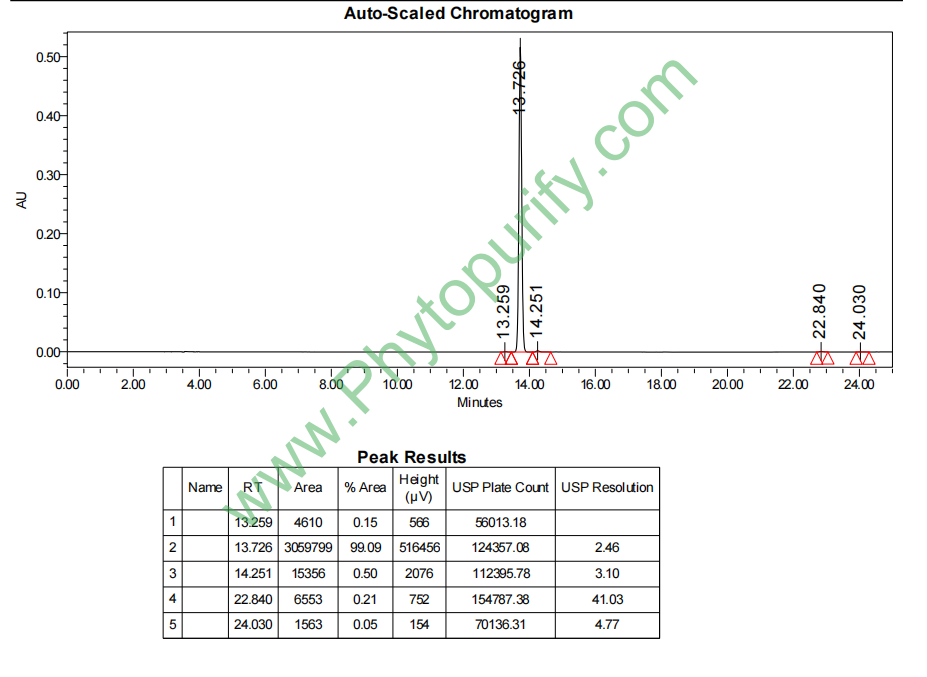
HPLC of (+)-Pinoresinol
Storage conditions:Short-term storage at 2~8℃, long-term storage at -20 ~ -80℃
77.3800
2.5854
2.5808
.0852
7.9965
6.5871
High
89.9182
3.6786
No
Yes
No
No
Yes
No
0.0
No
No
No
No
Natural products, as an important source of drug discovery, play an irreplaceable role in the history of human disease prevention and treatment. Among them, lignans have become a hot topic in pharmacological research due to their wide range of biological activities and unique chemical structures. Pinaresinol, as a typical furan type lignan, is widely present in various medicinal plants, grains, and vegetables. Its CAS number is 487-36-5, and its chemical structure is (+) -1S, 3aR, 4S, 6aR configuration. Early research focused on its properties as a plant estrogen and antioxidant, while recent pharmacological studies have continuously revealed its potential therapeutic value in metabolic diseases, inflammation, and proliferative diseases. Especially for diseases such as benign prostatic hyperplasia (BPH), turpentine exhibits the potential for multi-target and multi pathway regulation, involving multiple key targets such as PRKCE, ESR1, AR, PTGS2, etc. This article aims to systematically review the chemical properties, plant sources, pharmacological activities, mechanisms of action, and medicinal properties of turpentine, in order to provide comprehensive scientific references for the in-depth research and development of this natural product.
Pine resin is a furan type lignin dimer composed of two phenylpropanoid units connected by a β - β 'bond. Its molecular formula is C20H22O6 and its molecular weight is 358.39 g/mol. Its core structure consists of two benzene rings (A ring and B ring), connected by methoxy and methylenedioxy substituents respectively, and linked by tetrahydrofuran ring, forming a complex stereochemical structure. Its absolute configuration is (+) -1S, 3aR, 4S, 6aR, which has a decisive impact on its biological activity.
In terms of physical and chemical properties, turpentine exhibits typical lignan characteristics. Its calculated lipid water partition coefficient (LogP) is about 2.59, indicating that it has moderate lipophilicity and is conducive to transmembrane transport. The topological polar surface area (TPSA) is 77.38 Å ², indicating moderate polarity. The water solubility is relatively low, about 0.0852 mg/mL, which to some extent limits its bioavailability. It is worth noting that, based on its physicochemical parameters, turpentine has a high blood-brain barrier permeability, which provides the possibility for its potential application in central nervous system activity. The preliminary safety assessment shows that there is no significant risk of hERG potassium channel inhibition (predicted as' no '), and the Ames test prediction value is 0.0, indicating that it may not have direct genetic toxicity. These characteristics lay a preliminary foundation for its drug development.
Pine resin is widely distributed in the plant kingdom and is a secondary metabolite of many medicinal and edible plants. Its main plant sources include:
1. Pinus Lambertiana The resin and wood of various species of the genus Pinus, which is also the origin of its name "pine resin".
2. olive Olive oil and olive leaves contain abundant amounts of turpentine and its glycosidic forms, which are one of the main pathways for the intake of this compound in the Mediterranean diet.
3. sesame Sesame seeds and sesame oil are important dietary sources of turpentine, often in the form of turpentine diglucoside.
4. Chinese medicinal materials Traditional Chinese medicines such as Eucommia ulmoides Oliv., Acanthopanax senticosus, and Forsythia suspensa also contain high levels of turpentine, some of which are related to their traditional effects.
5. Other sources: A small amount of rosin also exists in cruciferous vegetables such as broccoli, cabbage and whole grains.
The method of extracting turpentine needs to be optimized based on the properties of the raw materials and the form of the target product. The conventional methods include:
* Organic solvent extraction method The most commonly used method is to use solvents such as methanol, ethanol, acetone, or ethyl acetate for reflux or ultrasonic extraction. This method has high efficiency, but relatively poor selectivity.
* Supercritical fluid extraction The use of supercritical CO ₂ as an extractant has the advantages of environmental protection, low temperature, and no solvent residue, making it particularly suitable for the extraction of thermosensitive substances, and can achieve a certain degree of separation by adjusting pressure and temperature.
* Enzyme assisted extraction Regarding the glycosidic form of turpentine, the use of cellulases, pectinases, etc. to destroy plant cell walls, or the use of β - glucosidase for hydrolysis, can increase the yield of free turpentine.
* Separation and purification Crude extracts usually need to be purified through a series of chromatographic techniques, such as silica gel column chromatography, preparative high-performance liquid chromatography (HPLC), etc., to obtain high-purity turpentine monomers. In recent years, the application of technologies such as high-speed countercurrent chromatography has also improved separation efficiency.
A large number of in vitro and in vivo studies have shown that turpentine has diverse pharmacological activities, and its research has expanded from the initial phytoestrogenic effects to multiple disease fields.
Anti benign prostatic hyperplasia activity This is the activity of turpentine that has received much attention in recent years. In a rat BPH model induced by testosterone, turpentine can significantly inhibit the increase in prostate weight and alleviate the proliferation of prostate epithelial cells, with an effect comparable to the classical drug finasteride. Its function is closely related to regulating hormone metabolism, inhibiting inflammation, and cell proliferation.
Lowering blood sugar and improving insulin resistance activity Pine resin exhibits a clear hypoglycemic effect. In the animal model of diabetes, it can reduce fasting blood glucose, improve glucose tolerance, and increase insulin sensitivity. Its mechanism involves promoting glucose uptake in skeletal muscle and adipose tissue, protecting pancreatic beta cell function, and regulating key enzyme activity in liver glucose metabolism.
Plant estrogens and bone protective activity As a lignan plant estrogen, turpentine can weakly bind to estrogen receptors (especially ER β), simulating or antagonizing the effects of endogenous estrogen. In ovariectomized rats (postmenopausal osteoporosis model), turpentine can partially inhibit bone density decline, reduce bone resorption, and demonstrate the potential to prevent osteoporosis.
Anti inflammatory and antioxidant activity Pine resin has strong free radical scavenging ability and antioxidant enzyme induction activity. In various inflammatory cell models, such as lipopolysaccharide stimulated macrophages, it can effectively inhibit the production of nitric oxide (NO), prostaglandin E2 (PGE2), as well as pro-inflammatory factors such as tumor necrosis factor - α (TNF - α) and interleukin-6 (IL-6).
Neuroprotective activity Thanks to its high blood-brain barrier permeability, turpentine has shown promising prospects in neuroprotection. Research has shown that it can alleviate neuronal toxicity induced by β - amyloid protein, inhibit excessive activation of microglia, and protect dopaminergic neurons in Parkinson's disease models. Its effects are related to antioxidant, anti-inflammatory, and anti apoptotic properties.
Other activities In addition, pine resin has been reported to have anti-tumor (such as inhibiting the proliferation of certain cancer cell lines), cardiovascular protective (such as improving endothelial function), and antifungal activities, but its underlying mechanisms need further clarification.
The pharmacological effects of turpentine, especially in the treatment of BPH, are achieved by acting on a complex molecular network involving multiple key targets and signaling pathways. The mechanism of action for a given target can be summarized as follows:
Hormone related targets:
Inflammation and proliferation related targets:
Cell cycle and apoptosis related targets:
In summary, turpentine does not act on a single target, but rather exerts a comprehensive effect against BPH by synergistically regulating hormone balance, inhibiting inflammatory response, blocking cell cycle, and inducing apoptosis through multiple targets. This multi-target mode of action is also the advantage of many natural products.
Although the pharmacological activity of turpentine is clear, whether it can be used as a drug still requires systematic pharmacological evaluation.
Absorption, distribution, metabolism, excretion:
Challenges and Strategies in Drug Development:
At present, there is still a lack of pharmacokinetic data on the pine resin system in humans, which is a key research gap that must be filled before it enters clinical practice.
As a natural active molecule with multi-target effects, turpentine has broad clinical application prospects, but also faces challenges.
Potential application directions:
Future research focus and challenges:
Pinaresinol, as a widely sourced and structurally unique natural lignan, has been increasingly scientifically validated for its multifaceted pharmacological activities, particularly in combating benign prostatic hyperplasia, regulating glucose metabolism, and neuroprotection. It exerts therapeutic effects in a multi pathway synergistic manner by regulating multiple key targets such as AR, ESR1, PTGS2, CASP3, PTEN, etc., reflecting the complexity advantage of natural product multi-target effects. Despite facing challenges such as water solubility and metabolic stability in drug development, these obstacles are expected to be overcome through the intervention of modern medicinal chemistry and pharmacology methods. In the future, with the in-depth analysis of its mechanism of action, the completion of systematic preclinical evaluation and the advancement of clinical research, rosin is expected to develop from a potential natural product to a drug or functional agent for the prevention and treatment of chronic diseases such as prostatic hyperplasia, diabetes and its complications, contributing its unique value to human health. The continuous research on turpentine will also provide useful references for the development of other lignans and even broader natural products.
