Introduction/Overview
In the field of natural product chemistry and pharmacology research, lignans have attracted much attention due to their extensive and significant biological activities. Arctigenin 4 '- O - β - gentiobioside (AG4G), CAS number 41682-24-0, is a member of the lignan glycoside class. Arctigenin, as the core active ingredient of traditional Chinese medicine such as burdock, has been widely reported for its anti-inflammatory, antiviral, and anti-tumor effects. As a glycosylated derivative of arctiin, AG4G not only changes its physicochemical properties but also potentially endows it with unique or enhanced pharmacological activity by connecting a gentian disaccharide (linked by two glucose molecules through a β -1,6 glycosidic bond) group. In recent years, research has revealed that AG4G has shown significant potential in antioxidant, anti-inflammatory, antiviral (especially influenza A virus), and anti-tumor aspects. At the same time, its application value in metabolic disorders and central nervous system dysfunction research has also begun to emerge. This article aims to systematically review the chemical structure, plant origin, pharmacological activity, mechanism of action, pharmacological evaluation, and clinical application prospects of AG4G, in order to provide comprehensive scientific references for the in-depth research and development of this compound.
Chemical structure and physicochemical properties
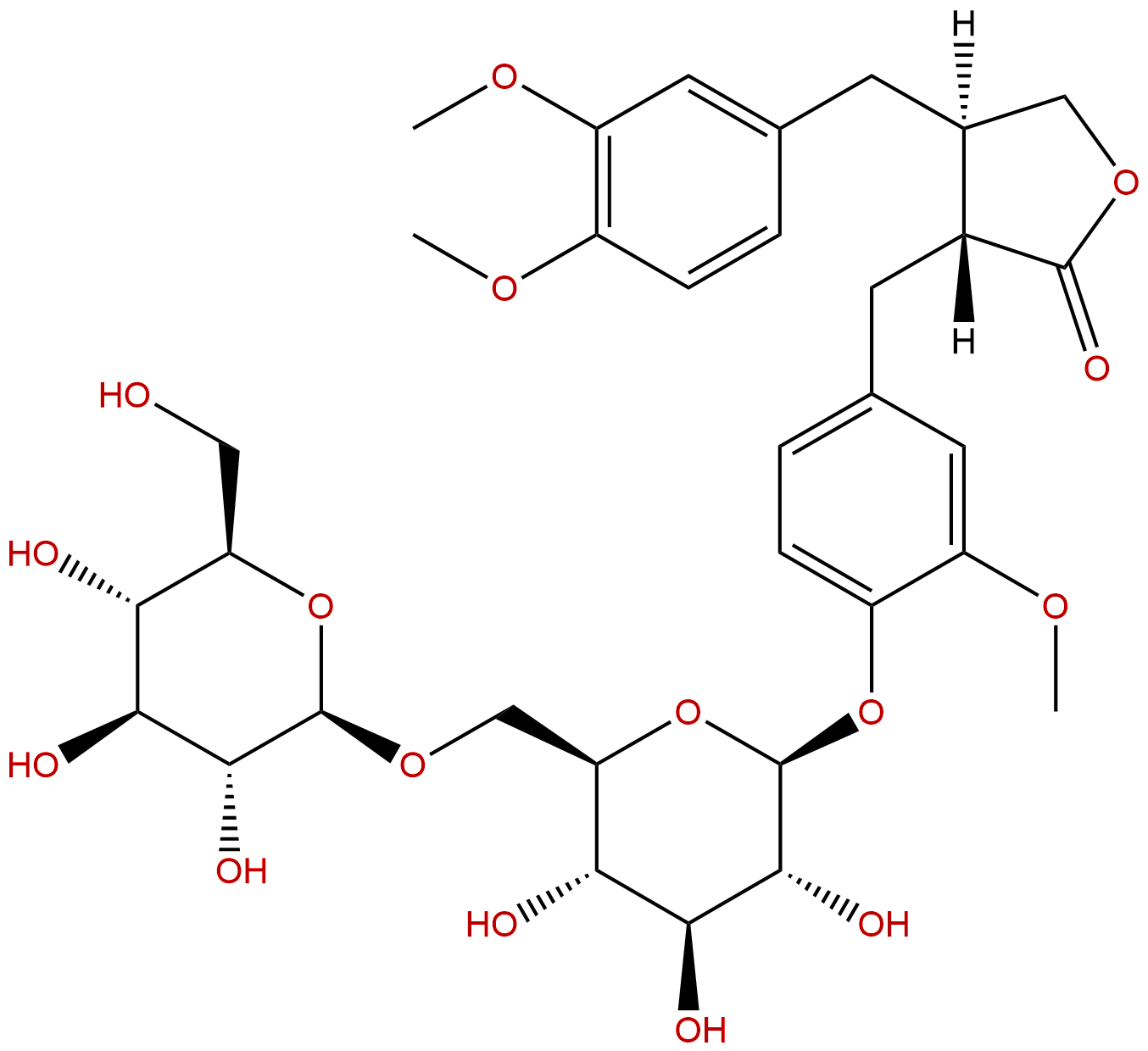
The chemical structure of AG4G is clear and belongs to the aryl naphthalide type lignan glycoside. Its parent nucleus is arctigenin, and the basic skeleton is composed of two phenylpropanoid units (C6-C3) connected by β - carbon, forming a tetrahydrofuran ring structure. Its key feature is that the hydroxyl group at the 4 '- position of the benzene ring of the arctiin glycoside is connected to a gentian disaccharide group (β - D-glucopyranosyl - (1 → 6) - β - D-glucopyranosyl) through an O-glycosidic bond. This glycosylation modification significantly affects the properties of the compound.
Its molecular formula is C34H44O18 and its molecular weight is 696.6990. From the analysis of parameters related to drug properties, the calculated lipid water partition coefficient (LogP) value is relatively low, about 0.1396, indicating strong hydrophilicity, mainly attributed to the large hydrophilic gentian disaccharide groups. The topologically polar surface area (TPSA) is as high as 232.5200 Å ², further confirming its strong polarity characteristics. The predicted value of water solubility is 4.4707 (usually measured in mg/mL or log mol/L, indicating moderate or good water solubility). Compared with its aglycone arctiin (which has strong lipid solubility), AG4G has greatly improved water solubility, which is beneficial for its dissolution and distribution in aqueous media such as biological fluids. However, high polarity and high molecular weight also pose challenges, as their predicted blood-brain barrier (BBB) permeability is "low," meaning their ability to enter the central nervous system in the form of prototype drugs is limited. In terms of early safety indicators, the prediction showed no risk of hERG potassium channel inhibition (hERG inhibition: no), and the Ames test predicted a value of 0.0 (indicating no mutagenic signal), providing preliminary positive data for its safety.
Plant sources and extraction methods
AG4G mainly comes from plants of the burdock genus in the Asteraceae family, especially the traditional Chinese medicine burdock seed(Arctium lappa L. Dry and ripe fruits, as well as roots, leaves, and other parts of burdock. As a traditional Chinese medicine, burdock root has the effects of dispersing wind and heat, promoting lung and rash, detoxifying and benefiting the throat. Its active ingredients are based on compounds such as arctiin (a glucoside of burdock root) and its aglycones, as well as lignans represented by AG4G. In addition, it may also be found in some plants of the same family or containing lignin components.
The extraction of AG4G from plant materials usually follows the general process of natural product extraction. Firstly, polar solvents such as methanol, ethanol, or aqueous ethanol are used to extract or reflux the dried and crushed burdock seeds, in order to fully extract the polar glycosides. After filtration and concentration, the crude extract obtained is preliminarily enriched and decolorized using macroporous adsorption resins (such as D101, AB-8, etc.). AG4G is usually enriched in the medium to high concentration ethanol elution sites (such as 50% -70% ethanol) through gradient elution with different concentrations of ethanol aqueous solutions. Further purification depends on chromatographic techniques, including normal or reverse phase silica gel column chromatography, Sephadex LH-20 column chromatography and high performance liquid chromatography (HPLC) preparation. The combination of reverse phase C18 chromatography column with methanol water or acetonitrile water system is one of the most effective methods for separating and purifying AG4G. During the extraction process, attention should be paid to controlling the temperature and pH value to avoid hydrolysis of glycosidic bonds. Modern technologies such as ultrasound assisted extraction and microwave-assisted extraction can improve extraction efficiency. Structural identification involves the comprehensive use of spectroscopic methods such as nuclear magnetic resonance (NMR, including 1H, 13C, 2D-NMR), mass spectrometry (MS), infrared (IR), and optical rotation.
Pharmacological activity research
A large number of in vitro and in vivo pharmacological studies have shown that AG4G has various biological activities, which are the basis of its medicinal potential.
-
antioxidant activity AG4G, through its phenolic hydroxyl structure, can effectively scavenge free radicals such as DPPH free radicals and ABTS free radical cations, and exhibits reducing power. Its antioxidant capacity may be stronger than its aglycone, as the introduction of sugar groups may provide additional hydrogen bonding sites, enhancing reactivity with free radicals. This antioxidant effect helps alleviate oxidative stress, which is a common pathological basis for many chronic diseases such as metabolic syndrome and neurodegenerative diseases.
-
anti-inflammatory activity AG4G has shown significant effects in various inflammatory models. In the lipopolysaccharide (LPS) - induced macrophage (such as RAW264.7) inflammation model, AG4G can dose dependently inhibit the production of nitric oxide (NO), prostaglandin E2 (PGE2), and pro-inflammatory cytokines (such as tumor necrosis factor - α (TNF - α), interleukin-6 (IL-6), IL-1 β). Its anti-inflammatory effect is closely related to the inhibition of inducible nitric oxide synthase (iNOS) and cyclooxygenase-2 (COX-2) protein expression.
-
Antiviral activity AG4G exhibits significant inhibitory activity against influenza A virus (IAV). Research has shown that it not only inhibits virus replication within cells, but may also act by interfering with the virus's lifecycle, such as virus adsorption or early steps after entering cells. Its anti IAV activity may be related to regulating the immune response of host cells and inhibiting the expression of viral nucleoprotein (NP), providing candidate molecules for the development of novel anti influenza drugs.
-
Antitumor activity As a potential anti-tumor agent, AG4G can inhibit the proliferation and promote apoptosis of many cancer cell lines (such as breast cancer, liver cancer, lung cancer, colon cancer cells). Its anti-tumor mechanism involves inducing cell cycle arrest (such as G1 phase or G2/M phase), activating caspase cascade reactions, regulating the Bcl-2/Bax protein ratio, and inducing a decrease in mitochondrial membrane potential. It is worth noting that its glycoside structure may affect its cellular uptake and intracellular metabolism, resulting in a different anti-tumor effect spectrum than arctiin.
-
Potential effects on metabolic disorders and central nervous system (CNS)Based on its antioxidant and anti-inflammatory properties, AG4G was explored for the study of metabolic disorders (such as diabetes, non-alcoholic fatty liver disease). It may work by improving insulin resistance, regulating lipid metabolism, and reducing tissue inflammation. In terms of the central nervous system, although its BBB permeability is low, its inhibitory effect on neuroinflammation may have an indirect protective effect on neurodegenerative diseases such as Alzheimer's disease and Parkinson's disease. In addition, the active metabolites produced by glycosylation of its aglycones under the action of gut microbiota may mediate some CNS effects.
Mechanism of action and molecular targets
The multiple pharmacological activities of AG4G stem from its regulation of multiple intracellular signaling pathways, and its mechanism of action and molecular target research have gradually deepened.
-
Nuclear factor kappa B (NF - κ B) signaling pathway This is the core pathway through which AG4G exerts anti-inflammatory and partially anti-tumor effects. Under inflammation or stress stimulation, AG4G can inhibit the activation of I κ B kinase (IKK), prevent the phosphorylation and degradation of I κ B α, and thus inhibit the nuclear translocation of NF - κ B p65 subunit. This ultimately leads to a decrease in transcription of downstream inflammatory mediator genes such as iNOS, COX-2, TNF - α, IL-6, etc.
-
Mitogen activated protein kinase (MAPK) signaling pathway AG4G can regulate the phosphorylation levels of MAPK family members, including extracellular signal regulated kinase (ERK), c-Jun N-terminal kinase (JNK), and p38 MAPK. Under different cellular environments and stimuli, the inhibition or regulation of these pathways by AG4G collectively mediates its anti-inflammatory, anti proliferative, and pro apoptotic effects.
-
Nuclear factor E2 related factor 2/antioxidant response element (Nrf2/ARE) pathway AG4G may play a role in antioxidant stress by activating the Nrf2 signaling pathway. Nrf2 is the main regulatory factor for cellular antioxidant defense. AG4G may promote the transfer of Nrf2 from the cytoplasm to the nucleus, bind to ARE, and upregulate the expression of phase II detoxifying enzymes and antioxidant proteins such as heme oxygenase-1 (HO-1) and quinone oxidoreductase 1 (NQO1), enhancing the cell's resistance to oxidative damage.
-
Virus related targets In terms of anti influenza virus, the exact molecular targets of AG4G are still being explored. In addition to potentially acting directly on viral proteins such as hemagglutinin HA and neuraminidase NA, it is more likely to exert its effects by regulating host factors, such as inhibiting cell signaling pathways necessary for viral replication (such as PI3K/Akt, NF - κ B), or interfering with the assembly and function of viral ribonucleoprotein (vRNP).
-
Cell cycle and apoptosis related proteins In the anti-tumor mechanism, AG4G induces cell cycle arrest by upregulating cyclin dependent kinase inhibitors (CDKI) such as p21 and p27, downregulating cyclins and cyclin dependent kinases (CDKs). At the same time, it promotes cancer cell apoptosis by regulating Bcl-2 family proteins (upregulation of pro apoptotic Bax and downregulation of anti apoptotic Bcl-2), activating caspase-3/-9, and possibly inducing mitochondrial and endoplasmic reticulum stress pathways.
Evaluation of drug properties and pharmacokinetics
Although AG4G exhibits excellent activity in vitro, its drug like and pharmacokinetic (PK) properties in vivo are key factors determining its successful development as a drug.
-
Drugability assessment Based on its physical and chemical parameters, AG4G meets some of the requirements in the "Rule of Five" (such as the possibility of exceeding the number of hydrogen bond donors and acceptors) and belongs to the common characteristics of glycosidic natural products. Its advantage lies in its good water solubility, and its potential oral absorption may be better than its aglycone (but glycoside compounds usually have poor intestinal permeability). The main challenge lies in: ① Oral bioavailability The large polar sugar groups may hinder their passive diffusion through intestinal epithelial cells and are easily hydrolyzed by intestinal microbiota or glycosidases on the intestinal mucosa into aglycones (arctiin) and sugars, which may be absorbed in the form of aglycones or secondary metabolites. ② Metabolic stability As a glycoside, it is prone to hydrolysis metabolism. ③ distribution High polarity limits its tissue distribution, especially its ability to penetrate the blood-brain barrier, which restricts its direct therapeutic application for CNS diseases.
-
pharmacokinetics At present, there is relatively limited public data on the PK research of AG4G system, but speculation can be made based on its structural characteristics and similar compounds. After oral administration, AG4G may have limited absorption in the upper gastrointestinal tract, with most entering the colon and being hydrolyzed by β - glucosidase secreted by the gut microbiota, releasing arctigenin. Glycosides have higher lipophilicity and are more easily absorbed into the portal vein circulation. The absorbed aglycones undergo extensive phase I (such as oxidation and demethylation) and phase II (glucuronidation and sulfation) metabolism in the liver. If the prototype AG4G is absorbed, it may also be enzymatically hydrolyzed in the liver and blood. Therefore, AG4G is likely to be a "prodrug", and its true active substance in the body is its aglycone arctiin or its further metabolites. This explains why although AG4G's BBB permeability is predicted to be low, it still shows potential in CNS dysfunction research - possibly through its metabolites or indirectly through regulating peripheral inflammation. Future research needs to clarify the absolute bioavailability, main metabolic pathways, major distribution organs, and excretion modes of AG4G in animals and humans.
Clinical application prospects and prospects
AG4G, as a multi-target and multifunctional natural active compound, has broad clinical application prospects but also faces challenges.
-
Prospect areas:
- Antiinfluenza virus drugs/adjuvant therapy Given its activity against influenza A virus, AG4G is expected to be developed as a novel anti influenza drug, especially against existing strains resistant to neuraminidase inhibitors. It can also be used as a compound ingredient or health product to enhance the body's antiviral immunity.
- Anti inflammatory and immunomodulatory agents Used to treat chronic inflammatory diseases such as arthritis, colitis, asthma, etc. Its natural source and multiple anti-inflammatory mechanisms have advantages.
- neoadjuvant therapy As a sensitizer or adjuvant drug for chemotherapy or radiotherapy, utilizing its dual effects of anti-tumor and reducing the side effects of radiotherapy and chemotherapy (such as inflammatory reactions).
- Management of metabolic diseases: It is a potential functional factor or drug precursor to improve insulin resistance and reduce metabolic inflammation in diabetes and its complications, non-alcoholic fatty liver and other diseases.
- Neuroprotective agent Although BBB has poor permeability, it can be used for the prevention or adjuvant treatment of neurodegenerative diseases through structural modifications (such as prodrug preparation), nano delivery systems, or by utilizing its indirect regulatory effects on peripheral and central nervous system inflammation.
-
Challenges and Prospects:
- Structural optimization and derivative development To address the issues of strong water solubility but poor membrane permeability and low BBB permeability, structural modification can be carried out through medicinal chemical methods. For example, acylation or alkylation of sugar groups, or designing prodrugs that are more easily hydrolyzed by specific enzymes to balance solubility, stability, and absorption. It is also possible to explore replacing the gentian disaccharide group with other functional groups to improve the PK/PD properties.
- New drug delivery system Using nanotechnology (such as liposomes, polymer nanoparticles, micelles) to encapsulate AG4G or its aglycones can improve its stability, targeting (such as tumor targeting, inflammation site targeting), and potentially promote its crossing of biological barriers (such as BBB).
- In depth mechanism research Further clarification is needed on its exact molecular targets for antiviral and anti-tumor effects, especially the contribution ratio and synergistic relationship between its glycoside form and aglycone form in vivo. It is crucial to clarify whether it serves as a "prodrug" or exerts its therapeutic effect independently.
- System preclinical and clinical research There is an urgent need to conduct systematic in vivo pharmacological, toxicological, and complete pharmacokinetic studies in animals to evaluate their effective dose range, long-term safety, and potential toxicity. Ultimately, its effectiveness and safety in the human body need to be validated through rigorous clinical trials.
Conclusion
Arctiin-4 '- O - β - gentian glycoside (AG4G) is an active lignan glycoside isolated from the traditional Chinese medicine Arctii. It inherits the multi-target properties of lignin compounds and exhibits enhanced water solubility and unique biological activity spectrum after glycosylation modification, especially in the areas of antioxidant, anti-inflammatory, anti influenza virus and anti-tumor potential. Its pharmacological effects are mainly achieved by regulating key signaling pathways such as NF - κ B, MAPK, Nrf2, etc. However, its strong polarity and low membrane permeability also pose challenges for its drug development, as its in vivo processes may involve complex microbial metabolism and biotransformation. In the future, through structural optimization, the application of new delivery systems, and in-depth research on the mechanism of action and pharmacokinetics, AG4G is expected to gradually move from a promising natural product lead compound to an innovative drug or functional ingredient for the treatment of viral infections, inflammatory diseases, tumors, and metabolic disorders, fully reflecting the value of modernization and internationalization of traditional Chinese medicine.