


Product name: 8-Gingerol
Synonym name:
Catalogue No.: BP0108
Cas No.: 23513-08-8
Formula: C19H30O4
Mol Weight: 322.445
Botanical Source: ginger (Zingiber officinale)
Physical Description: Powder
Type of Compound: Phenols
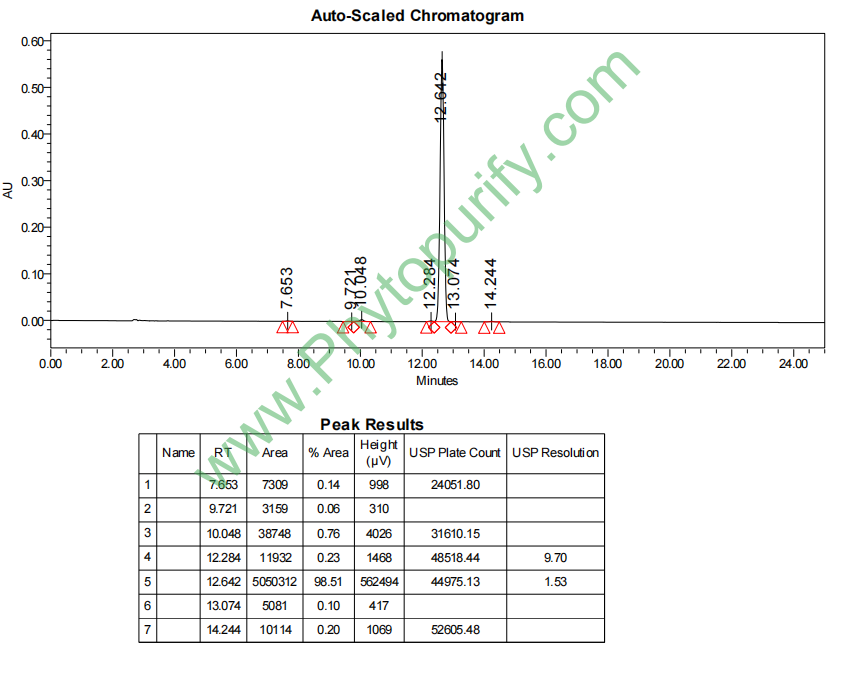
Purity: 95%~99%
Analysis Method: HPLC-DAD or/and HPLC-ELSD
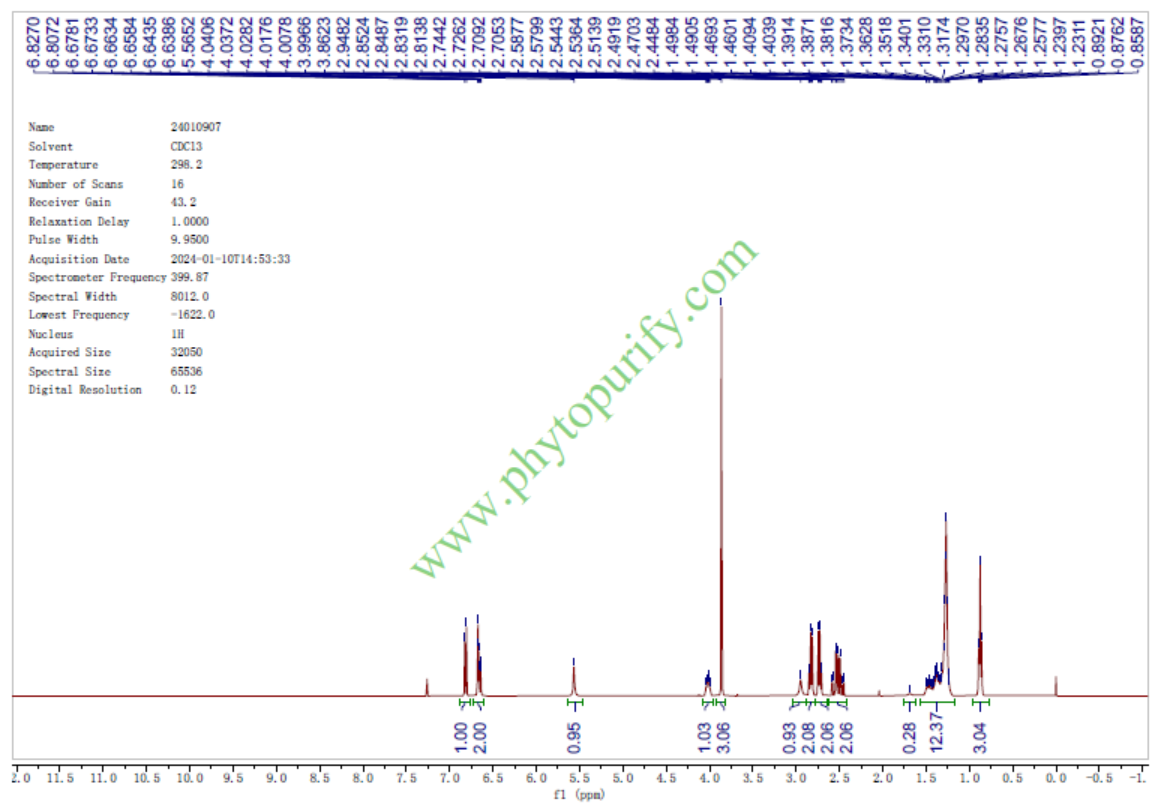
Identification Method: Mass, NMR
Packing: Brown vial or HDPE plastic bottle
Storage: Store in a well closed container, protected from air and light. Put into refrigerate or freeze for long term storage.
Whenever possible, you should prepare and use solutions on the same day. However, if you need to make up stock solutions in advance, we recommend that you store the solution as aliquots in tightly sealed vials at -20℃. Generally, these will be useable for up to two weeks.
The product could be supplied from milligrams to grams, up to kilograms
Inquire for bulk scale.
Descriptions:
8-Gingerol is one of the principal components of ginger, which is widely used in China and elsewhere as a food, spice and herb, shows immunosuppressive activity on the immune responses to ovalbumin (OVA) in mice, 8-gingerol suppressed lipopolysaccharide (LPS) and concanavalin A (ConA)-stimulated splenocyte proliferation in vitro. [1]
8-Gingerol suppresses cellular tyrosinase activity and decrease melanin content, inhibits the expression of MC1R, MITF, tyrosinase, TRP1 and TRP2, decreases intracellular RS and ROS levels in B16F10 and B16F1 cells, inhibits melanogenesis by down-regulation of MAPK, PKA signaling pathway; it could be used as an effective skin-whitening agent.[2]
8-Gingerol has inhibition of T lymphocyte proliferation and cytokine synthesis.[3]
8-Gingerol has anti-oxidant and anti-inflammatory activities.[4]
References:
[1] Lu J, Guan S, Shen X, et al. Molecules, 2011, 16(3):2636-45.
[2] Huang H C, Chou Y C, Wu C Y, et al. Biochem Biophyl Res Co, 2013, 438(2):375-81.
[3] Bernard M, Furlong S J, Coombs M R P, et al. Phytother Res, 2015, 29(11):1707–13.
[4] Dugasani S, Pichika M R, Nadarajah V D, et al. J Ethnopharmacol, 2009, 127(2):515-20.
[5] Bensoussan A, Lee S, Khoo C, et al. J Aoac Int, 2007,90(5):1219-26.
HPLC of 8-Gingerol
HNMR of 8-Gingerol
Storage conditions:Short-term storage at 2~8℃, long-term storage at -20 ~ -80℃
66.7600
4.2600
4.1500
Low
.7500
null
No
No
No
No
No
No
null
8-Gingerol, as one of the important active ingredients in ginger (Zingiber officinale Roscoe), has attracted much attention in recent years due to its diverse biological activities and potential clinical application value. Ginger, as a traditional Chinese medicine and seasoning, is widely used in Asia and even globally. Its pharmacological effects cover multiple aspects such as anti-inflammatory, antioxidant, anti-tumor, immune regulation, and cardiovascular protection. 8-gingerol, as a typical phenolic and β - hydroxy ketone compound in ginger, exhibits a unique molecular structure and multi-target mechanism of action, making it a hot topic in natural product pharmacology research.
This article aims to systematically review the chemical structure and physicochemical properties, plant sources, and extraction methods of 8-gingerol, explore its pharmacological activity and mechanism of action, evaluate its pharmacological properties and pharmacokinetic characteristics, and prospect its clinical application potential in fields such as cancer, infection, immunosuppression, and cardiovascular disease. By integrating the latest research progress, it is expected to provide theoretical basis and research direction for the drug development and clinical translation of 8-gingerol.
8-gingerol (CAS number: 23513-08-8), also known as (5S) -5-hydroxy-1- (4-hydroxy-3-methoxyphenyl) octanone, belongs to the class of mono methoxy phenolic and β - hydroxy ketone compounds. Its molecular formula is C17H26O4 and its molecular weight is 322.44 g/mol. The structural features of 8-gingerol include a benzene ring with methoxy and hydroxyl substituents, as well as a long-chain fatty side chain containing hydroxyl and ketone groups, which endows it with good lipid solubility and a certain degree of polarity.
In terms of physical and chemical properties, the LogP value of 8-gingerol is about 4.26, indicating high lipid solubility, which is beneficial for its permeation through the cell membrane. The polar surface area (TPSA) is 66.76 Å ² and the number of hydrogen bond acceptors is 4, indicating its potential for intermolecular hydrogen bond formation. The low blood-brain barrier permeability of 8-gingerol suggests limited direct effects on the central nervous system. The toxicity assessment showed no significant hepatotoxicity or cardiac toxicity, and did not inhibit hERG channels. The Ames mutagenicity test was negative, demonstrating good safety and potential for drug development.
8-gingerol is mainly present in the rhizomes of ginger (Zingiber officinale Roscoe) and is an important class of gingerol compounds in ginger. Ginger, as a traditional medicinal plant, is widely distributed in China, India, Japan, and Southeast Asia. Its rhizomes contain various gingerols and gingerones, among which 8-gingerol is one of the components with high content and significant activity.
There are various methods for extracting 8-gingerol, including solvent extraction, supercritical CO2 extraction, and liquid chromatography separation. Common solvents include ethanol, methanol, and ethyl acetate, which can effectively extract their lipophilic components. Modern extraction techniques such as ultrasound assisted extraction and microwave-assisted extraction have significantly improved extraction efficiency and purity. After extraction, high performance liquid chromatography (HPLC) combined with mass spectrometry (MS) is usually used for qualitative and quantitative analysis to ensure the purity and active ingredient content of 8-gingerol.
8-gingerol has significant antioxidant activity, which can effectively eliminate free radicals, reduce intracellular reactive oxygen species (ROS) and reactive sulfur (RS) levels, and protect cells from oxidative stress damage. Its anti-inflammatory effect is mainly manifested by inhibiting the expression and activity of cyclooxygenase-2 (COX-2), reducing the release of inflammatory mediators, and thus alleviating the inflammatory response. In vitro experiments have shown that 8-gingerol can inhibit the production of inflammatory factors by macrophages and other immune cells, while in vivo models have shown the effect of reducing inflammatory symptoms.
8-gingerol exerts immunosuppressive effects by inducing cell cycle arrest, promoting apoptosis, and regulating autophagy processes. Its regulation of immune cell function helps alleviate excessive immune reactions and has potential value in treating autoimmune and inflammatory diseases. In addition, 8-gingerol can regulate multiple signaling pathways, affect the proliferation and differentiation of immune cells, and exhibit complex immune regulatory functions.
8-gingerol exhibits the ability to inhibit proliferation, migration, and invasion in various tumor cell lines. Its anti-cancer mechanism involves inhibiting the epidermal growth factor receptor (EGFR) and its downstream STAT3 and ERK signaling pathways, inducing cancer cell apoptosis, and blocking cell cycle progression. Especially in colon cancer cells, 8-gingerol significantly inhibits tumor growth, indicating its potential as an anti-cancer drug. In addition, 8-gingerol enhances the sensitivity of tumor cells to treatment by reducing oxidative stress and regulating cellular autophagy.
8-gingerol can inhibit melanin production, mainly by suppressing tyrosinase activity and the expression of related genes (MC1R, MITF, TRP1, TRP2), reducing ROS levels in B16F10 and B16F1 melanocytes. Its mechanism of action involves downregulating the MAPK and protein kinase A (PKA) signaling pathways, thereby inhibiting melanin synthesis. This characteristic makes it have application prospects in the fields of skin whitening and anti pigmentation.
8-gingerol exhibits in vitro inhibitory effects on Helicobacter pylori, indicating its potential application value in the treatment of gastrointestinal infections. Its antibacterial mechanism may be related to the destruction of bacterial cell membrane structure and inhibition of key enzyme activity.
8-gingerol exerts cardioprotective effects through antioxidant, anti-inflammatory, and modulation of myocardial cell signaling pathways. Research has shown that 8-gingerol can alleviate myocardial ischemia-reperfusion injury, improve cardiac function, reduce myocardial cell apoptosis rate, and has potential value in the prevention and treatment of cardiovascular diseases.
The mechanism of action of 8-gingerol is diverse, involving multiple signaling pathways and molecular targets:
In addition, the potential regulatory role of 8-gingerol in hyperglycemia related targets such as EHMT2, UBP2, PAI1, AMPK, SGLT2, GCK, APP, BACE1, CES1, PTPN1 suggests its research value in the field of metabolic diseases.
The pharmacological parameters of 8-gingerol show that it has good potential for drug development. The molecular weight is moderate (322.44 g/mol), with a LogP value of 4.26, indicating good lipid solubility and cell membrane permeability. The TPSA is 66.76 Å ², with 4 hydrogen bond acceptors, which conforms to Lipinski's rule and is beneficial for oral absorption. Toxicological evaluation did not find significant hepatotoxicity, cardiotoxicity, or genotoxicity, indicating high safety.
Pharmacokinetic studies have shown that 8-gingerol has good bioavailability after oral administration and can effectively activate TRPV1 receptors, exerting physiological effects. Its blood-brain barrier permeability is low, reducing the risk of central nervous system side effects. The metabolic pathways mainly involve the liver enzyme system, and the metabolites are relatively stable. The excretion pathways are mainly bile and urine.
However, the poor water solubility of 8-gingerol limits its bioavailability and in vivo distribution. In the future, drug formulation improvements (such as nanocarriers, liposome encapsulation, etc.) are needed to enhance its pharmacokinetic properties.
Based on the multi-target and multi mechanism pharmacological activity of 8-gingerol, it has shown broad application prospects in multiple disease fields:
Future research should focus on the clinical safety evaluation, dosage form optimization, and combination therapy strategy of 8-gingerol, while deeply analyzing its molecular mechanism to promote its transformation from laboratory research to clinical application.
8-gingerol, as a representative active ingredient in ginger, exhibits a wide range of biological functions and good medicinal potential due to its unique chemical structure and diverse pharmacological activities. Its multiple mechanisms of action, including antioxidant, anti-inflammatory, anti-tumor, immune regulation, and cardiac protection, provide new ideas for the prevention and treatment of various diseases. Although significant progress has been made in the research of 8-gingerol, its clinical application still faces challenges of pharmacokinetic limitations and complex mechanisms.
In the future, it is necessary to strengthen systematic pharmacological research, preclinical safety evaluation, and formulation development of 8-gingerol, combined with modern medicinal chemistry and biotechnology methods, to promote its clinical translation. I believe that with further research, 8-gingerol will play a more important role in natural product pharmacology and modern medicine.
