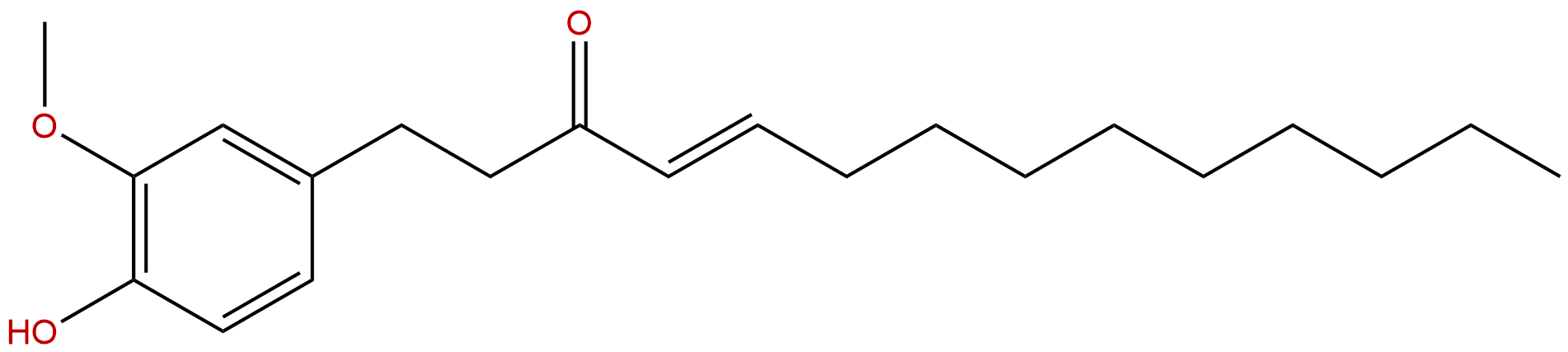


Product name: 10-Shogaol
Synonym name:
Catalogue No.: BP1771
Cas No.: 36752-54-2
Formula: C21H32O3
Mol Weight: 332.484
Botanical Source: Ginger
Physical Description: Oil
Type of Compound: Phenols
Purity: 95%~99%
Analysis Method: HPLC-DAD or/and HPLC-ELSD
Identification Method: Mass, NMR
Packing: Brown vial or HDPE plastic bottle
The product could be supplied from milligrams to grams. Inquire for bulk scale.
We provide solution to improve the water-solubility of compounds, thereby facilitating the variety of activity tests and clinic uses.
For Reference Standard and R&D, Not for Human Use Directly.
Description:
10-Shogaol, as an antioxidant for human skin cell growth and a migration enhancer with potential to be a novel wound repair agent.8- and 10-Shogaol have similar metabolic profiles to [6]-shogaol and exhibit similar toxicity toward human colon cancer cells.
References:
Int J Mol Sci. 2012;13(2):1762-77.
10-Shogaol, an antioxidant from Zingiber officinale for skin cell proliferation and migration enhancer.
METHODS AND RESULTS:
In this work, one of Zingiber officinale components, 10-Shogaol, was tested with 1,1-diphenyl-2-picrylhydrazyl (DPPH) radical scavenging, metal chelating ability, and reducing power to show antioxidant activity. 10-Shogaol promoted human normal epidermal keratinocytes and dermal fibroblasts cell growths. 10-Shogaol enhanced growth factor production in transforming growth factor-β (TGF-β), platelet derived growth factor-αβ (PDGF-αβ) and vascular endothelial growth factors (VEGF) of both cells. In the in vitro wound healing assay for 12 or 24 h, with 10-Shogaol, the fibroblasts and keratinocytes migrated more rapidly than the vehicle control group.
CONCLUSIONS:
Thus, this study substantiates the target compound, 10-Shogaol, as an antioxidant for human skin cell growth and a migration enhancer with potential to be a novel wound repair agent.
J Agric Food Chem. 2014 May 21;62(20):4632-42.
Cysteine-conjugated metabolites of ginger components, shogaols, induce apoptosis through oxidative stress-mediated p53 pathway in human colon cancer cells.
Shogaols, the major constituents of thermally processed ginger, have been proven to be highly effective anticancer agents.
METHODS AND RESULTS:
Our group has identified cysteine-conjugated shogaols (M2, M2', and M2″) as the major metabolites of [6]-, [8]-, and 10-Shogaol in human and found that M2 is a carrier of its parent molecule [6]-shogaol in cancer cells and in mice, while being less toxic to normal colon fibroblast cells. The objectives of this study are to determine whether M2' and M2″ behave in a similar manner to M2, in both metabolism and efficacy as anticancer agents, and to further explore the biological pro-apoptotic mechanisms of the cysteine-conjugated shogaols against human colon cancer cells HCT-116 and HT-29.
CONCLUSIONS:
Our results show that [8]- and 10-Shogaol have similar metabolic profiles to [6]-shogaol and exhibit similar toxicity toward human colon cancer cells. A brief screen of the markers attenuated by the proapoptotic activity of M2 revealed similar results for [8]- and 10-Shogaol and their respective cysteine-conjugated metabolites M2' and M2″. This study highlights the cysteine-conjugated metabolites of shogaols as novel dietary colon cancer preventive agents.
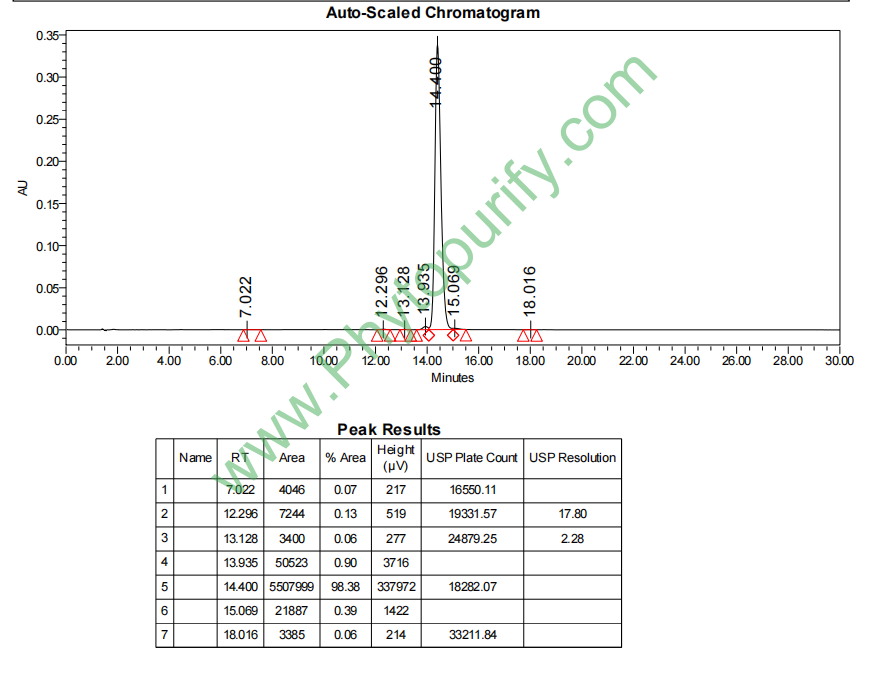
HPLC of 10-Shogaol
Storage conditions:Short-term storage at 2~8℃, long-term storage at -20 ~ -80℃
46.5300
5.9757
5.9750
.0024
6.0341
13.2723
High
94.5699
2.2300
Yes
Yes
Yes
No
No
No
0.0
No
No
No
Yes
Natural products, as an important treasure trove for drug discovery, play an irreplaceable role in the long history of human fight against diseases. Ginger(Zingiber officinale Roscoe, as a widely used medicinal and edible plant, is considered a key substance basis for its various pharmacological activities due to its spicy components, including gingerols and their dehydrated derivatives, such as Shogaols. Among them, 10 Shogaol (CAS number: 36752-54-2), as the main conversion product of gingerol during heating or storage, has attracted much attention due to its significant biological activity. Modern pharmacological research has shown that 10 gingerol not only has strong antioxidant capacity, but also exhibits remarkable potential in multiple fields such as anti-inflammatory, anticancer, and antiparasitic effects, especially in difficult to treat disease models such as arthritis and drug-resistant prostate cancer, showing promising therapeutic prospects. This article aims to systematically review the chemical properties, plant sources, pharmacological activities, molecular mechanisms of action, pharmacological evaluation, and clinical application prospects of 10 gingerol, in order to provide comprehensive scientific references for the in-depth research and development of this natural product.
The chemical name of 10 gingerol is (E) -1- (4-hydroxy-3-methoxyphenyl) -5-decen-3-one, with a molecular formula of C21H32O3 and a molecular weight of 332.4840. Its structure belongs to alkylphenol compounds, consisting of an ortho methoxyphenol (vanillin) head connected to a ketone group through an unsaturated ten carbon chain. Its double bond is located at the 10th position of the side chain, in the trans (E) configuration, which is a necessary structural feature for its activity.
Its physicochemical properties profoundly affect its bioavailability and mode of action. This compound has high lipophilicity, with a calculated LogP value of approximately 5.98, indicating strong lipophilicity. Consistent with this, its water solubility is extremely low, about 0.0024 mg/mL, which limits its dispersion and absorption in aqueous media. Its topological polar surface area (TPSA) is 46.53 Å ², which is relatively small and consistent with the characteristics of high membrane permeability. The preliminary pharmacological prediction model shows that 10 gingerol has a high potential for blood-brain barrier penetration, which provides a possibility for its application in central nervous system related diseases such as neuroinflammation and parasitic infections. Preliminary safety warnings indicate that there is no significant inhibitory risk on hERG potassium channels (suggesting low potential cardiac toxicity), and the Ames test prediction result is negative (0.0), suggesting that it may not be mutagenic. These basic physicochemical parameters lay the foundation for its subsequent formulation development and pharmacokinetic studies.
10 gingerol mainly comes from ginger, a plant in the ginger family(Zingiber officinale)The roots and stems. It is worth noting that the main active ingredient in fresh ginger is gingerol (such as 6-gingerol), while the content of 10 gingerol is relatively low. However, during the drying, heating (such as boiling, processing), or long-term storage of ginger, the β - hydroxyketone structure of the gingerol side chain undergoes dehydration reactions, specifically producing corresponding gingerol compounds. Therefore, the content of 10 gingerol in dried ginger or processed ginger products is significantly higher than that in fresh ginger.
There are various methods for extracting 10 gingerol, aiming to efficiently and environmentally obtain high-purity compounds. Traditional methods include solvent extraction, which often involves refluxing or leaching with organic solvents such as ethanol, methanol, acetone, or ethyl acetate, and then concentrating under reduced pressure to obtain crude extracts. Modern separation and purification technologies have greatly improved efficiency and purity:
1. Chromatographic technique Silica gel column chromatography is a commonly used method for preliminary separation, combined with thin-layer chromatography (TLC) monitoring. High performance liquid chromatography (HPLC) and preparative HPLC have become standard methods for obtaining high-purity 10 gingerol, often using C18 reverse phase columns with methanol water or acetonitrile water as the mobile phase.
2. Supercritical fluid extraction Using supercritical CO2 as an extractant has the advantages of being non-toxic, residue free, and operating at low temperatures. It can effectively extract thermosensitive and lipophilic components, making it suitable for large-scale extraction.
3. Ultrasonic assisted extraction and microwave-assisted extraction The use of physical fields to enhance mass transfer processes can significantly shorten extraction time and improve extraction efficiency.
The optimization of extraction process usually focuses on factors such as solvent type, concentration, temperature, time, and solid-liquid ratio to achieve the best yield. In addition, 10 gingerol can also be obtained through chemical synthesis or biosynthetic pathways, but natural extraction remains its main source.
Numerous in vitro and in vivo studies have confirmed that 10 gingerol has broad and powerful pharmacological activities.
Anti inflammatory and antioxidant activity 10 gingerol is a potent antioxidant that can directly eliminate free radicals and enhance the activity of intracellular antioxidant enzymes such as superoxide dismutase and glutathione peroxidase. Its anti-inflammatory effect is particularly prominent. In lipopolysaccharide (LPS) - induced macrophage models and various animal inflammation models, it can significantly inhibit the production of key pro-inflammatory cytokines such as interleukin-1 β (IL-1 β), interleukin-6 (IL-6), and tumor necrosis factor alpha (TNF - α). These cytokines are the core mediators of chronic inflammatory diseases such as rheumatoid arthritis.
anticancer activity 10 gingerol exhibits cytotoxicity towards various cancer cell lines and can induce apoptosis and cell cycle arrest. Of particular concern is its role in drug-resistant cancer. Research has shown that 10 gingerol can effectively inhibit the growth of prostate cancer cells resistant to Docetaxel. Its mechanism involves inducing reactive oxygen species (ROS) generation, disrupting mitochondrial membrane potential, and regulating apoptosis related proteins such as the Bcl-2 family caspases)。 This provides a new candidate molecule for overcoming tumor chemotherapy resistance.
Antiparasitic activity 10 gingerol on Guangzhou roundworm(Angiostrongylus cantonensis)The fifth stage larvae (L5) exhibit significant larval killing activity. Guangzhou roundworm is the main pathogen causing eosinophilic meningitis, and the activity of 10 gingerol suggests its potential value in the treatment of parasitic infections, especially central nervous system parasitic diseases.
Other activities: The study also suggests that 10 gingerol has certain potential in neuroprotection, analgesia, anti obesity and anti diabetes, and these activities are mostly related to the core mechanism of anti-inflammatory and antioxidant.
The multiple pharmacological effects of 10 gingerol stem from its diverse regulation of cellular signaling pathways, and its core mechanism of action is closely related to the inhibition of nuclear factor kappa B (NF - κ B) and cyclooxygenase-2 (COX-2) pathways.
Inhibition of NF - κ B signaling pathway NF - κ B is a central transcription factor that regulates inflammation, immune response, and cell survival. In the resting state, NF - κ B (usually referring to the p50/p65 dimer) binds to the inhibitory protein I κ B and exists in the cytoplasm. Under stimulation by TNF - α, IL-1, or LPS, the I κ B kinase (IKK) complex is activated, leading to phosphorylation and degradation of I κ B, thereby releasing NF - κ B for translocation to the nucleus and initiating transcription of target genes. 10 gingerol can effectively inhibit the phosphorylation of IKK/I κ B, prevent I κ B degradation, and thus block the nuclear translocation of NF - κ B. This directly leads to a series of pro-inflammatory factors downstream, such as IL1B、IL6、TNF)The gene expression of inflammatory mediators such as COX-2 is inhibited.
Inhibition of COX-2 (PTGS2) activity Cyclooxygenase-2 is a key rate limiting enzyme for prostaglandin synthesis during inflammation. 10 gingerol has been shown to directly inhibit the enzymatic activity of COX-2, with an IC50 value of 7.5 μ M. This reduces the production of potent inflammatory mediators such as prostaglandin E2 (PGE2), thereby exerting anti-inflammatory and analgesic effects.
Regulating matrix metalloproteinases (MMPs)In the pathological process of arthritis, the degradation of cartilage matrix and MMPs (such as...)MMP3、MMP13)Overexpression is closely related. 10 gingerol downregulates the expression of MMP3 and MMP13 by inhibiting pathways such as NF - κ B, which helps protect articular cartilage from damage.
Multiple pathways inducing apoptosis of cancer cells In terms of anti-cancer, in addition to affecting cell survival signals through the NF - κ B pathway, 10 gingerol can also activate the mitochondrial apoptosis pathway (endogenous pathway) and death receptor pathway (exogenous pathway), upregulate pro apoptotic proteins, downregulate anti apoptotic proteins, and ultimately activate the caspase cascade reaction.
In summary, 10 gingerol is targeted through NFKB1/NF-κB1、PTGS2(COX-2)、IL1B、IL6、TNF、MMP3、MMP13 Multiple key molecules closely related to diseases such as arthritis have formed a multi-target, networked mode of action, which may be the molecular basis for its highly effective anti-inflammatory effects.
Although 10 gingerol has significant in vitro activity, its pharmacological properties face challenges mainly due to its poor pharmacokinetic properties.
Absorption and bioavailability Due to its high lipid solubility and low water solubility, the oral absorption of 10 gingerol may be limited and susceptible to first pass effects. Animal studies have shown that its oral bioavailability is low. It metabolizes rapidly in the body, with the main metabolic pathways including reduction, glucuronidation, and sulfation. The prototype drug has a low concentration in plasma and is eliminated quickly.
distribution Its high LogP value and predicted high blood-brain barrier penetration facilitate its distribution to adipose tissue and the central nervous system, which explains its activity against brain parasites, but may also pose a potential risk of tissue accumulation.
Metabolism and excretion 10 gingerol is mainly metabolized by the liver, and cytochrome P450 enzyme systems (such as CYP1A2, CYP2C9) may be involved in its metabolism. Its metabolites are mainly excreted through urine and bile.
Formulation strategy To improve its bioavailability and efficacy, modern formulation technology has been widely studied
These advanced delivery systems are key to driving the conversion of 10 gingerol from active compounds to candidate drugs.
The diverse physical activities of 10 gingerol have brought broad application prospects in multiple therapeutic fields, but there are also many challenges.
Potential clinical application directions:
challenges faced:
Future Prospects:
10 gingerol, as one of the main active ingredients in ginger, has become a star molecule in natural product pharmacology research due to its excellent multiple pharmacological activities such as antioxidant, anti-inflammatory, anticancer, and antiparasitic. It demonstrates unique advantages in multi-target therapy for complex diseases by precisely intervening in key inflammatory and tumor signaling pathways such as NF - κ B and COX-2. Although there are significant shortcomings in its pharmacological properties, especially in terms of oral bioavailability, the rapid development of modern drug chemical modification strategies and novel drug delivery technologies provides powerful tools to overcome these obstacles. In the future, through in-depth interdisciplinary cooperation, after clarifying its mechanism of action network, completing systematic preclinical evaluation, and promoting clinical translational research, 10 gingerol and its optimized derivatives are expected to transform from a traditional spicy ingredient into new drug candidates for the treatment of major diseases such as arthritis and drug-resistant cancer, contributing modern wisdom derived from ancient plants to human health.
