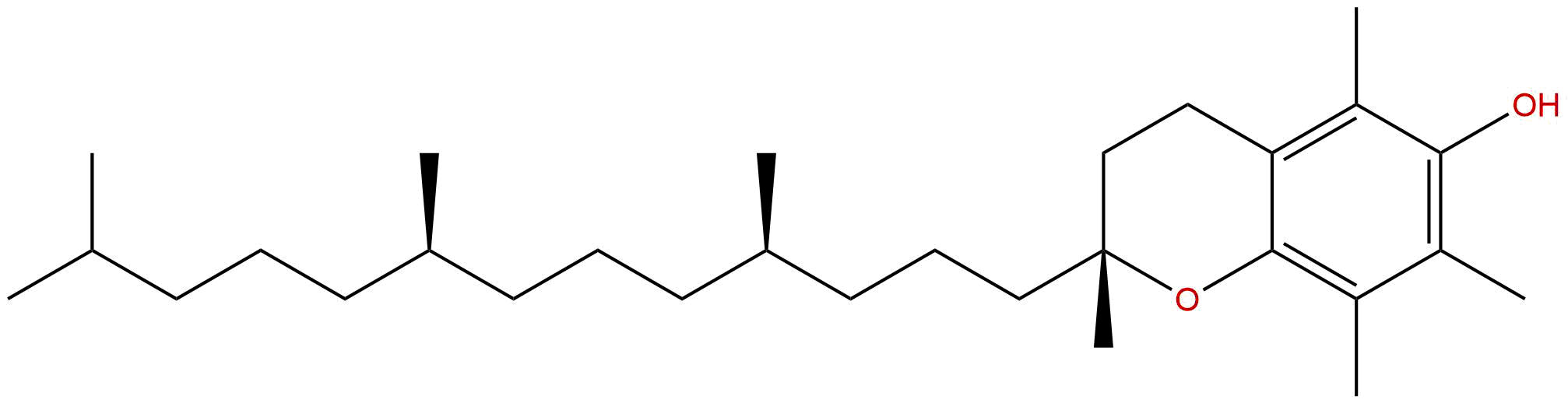


Product name: D-α-Tocopherol
Synonym name: Emipherol;Eprolin; Eprolin S;Esorb;Viteolin; D-Alpha-Tocopherol; α-Tocopherol; α-Vitamin E
Catalogue No.: SBP02699
Cas No.: 59-02-9
Formula: C29H50O2
Mol Weight: 430.717
Botanical Source:
Type of Compound: Tocopherols
Purity: 95%~99%
Analysis Method: HPLC-DAD or/and HPLC-ELSD
Identification Method: Mass, NMR
Packing: Brown vial or HDPE plastic bottle
Storage: Store in a well closed container, protected from air and light. Put into refrigerate or freeze for long term storage.
Whenever possible, you should prepare and use solutions on the same day. However, if you need to make up stock solutions in advance, we recommend that you store the solution as aliquots in tightly sealed vials at -20℃. Generally, these will be useable for up to two weeks.
The product could be supplied from milligrams to grams
Inquire for bulk scale.
For Reference Standard and R&D, Not for Human Use Directly.
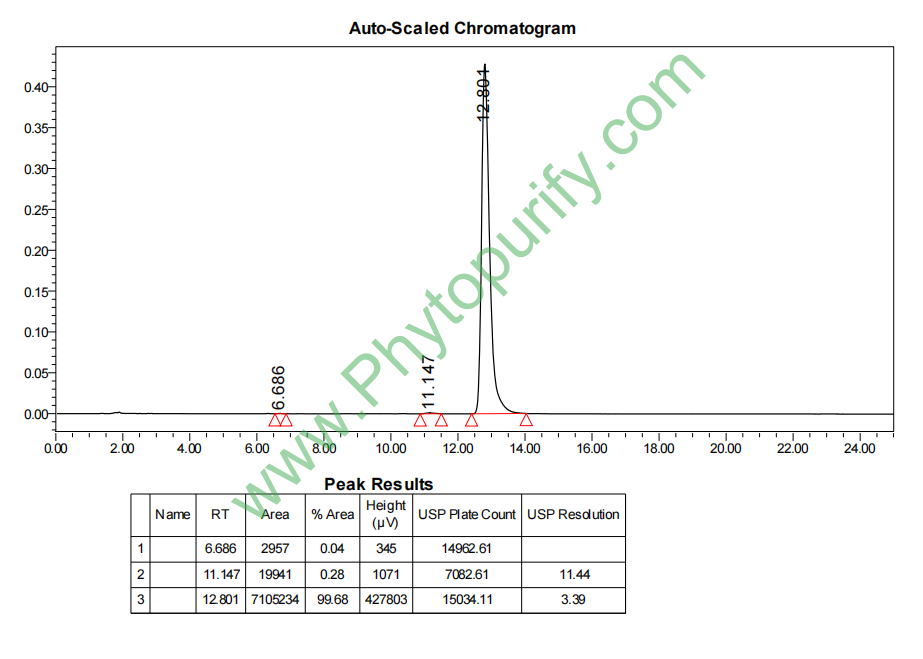
HPLC of D-α-Tocopherol
Storage conditions:Short-term storage at 2~8℃, long-term storage at -20 ~ -80℃
29.4600
10.0000
8.9000
High
95.0000
No
No
No
No
No
No
Alpha tocopherol, as the most biologically active natural isomer in the vitamin E family, has long been widely studied in pharmacology, nutrition, and natural product research due to its excellent antioxidant properties and diverse biological functions. Its natural stereoisomer (R, R, R) - α - tocopherol is widely present in various plant oils, such as sunflower oil and olive oil, and is one of the essential micronutrients for the human body. α - tocopherol not only plays a key role in the protection of cell membrane lipids, but also shows multiple pharmacological activities such as antiviral, anticoagulant, immune regulation and anti atherosclerosis, and its mechanism of action is closely related to a variety of molecular targets. This article will provide a systematic review of the chemical structure and physicochemical properties, plant sources and extraction methods, pharmacological activity and mechanism of action, pharmacological evaluation and pharmacokinetic characteristics of alpha tocopherol. Combined with its potential applications in cardiovascular diseases and other related diseases, it will explore its clinical development prospects and future research directions.
The chemical name of alpha tocopherol is (R, R, R) - alpha tocopherol, with a molecular formula of C29H50O2 and a molecular weight of 430.7 Da. Its structure consists of a 6-hydroxychromenol ring with three chiral centers and a saturated side chain (consisting of methyl substituted long-chain isoprene monomers). The molecule has two hydrogen bond acceptor sites and a polar surface area (TPSA) of approximately 29.46 Å ², exhibiting low polarity. The LogP value is as high as 10, indicating its high hydrophobicity, easy solubility in lipid environments, and difficult solubility in water. Its high hydrophobicity facilitates its localization in the lipid bilayer of the cell membrane and exerts antioxidant protection.
The stereochemical configuration of alpha tocopherol is crucial for its biological activity, and naturally occurring (R, R, R) - isomers exhibit stronger biological activity and bioavailability than their enantiomers (S, S, S). The compound has a half-life of up to 48 hours, indicating that it has a longer maintenance time in the body. Toxicological evaluation shows that the LD50 of alpha tocopherol is approximately 2000 mg/kg, and its liver toxicity, hERG channel inhibition, and Ames mutagenicity tests are all negative, indicating its high safety.
Alpha tocopherol is mainly present in various plant oils, especially sunflower oil and olive oil, which are rich in content. It serves as an important lipid soluble antioxidant in plants, protecting plant cell membranes from oxidative damage. In addition to vegetable oil, nuts, grains, and leafy vegetables also contain a certain amount of alpha tocopherol.
The traditional methods for extracting alpha tocopherol include solvent extraction, cold pressing, and distillation. Modern extraction techniques place greater emphasis on improving extraction efficiency and purity, with commonly used methods including supercritical CO2 extraction, molecular distillation, and high-performance liquid chromatography (HPLC) purification. Supercritical CO2 extraction has become the mainstream technology for industrial scale extraction of alpha tocopherol due to its environmentally friendly, selective, and solvent-free advantages. In addition, enzyme assisted extraction technology is gradually being applied to improve extraction efficiency and reduce energy consumption.
Alpha tocopherol, as a potent lipid soluble antioxidant, mainly exerts its biological effects by clearing free radicals and blocking lipid peroxidation chain reactions, protecting cell membrane lipids from oxidative damage. Its pharmacological activities include antioxidant, anti-inflammatory, immune regulation, anti-virus, anti atherosclerosis, anticoagulant and many other aspects.
Antioxidant effect
Alpha tocopherol can effectively capture lipid peroxidation free radicals, terminate the lipid peroxidation reaction chain, and protect cell membranes and low-density lipoprotein (LDL) from oxidative damage. Its antioxidant effect not only maintains the integrity of the cell membrane, but also regulates cell signaling, preventing the occurrence of oxidative stress-related diseases.
Anti inflammatory and immune regulation
Research has shown that alpha tocopherol can inhibit the release of inflammatory mediators, reduce levels of pro-inflammatory cytokines, regulate immune cell function, and enhance the body's immune response. Its regulation of the functions of macrophages, T cells, and natural killer cells helps to improve chronic inflammatory conditions.
Antiviral effect
Alpha tocopherol exhibits potential antiviral activity by regulating cell membrane fluidity and antioxidant mechanisms, inhibiting the replication and infection processes of various viruses.
Cardiovascular protective effect
As an antiatherosclerotic agent, α - tocopherol reduces the risk of cardiovascular disease by reducing the deposition of oxidized LDL, inhibiting platelet aggregation and improving vascular endothelial function. Its anticoagulant effect helps prevent thrombosis and maintain blood rheology stability.
The multiple biological effects of alpha tocopherol are closely related to its action on multiple molecular targets, especially in the prevention and treatment of cardiovascular diseases. Its main targets include:
Through these targets, alpha tocopherol not only exerts direct antioxidant and anti-inflammatory effects, but also regulates cellular signaling networks, improves cardiovascular function, and slows down disease progression.
The pharmacological parameters of alpha tocopherol show that it has good safety and a long in vivo half-life. Although its high lipid solubility (LogP=10) is beneficial for cell membrane penetration and distribution in the lipid environment, it may also limit its water solubility and oral bioavailability. Its low polarity and fewer hydrogen bond receptors (2) contribute to crossing the blood-brain barrier, indicating its potential application in central nervous system diseases.
Pharmacokinetic studies have shown that alpha tocopherol is mainly metabolized by the liver in vivo, with a half-life of about 48 hours and a long maintenance time, making it suitable for daily supplementation. Toxicological evaluation shows that it has low acute toxicity (LD50 of approximately 2000 mg/kg), no significant liver or cardiac toxicity (hERG inhibition negative), and no mutagenic risk (Ames test negative), indicating high safety.
However, the high lipid solubility of alpha tocopherol also poses challenges for formulation development, such as solubility limitations and unstable bioavailability, which need to be optimized through modern drug delivery systems such as nanocarriers and liposomes.
Alpha tocopherol, as a natural antioxidant and multifunctional pharmacological active molecule, has broad application prospects in clinical nutritional supplementation and disease prevention. Its protective role in cardiovascular disease is particularly prominent, which can reduce the risk of atherosclerosis and thrombosis by regulating oxidative stress, inflammatory reaction and hemorheology through multiple targets.
In addition, the potential of alpha tocopherol in immune regulation, antiviral and neuroprotective fields is gradually being recognized. In the future, combining precision medicine and molecular targeting strategies, alpha tocopherol is expected to be developed as a multi-target therapeutic drug, especially for applications in metabolic syndrome, neurodegenerative diseases, and chronic inflammatory diseases.
However, there are still controversies in terms of dosage, administration route, and long-term safety in current clinical research, and further large-scale, multicenter clinical trials are needed to clarify the optimal treatment plan and indications. In addition, innovation in formulation technology will help improve its bioavailability and therapeutic efficacy.
As the most active natural isomer in the vitamin E family, alpha tocopherol exhibits rich pharmacological activity and good safety due to its unique chemical structure and excellent antioxidant properties. Its multi-target mechanism of action provides new ideas for the prevention and treatment of cardiovascular diseases and related chronic diseases. In the future, with the continuous advancement of extraction technology and drug delivery systems, as well as in-depth analysis of their molecular mechanisms, alpha tocopherol is expected to play a greater role in clinical treatment and health promotion, becoming an important model for natural product pharmacology research and application.
