Introduction/Overview
Natural products have long been an important source of innovative drug discovery, among which curcumin, as the main active ingredient of turmeric, has attracted much attention due to its extensive anti-inflammatory, antioxidant, and anti-tumor activities. However, its inherent low bioavailability and metabolic instability limit its clinical application. To overcome these obstacles, a series of curcumin structural analogues have been designed and synthesized in order to improve their pharmacological activity while preserving or enhancing their pharmacological properties. Dimethylcurcumin (CAS number: 52328-98-0) is one of the important synthetic derivatives. Compared with the parent compound, dimethylcurcumin introduces two methyl groups on the benzene ring, which not only affects its physicochemical properties but also endows it with a unique and powerful pharmacological activity spectrum. Early studies have revealed its potential as an androgen antagonist, while in recent years, the focus of research has focused on its significant effect against a variety of malignant tumors, especially pancreatic cancer with high malignancy and poor prognosis. The purpose of this paper is to systematically review the chemical properties and pharmacological activities of dimethyl curcumin, especially the multi target mechanism of action and drug evaluation for pancreatic cancer, and look forward to its future clinical application prospects.
Chemical structure and physicochemical properties
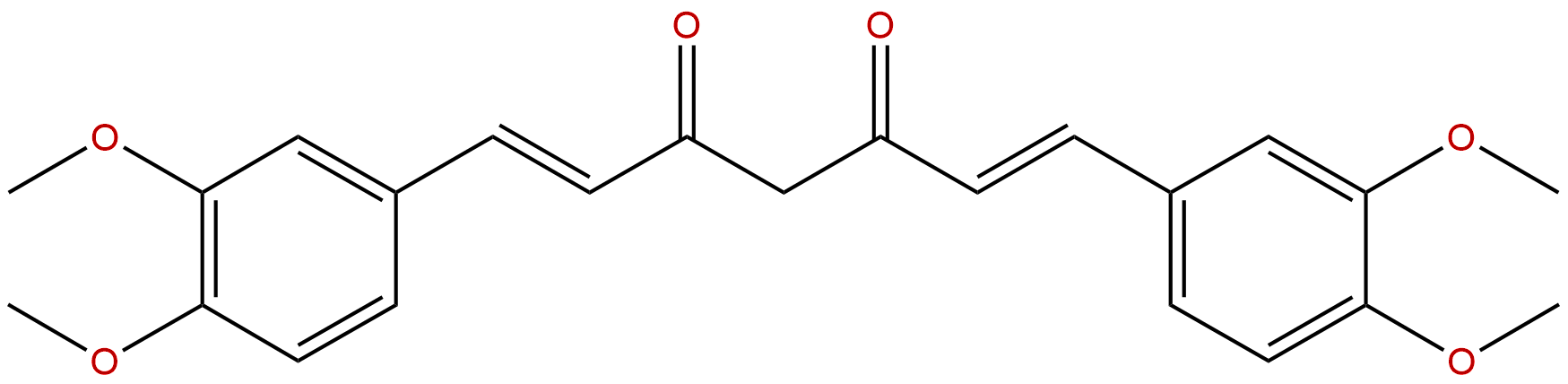
Dimethylcurcumin, also known as 1,7-bis (4-hydroxy-3,5-dimethoxyphenyl) -1,6-heptadiene-3,5-dione, is a structural analogue of curcumin. Its core structure is the same as curcumin, consisting of two aromatic rings connected by a seven carbon chain (containing an alpha, beta unsaturated beta diketone structure). The key structural modification is that the adjacent hydroxyl groups on both benzene rings are replaced by methoxy groups (- OCH ∝), forming a substitution pattern of 3,5-dimethoxy-4-hydroxyl. This modification significantly alters the electronic distribution and spatial conformation of the molecule.
Based on its chemical structure, dimethyl curcumin exhibits the following key physicochemical properties: molecular weight of 396.4390 g/mol. Its lipid water partition coefficient (LogP) is 3.2844, indicating that the compound has moderate lipophilicity, which is beneficial for its penetration of cell membranes, but may also affect its water solubility. The calculated topological polar surface area (TPSA) is 71.0600 Å ², which is relatively low and further supports its good membrane permeability. The water solubility measured in the experiment is relatively low, about 0.0095 mg/mL, which is a common challenge for many polyphenolic compounds. It is worth noting that its predicted blood-brain barrier permeability is "high", indicating that the molecule may act on targets or diseases related to the central nervous system. In early safety screening, dimethyl curcumin did not show significant hERG potassium channel inhibitory activity (hERG inhibition: no), reducing the risk of causing cardiac QT interval prolongation. The Ames test result is 0.3, indicating a low risk of mutagenicity, but further in vitro and in vivo genetic toxicity assessment is needed to confirm.
Plant sources and extraction methods
Strictly speaking, dimethyl curcumin is not a natural product directly extracted in large quantities from plants, but a curcumin derivative obtained through chemical synthesis or semi synthesis methods. The starting point for its design and preparation is natural curcumin. Curcumin is derived from the dried rhizomes of the ginger plant turmeric in the ginger family. Traditional extraction methods include organic solvent extraction (such as ethanol, acetone), ultrasound assisted extraction, microwave-assisted extraction, etc., to obtain crude curcumin extract, which is then purified by column chromatography and other methods.
After obtaining high-purity curcumin, it was structurally modified through chemical synthesis to prepare dimethyl curcumin. A typical synthetic pathway involves selective methylation reactions. For example, under alkaline conditions, methylation reagents such as dimethyl sulfate or iodomethane are used to methylate the adjacent hydroxyl groups on the benzene ring of curcumin, thereby converting the original hydroxyl groups into methoxy groups and generating the target compound dimethylcurcumin. The synthesized product needs to undergo structural confirmation through spectroscopic methods such as nuclear magnetic resonance and mass spectrometry, and purity analysis through methods such as high-performance liquid chromatography to ensure that the compounds used for subsequent pharmacological research have uniform quality and clear structure. This rational design and synthesis strategy based on natural product lead structures is an important research direction in the field of natural product medicinal chemistry.
Pharmacological activity research
Dimethylcurcumin exhibits a wider and more potent pharmacological activity than curcumin, especially in the field of anti-tumor research where it has been extensively studied.
- Antitumor activity The most prominent activity of dimethyl curcumin is its strong inhibitory effect on pancreatic cancer. A large number of preclinical studies have shown that it can significantly inhibit the proliferation, invasion and migration of many pancreatic cancer cell lines (such as PANC-1, MIA PaCa-2, AsPC-1), and induce cell apoptosis and cycle arrest. Its anti-tumor activity is not limited to pancreatic cancer, but also shows good effect in breast cancer, prostate cancer, lung cancer, colorectal cancer and other models. Its strength of action is usually superior to unmodified curcumin.
- Androgen antagonistic activity As one of its initially identified characteristics, dimethyl curcumin can antagonize the androgen receptor signaling pathway. This makes it potentially valuable in the treatment of prostate cancer, especially for castration resistant prostate cancer, possibly by blocking androgen receptor-mediated tumor growth and survival signals.
- Anti inflammatory and immune regulatory activity By targeting key inflammatory signaling pathways such as TLR4/NF - κ B, dimethyl curcumin can inhibit the production of pro-inflammatory cytokines (such as TNF - α, IL-6) and alleviate chronic inflammatory responses. Inflammation in the tumor microenvironment is closely related to immune suppression, therefore this activity indirectly contributes to its anti-tumor effect.
- Antioxidant and Cellular Protective Activities By activating the Nrf2 pathway (encoded by NFE2L2), dimethyl curcumin can upregulate the expression of a series of phase II detoxifying enzymes and antioxidant proteins, such as heme oxygenase-1, thereby enhancing the ability of cells to resist oxidative stress and toxic substance damage. This activity has protective significance in neurodegenerative diseases and chemical liver injury models.
- Anti angiogenic and anti metastatic activity Dimethylcurcumin can downregulate the expression of vascular endothelial growth factor and matrix metalloproteinases (such as MMP2), inhibit the formation of tumor neovascularization and degradation of extracellular matrix, thereby suppressing distant metastasis of tumors.
Mechanism of action and molecular targets
The pharmacological effect of dimethyl curcumin, especially its anti pancreatic cancer activity, stems from its coordinated regulation of multiple key signaling pathways and molecular targets, which reflects the advantages of multi target treatment strategies. For pancreatic cancer, its mechanism network involves:
- Inducing apoptosis and regulating BCL2 family Dimethylcurcumin can downregulate the expression of anti apoptotic protein BCL2, while possibly upregulating the levels of pro apoptotic proteins such as BAX, leading to loss of mitochondrial membrane potential, release of cytochrome C, and activation of caspase cascade reaction, ultimately inducing programmed cell death in tumor cells.
- Inhibition of STAT3 signaling pathway STAT3 is a key oncogenic transcription factor continuously activated in pancreatic cancer. Dimethylcurcumin can effectively inhibit the phosphorylation (activation) and nuclear translocation of STAT3, thereby downregulating the expression of downstream target genes (such as Cyclin D1, Survivor, BCL2), inhibiting cell proliferation, and promoting apoptosis.
- Regulating protein kinase C (PKC) subtypes PRKCA (PKC α) and PRKCE (PKC ε) play important roles in tumor growth, invasion, and chemotherapy resistance. Dimethylcurcumin has been shown to interfere with the activity or expression of PKC, particularly by inhibiting the membrane translocation of PKC α, thereby blocking its downstream pro survival and pro metastatic signals.
- Inhibition of tumor adaptation mediated by HIF-1 αIn the hypoxic microenvironment of tumors, HIF1A (hypoxia inducible factor-1 α) is stabilized and activated. Dimethylcurcumin can promote the degradation of HIF-1 α or inhibit its transcriptional activity, thereby weakening the metabolic adaptation, angiogenesis, and invasion ability of tumor cells under hypoxic conditions.
- Adjust drug efflux pump ABCB1 Overexpression of ABCB1 (P-glycoprotein) is one of the main causes of multidrug resistance. Research has shown that dimethyl curcumin may act as a regulator of ABCB1, inhibiting its efflux function, thereby reversing tumor cell resistance to chemotherapy drugs (such as gemcitabine) and enhancing chemotherapy efficacy.
- Inhibition of DNA Topoisomerase I (TOP1)Dimethylcurcumin may interfere with the activity of TOP1, affect DNA replication and repair, lead to DNA damage accumulation, and trigger cell apoptosis.
- Intervention of TLR4/NF - κ B inflammatory pathway By antagonizing TLR4 or inhibiting its downstream NF - κ B activation, dimethyl curcumin can reduce the release of pro-inflammatory and pro survival factors in the tumor microenvironment, suppress tumor associated inflammation, and indirectly inhibit tumor progression.
- Activate Nrf2 antioxidant pathway By activating the KEAP1-NFE2L2 pathway, dimethyl curcumin enhances the antioxidant defense ability of cells. In tumors, this role may have a dual nature: on the one hand, it protects normal cells, and on the other hand, it may help tumor cells resist oxidative stress in certain situations, which requires specific environmental analysis.
Evaluation of drug properties and pharmacokinetics
Although dimethyl curcumin exhibits excellent activity in vitro and animal models, its pharmacological properties still need to be comprehensively evaluated.
- Absorption, distribution, metabolism, excretion Currently, there is relatively limited pharmacokinetic research data on the dimethyl curcumin system. Based on its physicochemical properties (moderate LogP, low TPSA), it is predicted that it will have good passive absorption in the small intestine after oral administration. Its high predictive value of blood-brain barrier permeability provides the possibility for its treatment of brain tumors or neurological diseases. However, similar to curcumin, the phenolic hydroxyl and enone structures in dimethyl curcumin molecules may make it susceptible to glucuronidation and sulfation binding reactions in vivo, resulting in significant first pass effects, short plasma half-life, and potential bioavailability challenges. Its metabolites and their activities require further research.
- Formulation and administration strategy To improve its water solubility and bioavailability, new drug delivery systems are an important research and development direction. For example, preparing it into nanoparticles, liposomes, micelles, or cyclodextrin inclusion complexes can increase its solubility and stability, achieve targeted delivery and controlled release, thereby improving efficacy and reducing systemic toxicity. The combination regimen with standard chemotherapy drugs (such as gemcitabine and paclitaxel) is a practical strategy to overcome drug resistance and achieve synergy in pancreatic cancer.
- safety evaluation The preliminary hERG and Ames test results were negative, indicating good cardiac safety and low risk of genetic toxicity. However, a comprehensive preclinical safety evaluation, including studies on acute toxicity, chronic toxicity, reproductive toxicity, etc., has not been systematically reported yet, which is a necessary step before its clinical translation.
Clinical application prospects and prospects
Dimethylcurcumin, as a multi-target anti-tumor candidate drug, has broad clinical application prospects, but the road ahead is also full of challenges.
- Potential in the treatment of pancreatic cancer: There is no effective treatment for pancreatic cancer. Dimethyl curcumin provides a new treatment idea by simultaneously attacking multiple links such as tumor proliferation, survival, invasion, drug resistance and microenvironment. It is expected to serve as a sensitizer for first-line chemotherapy or for treating patients who are insensitive or resistant to traditional chemotherapy. Its combination with immune checkpoint inhibitors to regulate the immunosuppressive microenvironment is also a direction worth exploring.
- Application in prostate cancer and other cancers Based on its androgen antagonistic activity, it can be used for the treatment of prostate cancer, especially in the castration resistance stage. Its broad-spectrum anticancer activity also supports its exploration in other solid tumors.
- challenges faced:
- bioavailability The primary technical challenge to be addressed is how to effectively increase its in vivo exposure through formulation or prodrug strategies.
- Target specificity and off target effects Multi target characteristics are a double-edged sword, as they may enhance therapeutic efficacy but also bring unforeseen side effects. More precise clarification is needed on its main target network in different organizations.
- clinical translation Currently, most research is still in the preclinical stage. It is urgent to design rigorous clinical trials (phase I dose exploration, phase II efficacy verification) to evaluate its safety, tolerability, and preliminary efficacy in humans.
- Intellectual Property and Development Costs As a structurally clear synthetic derivative, its patent layout and subsequent large-scale production process development require a significant investment of resources.
Future research should focus on developing efficient and stable delivery systems; Using systems biology and computational chemistry methods to deeply analyze its multi-target action map; Conduct standardized preclinical safety pharmacology and toxicology research; And actively promote the initiation of early clinical trials.
Conclusion
Dimethyl curcumin, as a successful structural optimization product of curcumin, has become a highlight in the research and development of natural product derived drugs due to its significantly enhanced anti-tumor activity, especially its multi target synergistic mechanism against refractory pancreatic cancer. It intervenes in multiple key targets such as BCL2, STAT3, PKC, HIF-1 α, ABCB1 at the molecular level, demonstrating the potential to overcome tumor heterogeneity and drug resistance. Although there are still challenges in developing drug properties, especially in terms of bioavailability, modern medicinal chemistry and pharmaceutical technology provide powerful tools to address these issues. With more in-depth analysis of its mechanism of action and the development of new delivery systems, dimethyl curcumin is expected to move from laboratory to clinical, providing a new treatment option with multiple mechanisms for patients with malignant tumors such as pancreatic cancer, and also providing a valuable paradigm for innovative drug research and development based on natural products.