


Product name: 10-Gingerol
Synonym name:
Catalogue No.: BP0013
Cas No.: 23513-15-7
Formula: C21H34O4
Mol Weight: 350.499
Botanical Source: ginger (Zingiber officinale)
Physical Description: Powder
Type of Compound: Phenols
Purity: 95%~99%
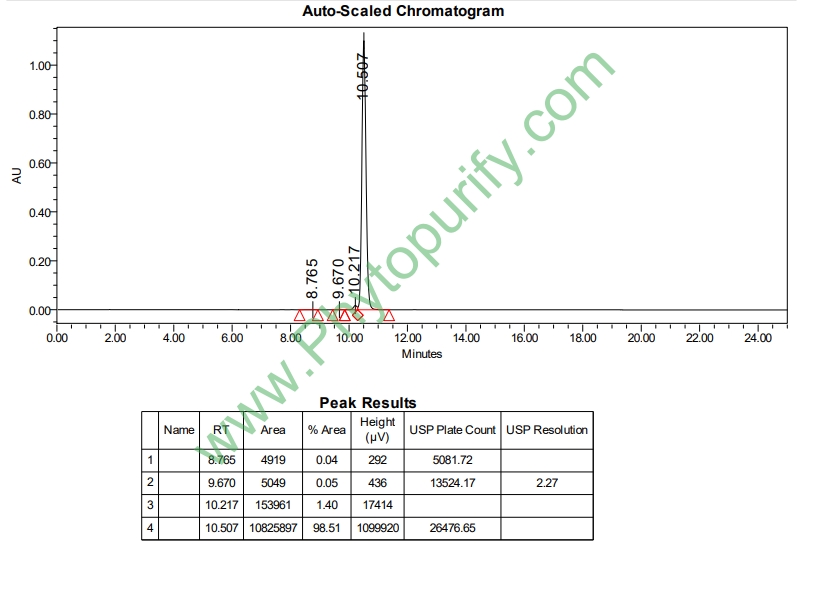
Analysis Method: HPLC-DAD or/and HPLC-ELSD
Identification Method: Mass, NMR
Packing: Brown vial or HDPE plastic bottle
Storage: Store in a well closed container, protected from air and light. Put into refrigerate or freeze for long term storage.
Whenever possible, you should prepare and use solutions on the same day. However, if you need to make up stock solutions in advance, we recommend that you store the solution as aliquots in tightly sealed vials at -20℃. Generally, these will be useable for up to two weeks.
The product could be supplied from milligrams to grams, up to kilograms
Inquire for bulk scale.
Descriptions:
10-Gingerol, fresh ginger extract, inhibits the production of nitric oxide, IL-1β, IL-6 and TNF-α as well as their mRNA levels in LPS-activated BV2 microglia,exhibits a significant anti-neuroinflammatory capacity.[1]
10-Gingerol improves cisplatin-induced anorexia by inhibiting acylated ghrelin degradation.[2]
10-Gingerol inhibits proliferation and invasion of MDA-MB-231 breast cancer cells through suppression of Akt and p38MAPK activity, suggests that it could be a potential therapeutic agent for the prevention and treatment of breast cancer.[3]
10-Gingerol has ameliorative effect on drug induced hepatotoxicity in albino rats.[4]
References:
[1] Ho S C, Chang K S, Lin C C. Food Chem, 2013, 141(3):3183-91.
[2] Sadakane C, Muto S, Nakagawa K, et al. Biochem Bioph Res Co, 2011, 412(3):506-11.
[3] Joo J H, Hong S S, Cho Y R, et al. Oncol Rep, 2016, 35(2):779-84.
[4] Saleh I, Alqasoumi. J Med Plants Res, 2012, 6(9): 1548-55.
[5] Lee S, Khoo C, Halstead C W, et al. J Aoac Int, 2007, 90(5):1219-26.
HPLC of 10-Gingerol
Storage conditions:Short-term storage at 2~8℃, long-term storage at -20 ~ -80℃
66.7600
4.9000
4.5000
Low
No
Unknown
No
No
No
No
Unknown
10 Gingerol is a natural phenolic compound mainly found in the fresh root oil resin of Zingiber officinale. As an important member of the gingerol family, 10 gingerol has attracted widespread attention in recent years due to its unique chemical structure and diverse biological activities. Research has shown that 10 gingerol has significant anti-inflammatory, antioxidant, anti proliferative, and anticancer activities, and its mechanism of action involves multiple cellular signaling pathways, particularly AMPK activation and regulation of the PI3K/Akt signaling pathway. In addition, 10 gingerol has shown good application potential in cardiovascular diseases, tumors, neuroinflammation, infectious diseases and other fields. This article provides a systematic review of the chemical structure and physicochemical properties, plant sources and extraction methods, pharmacological activity, mechanism of action, pharmacological evaluation, and future clinical application prospects of 10 gingerol. The aim is to provide a theoretical basis and reference for the in-depth research and drug development of this natural product.
10 gingerol (CAS number: 23513-15-7), also known as (5S) -5-hydroxy-1- (4-hydroxy-3-methoxyphenyl) decanone, belongs to the phenolic and β - hydroxy ketone compounds. Its molecular formula is C19H28O4 and its molecular weight is 350.49. The structure of 10 gingerol contains a monomethoxybenzene ring connected to a long alkyl chain containing a β - hydroxyl group, giving it unique hydrophobicity and polarity characteristics. In terms of physical and chemical properties, the LogP value of 10 gingerol is 4.90, indicating its high lipid solubility, which is beneficial for penetrating cell membranes, but its moderate polarity (TPSA 66.76 Å ²) ensures a certain degree of water solubility. The molecule contains four hydrogen bond acceptors, indicating its affinity for binding with biomolecules. The low permeability of the blood-brain barrier suggests that its role in the central nervous system may be limited. The toxicity assessment showed that 10 gingerol has no hepatotoxicity, cardiotoxicity, or hERG channel inhibition effect. The Ames mutagenicity test was negative, indicating its high safety and good pharmacological basis.
10 gingerol is mainly present in the fresh rhizome oil resin of ginger and is one of the representative gingerol compounds. Ginger, as a traditional Chinese medicine and seasoning, contains abundant volatile oils and non-volatile spicy components in its roots and stems. The content of 10 gingerol is greatly affected by the variety, harvesting time, and processing method. Common extraction methods include solvent extraction, supercritical CO2 extraction, and liquid chromatography separation. Traditional solvent extraction often uses ethanol, methanol, or ethyl acetate, combined with reflux extraction and concentration techniques, to effectively obtain high levels of 10 gingerol. Supercritical CO2 extraction has gradually become the preferred method for extracting 10 gingerol in recent years due to its green environmental protection and high selectivity. The extract is further purified by silica gel column chromatography or high-performance liquid chromatography (HPLC) to ensure the purity and activity of 10 gingerol. The optimization of extraction process not only improves the yield, but also provides high-quality raw material guarantee for subsequent pharmacological research and drug development.
10 gingerol exhibits significant anti-inflammatory effects, mainly achieved by inhibiting the production of inflammatory mediators and regulating inflammatory signaling pathways. As an AMPK agonist, it can activate energy metabolism related signals, inhibit the expression of pro-inflammatory transcription factors such as NF - κ B, and reduce the release of inflammatory factors such as TNF - α and IL-6. In addition, 10 gingerol has an IC50 of 10.47 μ M for scavenging DPPH radicals in vitro, and IC50 of 1.68 μ M and 1.35 μ M for scavenging superoxide and hydroxyl radicals, respectively, demonstrating its strong antioxidant capacity. This antioxidant effect helps to alleviate cellular damage caused by oxidative stress and protect tissue function.
10 gingerol inhibited the proliferation of many tumor cell lines, especially in breast cancer MDA-MB-231 cells, where IC50 was 12.1 μ M. Its anti-tumor mechanism involves the regulation of multiple signaling pathways, such as inhibiting the PI3K/Akt signaling pathway, reducing cell proliferation, migration, and invasion ability, while inducing cell apoptosis. 10 gingerol induced apoptosis is accompanied by phosphorylation of MAPKs family members (JNK, p38, ERK), suggesting that they promote tumor cell apoptosis by activating stress-related signaling pathways. In addition, 10 gingerol can cause the release of Ca2+from the endoplasmic reticulum and Ca2+influx into non-L-type Ca2+channels in cancer cells, leading to an increase in intracellular Ca2+concentration and triggering the apoptosis program. These effects make 10 gingerol a potential candidate molecule for tumor therapy.
10 gingerol can inhibit the proliferation of vascular smooth muscle cells and reduce the proliferation of new intima, which shows the protective effect on cardiovascular diseases, especially atherosclerosis and myocardial infarction. Its targets include APP, PTPN1, MAOA, ABCB1, ABCG2, ALOX5, TRPV1, etc., involving multiple mechanisms such as inflammatory response, lipid metabolism, and cell apoptosis. By activating the AMPK signaling pathway, 10 gingerol promotes energy metabolism balance, reduces myocardial ischemia-reperfusion injury, and has potential myocardial protective effects.
10 gingerol exhibits significant inhibitory effects in neuroinflammatory models, reducing the release of inflammatory mediators and alleviating neuronal damage. In addition, 10 gingerol has inhibitory effects on various oral pathogens, effectively inhibiting bacterial growth and preventing the spread of infections. Its antibacterial mechanism may be related to the destruction of bacterial cell membrane structure and inhibition of key enzyme activity. 10 gingerol also inhibits the deacetylation of exogenous ghrelin, indicating its potential application value in regulating gastrointestinal function.
The biological effects of 10 gingerol are mainly achieved through multiple signaling pathways and molecular targets. As an AMPK agonist, it activates the energy metabolism regulatory network, inhibits inflammation and metabolic adaptation of tumor cells. The PI3K/Akt signaling pathway is a key target of 10 gingerol's anti-tumor effect. By inhibiting this pathway, 10 gingerol reduces cell survival rate and promotes apoptosis. The phosphorylation of MAPKs family (including JNK, p38, ERK) is an important mechanism for inducing cellular stress response and apoptosis.
In cardiovascular disease, 10 gingerol targets various related proteins such as APP (amyloid precursor protein), PTPN1 (protein tyrosine phosphatase 1), MAOA (monoamine oxidase A), ABCB1 and ABCG2 (ATP binding cassette transporter), ALOX5 (lipoxygenase 5), TRPV1 (transient receptor potential vanillic acid receptor 1), etc., regulating inflammatory response, cellular metabolism, and ion channel function, thereby exerting a protective effect. In addition, 10 gingerol enhances its anti-tumor and anti-inflammatory effects by regulating intracellular Ca2+dynamics, affecting endoplasmic reticulum stress and apoptosis signals.
The pharmacological parameters of 10 gingerol show that it has good potential for drug development. The molecular weight of 350.49 is moderate, and LogP 4.9 indicates strong lipid solubility, which is beneficial for cell membrane penetration, but may affect water solubility and bioavailability. The TPSA is 66.76 Å ², with 4 hydrogen bond acceptors, which conforms to Lipinski's rule and facilitates oral absorption. The low permeability of the blood-brain barrier suggests that its role in the central nervous system may be limited, but it also reduces the risk of neurotoxicity.
Toxicological evaluation shows that 10 gingerol has no hepatotoxicity, cardiotoxicity, or hERG channel inhibition, and the Ames test is negative, indicating high safety. Regarding pharmacokinetics, existing studies have shown that 10 gingerol is well absorbed orally, but metabolized quickly, mainly through the liver enzyme system, producing various metabolites. It is widely distributed in the body, mainly accumulating in the liver and kidneys, and excreted mainly through bile and urine. Further research is needed in the future to enhance its bioavailability strategies and improve metabolic stability, in order to optimize clinical applications.
Based on the multi-target and multi mechanism effects of 10 gingerol, its clinical application prospects are broad in various diseases. Firstly, in the field of anti-tumor therapy, 10 gingerol has shown potential as an adjuvant or combination therapy drug by regulating the PI3K/Akt and MAPKs signaling pathways, inhibiting tumor cell proliferation and migration, inducing apoptosis. Secondly, in cardiovascular diseases such as myocardial infarction and atherosclerosis, 10 gingerol has a cardioprotective effect through anti-inflammatory, antioxidant and regulating the function of vascular smooth muscle cells, and can be developed as a drug for prevention and treatment of cardiovascular diseases in the future.
In addition, the application of 10 gingerol in neuroinflammation and infectious diseases also deserves attention, especially in the treatment of inflammatory bowel diseases such as oral diseases and ulcerative colitis. 10 gingerol shows good therapeutic potential. Combining its good safety and drug properties, modern drug delivery technologies such as structural modification and nanocarriers can be used in the future to enhance its bioavailability and targeting, and promote clinical translation.
However, the current clinical research on 10 gingerol is still in its preliminary stage and lacks systematic clinical trial data. In the future, it is necessary to strengthen in-depth research on its pharmacokinetics, toxicology, and clinical efficacy, clarify the optimal dosing regimen and safe dosage range, and promote it as an important candidate for the development of natural product drugs.
10 gingerol, as an important active ingredient in ginger, has shown great research and application value in the field of natural product pharmacology due to its unique chemical structure and diverse biological activities. Its multiple mechanisms of action, including anti-inflammatory, antioxidant, anti-tumor, and cardiovascular protection, provide new ideas and strategies for the treatment of related diseases. The pharmacological evaluation shows that 10 gingerol has good safety and drug development potential, but further pharmacokinetic optimization and clinical validation are still needed. In the future, combined with modern drug design and delivery technology, 10 gingerol is expected to become a new natural medicine for the treatment of various diseases, contributing more to human health.
