


Product name: Bisdemethoxycurcumin
Synonym name: Curcumin III; Didemethoxycurcumin; Deleted CAS No: 22608-12-4, 85801-92-9, 91884-88-7, 104024-29-5
Catalogue No.: BP0278
Cas No.: 33171-05-0
Formula: C19H16O4
Mol Weight: 308.333
Botanical Source: Curcuma zedoaria , Curcuma longa and Curcuma aromatica. Absent in some Curcuma spp.
Physical Description: Yellow powder
Type of Compound: Phenols
Purity: 95%~99%
Analysis Method: HPLC-DAD or/and HPLC-ELSD
Identification Method: Mass, NMR
Packing: Brown vial or HDPE plastic bottle
Storage: Store in a well closed container, protected from air and light. Put into refrigerate or freeze for long term storage.
Whenever possible, you should prepare and use solutions on the same day. However, if you need to make up stock solutions in advance, we recommend that you store the solution as aliquots in tightly sealed vials at -20℃. Generally, these will be useable for up to two weeks.
The product could be supplied from milligrams to grams, up to kilograms
Inquire for bulk scale.
Descriptions:
Bisdemethoxycurcumin can regulate anti-inflammatory and anti-proliferative responses through a ROS-independent mechanism, also suppresses MCF-7 cells proliferation by inducing ROS accumulation and modulating senescence-related pathways.[1]
Bisdemethoxycurcumin directly accelerates gastric ulcer healing with potency equal to curcumin, its antiulcer effect might be due to its properties of decreasing gastric acid secretion and enhancing the mucosal defensive mechanism through suppression of iNOS-mediated inflammation.[2]
Bisdemethoxycurcumin differentially inhibit cancer cell invasion through the down-regulation of MMPs and uPA.[3]
Bisdemethoxycurcumin induces apoptosis in activated HSCs, but not in hepatocytes, by impairing cellular energetics and causing a downregulation of cytoprotective proteins, likely through a mechanism that involves CBR2.[4]
Bisdemethoxycurcumin has effects on 12-Ο-tetradecanoylphorbol-13-acetate-induced tumor promotion.[5]
Bisdemethoxycurcumin has antioxidant activities, inhibits ovarian cancer via reducing oxidative stress mediated MMPs expressions.[6,7]
References:
[1] Sandur SK, Pandey MK, Sung B,et al. Carcinogenesis, 2007, 28(8):1765-73.
[2] Mahattanadul S, Nakamura T, Panichayupakaranant P, et al. Phytomed Int J Phytother Phytopharmacol, 2009, 16(4):342-51.
[3] Li Y B, Gao J L, Zhong Z F, et al. Pharmacol Rep Pr, 2013, 65(3):700-9.
[4]Yodkeeree S, Chaiwangyen W, Garbisa S, et al. J Nutl Biochem, 2009, 20(20):87-95.
[5] Lee P J, Woo S J, Jee J G, et al. Molecules, 2015, 20(1):1277-92.
Jayaprakasha G K, Rao L J, Sakariah K K. Food Chem 2006, 98(4):720-4.
[6]Huang M T, Ma W, Lu Y P, et al. Carcinogenesis, 1995, 16(10):2493-7.
[7] Pei H, Yang Y, Lin C, et al. Sci Rep, 2016, 6,28773.
[8] Jadhav B K, Mahadik K R, Paradkar A R. Chromatographia, 2007, 65(7):483-8.
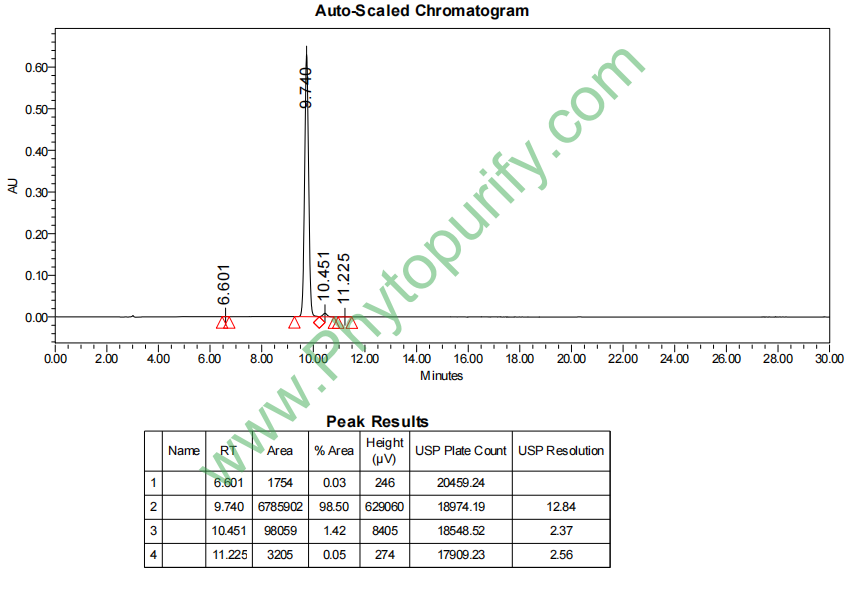
HPLC of Bisdemethoxycurcumin
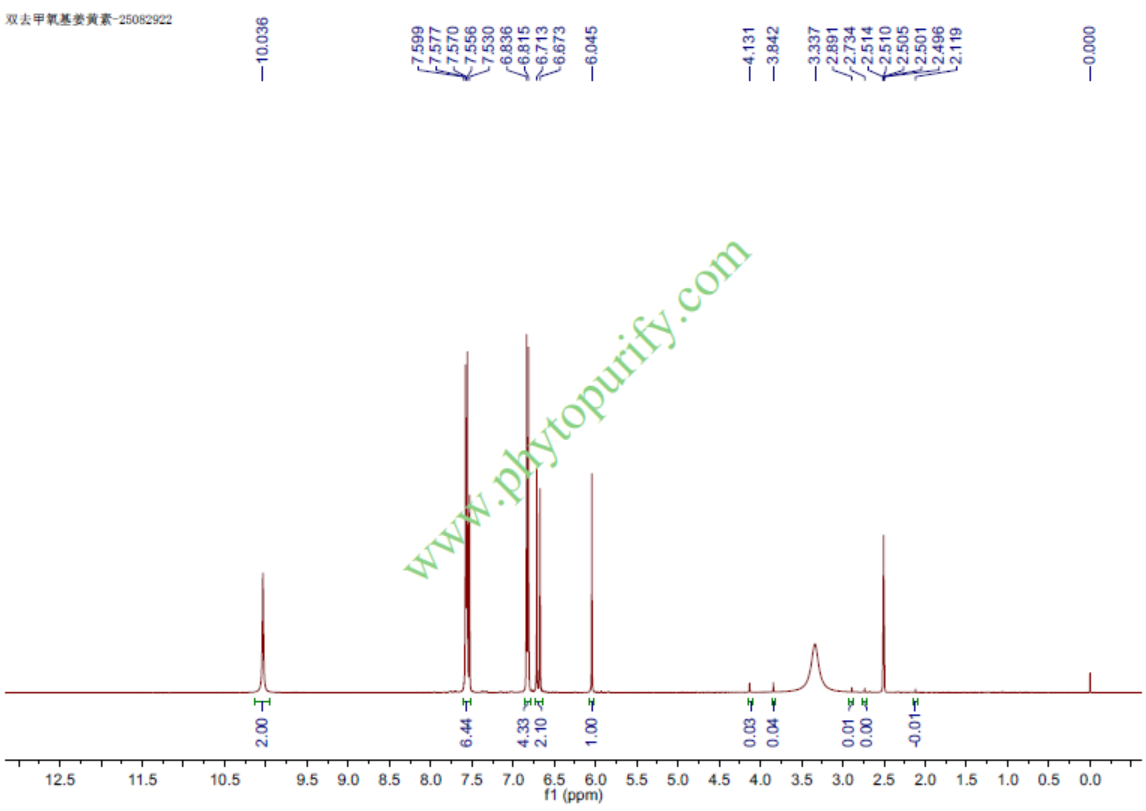
HNMR of Bisdemethoxycurcumin
Storage conditions:Short-term storage at 2~8℃, long-term storage at -20 ~ -80℃
74.6000
2.7295
2.7052
.0732
2.8104
6.4373
Low
90.7179
2.3006
Yes
Yes
Yes
No
Yes
Yes
0.0
No
Yes
Yes
Yes
Natural products, as an important treasure trove for drug discovery, play an irreplaceable role in the history of human disease prevention and treatment. Turmeric(Curcuma longa L. As a traditional Chinese medicine and spice, its pharmacological activity has attracted much attention, and its core active ingredient curcumin compounds are a research hotspot. Bisdemethoxycurcumin (BDMC), as one of the main homologs of curcumin, has a simpler chemical structure and lacks two methoxy groups compared to the well-known curcumin and demethoxycurcumin. This structural difference endows it with unique physicochemical properties and biological activity spectrum. In recent years, with the in-depth study of curcumin compounds, BDMC has gradually moved from "supporting role" to the center of the stage, showing significant potential in anti-inflammatory, antioxidant, anti-tumor, neuroprotective and other aspects, especially in inflammatory bowel disease (such as colitis) and other disease models, showing remarkable efficacy. Its CAS number is 33171-05-0. As a natural β - diketone polyphenol, its mechanism of action involves the regulation of multiple key signaling pathways and molecular targets. This article aims to systematically review the chemical properties, plant sources, pharmacological activities, molecular mechanisms of action, pharmacological characteristics, and clinical application prospects of BDMC, in order to provide comprehensive scientific references for the in-depth research and development of this natural product.
The chemical name of bis (methoxycurcumin) is (1E, 6E) -1,7-bis (4-hydroxyphenyl) -1,6-heptadiene-3,5-dione. Its molecular formula is C19H16O4 and its molecular weight is 308.3330. Structurally, BDMC belongs to the typical class of diarylheptane compounds, with its core skeleton consisting of a seven carbon chain (heptane). The C3 and C5 positions are ketone groups, forming a β - diketone structure, while the C1 and C7 positions are respectively connected to a 4-hydroxyphenyl group (i.e. p-hydroxycinnamoyl group) through an alkene bond. Compared with curcumin, BDMC lacks methoxy groups (- OCH3) on both aromatic rings and only retains phenolic hydroxyl groups (- OH). This structural characteristic makes it the member with relatively high polarity and the smallest molecular weight among curcumin compounds.
Its physicochemical properties directly affect its bioavailability and activity. The calculated lipid water partition coefficient (LogP) is 2.7295, indicating that BDMC has moderate lipophilicity, but slightly stronger hydrophilicity compared to curcumin (LogP of about 3.2). The topologically polar surface area (TPSA) is 74.6000 Å ², reflecting the presence of hydrogen bond donors (two phenolic hydroxyl groups) and acceptors (two carbonyl oxygen groups) in its molecule. The water solubility is poor, about 0.0732 mg/mL, which is a common characteristic of most polyphenolic compounds and limits their dispersion and absorption in aqueous media. Its β - diketone structure may lead to keto enol tautomerism at physiological pH, which may affect its chelating ability with metal ions and interaction with biomolecules. Overall, the chemical structure of BDMC determines its fundamental reactivity as a polyphenol and β - diketone compound, such as scavenging free radicals, chelating metal ions, and acting as a Michael reaction receptor for covalent binding with nucleophilic agents (such as thiol groups in proteins).
Double demethoxycurcumin mainly comes from plants of the Curcuma genus in the ginger family, especially turmeric(Curcuma longa L. The roots and stems of. In the crude extract of turmeric, the content of BDMC is usually lower than that of curcumin and demethoxycurcumin, which together form "curcumin compounds". The relative proportion of BDMC varies depending on the variety, origin, harvest season, and storage conditions, usually accounting for about 3-10%.
The extraction of BDMC from plant materials mainly follows the general extraction principles of polyphenolic compounds. Traditional methods include organic solvent extraction, with commonly used solvents including ethanol, acetone, ethyl acetate, etc. For example, using high concentration ethanol (such as 95%) for Soxhlet extraction or hot reflux extraction can effectively extract BDMC together with other curcumin compounds. In order to improve extraction efficiency and selectivity, modern extraction techniques have been widely applied:
1. Ultrasound assisted extraction Utilizing the cavitation effect generated by ultrasound to destroy plant cell walls, accelerate solvent permeation and solute release, has the advantages of short time, high efficiency, and low temperature.
2. Microwave assisted extraction Microwave energy directly acts on polar molecules inside the material, generating instantaneous high temperature and high pressure, and quickly and efficiently extracting target components.
3. Supercritical fluid extraction CO2 is commonly used as an extractant to change its solubility by adjusting temperature and pressure. This method has no solvent residue and good selectivity, but the equipment cost is high, and for BDMC with high polarity, it is often necessary to add entrainers (such as ethanol) to improve the yield.
The extracted compound is usually a mixture of curcumin compounds, which requires further separation and purification to obtain high-purity BDMC. Conventional separation methods include column chromatography (such as silica gel column chromatography, reverse phase C18 column chromatography), preparative thin-layer chromatography, and high-performance liquid chromatography. Among them, reverse phase high performance liquid chromatography (RP-HPLC) is the most commonly used and effective method for separating and quantitatively analyzing BDMC. It usually uses a C18 chromatographic column and gradient elution with methanol water or acetonitrile water (often containing small amounts of acids such as formic acid or acetic acid to improve peak shape) as the mobile phase. In recent years, preparative chromatography techniques such as high-speed countercurrent chromatography have also provided new options for the large-scale separation of BDMC.
Numerous in vitro and in vivo studies have confirmed that BDMC has a wide range of pharmacological activities, some of which are even superior to curcumin.
The multiple pharmacological activities of BDMC stem from its diverse regulation of cellular signaling networks. Its mechanism of action is not to act on a single target, but to intervene in the disease process in a "multi-target" mode. Regarding its outstanding anti colitis activity, research has revealed that it involves multiple key molecular targets and pathways:
Despite the significant pharmacological activity of BDMC, its potential to become an ideal drug faces challenges similar to those of curcumin compounds in terms of drug development.
Double demethoxycurcumin, as a natural active molecule with multi-target effects, has broad clinical application prospects but is also full of challenges.
Potential application directions:
Challenges and Future Prospects:
As an important natural diarylheptane compound in turmeric, bisdemethoxycurcumin exhibits extensive and significant pharmacological activities, especially in anti-inflammatory, antioxidant, anti-tumor, and colon mucosal protection, due to its relatively simple chemical structure and unique polyphenol and β - diketone properties. Its multi-target mechanism involves the regulation of key inflammatory pathways such as TLR4/NF - κ B and MAPK, as well as multiple molecular targets such as CES1, FAAH, and SPHK1, providing a scientific basis for its treatment of complex diseases such as colitis. Although its poor water solubility and low oral bioavailability limit its current applications due to drug defects, it is expected to overcome these bottlenecks through new drug delivery technologies, structural modifications, and combination therapy strategies. In the future, with a deeper understanding of its mechanism of action, continuous innovation in delivery systems, and the advancement of rigorous clinical research, bisdemethoxycurcumin is expected to gradually develop from a potential natural product into an innovative drug or functional ingredient for the prevention and treatment of inflammatory bowel disease and other related diseases, contributing its unique value to human health.
