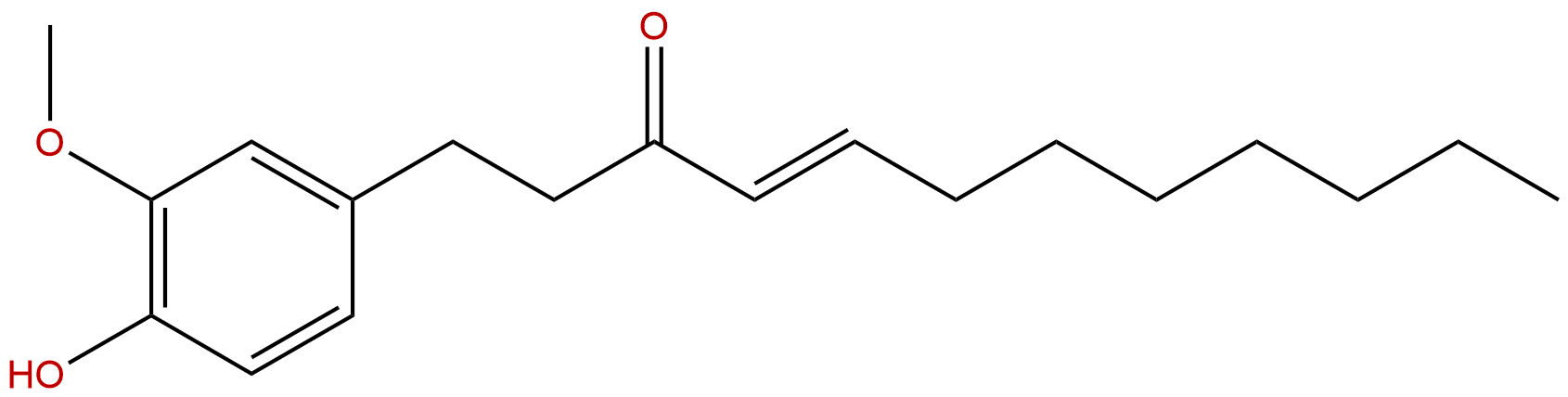


Product name: 8-Shogaol
Synonym name:
Catalogue No.: BP1770
Cas No.: 36700-45-5
Formula: C19H28O3
Mol Weight: 304.43
Botanical Source: Ginger
Physical Description: Powder
Type of Compound: Phenols
Purity: 95%~99%
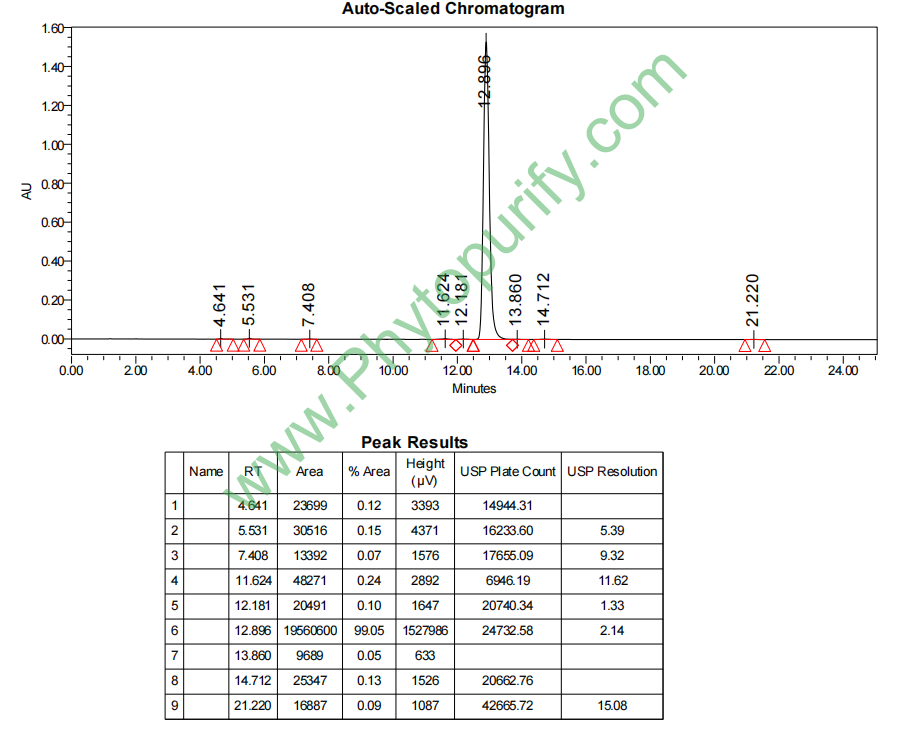
Analysis Method: HPLC-DAD or/and HPLC-ELSD
Identification Method: Mass, NMR
Packing: Brown vial or HDPE plastic bottle
The product could be supplied from milligrams to grams. Inquire for bulk scale.
We provide solution to improve the water-solubility of compounds, thereby facilitating the variety of activity tests and clinic uses.
For Reference Standard and R&D, Not for Human Use Directly.
HPLC of 8-Shogaol
Storage conditions:Short-term storage at 2~8℃, long-term storage at -20 ~ -80℃
46.5300
5.0953
5.0950
.0053
6.3930
15.1151
High
94.5699
2.2073
Yes
Yes
Yes
No
No
No
0.0
No
No
No
Yes
Natural products, as an important source of drug discovery and development, have played an irreplaceable role in the long history of human fight against diseases. Ginger(Zingiber officinale Roscoe, as a widely used medicinal and edible plant, has always been a hot topic in modern pharmacological research for its spicy active ingredients, gingerol compounds. Among them, 8-gingerol ([8] - Shogaol, CAS number: 36700-45-5), as the main pungent component generated by ginger dehydration during drying, heating, or long-term storage, has attracted much attention in recent years due to its extensive and significant biological activity. Research has shown that 8-gingerol not only retains the traditional anti-inflammatory and antioxidant properties of ginger, but also exhibits strong potential in anti-tumor, antiplatelet aggregation, neuroprotection, and regulation of gastrointestinal function. Especially its regulatory role on key inflammatory signaling pathways such as nuclear factor kappa B (NF - κ B) and mitogen activated protein kinase (MAPK) has shown promising application prospects in the intervention of major diseases such as rheumatoid arthritis, inflammatory bowel disease, and even cancer. This article aims to systematically review the chemical properties, plant sources, pharmacological activities, molecular mechanisms of action, pharmacological evaluation, and clinical application potential of 8-gingerol, in order to provide comprehensive scientific references for the deep development and transformation research of this natural product.
8-gingerol is a typical phenylenone compound, with the chemical name (E) -1- (4-hydroxy-3-methoxyphenyl) -4-decen-3-one. Its molecular structure consists of three main parts: a para hydroxyl, meta methoxy substituted benzene ring (i.e. guaiacol group), an alpha, beta unsaturated ketone (enone) functional group, and a medium length aliphatic side chain. Its molecular formula is C19H28O3 and its molecular weight is 304.4300.
The core pharmacophore of 8-gingerol is believed to be the alpha, beta unsaturated ketone structure (Michael reaction receptor), which enables it to act as an electrophilic molecule and undergo Michael addition reactions with nucleophilic thiol groups (- SH) in biomolecules such as proteins, thereby covalently modifying and affecting the functions of various target proteins. This is the key chemical basis for its multiple biological activities.
From the perspective of physicochemical parameters related to drug properties, 8-gingerol exhibits typical hydrophobic characteristics. The calculated lipid water partition coefficient (LogP) is 5.0953, indicating strong lipid solubility. The topological polar surface area (TPSA) is 46.53 Å ², which is relatively small. These parameters collectively determine its extremely low water solubility (approximately 0.0053 mg/mL), which poses a challenge for its oral absorption and formulation development. On the other hand, its high lipid solubility makes it easy to penetrate cell membranes and predicts its high blood-brain barrier permeability, which provides the possibility for its potential central nervous system activity (such as neuroprotection). Preliminary safety predictions indicate that there is no risk of hERG potassium channel inhibition (low risk of arrhythmia), and the Ames test predicts a negative result (no mutagenicity), providing a favorable safety starting point for its further development.
8-gingerol is mainly derived from ginger, a plant in the ginger family(Zingiber officinale). It is worth noting that the main active ingredient in fresh ginger is gingerol (such as [6] - gingerol), which has a hydroxyl group at the end of its side chain. 8-gingerol is not the main component in fresh ginger, but is generated by dehydration reactions of gingerol during heating, drying, or long-term storage. Therefore, the content of 8-gingerol in dried ginger is usually significantly higher than that in fresh ginger. Its content is also significantly affected by ginger variety, origin, harvesting time, and processing technology (such as temperature and time).
The extraction of 8-gingerol from ginger mainly relies on organic solvent extraction method. Common solvents include ethanol, methanol, acetone, ethyl acetate, etc. In order to improve extraction efficiency, modern extraction techniques are often combined with traditional methods:
1. Traditional solvent extraction Soak or reflux the dried ginger powder in a suitable solvent (such as ethanol) for extraction, and concentrate to obtain a crude extract.
2. Assisted Extraction Technology Ultrasound assisted extraction, microwave-assisted extraction and other technologies can effectively shorten the extraction time and improve the yield of target compounds.
3. Separation and purification The crude extract obtained has complex components and requires further separation and purification to obtain high-purity 8-gingerol. Column chromatography techniques such as silica gel column chromatography and reverse phase C18 column chromatography are commonly used, with gradient elution using solvent systems of different polarities. High performance liquid chromatography (HPLC) and preparative liquid chromatography are the final key steps in obtaining high-purity monomeric compounds. Thin layer chromatography (TLC) and HPLC are commonly used for monitoring and identifying extraction and purification processes.
Numerous in vitro and in vivo studies have confirmed that 8-gingerol has multiple pharmacological activities and its effects are extensive and profound.
Anti inflammatory and immune regulatory activity This is one of the core activities of 8-gingerol. In various acute and chronic inflammation models, 8-gingerol has shown strong anti-inflammatory effects. It can significantly inhibit the excessive production of nitric oxide (NO), prostaglandin E2 (PGE2), and key pro-inflammatory cytokines such as tumor necrosis factor - α (TNF - α), interleukin-6 (IL-6), and interleukin-1 β (IL-1 β) in macrophages induced by stimuli such as lipopolysaccharide (LPS). In animal models of rheumatoid arthritis (RA), 8-gingerol can alleviate joint swelling, cartilage damage, and bone erosion, and its effect is closely related to the inhibition of synovitis.
Antitumor activity: 8-gingerol can inhibit the growth and induce apoptosis of many cancer cell lines, including leukemia, breast cancer, lung cancer, colon cancer, pancreatic cancer, prostate cancer, etc. Its anti-cancer mechanisms are diverse, including inducing cell cycle arrest (such as G2/M phase arrest), activating caspase cascade mediated apoptosis, inducing depolarization of mitochondrial membrane potential, increasing reactive oxygen species (ROS) generation, and inhibiting cancer cell invasion and metastasis. Research has shown that it has a particularly significant inducing effect on apoptosis in certain leukemia cells.
Antiplatelet aggregation effect 8-gingerol can effectively inhibit platelet aggregation, with an IC50 value of approximately 5 μ M. This activity has potential significance for preventing thrombosis related cardiovascular and cerebrovascular diseases (such as atherosclerosis, myocardial infarction).
Gastrointestinal regulatory effect This is highly correlated with Irritable Bowel Syndrome (IBS) mentioned in the introduction. 8-gingerol can regulate gastrointestinal function through various pathways: by activating transient receptor potential vanillic acid subtype 1 (TRPV1) and anchoring protein subtype A1 (TRPA1), it generates an initial spicy sensation, which may subsequently trigger desensitization and alleviate visceral hypersensitivity; Reduce low-grade intestinal inflammation by inhibiting the Toll like receptor 4 (TLR4) signaling pathway; Regulating intestinal smooth muscle activity (involving cholinergic receptors such as CHRM3) and ion channels (such as KCNQ1) to affect intestinal motility. These multi-target effects give it comprehensive regulatory potential for symptoms such as abdominal pain, bloating, and abnormal bowel movements in IBS.
Neuroprotective and analgesic activity Its anti-inflammatory and antioxidant properties help alleviate neuroinflammation. In addition, by regulating pain receptors such as TRPV1, 8-gingerol may participate in the modulation of pain signals and have a certain analgesic effect.
antioxidant activity As a phenolic compound, 8-gingerol has the ability to scavenge free radicals and alleviate oxidative stress damage to cells and tissues.
The multiple pharmacological activities of 8-gingerol stem from its precise intervention in multiple key signaling pathways within cells, and its core mechanism of action lies in the covalent modification of specific protein targets by its alpha, beta unsaturated ketone structure.
Core target: TAK1-TAB1 complex Transforming growth factor beta activated kinase 1 (TAK1) is a key upstream regulator of the MAPK and NF - κ B signaling pathways, and its binding to the adapter protein TAB1 is crucial for its complete activation. Research has shown that 8-gingerol can Selective targeting of TAK1 and TAK1-TAB1 complexes The cysteine residue of TAK1 is covalently modified through Michael addition reaction, with an IC50 of approximately 5 μ M, thereby inhibiting its kinase activity. The inactivation of TAK1 leads to the blockade of downstream IKK (I κ B kinase complex), Akt (protein kinase B), and MAPKs (such as JNK, p38, ERK) signaling pathways.
Inhibition of NF - κ B and MAPK pathways By inhibiting TAK1,8-ogingerol, the classic pro-inflammatory and pro survival signaling pathways NF - κ B and MAPK were effectively blocked. Inhibition of the NF - κ B pathway leads to downregulation of gene expression of pro-inflammatory factors (TNF - α, IL-6, IL-1 β) and enzymes (such as COX-2, with an IC50 of 17.5 μ M). Inhibition of the MAPK pathway affects cell proliferation, differentiation, and stress response. The synergistic inhibition of these two pathways is the core molecular basis for its anti-inflammatory and induction of cancer cell apoptosis.
Multi target network for irritable bowel syndrome (IBS)In the context of IBS, the action of 8-gingerol exhibits networked characteristics
Mechanism of inducing cell apoptosis In cancer cells, in addition to inhibiting Akt (pro survival signal) and activating MAPK (pro apoptotic signal), 8-gingerol can also induce mitochondrial pathway apoptosis, leading to cytochrome C release and caspase-3 activation. Its pro oxidative properties (increasing ROS) also play a role in inducing cancer cell death.
Despite the excellent pharmacological activity of 8-gingerol, its pharmacological development still faces challenges, and its pharmacokinetic properties are a key bottleneck in research and development.
Absorption, distribution, metabolism, excretion (ADME):
Challenges and Strategies in Drug Development:
Preclinical pharmacokinetic studies are crucial for determining dosing regimens and predicting human doses, but currently publicly available and systematic pharmacokinetic data of 8-gingerol in vivo are relatively limited, and more research is needed to fill this gap.
Based on its rich pharmacological activity and clear target of action, 8-gingerol has broad clinical application prospects in multiple disease fields, but its transformation still requires solid research and promotion.
Potential application areas:
Future research directions and challenges:
8-gingerol, as a key active ingredient in ginger, exhibits excellent multiple pharmacological activities in anti-inflammatory, anti-tumor, antiplatelet, and gastrointestinal function regulation through covalent modification of key signaling nodes such as TAK1, thanks to its unique α, β - unsaturated ketone chemical structure. The study of its mechanism of action has deepened from the description of phenomena to the molecular target level, especially its core regulatory role in the NF - κ B and MAPK signaling pathways, providing a solid scientific basis for the treatment of diseases such as rheumatoid arthritis and irritable bowel syndrome. However, its inherent low water solubility and potential rapid metabolism as drug forming bottlenecks restrict its transformation from an "active compound" to a "candidate drug". Future research should focus on overcoming these obstacles through innovative formulation technology and systematic preclinical development, and actively promoting rigorous clinical evaluation. In summary, 8-gingerol is a highly valuable natural product lead compound, and its in-depth research not only helps to reveal the modern scientific connotation of ginger's traditional efficacy, but also has the potential to bring new natural medicine choices for the treatment of various refractory diseases.
