| Catalog No | Package | Original Price | Price | Inventory | Quantity | Operating |
|---|---|---|---|---|---|---|
| BP5270-5mg | 5mg | $420.00 | Sign in |
|


Storage conditions:Short-term storage at 2~8℃, long-term storage at -20 ~ -80℃
333.6700
1.9703
1.9705
.1572
.5672
.2889
Low
74.7749
6.7489
No
No
No
No
No
No
0.0
Yes
No
No
Yes
Natural products, as an important source of drug lead compounds, occupy an irreplaceable position in the history of human disease prevention and treatment. Among numerous natural products with biological activity, saponin compounds have attracted much attention due to their structural diversity and extensive pharmacological activities. Ciwujia(Acanthopanax senticosus Siberian ginseng, also known as Siberian ginseng, has a long history of application in East Asia as a traditional medicinal plant. It is mainly used to enhance physical strength, resist fatigue, regulate immune function, and improve cognitive function. Modern pharmacological research has confirmed that Acanthopanax senticosus contains various active ingredients, including Acanthopanax senticosus glycosides, flavonoids, polysaccharides, and saponin compounds.
Ciwujianoside C1 (CAS number: 114906-73-9) is a triterpenoid saponin compound isolated from the leaves of Ciwujianoside. This compound was initially identified and named by Russian and Japanese scholars in the late 1980s and early 1990s from Acanthopanax senticosus. As one of the unique active ingredients of plants in the genus Acanthopanax, Acanthopanax saponin C1 has gradually entered the field of researchers in recent years due to its unique biological activity spectrum. Preliminary studies have shown that the compound has the ability to inhibit pancreatic lipase activity, indicating its potential value in metabolic regulation. More importantly, based on network pharmacology and molecular docking analysis, it was found that Ciwujia saponin C1 interacts with multiple immune regulatory targets, including key signaling molecules such as TLR4, STAT3, NFKB1, suggesting that it may have broader application prospects in the field of immune regulation.
This article will provide a systematic review of the research progress of Ciwujia saponin C1 from multiple dimensions, including chemical structure, plant origin, pharmacological activity, mechanism of action, pharmacological evaluation, and clinical application prospects, in order to provide reference for the in-depth research and development of this natural product.
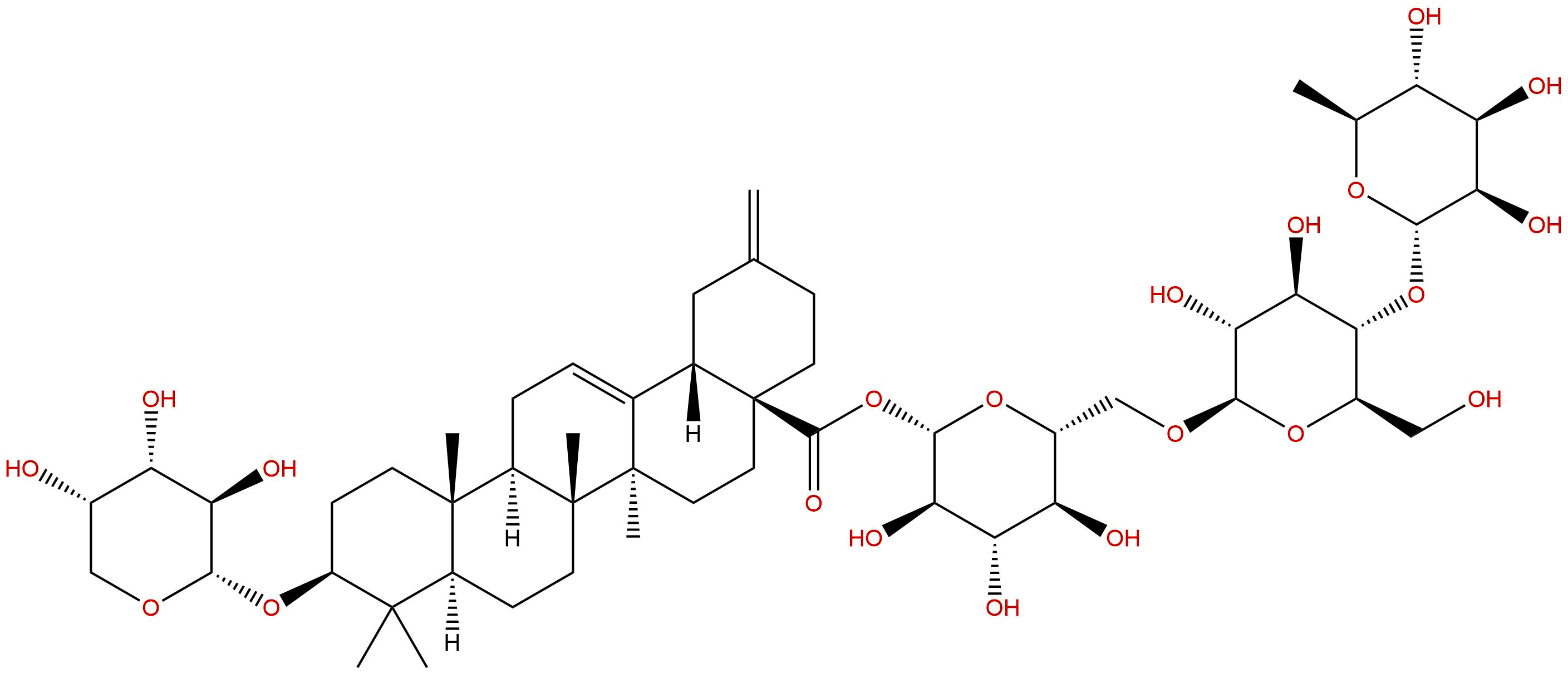
Ciwujia saponin C1 belongs to the oleanane type pentacyclic triterpenoid saponin, and its aglycone is a derivative of oleanolic acid. The molecular formula of this compound is C ₅∝ H ₈₆ O ₂₀, with a molecular weight of 1043.2070 g/mol. Structurally, the sugar chain of Ciwujia saponin C1 is composed of multiple monosaccharide units, typically including glucose, rhamnose, arabinose, etc., which are connected to the C-3 or C-28 positions of the nucleoside through glycosidic bonds. This complex glycosylation pattern endows the compound with unique physicochemical properties and biological activity.
Specifically, the glycoside skeleton of Ciwujia saponin C1 has a typical pentacyclic triterpenoid structure, consisting of five ring systems A, B, C, D, and E, with the E ring being a five membered ring. The C-17 position is connected to a carboxyl group, and the C-3 position hydroxyl group forms an O-glycosidic bond with the sugar chain. The composition and connection order of sugar chains are key factors determining the structural differences between this compound and other saponins of Acanthopanax senticosus, such as saponins B and E. High resolution mass spectrometry and nuclear magnetic resonance spectroscopy analysis indicate that the sugar chain of Ciwujia saponin C1 may contain 3-4 monosaccharide residues, forming linear or branched structures.
The pharmacological parameters obtained based on computational chemistry methods show that Ciwujia Saponin C1 has the following characteristics:
Lipid water partition coefficient (LogP): 1.9703. This value indicates that the compound has moderate lipophilicity, neither completely hydrophobic nor completely hydrophilic. A LogP value in the range of 1-3 is generally considered favorable for the intestinal absorption of oral drugs, but the LogP value of Ciwujia saponin C1 is slightly lower than the ideal range (usually considered to be optimal between 2-3), suggesting that it may have a certain hydrophilic tendency.
Polarized surface area (TPSA): 333.6700 Å ². TPSA is an important parameter for evaluating the oral bioavailability and membrane permeability of compounds. It is generally believed that compounds with TPSA greater than 140 Å ² are difficult to passively diffuse across the cell membrane. The TPSA value of Ciwujia saponin C1 is much higher than this threshold, mainly due to the large number of hydroxyl and sugar units in its molecule. A high TPSA value indicates that the oral absorption of the compound may be poor and needs to be absorbed through active transport or paracellular pathways.
Water solubility:0.1572 mg/mL。 This compound has low solubility in water and belongs to insoluble compounds. Low water solubility is a common feature of many saponin compounds and an important factor limiting their formulation development and bioavailability.
Blood-brain barrier penetrability: Low. Based on molecular feature prediction, it is difficult for Ciwujia saponin C1 to penetrate the blood-brain barrier and enter the central nervous system. This characteristic to some extent limits its application in neurological diseases, but also reduces the risk of central nervous system toxicity.
HERG inhibition: Negative. HERG potassium channel inhibition is the main cause of drug-induced cardiac toxicity (QT interval prolongation). Ciwujia saponin C1 has no inhibitory effect on hERG channels, indicating a low risk of cardiac toxicity.
Ames test: 0.0. The Ames test is used to evaluate the mutagenicity of compounds, and a result of 0.0 indicates that the compound has no mutagenic activity under standard testing conditions and has a low risk of genetic toxicity.
Based on the above parameters, Ciwujia saponin C1 has typical physicochemical characteristics of natural saponin compounds: high molecular weight, high polarity surface area, low water solubility, and low membrane permeability. These characteristics have a significant impact on its pharmacokinetic behavior and administration route design.
Ciwujia saponin C1 mainly comes from the Araliaceae plant, Ciwujia(Acanthopanax senticosus (Rupr. & Maxim.) Harms)。 Ciwujia is a deciduous shrub widely distributed in Northeast China, the Far East of Russia, the Korean Peninsula, and northern Japan. In China, Acanthopanax senticosus mainly grows in mountainous forest edges or shrubs in provinces such as Heilongjiang, Jilin, Liaoning, Hebei, and Shanxi.
It is worth noting that the distribution of Ciwujia saponin C1 in plants has tissue specificity. Research has shown that this compound is mainly enriched in the leaves of Acanthopanax senticosus, while its content is relatively low in the roots, stems, fruits, and other parts. This distribution feature is in sharp contrast to many other active ingredients of Acanthopanax senticosus, such as Acanthopanax senticosus glycosides B and E, which mainly exist in roots and rhizomes. From the perspective of resource utilization, as a renewable resource, the harvesting of leaves has a relatively small impact on plant survival and is conducive to sustainable development and utilization.
Other plants belonging to the same genus, such as the rootless plant Wujia, except for the thorny Wujia(Acanthopanax sessiliflorus)Red Haired Five Plus(Acanthopanax giraldii)It may also contain Ciwujia saponin C1 or its structural analogues, but the content is usually low. Therefore, the leaves of Acanthopanax senticosus are still the main natural source of this compound.
The extraction of Ciwujia saponin C1 is usually carried out using classical natural product chemistry methods combined with modern separation and purification techniques. The following are commonly used extraction processes:
Raw material pretreatment Fresh or dry leaves of Acanthopanax senticosus are crushed and sieved through a 40-60 mesh sieve to obtain a uniform plant powder.
Solvent extraction Use ethanol water mixed solvent (usually 60% -80% ethanol) for reflux extraction or percolation extraction. The extraction temperature is controlled at 60-80 ℃, the extraction time is 2-4 hours, and the extraction is repeated 2-3 times. The optimization of ethanol concentration, extraction temperature, and time is crucial for improving the extraction rate of Ciwujia saponin C1.
Concentration and preliminary purification Combine the extraction solutions, concentrate under reduced pressure until there is no alcohol odor, and obtain a concentrated aqueous solution. Subsequently, n-butanol extraction (usually 3-4 times) is used to transfer the saponin components from the aqueous phase to the organic phase. The n-butanol extract was concentrated under reduced pressure to obtain the crude extract of total saponins.
Column chromatography separation The crude extract of total saponins was preliminarily separated by silica gel column chromatography using chloroform methanol water (different ratios) gradient elution. The fraction rich in Ciwujia saponin C1 is further purified by reverse phase column chromatography (such as ODS column) using methanol water or acetonitrile water systems for elution.
Preparation by High Performance Liquid Chromatography For the acquisition of high-purity Ciwujia saponin C1, preparative high-performance liquid chromatography (pre HPLC) can be used for final purification. The commonly used chromatographic conditions include a C18 reverse phase column, a mobile phase of acetonitrile water (25:75 to 40:60, v/v), and detection wavelengths of 203 nm or 210 nm.
Structural Identification The purified compound was structurally confirmed by techniques such as mass spectrometry (MS), nuclear magnetic resonance spectroscopy (¹ H-NMR, ¹ ³ C-NMR, 2D-NMR), etc.
In recent years, some new extraction techniques such as ultrasound assisted extraction, microwave-assisted extraction, and supercritical fluid extraction have also been attempted for the extraction of saponins C1 from Acanthopanax senticosus. These techniques have the advantages of high extraction efficiency, short time, and low solvent consumption, but they are still in the laboratory research stage and have not yet been industrialized.
The earliest reported pharmacological activity of Ciwujia saponin C1 was its inhibitory effect on pancreatic lipase. Pancreatic lipase is a key enzyme in the process of dietary fat digestion, responsible for hydrolyzing triglycerides into monoglycerides and free fatty acids for intestinal absorption. Inhibiting pancreatic lipase activity can reduce fat absorption, resulting in weight loss and improved lipid profile.
In vitro enzyme activity assays showed that saponins C1 from Acanthopanax senticosus inhibited pancreatic lipase activity in a concentration dependent manner, with a half maximal inhibitory concentration (IC ₅₀) at the micromolar level. Compared with the known pancreatic lipase inhibitor Orlistat, the inhibitory activity of Ciwujia saponin C1 is relatively weak, but its safety advantage as a natural product still makes it valuable for development. Molecular simulation studies suggest that the saponin C1 of Acanthopanax senticosus may interfere with substrate enzyme binding by forming hydrogen bonds and hydrophobic interactions with amino acid residues near the active site of lipase through its sugar chain.
In recent years, with the application of network pharmacology and systems biology methods, the immunomodulatory activity of Ciwujia saponin C1 has gradually become a research hotspot. Based on target prediction and molecular docking analysis, the compound was found to have potential interactions with multiple immune related signaling pathways.
Preliminary cell experiments have shown that saponins C1 from Acanthopanax senticosus can regulate the activity of macrophages, T lymphocytes, and B lymphocytes. In a macrophage model stimulated by lipopolysaccharide (LPS), saponins C1 from Acanthopanax senticosus can inhibit the production of pro-inflammatory cytokines (such as TNF - α, IL-6) and promote the expression of anti-inflammatory cytokines (such as IL-10), exhibiting a bidirectional immune regulatory effect. In T cell differentiation experiments, this compound can affect Th1/Th2 balance and promote the differentiation of regulatory T cells (Tregs), suggesting its potential therapeutic potential in autoimmune and inflammatory diseases.
In addition, Ciwujia saponin C1 has been found to enhance the activity of natural killer cells (NK cells), improve the body's anti infection and anti-tumor immune capabilities. This immune enhancing effect may be consistent with the traditional use of Acanthopanax senticosus as an "adaptogen".
In addition to the main activities mentioned above, Ciwujia saponin C1 also exhibits other biological activities:
antioxidant activity This compound has shown certain free radical scavenging ability in vitro experiments and can reduce the levels of oxidative stress markers such as malondialdehyde and reactive oxygen species. Its antioxidant activity may be related to the phenolic hydroxyl and sugar moieties in its molecule.
anti-inflammatory activity In various inflammatory models, Ciwujia saponin C1 can inhibit the production of inflammatory mediators (such as nitric oxide and prostaglandin E2) and alleviate inflammatory reactions. This activity is closely related to its immune regulatory effect.
Antitumor activity Preliminary studies have shown that saponins C1 from Acanthopanax senticosus have a proliferative inhibitory effect on certain tumor cell lines (such as HepG2 liver cancer cells and A549 lung cancer cells), but their anti-tumor activity is relatively weak and may need to be combined with other drugs to achieve significant effects.
Using network pharmacology methods, researchers systematically predicted the potential molecular targets of Ciwujia saponin C1. Through chemical structure similarity search, reverse molecular docking, and pharmacophore model analysis, a series of candidate targets related to immune regulation were identified, including:
TLR4 (Toll like receptor 4)TLR4 is a key pattern recognition receptor in the innate immune system, which can recognize pathogen related molecular patterns such as LPS and activate downstream NF - κ B and IRF3 signaling pathways. The molecular docking results showed that Ciwujia saponin C1 may regulate its signal transduction by interacting with the MD-2 binding domain of TLR4.
STAT3 (Signal Transduction and Transcription Activating Factor 3)STAT3 is a core member of the JAK/STAT signaling pathway, involved in regulating cell proliferation, differentiation, and immune response. Ciwujia saponin C1 may regulate Th17 cell differentiation and inflammatory response by affecting the phosphorylation level of STAT3.
NFKB1 (nuclear factor kappa B subunit 1)NF - κ B is the main transcription factor for inflammation and immune response. Ciwujia saponin C1 may inhibit the phosphorylation and degradation of I κ B α, block the nuclear translocation of NF - κ B, and thus suppress the expression of pro-inflammatory genes.
TGFB1 (Transforming Growth Factor β 1)TGF - β 1 plays a dual role in immune regulation, promoting Treg cell differentiation and participating in fibrosis processes. Ciwujia saponin C1 may affect immune tolerance and tissue repair by regulating TGF - β 1 signaling.
CTLA4 (cytotoxic T lymphocyte associated protein 4)CTLA4 is a negative regulator of T cell activation and plays a critical role in immune checkpoints. Ciwujia saponin C1 may regulate T cell immune response by affecting the expression or function of CTLA4.
FOXP3 (forkhead box protein P3)FOXP3 is the main transcription factor of Treg cells, determining their differentiation and function. Ciwujia saponin C1 may promote Treg cell-mediated immune suppression by upregulating FOXP3 expression.
IL2, IL10, IFNG (interferon gamma)These cytokines play important roles in immune regulation. Ciwujia saponin C1 may regulate Th1/Th2 balance and immune response intensity by affecting the expression levels of these cytokines.
Based on the above target analysis, Ciwujia saponin C1 may exert immunomodulatory effects through the following signaling pathways:
TLR4/NF - κ B pathway Ciwujia saponin C1 may inhibit the activation of NF - κ B and reduce the production of pro-inflammatory cytokines by inhibiting the binding of TLR4 to its ligand or interfering with the interaction between TLR4 and downstream adaptor proteins such as MyD88 and TRIF.
JAK/STAT pathway This compound may affect cytokine signaling transduction by regulating the activity of JAK kinases or phosphorylation of STAT proteins. Especially the regulation of STAT3 and STAT4 may affect the differentiation of Th17 and Th1 cells.
TGF - β/Smad pathway Ciwujia saponin C1 may affect the differentiation and function of Treg cells by regulating the activity of TGF - β receptors or phosphorylation of Smad proteins.
PI3K/Akt/mTOR pathway This pathway plays an important role in immune cell metabolism and functional regulation. Ciwujia saponin C1 may regulate the proliferation, differentiation, and effector functions of immune cells by affecting the activity of this pathway.
Based on existing research evidence, we propose the following hypothesis regarding the immunomodulatory mechanism of Ciwujia saponin C1:
Ciwujia saponin C1 may serve as a multi-target natural immune modulator, producing comprehensive immune regulatory effects by simultaneously acting on multiple immune related targets. Under inflammatory conditions, this compound can inhibit the excessive activation of the TLR4/NF - κ B pathway and reduce the production of pro-inflammatory cytokines; At the same time, by promoting TGF - β signaling and FOXP3 expression, the immunosuppressive function of Treg cells is enhanced, thereby restoring immune homeostasis. In a state of immune deficiency, Ciwujia saponin C1 may enhance Th1 type immune response and improve the body's ability to resist infections by activating STAT4 and IFNG signals. This bidirectional regulatory effect (immune suppression and immune enhancement) is a typical characteristic of "adaptogen" natural products.
It should be pointed out that the above mechanism hypothesis is mainly based on computer simulations and limited in vitro experimental data, and still needs to be verified through systematic in vitro and in vivo experiments. In particular, further research is needed to elucidate the direct binding mode, binding affinity, and dynamic changes in downstream signaling pathways of Ciwujia saponin C1 to these targets.
Based on Lipinski's Rule of Five and Veber's Rule, evaluate the pharmacological properties of Ciwujia saponin C1:
Lipinski's Five Rules The molecular weight of the compound (1043.2 Da) far exceeds the threshold of 500 Da; LogP value (1.97) meets the requirement of ≤ 5; The number of hydrogen bond donors (expected to be>10 hydroxyl groups) exceeds 5; The number of hydrogen bond acceptors (expected to be>20 oxygen atoms) exceeds 10. Therefore, Ciwujia saponin C1 clearly violates multiple criteria in Lipinski's Five Rules, indicating its poor pharmacological properties as an oral medication.
Veber rules The TPSA (333.67 Å ²) of this compound far exceeds the threshold of 140 Å ²; The number of rotatable keys (expected to be>20) exceeds 10. It also violates the Veber rule, further confirming that its oral bioavailability may be low.
However, it should be pointed out that the Lipinski rule is mainly applicable to traditional small molecule oral drugs, and its applicability to natural products, especially saponin compounds, has certain limitations. Many natural products with good clinical efficacy, such as paclitaxel and digoxin, also clearly violate the Lipinski rule, but they can still exert therapeutic effects through non oral administration routes or special absorption mechanisms.
Based on a computational pharmacokinetic model, predict the ADME (absorption, distribution, metabolism, excretion) characteristics of Ciwujia saponin C1:
absorb Due to its high molecular weight, high polarity, and low water solubility, the oral absorption of Ciwujia saponin C1 is poor. It may be mainly absorbed through the following pathways: (1) passive diffusion: but limited by high TPSA and limited transmembrane ability; (2) Paracellular pathway: absorbed through tight intercellular connections, but limited by high molecular weight; (3) Active transport: absorption may be mediated by sugar transporters (such as SGLT1) or saponin specific transporters in the intestine.
distribution The distribution volume of this compound may be small, mainly distributed in extracellular fluid. Due to its high polarity and low fat solubility, it is difficult to penetrate the cell membrane and enter the cell, as well as the blood-brain barrier. The plasma protein binding rate may be high, especially when binding to albumin.
Metabolism Ciwujia saponin C1 may undergo extensive metabolism in the intestine and liver. The main metabolic pathways may include: (1) hydrolysis of sugar chains: under the action of gut microbiota or liver glycosidase, sugar chains are gradually hydrolyzed to generate secondary glycosides or aglycones; (2) Further metabolism of aglycones: Oleanolic acid aglycones may undergo phase I metabolism such as hydroxylation and carboxylation, as well as phase II metabolism such as glucuronic acid binding.
excretion The compound and its metabolites may mainly enter the intestine through bile excretion and ultimately be excreted with feces. Renal excretion may not be the main pathway due to its high molecular weight and polarity.
Given the pharmacological challenges of Ciwujia saponin C1, the following formulation strategies may help improve its pharmacokinetic properties:
nano-formulation Utilizing carrier systems such as liposomes, nanoemulsions, and polymer nanoparticles to enhance the solubility and bioavailability of the compound. Nanoformulations can also achieve targeted delivery, increasing the concentration of drugs at the site of action.
Phospholipid complex The formation of a complex between Ciwujia saponin C1 and phospholipids can enhance its lipid solubility and transmembrane ability, thereby improving oral absorption.
Prodrug design By chemical modification, the sugar chain is partially protected or replaced, or a group that can promote absorption is introduced to release active ingredients through enzymatic hydrolysis or chemical conversion in vivo.
Regulation of gut microbiota Using prebiotics or probiotics to regulate the composition of gut microbiota and promote the metabolism and absorption of Ciwujia saponin C1 in the intestine.
Based on the pharmacological activity spectrum of Ciwujia saponin C1, it has potential application value in the following disease fields:
Metabolic diseases As a pancreatic lipase inhibitor, Ciwujia saponin C1 can be used as an adjuvant therapy for obesity and hyperlipidemia. Compared to orlistat, its safety advantage as a natural product may make it more suitable for long-term use.
Autoimmune diseases By regulating immune balance and promoting Treg cell differentiation, Ciwujia saponin C1 may have therapeutic potential for autoimmune diseases such as rheumatoid arthritis, inflammatory bowel disease, and multiple sclerosis.
Inflammatory diseases Its anti-inflammatory activity makes it possible for the treatment of chronic inflammatory diseases such as chronic hepatitis, nephritis, dermatitis, etc.
Immunocompromised state As an immune enhancer, Ciwujia saponin C1 can be used to improve immune dysfunction, such as immune reconstruction after radiotherapy and chemotherapy, chronic fatigue syndrome, and age-related immune decline.
neoadjuvant therapy Although its direct anti-tumor activity is weak, as an immunomodulatory agent, Ciwujia saponin C1 may enhance anti-tumor immune response and be used in combination with chemotherapy drugs or immune checkpoint inhibitors to improve treatment efficacy.
Despite the diverse pharmacological activities and potential applications of Ciwujia saponin C1, its research and development still face many challenges. Future research should focus on the following directions:
In depth pharmacological research Establish a systematic in vivo pharmacological evaluation system, verify its immunomodulatory, anti-inflammatory, and anti obesity activities in various animal models, and clarify its effective dosage and administration regimen.
Explanation of the mechanism of action Using techniques such as gene knockout mice, RNA interference, and proteomics, we systematically studied the interaction mechanism between Ciwujia saponin C1 and targets such as TLR4, STAT3, and NFKB1, revealing the molecular basis of its immune regulation.
Pharmacokinetic study Conduct systematic pharmacokinetic studies in vivo, including oral bioavailability, tissue distribution, metabolic pathways, and excretion characteristics, to provide a basis for formulation design.
Research on Structural Optimization and Structure Performance Relationship By chemical modification or biological transformation, derivatives of Ciwujia saponin C1 can be obtained, and the relationship between sugar chain composition, connection mode, and biological activity can be studied to search for lead compounds with stronger activity and better drug properties.
Formulation development Develop formulations suitable for clinical applications, such as nanoliposomes, phospholipid complexes, solid dispersions, etc., to improve their bioavailability and therapeutic efficacy.
safety evaluation Conduct systematic toxicology research, including acute toxicity, long-term toxicity, reproductive toxicity, immunotoxicity, etc., to evaluate the safety of its clinical application.
Ciwujia saponin C1, as a natural triterpenoid saponin isolated from Ciwujia leaves, has a unique chemical structure and various biological activities. From the initial discovery of pancreatic lipase inhibitory activity to the immune regulatory potential revealed by network pharmacology in recent years, this compound is gradually demonstrating its application value in the treatment of metabolic and immune related diseases. However, its drug defects such as high molecular weight, high polarity, low water solubility, and low oral bioavailability pose severe challenges to its development.
Looking ahead to the future, with the continuous advancement of modern pharmaceutical chemistry, formulation, pharmacology, and systems biology technologies, there is hope for breakthrough progress in the research of Ciwujia saponin C1. By optimizing its structure to improve its drug properties, enhancing its bioavailability through new formulation technologies, and clarifying its target through in-depth mechanism research, this natural product may ultimately be transformed into clinically available therapeutic drugs. Meanwhile, the study of Ciwujia saponin C1 also provides valuable reference and inspiration for the development of other natural saponin compounds.
In today's world where the concepts of "returning to nature" and "green medicine" are increasingly deeply rooted in people's hearts, the study of Ciwujia saponin C1, as an important active ingredient of the traditional medicinal plant Ciwujia, not only has important scientific significance, but also contains enormous potential for application. We look forward to more researchers paying attention to this compound and jointly promoting its translational process from laboratory to clinical use.
Batch can search by a CAS number,one per line
