


Product name: Eleutheroside E
Synonym name: Acanthoside D; Syringaresinol-di-O-glucoside; Related CAS No: 19046-36-7 96038-87-8 66791-77-3
Catalogue No.: BP0527
Cas No.: 39432-56-9
Formula: C34H46O18
Mol Weight: 742.724
Botanical Source: Eleutherococcus senticosus
Physical Description:
Type of Compound: Lignans
Purity: 95%~99%
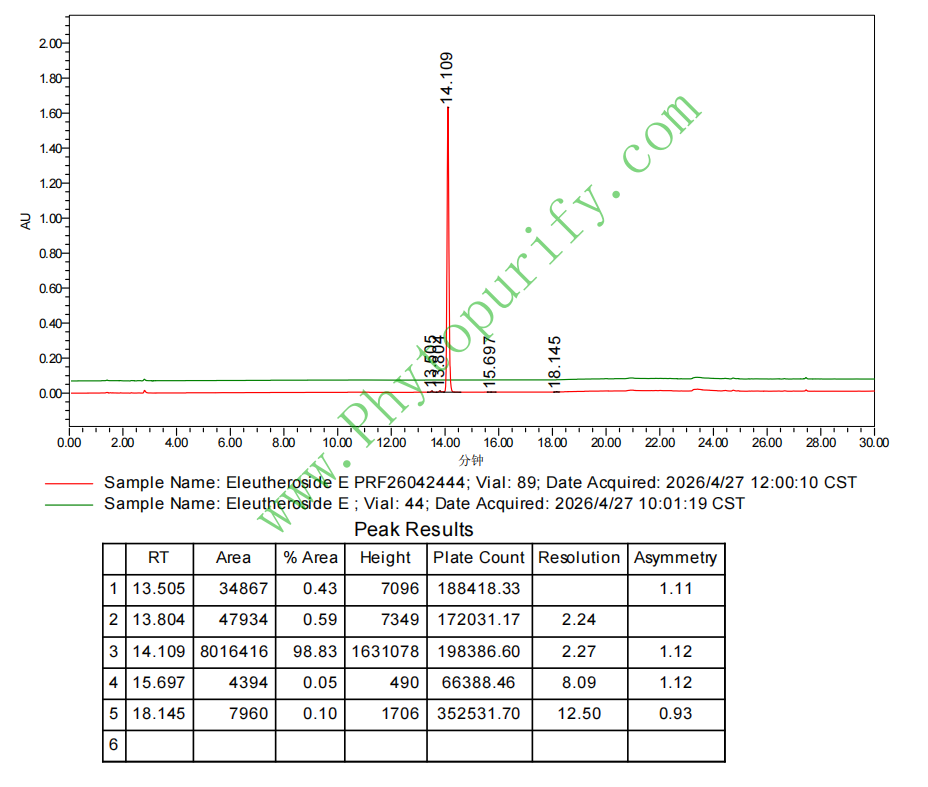
Analysis Method: HPLC-DAD or/and HPLC-ELSD
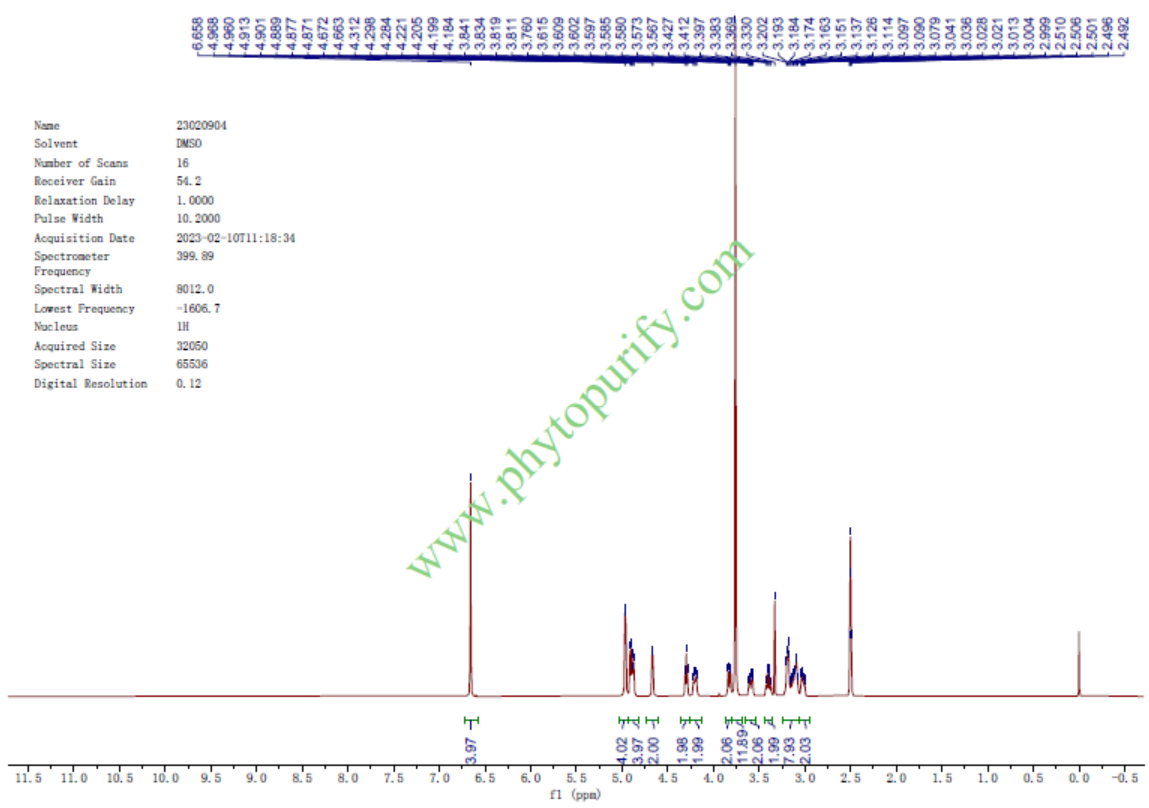
Identification Method: Mass, NMR
Packing: Brown vial or HDPE plastic bottle
Storage: Store in a well closed container, protected from air and light. Put into refrigerate or freeze for long term storage.
Whenever possible, you should prepare and use solutions on the same day. However, if you need to make up stock solutions in advance, we recommend that you store the solution as aliquots in tightly sealed vials at -20℃. Generally, these will be useable for up to two weeks.
The product could be supplied from milligrams to grams
Inquire for bulk scale.
Description:
Eleutheroside E(EE) has anti-inflammatory and protective effects in ischemia heart, the beneficial effect of EE may provide an effective and powerful strategy to alleviate behavioral alterations induced by sleep deprivation, it may influence to immune-enhancing through increasing the physical endurance capacity and immune cell activation. EE significantly decreases the inflammatory cell infiltration, pannus formation, cartilage damage, bone erosion of CIA mice, the generation of TNF-α and IL-6, the metabolism of drugs metabolized via CYP2C9 and CYP2E1.
References:
Oriental Pharmacy & Experimental Medicine, 2010, 10(3):191-9.
Immune-enhancing effect of Acanthopanax Koreanum and its component, Eleutheroside E on the protein-energy malnourished C57bl/6 mice
Acanthopanax Koreanum stem (AK) has been used in Korea as a tonic and sedative as well as a drug with ginseng like activities.
METHODS AND RESULTS:
The purpose of our present study was to investigate the effects of AK extract (AKE) and Eleutheroside E, major component of AKE on an exacerbated immune function through utilization of protein-energy malnutrition (PEM) diet by using forced swimming test (FST). The immobility time were significantly decreased in the AKE or Eleutheroside E-administrated group compared with the control group on the FST (P compared with unstimulated splenocytes but not interleukin (IL)-4. Eleutheroside E also significantly increased the IFN-\gamma production but not IL-2 and IL-4 in T cell line, MOLT-4 cells.
CONCLUSIONS:
These results suggest that AKE and Eleutheroside E may influence to immune-enhancing through increasing the physical endurance capacity and immune cell activation.
Eur J Pharmacol. 2011 May 11;658(2-3):150-5.
The effect of Eleutheroside E on behavioral alterations in murine sleep deprivation stress model.
Eleutheroside E (EE), a principal component of Eleutherococcus senticosus, has been reported to have anti-inflammatory and protective effects in ischemia heart etc. However, whether it can mitigate behavioral alterations induced by sleep deprivation, has not yet been elucidated. Numerous studies have demonstrated that memory deficits induced by sleep deprivation in experimental animals can be used as a model of behavioral alterations. The present study investigated the effect of EE, on cognitive performances and biochemical parameters of sleep-deprived mice.
METHODS AND RESULTS:
Animals were repeatedly treated with saline, 10 or 50mg/kg EE and sleep-deprived for 72 h by the multiple platform method. Briefly, groups of 5-6 mice were placed in water tanks (45 × 34 × 17 cm), containing 12 platforms (3 cm in diameter) each, surrounded by water up to 1cm beneath the surface or kept in their home cage. After sleep deprivation, mice showed significant behavioral impairment as evident by reduced latency entering into a dark chamber, locomotion and correctly rate in Y maze, and increased monoamines in hippocampus. However, repeated treatment with EE restored these behavioral and biochemical alterations in mice.
CONCLUSIONS:
In conclusion, the beneficial effect of EE may provide an effective and powerful strategy to alleviate behavioral alterations induced by sleep deprivation.
HPLC of Eleutheroside E
HNMR of Eleutheroside E
Storage conditions:Short-term storage at 2~8℃, long-term storage at -20 ~ -80℃
254.1400
-.4513
-.4516
5.8684
.5736
.2304
Low
64.3801
5.1393
Yes
No
No
No
No
No
0.0
Yes
No
Yes
Yes
Ciwujia(Eleutherococcus senticosus As a traditional medicinal plant, (Rupr.&Maxim.) Maxim. has a long history of application in folk medicine in East Asia, especially in China, South Korea, and Russia. It is often used for anti fatigue, enhancing non-specific resistance, and delaying aging. Its pharmacological activity is believed to stem from the synergistic effects of multiple complex components, among which lignan glycosides are one of its main active ingredients. Eleutheroside E, also known as syringaresinol-4 ', 4' '- bis-O - β - D-glucoside, is an important lignan glycoside compound in Eleutheroside. Its CAS number is 39432-56-9. In recent years, with the deepening of modern pharmacological research, the various biological activities of Acanthopanax senticosus glycoside E have gradually been revealed. It not only exhibits classic anti-inflammatory and antioxidant properties, but also shows great potential in cardiovascular protection, metabolic disease improvement, and neuroprotection. Research shows that acanthopanax senticosus glycoside E can reduce cardiomyocyte apoptosis induced by hypoxia reoxygenation injury, improve metabolism disorder related to type 2 diabetes, and have a clear improvement effect on cognitive impairment. These findings have transformed it from a traditional nourishing ingredient to a candidate drug molecule with clear molecular targets and therapeutic prospects. This article aims to systematically review the chemical structure, plant origin, pharmacological activity, mechanism of action, pharmacological evaluation, and clinical application prospects of Ciwujia glycoside E, in order to provide comprehensive academic references for the in-depth research and development of this compound.
Ciwujia glycoside E is a lignan glycoside compound with a molecular formula of C34H46O18 and a molecular weight of 742.7240. Its basic skeleton consists of two phenylpropane units (C6-C3) connected by β - β 'to form the lignin core - Syringaresinol. The two phenolic hydroxyl groups of the mother nucleus (located at positions 4 'and 4' 'respectively) are connected to a β - D-glucopyranose group via an O-glycosidic bond, forming a dual glycosidic structure. This structure endows Ciwujia glycoside E with unique physicochemical properties.
From the analysis of parameters related to medicinal properties, Ciwujia glycoside E exhibits typical polar molecular characteristics. The calculated lipid water partition coefficient (LogP) is -0.4513, indicating that its hydrophilicity is slightly stronger than its lipophilicity. The topologically polar surface area (TPSA) is as high as 254.14 Å ², mainly attributed to the abundant ether bonds, hydroxyl groups on the sugar ring, and glycosidic oxygen atoms in the molecule, which make it easy to form hydrogen bonds. The theoretically calculated water solubility value is 5.8684, indicating that it has a certain solubility in water, which is consistent with its glycoside structure. However, the high polarity and TPSA also pose challenges to its biofilm permeability. The predictive model shows that its blood-brain barrier permeability is "low", which means that without structural modification or the use of delivery systems, its ability to enter the central nervous system as a prototype drug is limited. This seems contradictory to its reported neuroprotective activity, suggesting that its action may involve indirect mechanisms such as peripheral anti-inflammatory and antioxidant effects, or require metabolic transformation. In the preliminary safety screening, Ciwujia glycoside E did not show potential hERG potassium channel inhibitory activity (hERG inhibition: No), which reduces its risk of inducing QT interval prolongation and apical torsion type ventricular tachycardia. In addition, the Ames test predicted a value of 0.0, indicating that under the computer prediction model, there is no risk of mutagenicity, providing preliminary positive signals for subsequent safety evaluations.
Ciwujia glycoside E mainly comes from the dried roots and rhizomes of the plant Ciwujia in the Araliaceae family, and can also be found in the stem bark, but the content is usually lower than that in the roots. The content of Ciwujia glycoside E is influenced by various factors, including plant origin, harvest season, growth period, and medicinal parts. Therefore, standardized planting and harvesting are crucial for ensuring the uniformity of raw material quality.
Extracting icariin E from plant materials usually follows the conventional process of natural product chemistry. Firstly, the dried rhizomes of Acanthopanax senticosus need to be crushed to increase the solvent contact area. The extraction methods mainly include:
1. Solvent extraction method The most commonly used method is to use different concentrations of ethanol (such as 50% -70%) or methanol for heating reflux extraction or ultrasound assisted extraction. Ethanol has become the preferred choice due to its safety, cost-effectiveness, and good extraction efficiency. The water extraction method is also feasible, but it may extract more impurities such as polysaccharides and proteins, which increases the difficulty of subsequent purification.
2. Purification and Separation After filtration and concentration, the crude extract is usually preliminarily enriched using macroporous adsorption resins (such as D101, AB-8 type). By utilizing the adsorption characteristics of the resin for glycosides, gradient elution is performed with water and different concentrations of ethanol. Ciwujia glycoside E is usually partially enriched in 30% -50% ethanol elution. Further purification relies on chromatographic techniques, including silica gel column chromatography, reverse phase silica gel column chromatography (such as ODS-C18), and high-performance liquid chromatography (HPLC) preparative chromatography. By comparing the retention time with standard samples, or by combining mass spectrometry and nuclear magnetic resonance spectroscopy for structural identification, high-purity Ciwujia glycoside E can be obtained.
3. Modern extraction techniques In order to improve extraction efficiency and reduce solvent consumption, some modern technologies such as microwave-assisted extraction and supercritical carbon dioxide extraction have also been studied and applied, but the cost-effectiveness ratio of their large-scale production still needs to be evaluated.
At present, the quantitative analysis of Ciwujia glycoside E mainly relies on high-performance liquid chromatography ultraviolet detection (HPLC-UV) or high-performance liquid chromatography-mass spectrometry (HPLC-MS/MS), which are sensitive, accurate, and can be used for quality control of medicinal materials, optimization of extraction processes, and pharmacokinetic research.
A large number of pharmacological studies both in vitro and in vivo have confirmed that Ciwujia Glycoside E has various biological activities, and its effects far exceed the traditional concept of "adaptogen", specifically reflected in the following core areas:
1. Cardiovascular protective effect
Myocardial ischemia/reperfusion injury is a key pathological process in the treatment of cardiovascular diseases such as coronary heart disease. Research has shown that Ciwujia glycoside E can significantly alleviate hypoxia reoxygenation (H/R) - induced myocardial cell damage. In cell models, pretreatment with Ciwujia glycoside E can increase myocardial cell viability, reduce lactate dehydrogenase leakage, and significantly inhibit cell apoptosis. In animal ischemia/reperfusion injury models, administration of Ciwujia glycoside E can reduce myocardial infarction area and improve cardiac function. Its protective mechanism is closely related to the inhibition of oxidative stress and inflammatory response.
2. Anti inflammatory and immune regulatory effects
Ciwujia glycoside E has a wide range of anti-inflammatory activities. In the macrophage inflammation model induced by lipopolysaccharide (LPS), it can dose dependently inhibit the production of nitric oxide, prostaglandin E2, and various pro-inflammatory cytokines such as TNF - α, IL-1 β, IL-6. In animal models such as acute lung injury, colitis, and arthritis, Ciwujia glycoside E has also shown good anti-inflammatory effects. Its immune regulatory effect is manifested as multi-target regulation of immune cell activation and differentiation, which not only inhibits excessive inflammation, but also seems to have a regulatory effect on immune balance, which is related to its influence on multiple immune cell subpopulation related factors such as Th1/Th2/Th17/Treg.
3. Improve type 2 diabetes and related metabolic disorders
Acanthopanax senticosus glycoside E shows potential in the prevention and treatment of type 2 diabetes and its complications. In insulin resistance cell model and type 2 diabetes mouse model induced by high-fat diet combined with streptozotocin, acanthopanax senticosus glycoside E intervention can improve glucose tolerance, enhance insulin sensitivity and reduce fasting blood glucose. In addition, it can regulate lipid metabolism, reduce serum total cholesterol, triglycerides, and low-density lipoprotein levels. These effects are closely related to reducing inflammation in adipose tissue and liver, and improving oxidative stress.
4. Neuroprotection and improvement of cognitive impairment
This is the active field of Ciwujia glycoside E that has received much attention in recent years. In Alzheimer's disease model cells (such as neurons treated with A β 25-35), icariin E can increase cell survival rate and reduce apoptosis. In animal models, including scopolamine induced memory impairment mice, A β injection model mice, and naturally aging cognitive decline mice, long-term administration of icariin E can significantly improve their learning and memory abilities, such as showing better performance in Morris water maze and new object recognition experiments. Its neuroprotective effects involve multiple aspects such as combating A β toxicity, inhibiting tau protein hyperphosphorylation, reducing neuroinflammation, and protecting synaptic function.
5. Antioxidant stress response
The antioxidant capacity of Ciwujia glycoside E is the basis for its numerous pharmacological activities. It can directly eliminate free radicals (such as DPPH free radicals, ABTS free radicals), enhance the activity of intracellular antioxidant defense system, including increasing the activity of superoxide dismutase, catalase, glutathione peroxidase, and upregulating the expression of antioxidant proteins such as heme oxygenase-1. By maintaining intracellular redox balance, it protects cells from oxidative damage.
The multiple pharmacological activities of Ciwujia glycoside E stem from its precise regulation of multiple signaling pathways within cells. The existing research has preliminarily outlined its functional network, especially the core targets and pathways in immune regulation and inflammatory response.
Core mechanism of action: Regulating the immune inflammatory signaling network
The key to the anti-inflammatory and immunomodulatory effects of Ciwujia glycoside E lies in its intervention on key signaling nodes in innate and adaptive immune responses. Its targets are highly concentrated in the two core inflammatory signaling pathways of Toll like receptor 4/nuclear factor kappa B (TLR4/NF - κ B) and Janus kinase/signal transducer and activator of transcription (JAK/STAT).
Inhibition of TLR4/NF - κ B pathway TLR4 is a key receptor that recognizes pathogen associated molecular patterns such as LPS. Its activation triggers the downstream myeloid differentiation factor 88 dependent pathway, ultimately leading to nuclear translocation of transcription factor NF - κ B (composed of the p50 subunit encoded by NFKB1) and initiating transcription of a large number of pro-inflammatory cytokine genes. Research has shown that Ciwujia glycoside E can directly or indirectly inhibit the activation or expression of TLR4, thereby blocking the activation of NF - κ B, which explains its strong inhibition of pro-inflammatory factors such as TNF - α, IL-1 β, IL-6.
Regulating the JAK/STAT pathway This pathway is the center of cytokine signaling transduction. Ciwujia glycoside E has regulatory effects on multiple STAT family members. It can inhibit pro-inflammatory signals such as IL-6/gp130 activated STAT3 phosphorylation, thereby suppressing pro-inflammatory responses such as macrophage M1 polarization. Meanwhile, it may positively regulate the anti-inflammatory function of STAT3 in certain contexts by affecting the signaling of anti-inflammatory factors such as IL-10. In addition, its inhibition of STAT4 (mediating IL-12 signaling and promoting Th1 differentiation) and potential impact on STAT5 (possibly involved in Treg function) jointly regulate the balance of Th1/Th2/Treg.
Regulating key immune cytokines and transcription factors:
Mechanism extension in other pathological models
* In cardiovascular protection In addition to the anti-inflammatory and antioxidant mechanisms mentioned above, it may also protect cardiomyocytes by activating cell survival pathways such as PI3K/Akt and Nrf2/HO-1, and inhibiting mitochondrial dependent apoptosis pathways (such as regulating the Bcl-2/Bax ratio and inhibiting caspase-3 activation).
* In neuroprotection In addition to inhibiting neuroinflammation (TLR4/NF - κ B activation in microglia), it may also promote neuronal survival and synaptic plasticity by activating the TrkB/Akt/CREB pathway related to brain-derived neurotrophic factor (BDNF); Simultaneously regulating kinase/phosphatase activities such as GSK-3 β and PP2A associated with Alzheimer's disease, reducing A β production and tau protein pathology.
* In improving insulin resistance By inhibiting inflammatory pathways such as IKK β/NF - κ B and JNK in adipose tissue and liver, the promotion of serine phosphorylation of insulin receptor substrates is relieved, thereby restoring the normal transmission of the insulin signaling pathway (IRS-1/PI3K/Akt).
Although the pharmacological activity of Acanthopanax senticosus glycoside E is extensive, its successful development as a drug largely depends on its pharmacological properties, namely "pseudo pharmacological" and pharmacokinetic characteristics.
Analysis of drug properties parameters As mentioned earlier, the molecular weight of Acanthopanax senticosus glycoside E is relatively large (>500), with high polarity (TPSA>140 Å ², LogP<0), which conforms to some unfavorable factors in Lipinski's "Five Rules" (molecular weight>500, hydrogen bond donor>5, hydrogen bond acceptor>10), indicating that its oral bioavailability may be low. Its low blood-brain barrier permeability prediction also limits its effectiveness in directly treating central nervous system diseases. However, its good water solubility and lack of hERG inhibition and mutagenicity warning are positive advantages.
Current status of pharmacokinetic research At present, there is relatively limited research on the pharmacokinetics of the E system of Acanthopanax senticosus, mainly focusing on the extraction of Acanthopanax senticosus. Current information prompt:
* absorb As a highly polar glycoside compound, its oral absorption may be incomplete and slow. The gut microbiota may hydrolyze its glycosidic bonds and convert them into aglycones (eugenol), which have increased lipid solubility, are more easily absorbed, and may have different biological activities. This suggests that Ciwujia Glycoside E may be a "prodrug".
* distribution Due to its polarity, the predicted tissue distribution is mainly concentrated in the blood and extracellular fluid, with limited ability to enter deep tissues, especially the brain. This is consistent with its prediction of low BBB permeability.
* Metabolism The main metabolic pathways of Acanthopanax senticosus glycoside E may include: 1) hydrolysis into aglycones by β - glucosidase in the gut microbiota; 2) Phase I (such as hydroxylation) and Phase II metabolism (such as glucuronidation and sulfation) occur in the liver. The activity of aglycones and their metabolites deserves attention.
* excretion The prototype drug and its metabolites may be mainly excreted through the kidneys and urine.
Optimization strategy for drug properties In order to improve the pharmacological properties of Ciwujia glycoside E, the following strategies may be adopted in the future:
1. Structural modification Chemical modification of its sugar moiety or glycoside benzene ring to synthesize a series of derivatives aimed at balancing its hydrophilicity and lipophilicity, improving membrane permeability and oral bioavailability, and even enhancing its BBB permeability.
2. New drug delivery system Using nanotechnology, such as preparing liposomes, polymer nanoparticles, solid lipid nanoparticles, or self microemulsion delivery systems, to encapsulate Ciwujia glycoside E can significantly improve its solubility, protect it from premature metabolism, enhance intestinal absorption, and potentially achieve targeted delivery through modification (such as inflammatory sites or the brain).
3. Prodrug strategy Design prodrugs that are activated in specific parts of the body, such as enzymes highly expressed in inflammatory areas, to enhance targeting and bioavailability.
The multi-target and multi pathway action characteristics of Ciwujia Glycoside E give it unique advantages in the treatment of complex diseases, but also bring challenges.
Potential clinical application directions:
1. Cardiovascular disease adjuvant therapy As an adjuvant drug for preventing or reducing myocardial ischemia/reperfusion injury, it can be used for perioperative protection in coronary heart disease intervention therapy (such as percutaneous coronary intervention therapy).
2. Metabolic diseases: As a potential adjuvant therapy for type 2 diabetes and its complications (such as diabetes nephropathy, neuropathy), it is especially suitable for diabetes patients with chronic low-grade inflammation.
3. Neurodegenerative diseases and cognitive impairment Although BBB has low permeability, its indirect neuroprotective effects through peripheral anti-inflammatory and antioxidant effects, as well as the possible presence of metabolic active products, make it valuable for early intervention and prevention of diseases such as Alzheimer's disease and vascular dementia. It can also be explored for the treatment of cognitive impairment after chemotherapy or postoperative cognitive dysfunction.
4. Autoimmune and inflammatory diseases Based on its ability to regulate Th17/Treg balance and inhibit pro-inflammatory factors, it may have therapeutic potential for autoimmune diseases such as rheumatoid arthritis and inflammatory bowel disease.
5. As an immune adjuvant or health supplement Its mild immune regulatory effect can be used to regulate the body's immune function, as immune support after tumor radiotherapy and chemotherapy, or for immune enhancement in susceptible populations.
Challenges faced and future research directions:
1. In depth mechanism research Need to more accurately clarify its direct molecular targets (are they direct binding ligands for TLR4, STAT3, etc.)? )And use tools such as gene knockout animals to validate the necessity of specific pathways in their pharmacological effects at the overall animal level.
2. Systematic pharmacokinetics and metabolism research Comprehensive ADME research must be conducted to clarify its absorption, distribution, metabolite profile, and main active forms in different species, which is the basis for dose design and clinical translation.
3. Optimization of drug properties Actively promote the development of structural modifications or novel delivery systems to address the core bottlenecks of low bioavailability and poor BBB penetration.
4. Preclinical safety evaluation and clinical trials After completing systematic pharmacological and toxicological studies (long-term toxicity, reproductive toxicity, etc.), gradually advance clinical trials from phase I to phase III to verify its safety and efficacy in humans.
5. Research on Compound and Synergistic Effects As an active ingredient in traditional Chinese medicine, studying its synergistic effect with other components in Ciwujia (such as Ciwujia glycoside B, isoquercetin, etc.), or its combination therapy with other drugs, may achieve better therapeutic effects and reduce side effects.
Ciwujia glycoside E, as one of the core active ingredients of traditional Chinese medicine Ciwujia, has transformed from a substance under the vague concept of "adaptogen" to a modern drug candidate molecule with clear and diverse pharmacological activities and partially clear molecular mechanisms. Its outstanding performance in anti-inflammatory, antioxidant, cardiovascular protection, metabolic improvement, and neuroprotection demonstrates its enormous potential for treating various chronic complex diseases. The core of its mechanism of action lies in regulating key immune inflammatory signaling networks such as TLR4/NF - κ B and JAK/STAT, affecting multiple links from innate immunity to adaptive immunity. However, its inherent pharmaceutical defects, such as low oral bioavailability and low blood-brain barrier permeability caused by high polarity, are scientific issues that it must face and solve in the process of transforming into clinical drugs. Future research should focus on revealing its direct targets through chemical biology methods, optimizing its pharmacokinetic properties through medicinal chemistry and pharmaceutical strategies, and verifying its human efficacy through standardized clinical studies. The research process of Ciwujia Glycoside E is a vivid example of modern science and technology interpreting and developing the precious heritage of traditional Chinese medicine, and its subsequent progress deserves continuous attention.
