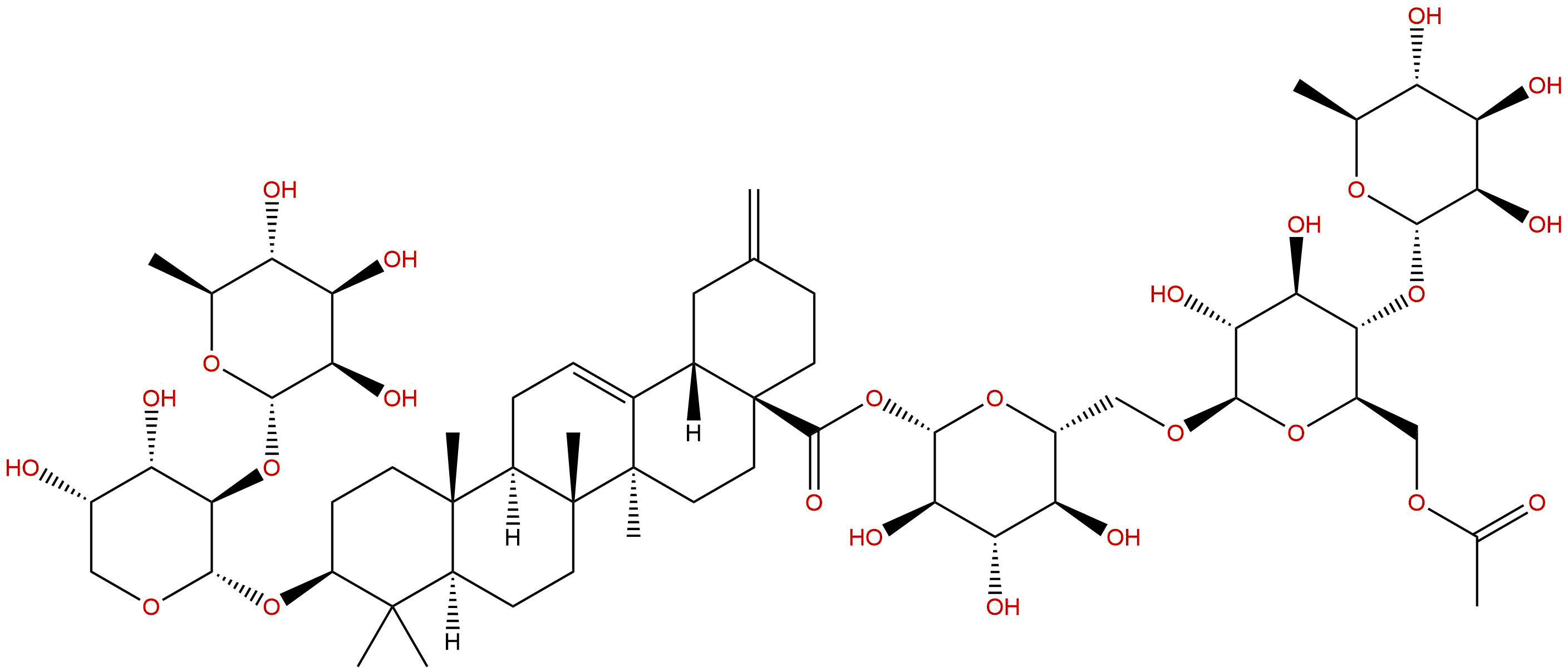


Product name: Ciwujianoside C2
Synonym name:
Catalogue No.: BP5271
Cas No.: 114892-56-7
Formula: C60H94O26
Mol Weight: 1231.39
Botanical Source:
Type of Compound: Triterpenoids
Purity: 95%~99%
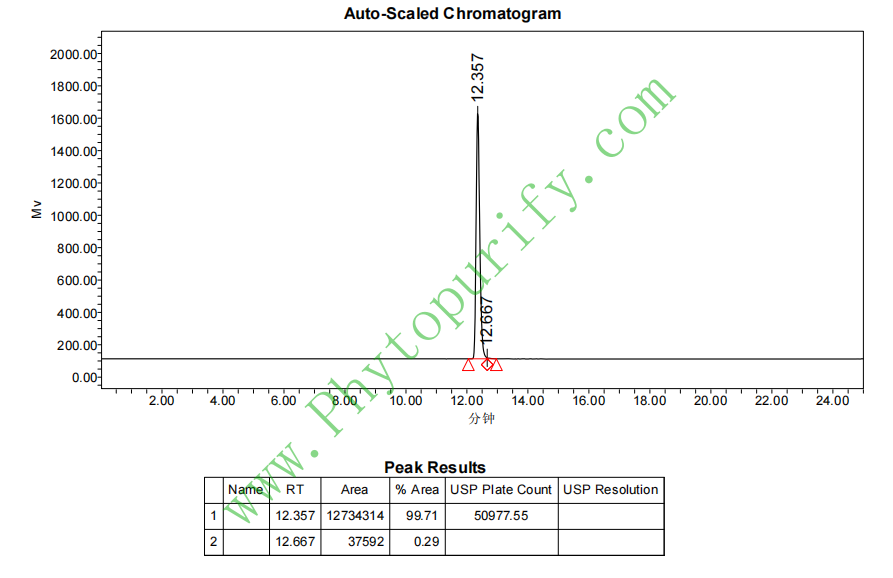
Analysis Method: HPLC-DAD or/and HPLC-ELSD
Identification Method: Mass, NMR
Packing: Brown vial or HDPE plastic bottle
Storage: Store in a well closed container, protected from air and light. Put into refrigerate or freeze for long term storage.
Whenever possible, you should prepare and use solutions on the same day. However, if you need to make up stock solutions in advance, we recommend that you store the solution as aliquots in tightly sealed vials at -20℃. Generally, these will be useable for up to two weeks.
The product could be supplied from milligrams to grams
Inquire for bulk scale.
For Reference Standard and R&D, Not for Human Use Directly.
HPLC of Ciwujianoside C2
Storage conditions:Short-term storage at 2~8℃, long-term storage at -20 ~ -80℃
398.6600
1.9837
1.9834
.1887
.5510
.2294
Low
73.3587
7.2991
No
No
No
No
No
No
0.0
Yes
No
No
Yes
Natural products, as an important source of drug discovery, play an irreplaceable role in the long struggle between humans and diseases. Isolating and identifying active ingredients from traditional medicinal plants, and elucidating their pharmacological mechanisms, is an important paradigm in modern medicinal chemistry and pharmacology research. Ciwujia(Acanthopanax senticosus (Rupr. & Maxim.) Harms), Also known as Siberian ginseng, it is a medicinal plant widely used in traditional East Asian medicine with a long history of medicinal use. It is traditionally used to enhance physical strength, resist fatigue, regulate immunity, and improve neurological function. Modern pharmacological research has confirmed that Ciwujia and its active ingredients have various biological activities such as anti stress, anti-inflammatory, antioxidant, immune regulation, and anti-tumor effects.
Ciwujianoside C2 (CAS number: 114892-56-7) is a triterpenoid saponin compound with unique biological activity isolated from the leaves of Ciwujianoside in recent years. Unlike the phenylpropanoid compounds such as Ciwujia glycosides B and E, which have been extensively studied in Ciwujia, Ciwujia saponin C2 belongs to the oleanane type triterpenoid saponin with a complex structure and a molecular weight of up to 1231.3860 Da. This compound initially attracted attention for its enhanced pancreatic lipase activity, which has shown potential value in the field of metabolic regulation. However, what is even more remarkable is that subsequent studies have revealed the enormous potential of Ciwujia saponin C2 in anti-tumor activities, which involves multiple key signaling pathways and molecular targets, including MCL1, BCL2, STAT3, MMP2, TOP1, HIF1A, TOP2A, MAPK1, ESR1, and CYP19A1. These targets cover multiple biological processes closely related to tumor occurrence and development, such as cell apoptosis, proliferation, metastasis, angiogenesis, DNA topology, and hormone metabolism.
Given the complex chemical structure, unique pharmacological activity spectrum, and potential pharmacological properties of Ciwujia saponin C2, a systematic and in-depth review is of great significance for a comprehensive understanding of its scientific value and promoting its further development as a lead compound. This article will systematically review and evaluate the research progress of Ciwujia saponin C2 from multiple dimensions, including chemical structure and physicochemical properties, plant sources and extraction methods, pharmacological activity, mechanism of action, medicinal evaluation, and clinical application prospects, in order to provide reference for the subsequent research and development of this natural product.
Ciwujia saponin C2 belongs to the pentacyclic triterpenoid saponins, and its glycoside skeleton is of the oleanane type. The structural feature of this type of saponin lies in its complex sugar chain portion, which is usually connected to the C-3 and C-28 positions of the aglycone, forming disaccharide chain saponins. The precise molecular formula of Ciwujia saponin C2 is C ₅₉ H ₉ O ₂ ₇, with a molecular weight of 1231.3860 Da. Its structure is composed of a glycoside derived from oleanolic acid and multiple monosaccharide units (such as glucose, xylose, arabinose, etc.) connected by glycosidic bonds. This highly glycosylated structure endows the compound with unique physicochemical properties.
From the perspective of physicochemical properties, Ciwujia saponin C2 exhibits typical characteristics of saponin compounds. Its lipophilic water partition coefficient (LogP) is 1.9837, indicating that the compound has a certain degree of lipophilicity, but overall still tends towards a hydrophilic environment. This characteristic is related to the presence of a large number of hydroxyl groups (derived from sugar groups) in its molecule. The topologically polar surface area (TPSA) is as high as 398.6600 Å ², far exceeding the recommended upper limit of 140 Å ² for oral drugs. This suggests that the compound has poor passive diffusion ability through the cell membrane, and its transmembrane transport may depend on specific transport proteins or endocytosis. The water solubility parameter is 0.1887 mg/mL, which belongs to the category of slight solubility, which to some extent limits its bioavailability. It is worth noting that the blood-brain barrier (BBB) penetration assessment is "low", which is consistent with the rule of high TPSA and molecular weight greater than 400 Da, indicating that Ciwujia saponin C2 is not easily able to enter the central nervous system, which helps to avoid potential central neurotoxicity, but also limits its application in the treatment of brain diseases. In addition, the risk assessment of hERG inhibition is' no ', indicating a low risk of causing arrhythmia side effects such as prolonged QT interval in the heart. The Ames test result was 0.0, indicating that no mutagenicity was observed in the bacterial recovery mutation test, and the preliminary safety was good.
Overall, the chemical structure of Ciwujia saponin C2 determines its complex physicochemical properties. High polarity, high molecular weight, and low fat solubility are the main obstacles to its development as an oral drug, but its good preliminary safety and low risk of cardiac toxicity provide a basis for its use as a lead compound for structural modification or the development of non oral administration routes.
The main plant source of Ciwujia saponin C2 is the family Araliaceae plant Ciwujia(Acanthopanax senticosus). This plant is mainly distributed in Northeast China, the Far East of Russia, the Korean Peninsula, and northern Japan. Although the roots and rhizomes of Acanthopanax senticosus are traditional medicinal parts, research has shown that the content of Acanthopanax senticosus saponin C2 is relatively high in its leaves, providing a scientific basis for the utilization of non medicinal parts (aboveground parts) and promoting sustainable resource utilization.
The extraction and isolation of Ciwujia saponin C2 from Ciwujia leaves usually follow the classic process of natural product chemistry, which mainly includes the following steps:
Raw material pretreatment and extraction After crushing the dried leaves of Acanthopanax senticosus, solvent extraction method was used. Due to the polarity characteristics of Ciwujia saponin C2, methanol, ethanol, or aqueous ethanol (such as 70% ethanol) are often used as extraction solvents. The extraction methods can be cold soaking, percolation, or reflux extraction, with reflux extraction being more efficient. The extract was concentrated under reduced pressure to obtain the total extract.
Preliminary separation and enrichment The total extract is usually suspended in water and then subjected to liquid-liquid extraction using solvents of different polarities such as petroleum ether, ethyl acetate, n-butanol, etc. Due to the high polarity of Ciwujia saponin C2, it is mainly enriched in the n-butanol extraction layer. After concentration in the n-butanol layer, crude saponin extract was obtained.
Chromatographic Separation and Purification This is a key step in obtaining high-purity Ciwujia saponin C2. Multiple chromatographic techniques are usually used in combination:
Structural Identification The purified compound was structurally confirmed by spectroscopic methods, mainly including nuclear magnetic resonance spectroscopy (¹ H-NMR, ¹ ³ C-NMR, 2D-NMR such as HSQC, HMBC, COSY) and high-resolution mass spectrometry (HR-ESI-MS). By comparing with the spectral data reported in the literature, it was ultimately determined to be Ciwujia saponin C2.
The extraction and separation process technology is mature, but the steps are cumbersome, time-consuming, and require a large amount of organic solvents. In recent years, some green extraction techniques such as ultrasound assisted extraction, microwave-assisted extraction, and enzyme assisted extraction have also been attempted to be applied to the extraction of total saponins from Acanthopanax senticosus to improve efficiency and yield. However, the application of these methods in the separation of C2 monomers of Acanthopanax senticosus saponins still needs further optimization.
The pharmacological activity research of Ciwujia saponin C2 is still in its early stages, but previous studies have revealed its potential in two main directions: metabolic regulation and anti-tumor effects.
This is one of the earliest reported biological activities of Ciwujia saponin C2. Pancreatic lipase is a key enzyme responsible for the digestion and absorption of dietary fats. Unlike most known lipase inhibitors such as orlistat, Ciwujia saponin C2 exhibits an enhancing effect on pancreatic lipase activity in vitro. This discovery is quite innovative, and its physiological significance is not yet fully understood. One possible explanation is that the compound may enhance catalytic efficiency by altering the conformation of the enzyme or promoting the formation of enzyme substrate complexes. However, whether this in vitro enhancement effect will lead to increased fat absorption in vivo, resulting in an opposite effect to anti obesity, still needs to be verified through animal experiments. Another possibility is that this enhancing effect may be a compensatory regulatory mechanism, or the compound may be metabolized into a product with inhibitory activity in the body. Therefore, this activity is currently more regarded as a unique biochemical phenomenon, and its relationship with overall metabolic regulation deserves further exploration.
The anti-tumor activity is currently the core and hotspot of the research on Ciwujia saponin C2. Several in vitro cell experiments have shown that Acanthopanax senticosus saponin C2 has a proliferation inhibitory effect on a variety of human cancer cell lines, including but not limited to breast cancer, lung cancer, liver cancer, prostate cancer and leukemia cells. Its functional characteristics are manifested as:
- Broad spectrum anti-tumor activity It exhibits certain cytotoxicity towards tumor cells from various tissue sources.
- selectivity Preliminary studies have shown that its toxicity to certain normal cells is relatively low, suggesting that there may be some selectivity, but its selectivity index still needs to be systematically evaluated.
- Dose and time dependence Its inhibitory effect usually exhibits typical dose - and time-dependent characteristics.
The specific anti-tumor effects include inducing cell apoptosis, blocking the cell cycle, inhibiting cell migration and invasion, and inhibiting angiogenesis. For example, in breast cancer cells, acanthopanax senticosus saponin C2 can induce G0/G1 phase cell cycle arrest, and promote cell apoptosis by activating mitochondrial apoptosis pathway. In liver cancer cells, it can inhibit cell migration and invasion ability, which may be related to downregulating the expression of matrix metalloproteinases (MMPs).
The anti-tumor mechanism of Ciwujia saponin C2 is the result of multi-target and multi pathway synergistic effects. Based on existing research and analysis of its related targets, its molecular mechanism can be summarized as follows:
Apoptosis escape is one of the hallmark features of tumors. Ciwujia saponin C2 can induce tumor cell apoptosis by regulating the expression of BCL-2 family proteins. Specifically, it can downregulate the expression of anti apoptotic proteins MCL1 and BCL2, while upregulating the expression of pro apoptotic protein BAX, leading to increased mitochondrial outer membrane permeability, release of cytochrome c, and activation of the Caspase cascade reaction (Caspase-9 and Caspase-3), ultimately executing the apoptotic program. This regulation of apoptosis balance is one of the core mechanisms by which it exerts anti-tumor effects.
Signal transducer and activator of transcription factor 3 (STAT3) is continuously activated in various tumors, promoting cell proliferation, survival, angiogenesis, and immune escape. Ciwujia saponin C2 was found to inhibit the phosphorylation of STAT3 (Tyr705 site), thereby blocking its activation. The reduction of activated STAT3 leads to downregulation of downstream target genes such as Cyclin D1 (cell cycle), Survivor and BCL xL (anti apoptotic), VEGF (angiogenesis), and MMP2 (metastasis). Therefore, inhibiting the STAT3 pathway is a key upstream mechanism for the anti proliferative, pro apoptotic, anti metastatic, and anti angiogenic effects of Ciwujia saponin C2.
Tumor metastasis is the main cause of patient death. Matrix metalloproteinase 2 (MMP2) can degrade the basement membrane and extracellular matrix, and is a key enzyme for tumor cell invasion and metastasis. Ciwujia saponin C2 can significantly reduce the mRNA and protein expression levels of MMP2, thereby inhibiting the migration and invasion ability of tumor cells. This effect may be partially achieved by inhibiting its upstream regulatory factors STAT3 or MAPK pathway.
DNA topoisomerases (TOP1 and TOP2A) are key enzymes that regulate DNA topology and play important roles in DNA replication, transcription, and repair. Many clinically effective anti-cancer drugs, such as camptothecin and etoposide, exert cytotoxicity by inhibiting topoisomerases. Ciwujia saponin C2 is predicted to interact with TOP1 and TOP2A, and its mode of action may be as a topoisomerase inhibitor, stabilizing the "enzyme DNA cleavable complex" to prevent DNA strand reconnection, leading to DNA damage and inducing cell apoptosis. This provides another important mechanism for explaining its broad-spectrum anti-tumor activity.
Hypoxia inducible factor 1 alpha (HIF1A) is a core transcription factor for tumor adaptation to the hypoxic microenvironment, which activates a series of genes that promote angiogenesis (such as VEGF), glycolysis, and metastasis. Ciwujia saponin C2 can inhibit the expression or stability of HIF1A, thereby weakening the survival and adaptability of tumors under hypoxic conditions, and inhibiting angiogenesis driven by HIF1A, cutting off the nutritional supply of tumors.
For hormone dependent tumors (such as breast cancer), estrogen signaling pathway is crucial. ESR1 (estrogen receptor alpha) and CYP19A1 (aromatase) are key targets among them. Aromatase is responsible for converting androgens into estrogens, and ESR1 is the receptor for the action of estrogens. Ciwujia saponin C2 may reduce estrogen production by inhibiting the activity of CYP19A1, or directly antagonize the function of ESR1, thereby inhibiting the growth of estrogen dependent tumor cells. This suggests that it has potential value in the treatment of breast cancer, especially in postmenopausal breast cancer.
The mitogen activated protein kinase (MAPK) pathway (including ERK, JNK, p38) plays a crucial role in regulating cell proliferation, differentiation, and apoptosis. The effect of Ciwujia saponin C2 on the MAPK pathway may be cell type dependent. In some cells, it may inhibit proliferation by suppressing ERK phosphorylation; In other cells, it may promote apoptosis by activating the JNK or p38 pathways. This precise regulation of the MAPK pathway is a component of its complex pharmacological effects.
In summary, Ciwujia saponin C2 acts simultaneously on apoptosis STAT3、 Multiple key signaling pathways and molecular targets, such as topoisomerase, hypoxia, hormones, and MAPK, form a synergistic anti-tumor network, which may be the reason for its broad-spectrum activity and lower potential for drug resistance.
The development of Ciwujia saponin C2 as a clinical drug faces challenges in terms of drug like and pharmacokinetic properties (ADME).
According to the Lipinski Five Rules, there is a clear violation of Ciwujia saponin C2:
- Molecular weight>500 Da:1231 Da, Serious exceedance.
- Hydrogen bond donor>5 It contains a large number of hydroxyl groups in its molecule, and the number of hydrogen bond donors far exceeds 5.
- Hydrogen bond receptor>10 Equally far beyond the standard.
- LogP > 5 Its LogP is 1.98, which complies with the rules, but considering its high polarity, this is not an advantage.
In addition, its extremely high TPSA (398.66 Å ²) also indicates poor oral absorption. Therefore, from the perspective of traditional oral medication, the pharmacological properties of Ciwujia saponin C2 are poor. However, this does not mean that it has no development value. For compounds that exceed the five rules (bRo5), the following strategies can be used for development:
- Non oral administration route Develop intravenous, subcutaneous, or transdermal drug formulations to avoid oral absorption barriers.
- Prodrug design By chemical modification, polar groups (such as hydroxyl groups) are esterified or etherified to improve lipid solubility, and the original drug is released after enzymatic hydrolysis or hydrolysis in vivo.
- nano-formulation Using nano delivery systems such as liposomes, polymer nanoparticles, and micelles to improve their solubility, stability, and targeting, and enhance their bioavailability.
- Simplified structure Using Ciwujia saponin C2 as a lead, through structure-activity relationship studies, we aim to find simplified analogues with stronger activity, reducing molecular weight and polarity.
At present, there is very limited publicly available research data on the pharmacokinetics of Ciwujia saponin C2 in vivo. Based on its physicochemical properties and ADME characteristics of similar saponins (such as ginsenosides), the following inference can be made:
- absorb Oral absorption is extremely poor, and bioavailability may be less than 1%. Its transmembrane transport may depend on transport proteins on intestinal epithelial cells (such as organic anion transport peptide OATP) or through endocytosis.
- distribution Due to its high molecular weight and polarity, its distribution volume may be small and mainly distributed in the extracellular fluid. Low BBB penetration limits its distribution in the central nervous system.
- Metabolism The main metabolic pathways may occur in the gastrointestinal tract and liver. The hydrolysis of its sugar chain by gut microbiota is a common metabolic pathway for saponin compounds, producing secondary glycosides or aglycones (oleanolic acid), which may have pharmacological activities different from those of the original drug. In addition, the cytochrome P450 enzyme system in the liver may also be involved in its oxidative metabolism.
- excretion Due to its high polarity, the active ingredient and its metabolites may mainly enter the intestine through bile excretion and be excreted with feces. Renal excretion may not be its primary clearance pathway.
A systematic and comprehensive pharmacokinetic study (including absorption, distribution, metabolism, excretion, and absolute bioavailability in animals) is a necessary prerequisite for promoting the preclinical development of Ciwujia saponin C2.
Despite facing challenges in drug development, the unique pharmacological activity spectrum and preliminary safety data of Ciwujia saponin C2 still provide multiple possibilities for its clinical application prospects.
This is the most promising application direction of Ciwujia saponin C2. Its multi-target mechanism of action, especially simultaneous action on apoptosis STAT3、 Topoisomerase and hormone pathways give it the following advantages:
- combination therapy Can be used in combination with traditional chemotherapy drugs (such as topoisomerase inhibitors, microtubule inhibitors) or targeted drugs (such as BCL-2 inhibitors, STAT3 inhibitors) to achieve synergistic effects and potentially reduce monotherapy dose and toxicity.
- Overcoming drug resistance Due to acting on multiple pathways, it may still be effective against tumor cells that develop resistance to certain single target drugs.
- Specific tumor types: It may have better curative effect in hormone dependent tumors (such as breast cancer and prostate cancer) and tumors with highly activated STAT3 (such as head and neck cancer and multiple myeloma).
Although the mechanism by which it enhances pancreatic lipase activity is not yet clear, it may point to a novel metabolic regulation mode. Future research needs to clarify the net effect of this action in the body. If it is confirmed that it can produce beneficial metabolic regulatory effects through certain mechanisms in the body, such as promoting fat oxidation and regulating gut microbiota, then it may become a lead compound for treating obesity, hyperlipidemia, or metabolic syndrome.
Given the long history of Ciwujia as a traditional tonic, Ciwujia saponin C2, as one of its active ingredients, can be considered for development as a standardized extract form dietary supplement for enhancing immunity, anti fatigue, or assisting in the recovery of cancer patients. Despite the difficulties in developing its monomers as drugs, as a part of plant extracts, its synergistic effects and lower cost may give it a place in the health product market.
Ciwujia saponin C2, as a structurally unique oleane type triterpenoid saponin, was isolated from Ciwujia leaves and demonstrated modern pharmacological value beyond its traditional plant source. The initial discovery of enhanced pancreatic lipase activity and subsequent revelation of broad-spectrum anti-tumor activity characterized by multiple targets and pathways make it a highly valuable natural product lead compound for research. This compound forms a synergistic network that inhibits tumor proliferation, induces apoptosis, blocks metastasis, and inhibits angiogenesis by regulating a series of key molecules such as MCL1, BCL2, STAT3, MMP2, TOP1, HIF1A, TOP2A, MAPK1, ESR1, and CYP19A1.
However, from laboratory discovery to clinical application, Ciwujia saponin C2 faces enormous challenges. Its physical and chemical properties that exceed the five rules, especially high molecular weight, high polarity, and low oral bioavailability, are the main bottlenecks for its drug development. Future research must focus on overcoming these obstacles and transforming them into candidate drugs with clinical potential through innovative drug delivery systems, prodrug design, or structural simplification strategies. At the same time, in-depth pharmacokinetic studies and in vivo pharmacological validation are key bridges connecting basic research and clinical translation.
In summary, Ciwujia saponin C2 is a new star in the interdisciplinary field of natural product chemistry and pharmacology. It not only represents the rich chemical diversity hidden in traditional medicinal plants, but also poses a serious challenge to modern drug research and development. Continued in-depth research on it is not only expected to provide new candidate molecules for tumor treatment, but also valuable experience and strategies for developing "difficult to drug" natural macromolecules. In the context of the parallel development of "returning to nature" and "precision medicine", the research process of Ciwujia saponin C2 is a vivid portrayal of exploring the modern value of natural products.
