


Synonym name: Yemuoside YM10
Catalogue No.: BP0372
Cas No.: 114902-16-8
Formula: C58H92O25
Mol Weight: 1189.35
Botanical Source: Stauntonia chinensis
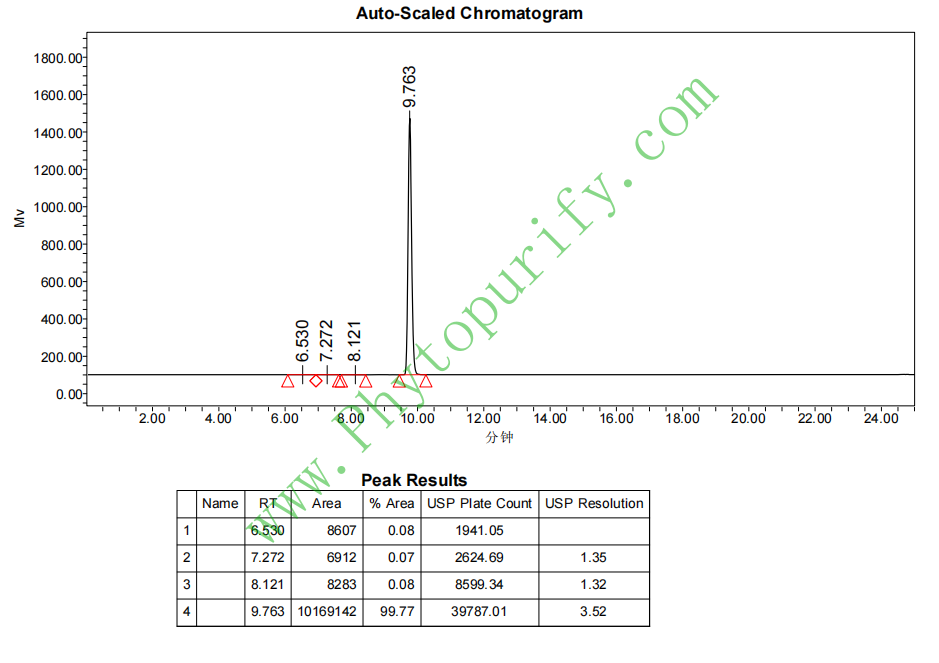
Purity: 95%~99%
Analysis Method: HPLC-DAD or/and HPLC-ELSD
Identification Method: Mass, NMR
Packing: Brown vial or HDPE plastic bottle
Can be supplied from milligrams to grams.
For Reference Standard and R&D, Not for Human Use Directly.
Inquire for bulk scale.
HPLC of Ciwujianoside B
Storage conditions:Short-term storage at 2~8℃, long-term storage at -20 ~ -80℃
Ciwuqianoside B is a natural triterpenoid saponin compound isolated from Acanthopanax senticosus, which has attracted much attention in recent years due to its significant radiation protection and cognitive enhancement effects. As an orally active ingredient, Ciwujia saponin B can penetrate the blood-brain barrier, exerting multiple pharmacological effects of neuroprotection and immune regulation, demonstrating potential application value in the treatment of radiation injury and the prevention and treatment of neurodegenerative diseases. This article provides a systematic review of the chemical structure, sources, pharmacological activity, mechanism of action, and pharmacological evaluation of saponins B from Acanthopanax senticosus, aiming to provide theoretical basis and research direction for its further drug development and clinical translation.
The molecular formula of Ciwujia saponin B is C58H94O26, with a molecular weight of 1205.33, and it belongs to the class of high molecular weight triterpenoid saponins. Its structure is composed of a pentacyclic triterpenoid parent nucleus and multiple sugar residues connected by glycosidic bonds, with abundant hydroxyl and sugar groups, resulting in its high hydrophilicity. In terms of physical and chemical properties, the LogP value of Ciwujia saponin B is about -3.0, indicating its strong hydrophilicity and good water solubility; The polar surface area (TPSA) is as high as 416.79 Å ², and the number of hydrogen bond acceptors is 25, indicating its high molecular polarity, which may affect its membrane permeability and bioavailability. Despite its large molecular weight and strong polarity, experiments have shown that it has the ability to penetrate the blood-brain barrier, suggesting that it may achieve brain distribution through specific transport mechanisms.
Ciwujia saponin B mainly exists in the roots, stems, and leaves of Ciwujia. Ciwujia is a plant of the genus Ciwujia in the family Araliaceae, widely distributed in Northeast China and the Far East of Russia. It is used in traditional Chinese medicine to enhance physical strength, resist fatigue, and regulate immunity. The extraction of saponins B from Acanthopanax senticosus is usually carried out by alcohol extraction, using 70% -95% ethanol or methanol for reflux extraction of dried plant materials. The extraction solution is purified through concentration, liquid-liquid distribution, and multi-step chromatographic separation (such as silica gel column chromatography, reverse phase high performance liquid chromatography HPLC) to obtain high-purity saponins of Acanthopanax senticosus. In recent years, the application of ultrasound assisted extraction and high-performance membrane separation technology has improved the extraction efficiency and purity, providing technical support for large-scale preparation.
Research on the application of Ciwujia saponin B in radiation protection has shown that it has significant cellular protective effects. Both in vitro and in vivo experiments have shown that Ciwujia saponin B can effectively reduce radiation-induced DNA damage, alleviate cell cycle arrest and apoptosis. It regulates the ratio of apoptosis related proteins Bax/Bcl-2, reduces the expression of pro apoptotic factors, protects bone marrow cells from radiation damage, promotes bone marrow cell proliferation, and restores hematopoietic function. In addition, Ciwujia saponin B can downregulate the activity of nuclear factor NF - κ B, inhibit radiation-induced inflammatory reactions, and alleviate tissue damage.
The research on the neuroprotection and cognitive function of Ciwujia saponin B has also made positive progress. Experimental data shows that saponins B from Acanthopanax senticosus can enhance the object recognition and memory abilities of normal mice, exhibiting a good memory enhancement effect. In an in vitro neuronal culture model, saponins B from Acanthopanax senticosus promote dendritic extension in primary cortical neurons, suggesting that it may improve cognitive function by promoting neural plasticity. This effect has potential significance for the prevention and treatment of neurodegenerative diseases such as Alzheimer's disease.
Ciwujia saponin B also exhibits multi-target immunomodulatory activity. Related studies have shown that it can regulate the expression of various immune related factors, including TLR4, STAT3, IL-2, NF - κ B, TGF - β 1, CTLA4, STAT4, IL-10, FOXP3, and IFN - γ. By regulating these signaling pathways, Ciwujia saponin B plays an important role in regulating immune balance, inhibiting inflammatory reactions, and promoting immune cell function, providing a theoretical basis for its application in immune related diseases.
The pharmacological effects of Ciwujia saponin B involve multiple signaling pathways and molecular targets, mainly including:
Inhibition of NF - κ B signaling pathway Ciwujia saponin B can inhibit the activation of NF - κ B, reduce the expression of inflammatory factors, and alleviate tissue damage caused by radiation and inflammation.
Adjusting the Bax/Bcl-2 ratio By reducing the expression of pro apoptotic protein Bax and increasing the level of anti apoptotic protein Bcl-2, Ciwujia saponin B inhibits cell apoptosis and protects bone marrow and nerve cells.
Regulation of immune regulatory factors Ciwujia saponin B affects the expression of immune regulatory factors such as TLR4, STAT3, IL-2, TGF - β 1, regulates immune response, and promotes immune homeostasis.
Promote neural plasticity By promoting dendritic extension and synaptic formation in neurons, saponins B from Acanthopanax senticosus enhance the plasticity of neural networks and improve cognitive function.
Antioxidant and DNA Protection Ciwujia saponin B may reduce radiation-induced oxidative stress and protect DNA from damage through antioxidant mechanisms.
The combined effect of these mechanisms results in multiple effects of Ciwujia saponin B in radiation protection and cognitive function improvement.
Despite the large molecular weight and strong polarity of Ciwujia saponin B, which theoretically is not conducive to oral absorption and blood-brain barrier penetration, experiments have shown that it has good oral activity and brain distribution ability. Its LogP value is -3.0, indicating strong hydrophilicity, with a TPSA of up to 416.79 Å ² and a large number of hydrogen bond receptors, all suggesting that it may mediate absorption and brain transport through specific transport proteins.
At present, there is no clear safety data regarding the hepatotoxicity, cardiotoxicity, hERG channel inhibition, and genotoxicity (Ames test) of saponins B from Acanthopanax senticosus, and further systematic evaluation is needed. Pharmacokinetic studies have shown that Ciwujia saponin B has a long half-life in vivo and can maintain stable plasma concentrations, making it suitable for oral administration.
In addition, the high polarity and high molecular weight of Ciwujia saponin B may limit its bioavailability, and in the future, its pharmacokinetic performance can be improved through formulation optimization (such as nanocarrier and liposome encapsulation).
Ciwujia saponin B, as a natural radiation protective agent and cognitive enhancer, has broad clinical application prospects. It has shown significant therapeutic effects in the protection and repair of radiation damage in the hematopoietic system, and is suitable as an adjuvant therapy for radiotherapy patients and those exposed to nuclear radiation. Meanwhile, the promoting effect of Ciwujia saponin B on cognitive function provides a new therapeutic approach for neurodegenerative diseases such as Alzheimer's disease and Parkinson's disease.
Future research should focus on the following aspects:
safety evaluation The system conducts safety studies on liver toxicity, cardiac toxicity, and genetic toxicity to ensure the safety of clinical applications.
Pharmacokinetic optimization Improve oral bioavailability and brain distribution efficiency through drug formulation technology.
In depth analysis of the mechanism of action Using multi omics techniques and molecular biology methods to further clarify its molecular targets and signaling pathway regulatory network.
Clinical trial design Conduct multicenter, randomized, double-blind clinical trials to validate its efficacy and safety in radiation protection and cognitive impairment treatment.
Combination therapy research Explore the synergistic effect of Ciwujia saponin B with other drugs to enhance therapeutic efficacy.
In summary, Ciwujia saponin B, as a natural product with unique pharmacological activity, has the potential to become a new type of radiation protection and neuroprotective drug.
Ciwujia saponin B, as an important active ingredient in Ciwujia, has become a hot topic in natural product pharmacology research due to its significant radiation protection and cognitive enhancement effects. Its multi-target and multi mechanism pharmacological properties provide new strategies for radiation damage repair and prevention and treatment of neurological diseases. Although its pharmacological and safety data are not yet complete, with the deepening of research and technological progress, Ciwujia Saponin B is expected to become a new natural medicine with clinical application value. Future research needs to focus on mechanism analysis, pharmacokinetic optimization, and clinical validation to promote its transition from laboratory to clinical use and benefit more patients.
