


Product Name: Dihydroartemisinic acid
Synonym name: Dihydro-Artmisinic Acid
Catalogue No.: BP3702
Cas No.: 85031-59-0
Formula: C15H24O2
Mol Weight: 236.355
Botanical Source: Artemisia annua
Purity: 95%~99%
Analysis Method: HPLC-DAD or/and HPLC-ELSD
Identification Method: Mass, NMR
Packing: Brown vial or HDPE plastic bottle
Can be supplied from milligrams to grams. Inquire for bulk scale.
For Reference Standard and R&D, Not for Human Use Directly.
Description:
Dihydroartemisinic acid is a precursor to the antimalarial agent artemisinin.
References:
Proc Natl Acad Sci U S A. 2012 Jan 17;109(3):E111-8.
Production of amorphadiene in yeast, and its conversion to dihydroartemisinic acid, precursor to the antimalarial agent artemisinin.
Malaria, caused by Plasmodium sp, results in almost one million deaths and over 200 million new infections annually. The World Health Organization has recommended that artemisinin-based combination therapies be used for treatment of malaria. Artemisinin is a sesquiterpene lactone isolated from the plant Artemisia annua. However, the supply and price of artemisinin fluctuate greatly, and an alternative production method would be valuable to increase availability.
METHODS AND RESULTS:
We describe progress toward the goal of developing a supply of semisynthetic artemisinin based on production of the artemisinin precursor amorpha-4,11-diene by fermentation from engineered Saccharomyces cerevisiae, and its chemical conversion to Dihydroartemisinic acid, which can be subsequently converted to artemisinin. Previous efforts to produce artemisinin precursors used S. cerevisiae S288C overexpressing selected genes of the mevalonate pathway [Ro et al. (2006) Nature 440:940-943]. We have now overexpressed every enzyme of the mevalonate pathway to ERG20 in S. cerevisiae CEN.PK2, and compared production to CEN.PK2 engineered identically to the previously engineered S288C strain. Overexpressing every enzyme of the mevalonate pathway doubled artemisinic acid production, however, amorpha-4,11-diene production was 10-fold higher than artemisinic acid. We therefore focused on amorpha-4,11-diene production. Development of fermentation processes for the reengineered CEN.PK2 amorpha-4,11-diene strain led to production of > 40 g/L product.
CONCLUSIONS:
A chemical process was developed to convert amorpha-4,11-diene to Dihydroartemisinic acid, which could subsequently be converted to artemisinin. The strains and procedures described represent a complete process for production of semisynthetic artemisinin.
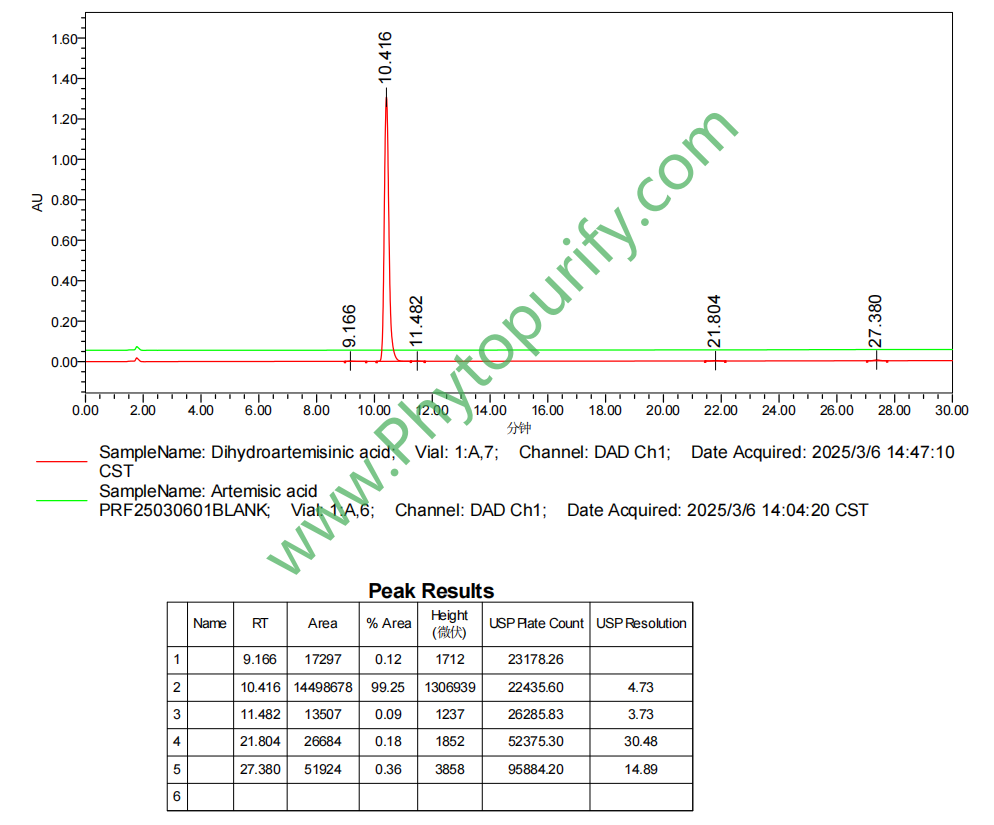
HPLC of Dihydroartemisinic acid
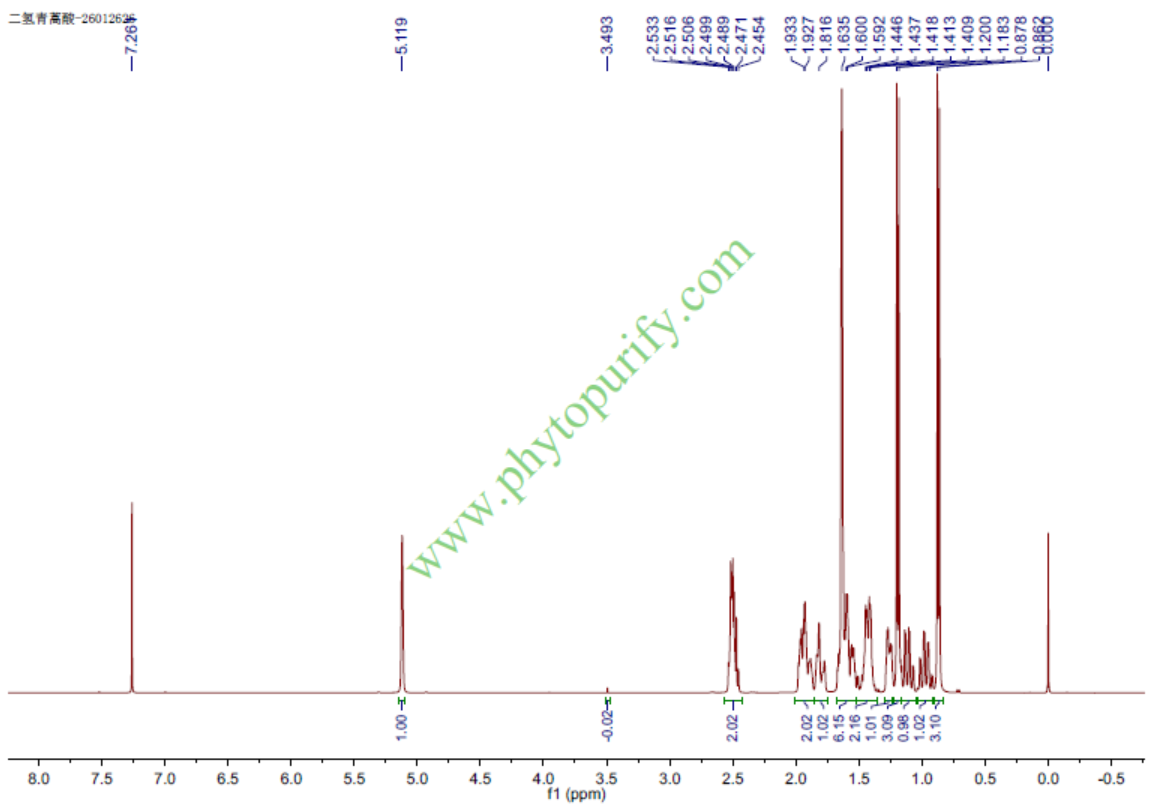
HNMR of Dihydroartemisinic acid
Storage conditions:Short-term storage at 2~8℃, long-term storage at -20 ~ -80℃
37.3000
3.8975
1.9956
.1588
6.5061
7.7242
High
91.7709
4.0804
No
Yes
No
No
No
No
0.0
No
No
Yes
No
Dihydroartemisinic acid (DHAA), also known as dihydroartemisinin acid, is a naturally occurring sesquiterpene monocarboxylic acid compound with a CAS number of 85031-59-0. It occupies a pivotal position in modern pharmaceutical research, with its core identity being The key biosynthetic precursor of the revolutionary antimalarial drug artemisinin Artemisinin and its derivatives (collectively referred to as artemisinin based drugs) are the core components of artemisinin combination therapies (ACTs) recommended by the World Health Organization as first-line anti malaria therapies, saving millions of lives worldwide. Their discoverer, researcher Tu Youyou, was awarded the Nobel Prize in Physiology or Medicine in 2015 for this achievement.
Dihydroartemisinin acid mainly comes from Asteraceae plants Artemisia annua L In plants, it is catalyzed by the mevalonate pathway and sesquiterpene synthase, and ultimately converted into artemisinin with a unique peroxide bridge structure under light and oxidative conditions. This transformation process is not only a miraculous creation in nature, but also a research hotspot in the fields of chemistry and biosynthesis. In addition to its role as a "bridge" as a precursor, recent studies have gradually revealed that dihydroartemisic acid itself also exhibits significant potential that cannot be ignored Direct biological activity Especially in the fight against drug-resistant malaria parasites, it has shown potential. In depth exploration of it not only helps optimize the production process of artemisinin (such as synthetic biology and metabolic engineering), but also provides new ideas for developing novel antimalarial and other therapeutic drugs based on its structure. This article will systematically analyze the scientific connotation of this important natural product from multiple dimensions such as chemistry, pharmacology, and medicinal properties.
The molecular formula of dihydroartemisinin acid is C15H24O2 The molecular weight is 236.3550 g/mol Its structure belongs to the sesquiterpene class, with a decahydronaphthalene skeleton connected to a propionic acid side chain. Specifically, it can be described as being replaced by a (1S, 4R, 4aS, 8aR) -4,7-dimethyl-1,2,3,4,4a, 5,6,8a-octahydronaphthalen-1-yl group at position 2 of propionic acid. Its SMILES string (CC1=C [C @ H] 2)C@@HC@HCC[C@H]2C@@H C (=O) O accurately describes its atomic connections and stereochemistry, demonstrating that it has multiple chiral centers, and its stereoconfiguration is crucial for its biological activity.
Analyzing its physicochemical properties from the parameters of drug properties:
* fat-soluble: Calculated The LogP value is 3.90 This indicates that the compound has moderate to strong lipophilicity, which is beneficial for its penetration of cell membranes, but may also affect its water solubility.
* Water solubility The predicted water solubility is approximately 0.16 mg/mL It belongs to slightly soluble, which is consistent with a higher LogP value.
* Polar Surface Area:The topological polar surface area (TPSA) is 37.30 Å ²A relatively small value usually indicates good membrane permeability.
* acidity and alkalinity The carboxyl group in its structure makes it a weak acid, which may partially dissociate at physiological pH The LogD (distribution coefficient at pH 7.4) is 2.00 Significantly lower than LogP, indicating that its ionized form reduces apparent lipid solubility under physiological conditions.
These basic physicochemical parameters collectively depict a typical Drug like small molecules Profile: Moderate molecular weight (<500), with some lipid solubility but not too high, small polar surface area, indicating good membrane permeability potential, laying the foundation for its subsequent biological activity.
Dihydroartemisinin acid exists almost exclusively in Artemisia annua L In the middle. Qinghao, also known as Huanghuahao, is an annual herbaceous plant of the Artemisia genus in the Asteraceae family, widely distributed in temperate and subtropical regions of Eurasia. In traditional Chinese medicine, the medicinal history of Artemisia annua is long-standing. The earliest can be traced back to Ge Hong's "Emergency Prescriptions for Elbow Reserve" in the Eastern Jin Dynasty, which recorded that "one grip of artemisia annua, two liters of water soaked, twisted into juice, and taken as much as possible" was used to treat various symptoms of cold and heat (typical symptoms of malaria). Afterwards, medical books from various dynasties such as "Compendium of Materia Medica" were included, mainly used for clearing heat, relieving summer heat, and stopping malaria.
However, traditional water decoction or ethanol extraction methods cannot efficiently obtain artemisinin with antimalarial activity because artemisinin is thermally unstable, and traditional usage does not recognize the critical role of the peroxide bridge structure. It was not until the 1970s that the Chinese scientist Tu Youyou's team was inspired by the ancient literature of "grinding juice" and used low-temperature ether extraction to successfully isolate artemisinin crystals, ushering in a new era of modern antimalarial drugs. The biosynthetic pathway of artemisinin in Artemisia annua plants has been largely elucidated: farnesyl pyrophosphate (FPP) is catalyzed by sophoride synthase (ADS) to produce sophoride, which then undergoes a series of oxidation, reduction, and rearrangement reactions to ultimately produce artemisinin. But Dihydroartemisinin is the second to last key intermediate in this pathway Under the action of artemisinin synthase (or non enzymatic photooxidation reaction), the carbon carbon double bond at its end is oxidized, forming the unique peroxide bridge bond of artemisinin. Therefore, increasing the content of dihydroartemisinin in Artemisia annua is an important metabolic engineering strategy to enhance artemisinin production.
The core pharmacological activity association of dihydroartemisinin acid is against malaria Although it is not the final drug molecule itself, as a direct precursor of artemisinin, its research value is extremely high. More importantly, existing research suggests that dihydroartemisinin itself may also have inhibitory effects on malaria parasites, and its mechanism of action may be both related to and different from its final product artemisinin.
The classic mechanism of action of artemisinin based drugs is that in infected red blood cells, malaria parasites digest hemoglobin to produce high concentrations of ferrous ions (Fe ² ⁰⁺). The peroxide bridge in artemisinin is reduced and cleaved by Fe ² ⁰⁺, producing highly active free radicals (such as oxygen center free radicals and carbon center free radicals). These free radicals undergo alkylation and covalent binding with various proteins of the malaria parasite (such as PFATP6, histones, etc.), resulting in loss of protein function, membrane structure damage, and ultimately killing the malaria parasite.
Dihydroartemisinin acid does not contain peroxide bridges, so its action may not depend on iron mediated free radical activation. The target information prompted by the database (PFCRT, PFMDR1, PFDHFR, PFK13, PFATP6) provided us with clues. These targets are all Key proteins of Plasmodium falciparum:
* PFCRT (chloroquine resistance transporter) and PFMDR1 (multidrug resistance protein 1)Both are the main mediators for malaria parasites to develop resistance to classic antimalarial drugs such as chloroquine and mefloquine, responsible for pumping the drugs out of the site of action (food foam). Dihydroartemisinin may act as a substrate or regulator for these transporters, affecting their function and potentially reversing or delaying drug resistance.
* PFDHFR (dihydrofolate reductase)It is a target of anti folate drugs such as sulfadoxine pyrimethamine. Dihydroartemisinin may interfere with this enzyme in a way different from classical inhibitors, providing a new anti folate mode of action.
* PFK13 (Kelch13 protein)The genetic mutation is the main molecular marker of delayed clearance (i.e. partial resistance) of artemisinin based drugs. Studying the interaction between dihydroartemisinin and PFK13 can help understand the underlying mechanisms of artemisinin resistance and identify strategies to overcome it.
* PFATP6 (sarcoplasmic/endoplasmic reticulum calcium ATPase 6)It has been proposed as one of the main targets of artemisinin. Although dihydroartemisic acid does not have a peroxide bridge, its similar sesquiterpene skeleton may still be able to bind to this enzyme, interfering with the calcium ion homeostasis of malaria parasites through competitive or allosteric inhibition.
In summary, the anti malarial mechanism of dihydroartemisinin may be Multi targeted, non radical dependent It may exert a synergistic inhibitory effect by interfering with multiple links such as drug-resistant proteins, metabolic key enzymes, and ion balance proteins in malaria parasites. This multi-target characteristic has potential advantages in addressing the increasingly severe problem of malaria parasite drug resistance. In addition, there have been studies exploring its activity in other fields such as anti-inflammatory and anti-tumor, but anti malaria is still its most clear and important research direction.
Based on the provided pharmacological parameters, we can conduct a preliminary evaluation of the characteristics of dihydroartemisinin as a potential drug lead compound, and refer to it Lipinski's Rule of Five (Ro5) Measure:
Conclusion: Dihydroartemisinin acid fully complies with Lipinski's five rules It has a good chemical spatial basis for becoming an oral medication.
Further analysis of other key pharmacological parameters:
* Absorption and penetration:The predicted permeability of Caco-2 cells is 7.72 (× 10 ⁻⁶ cm/s)It belongs to highly permeable compounds.The predicted effective permeability coefficient (Peff) for humans is 6.51 (× 10 ⁻⁴ cm/s)It also supports its good intestinal absorption potential.
* distribution: Predict it The blood-brain barrier (BBB) penetration is "high"This suggests that it may have therapeutic potential for cerebral malaria (a dangerous complication of malaria), but it also means that attention needs to be paid to potential central nervous system side effects.The predicted plasma protein binding rate (PPB) is as high as 91.77%It indicates that it mainly binds to proteins in the blood, which may affect its free drug concentration and efficacy rate.
* Metabolism and toxicity:
* Ames test, chromosome aberration, hERG inhibition prediction are all negative/none/no Preliminary indication of it Low risk of genetic toxicity and cardiac toxicity。
*The prediction of skin sensitization (Skid_Sens) is "yes", indicating caution when developing topical formulations.
*Elevated serum alanine aminotransferase (Ser_ST) is predicted to be "yes", indicating There may be a potential risk of liver cell damage This is an aspect that needs to be focused on in the subsequent preclinical safety evaluation.
*The maximum recommended therapeutic dose (MRTD) prediction is' no ', which may be related to its predicted hepatotoxicity signal.
Overall, dihydroartemisinin acid Excellent performance in pharmacokinetic properties (ADME)Especially in terms of absorption and permeability prediction, it is very good and conforms to the rules of drug likeness. The main development risks may be concentrated in Potential liver toxicity and high plasma protein binding rate This needs to be improved through structural modifications (such as preparing prodrugs or derivatives) during the lead compound optimization stage.
At present, research on dihydroartemisinin acid mainly focuses on the following directions:
Application prospects and prospects Dihydroartemisinin is not just a precursor, it is moving from behind the scenes to the forefront. In the future, it is expected to achieve value breakthroughs in the following areas:
* As a stable and efficient intermediate for the production of artemisinin To ensure the safety of raw material supply for global antimalarial drugs.
* Develop a novel mechanism of action for antimalarial drugs based on the dihydroartemisinin framework Especially for the treatment of drug-resistant malaria where artemisinin combination therapy has failed.
* Build a multi-target drug combination for anti malaria with it as the core Through multi link collaborative attacks, delay the development of drug resistance.
In short, dihydroartemisic acid, as a precious molecule gifted by nature, has been constantly redefined in the continuous exploration of scientists for its value. From the invisible intermediates in ancient herbs to the new hope of modern pharmacy in combating drug-resistant malaria, its story is a model of extending the research value of natural products. With the continuous advancement of synthetic biology, structural biology, and medicinal chemistry technologies, dihydroartemisinin acid and its derivatives are bound to play a more important role in global public health and drug development.
