

Product name: β-Caryophyllene
Synonym name: trans-Caryophyllene
Catalogue No.: BPF0502
Cas No.: 87-44-5
Formula: C15H24
Mol Weight: 204.357
Botanical Source:
Physical Description: Oil
Type of Compound: Sesquiterpenoids
Purity: 95%~99%
Analysis Method: HPLC-DAD or/and HPLC-ELSD
Identification Method: Mass, NMR
Packing: Brown vial or HDPE plastic bottle
Storage: Store in a well closed container, protected from air and light. Put into refrigerate or freeze for long term storage.
Whenever possible, you should prepare and use solutions on the same day. However, if you need to make up stock solutions in advance, we recommend that you store the solution as aliquots in tightly sealed vials at -20℃. Generally, these will be useable for up to two weeks.
The product could be supplied from milligrams to grams, up to kilograms
Inquire for bulk scale.
Descriptions:
Trans-caryophyllene (TC), a component of essential oil found in many flowering plants, has shown its neuroprotective effects in various neurological disorders, TC has effect on kainic acid-induced seizure activity caused by oxidative stress and pro-inflammation, and significantly inhibits KA-induced generation of malondialdehyde, TC exert cerebral anti-inflammatory effects by mitigating the expression of proinflammatory cytokines, such as TNF-α and IL-1β; suggest that TC has a potential protective effect on chemical induced seizure and brain damage.[1]
Trans-caryophyllene and alpha-humulene from Salvia officinalis has cytotoxic activity in animal and human tumor cells.[2]
Trans-caryophyllene has anti-spasmodic activity on rat tracheal smooth muscle which could be explained, at least in part, by the voltage-dependent Ca2? channels blockade.[3]
Trans-caryophyllene can reduce both acute and chronic pain in mice, which may be mediated through the opioid and endocannabinoid systems.[4]
Trans-caryophyllene possesses anti-inflammatory and analgesic properties, has the prevention of leukopenia in an experimental chemotherapy model in Wistar rats, exerts anti-inflammatory effects in TNF-α-stimulated chondrocyte models.[5,6]
References:
[1] Liu H, Song Z, Liao D, et al. Neurochem Res, 2015, 40(1):118-23.
[2] Hadri A E, Rio M A G D, Sanz J, et al. An Real Acad F, 2010, 76(3):343-56.
[3] Pinho-Da-Silva L, Mendes-Maia P V, Teófilo T M, et al. Molecules, 2012, 17(10):11965-77.
[4] Paula-Freire L I G, Andersen M L, Gama V S, et al. Phytomed Int J Phytother Phytopharmacol, 2013, 21(3):356-62.
[5] Campos M I, Campos C N, Aarestrup F M. Mol Clin Oncol, 2015, 3(4):825-8.
[6] Campos M I C, Vieira W D A, Aarestrup F M, et al. Int J Mol Med, 2014, 34:S31.
[7] Patra K C, Singh B, Pareta S, et al. NatProd Res, 2010, 24(20):1933-8.
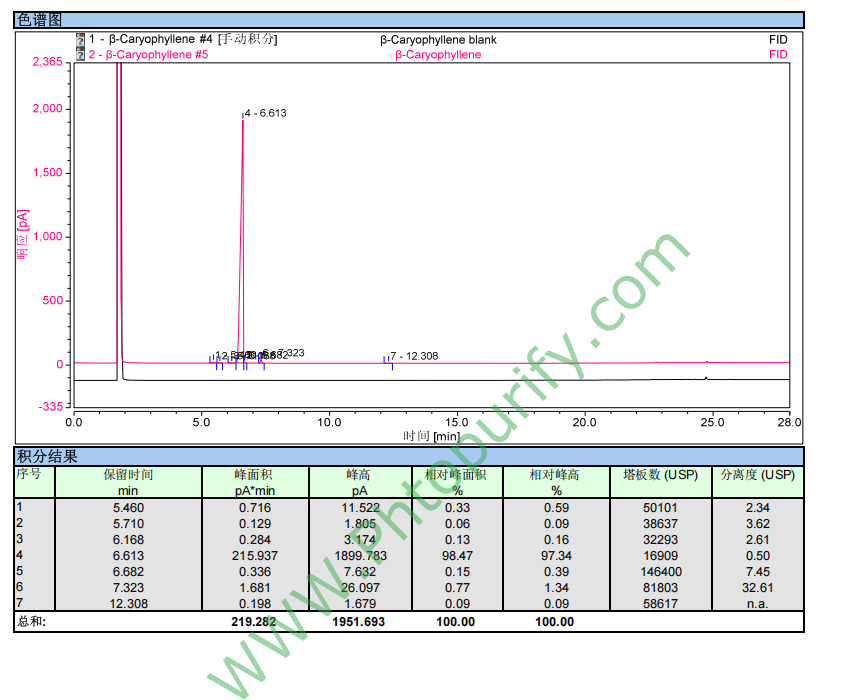
HPLC of β-Caryophyllene
Storage conditions:Short-term storage at 2~8℃, long-term storage at -20 ~ -80℃
.0000
5.6172
5.6172
.0006
11.2392
19.1570
High
89.6383
4.1718
No
Yes
No
No
No
No
0.0
No
No
Yes
Yes
Natural products, as an important source of lead compounds for drugs, play an irreplaceable role in the long history of human struggle against diseases. Among them, terpenoids have attracted much attention due to their structural diversity and wide range of biological activities. Among numerous terpenoids, β - Caryophyllene, as a unique bicyclic sesquiterpene, has attracted strong interest from researchers in the field of natural product pharmacology in recent years. β - Caryophyllene is widely present in essential oils of various aromatic plants, especially clove oil, black pepper, cinnamon, and rosemary, and is one of the key active ingredients in many spices and traditional herbs.
The uniqueness of β - caryophyllene lies in its identity as a dietary cannabinoid. It is currently the only common dietary terpene known to directly and selectively activate cannabinoid receptor type 2 (CB2 receptor) without producing psychoactive side effects mediated by cannabinoid receptor type 1 (CB1 receptor). This characteristic demonstrates enormous potential in the treatment of inflammation, pain, neurodegenerative diseases, and metabolic disorders. In addition, β - caryophyllene has been widely studied for its various pharmacological activities such as anti-inflammatory, antioxidant, antibacterial, anti anxiety, and analgesic effects. Its mechanism of action is not limited to the cannabinoid system, but also involves the regulation of various inflammatory signaling pathways and ion channels.
This review aims to comprehensively review the research status of β - caryophyllene, from its chemical structure, plant origin, pharmacological activity, mechanism of action, to drug evaluation and clinical application prospects, in order to provide a systematic and in-depth explanation, in order to provide scientific basis for the further development and utilization of this natural product.
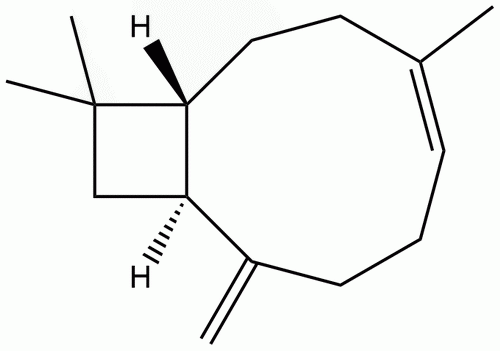
The chemical structure of β - caryophyllene belongs to bicyclic sesquiterpenes, with a molecular formula of C ₁₅ H ₂₄ and a molecular weight of 204.3570 g/mol. The core of its structure is a bicyclic system composed of a nine membered ring fused with cyclobutane, containing an exo methylene group (=CH ₂) and an inner double bond. In stereochemistry, the most common and biologically active form in nature is (-) - β - caryophyllene, which has an S configuration at the stereocenter adjacent to the outer double bond, while the remaining two stereocenters are both in the R configuration. Its enantiomer is (+) - β - caryophyllene, but the latter is relatively rare in nature and usually has weaker biological activity.
From the perspective of physical and chemical properties, β - caryophyllene exhibits typical lipophilic characteristics. Its oil-water partition coefficient (LogP) is as high as 5.6172, indicating that it has strong lipid solubility and is easily soluble in organic solvents and non-polar media, while its solubility in water is extremely low, only 0.0006 mg/mL. This high lipophilicity determines that it can easily cross biological membranes, including the blood-brain barrier (BBB). The pharmacological parameters show that β - caryophyllene has high blood-brain barrier permeability, which provides a structural basis for its application in the treatment of central nervous system diseases. In addition, its topological polar surface area (TPSA) is 0.0000, further confirming its non-polar characteristics. In terms of safety assessment, β - caryophyllene showed a negative result (0.0) in the Ames test, indicating that it does not have direct mutagenicity; At the same time, the hERG inhibition test result was negative, indicating a low risk of causing cardiac QT interval prolongation related arrhythmias. These physicochemical properties and preliminary safety data lay a solid foundation for its development as a candidate drug or functional food ingredient.
β - Caryophyllene is widely distributed in the plant kingdom and is one of the main components of many aromatic plant essential oils. The most abundant source of its content includes cloves(Syzygium aromaticum)Flower bud oil, in which the content of β - caryophyllene can be as high as 10% -20% or more; In addition, black pepper(Piper nigrum)Cinnamon(Cinnamomum zeylanicum)Rosemary(Rosmarinus officinalis)Cannabis(Cannabis sativa)Beer hops(Humulus lupulus)And various basil genera(Ocimum)Plants also contain high levels of β - caryophyllene. It is worth noting that β - caryophyllene often coexists with α - caryophyllene (i.e. α - coumarine), and the two are structurally isomers of each other, but there are differences in biological activity.
The most traditional and commonly used method for extracting β - caryophyllene is steam distillation, which is suitable for extracting volatile essential oils from plant materials. The content of β - caryophyllene in the obtained essential oils depends on the plant species, place of origin, harvest season, and distillation conditions. In order to obtain higher purity β - caryophyllene, researchers often use supercritical fluid extraction technology, especially using carbon dioxide as a solvent. Supercritical CO ₂ extraction has the advantages of low operating temperature, no solvent residue, and adjustable selectivity, which can more effectively extract thermosensitive components and increase the relative content of β - caryophyllene in the extract. In addition, organic solvent extraction (such as using n-hexane or ethanol) combined with column chromatography separation technology is also a commonly used method for laboratory scale preparation of high-purity β - caryophyllene. In recent years, with the promotion of green chemistry concepts, new technologies such as microwave-assisted extraction and ultrasound assisted extraction have also been applied to the extraction of β - caryophyllene. These methods have the advantages of short extraction time and high efficiency, but further optimization is still needed for industrial applications.
The pharmacological activity spectrum of β - caryophyllene is extremely broad, among which anti-inflammatory effect is one of its most core and extensively studied activities. Numerous in vitro and in vivo studies have confirmed that β - caryophyllene can significantly inhibit inflammatory responses in various inflammatory models. For example, in a macrophage model stimulated by lipopolysaccharide (LPS), β - caryophyllene can significantly reduce the production of pro-inflammatory cytokines such as tumor necrosis factor - α (TNF - α), interleukin-6 (IL-6), and interleukin-1 β (IL-1 β). In animal models, β - caryophyllene showed significant inhibitory effects on carrageenan induced toe swelling, complete Freund's adjuvant induced arthritis, and colitis.
In addition to anti-inflammatory effects, β - caryophyllene also exhibits significant analgesic activity. Its analgesic mechanism is partially attributed to the activation of CB2 receptors, which exert effects in inflammatory pain and neuropathic pain models, without producing the common central side effects of opioid drugs or CB1 receptor agonists. In addition, β - caryophyllene also has antioxidant activity, which can clear free radicals and alleviate oxidative stress damage. In terms of neuroprotection, β - caryophyllene has shown potential to protect neurons and improve cognitive function in Alzheimer's disease, Parkinson's disease, and cerebral ischemia-reperfusion injury models through anti-inflammatory and antioxidant mechanisms. In addition, studies have shown that β - caryophyllene has various pharmacological activities such as anti anxiety, anti depression, antibacterial (especially against Helicobacter pylori and Staphylococcus aureus), anti-tumor (by inducing apoptosis and inhibiting proliferation), and protecting the liver and gastrointestinal mucosa.
The pharmacological activity of β - caryophyllene originates from its interactions with multiple molecular targets, with the most critical being its selective activation of cannabinoid receptor type 2 (CB2). CB2 receptors are mainly expressed in immune cells and surrounding tissues. Upon activation, they can inhibit the release of pro-inflammatory factors, regulate immune responses, and exert anti-inflammatory and analgesic effects. Unlike CB1 receptors, activation of CB2 receptors does not cause psychoactive effects, making β - caryophyllene an attractive non psychoactive cannabinoid.
In terms of anti-inflammatory mechanisms, β - caryophyllene activates CB2 receptors, thereby inhibiting the nuclear factor kappa B (NF - κ B) signaling pathway. Specifically, it can inhibit the activity of I κ B kinase β (IKBKB), prevent the phosphorylation and degradation of I κ B α, thereby reducing the nuclear translocation of NF - κ B subunit RELA (p65), and ultimately downregulating the expression of various pro-inflammatory genes, including TNF, IL-6, cyclooxygenase-2 (PTGS2/COX-2), and inducible nitric oxide synthase (NOS2/iNOS). In addition, β - caryophyllene can also affect inflammatory responses by regulating the phosphorylation levels of signal transduction and transcription activator 3 (STAT3). In the inflammasome related pathway, β - caryophyllene can inhibit the activation of cysteine containing aspartic acid protease 1 (CASP1), thereby reducing the maturation and secretion of IL-1 β.
In addition to cannabinoid receptors, β - caryophyllene can also interact with transient receptor potential (TRP) channels. Research has shown that β - caryophyllene is a regulator of TRPV1 (transient receptor potential vanillic acid subtype 1) and TRPA1 (transient receptor potential anchor protein subtype 1). TRPV1 and TRPA1 are key ion channels for pain and inflammation perception, and the regulatory effect of β - caryophyllene on them may partially explain its analgesic and anti-inflammatory effects. In addition, β - caryophyllene also has a certain inhibitory effect on cyclooxygenase-1 (PTGS1/COX-1) and cyclooxygenase-2 (PTGS2/COX-2), which further enriches its anti-inflammatory mechanism network.
The pharmacological evaluation of β - caryophyllene requires comprehensive consideration of its physicochemical properties, pharmacokinetic characteristics, and preliminary safety. As mentioned earlier, its high LogP value (5.6172) and low water solubility (0.0006 mg/mL) are typical characteristics of lipophilic compounds. Although this high lipophilicity is beneficial for membrane permeability and blood-brain barrier crossing, it also brings problems such as low oral bioavailability, widespread distribution in the body, and easy accumulation in adipose tissue.
In terms of pharmacokinetics, β - caryophyllene is mainly absorbed through the gastrointestinal tract after oral administration, but due to its strong lipid solubility, the absorption process is greatly affected by the fat content in food. After absorption, β - caryophyllene rapidly distributes in the body, and due to its high blood-brain barrier permeability, it can quickly enter the central nervous system. In terms of metabolism, β - caryophyllene is mainly oxidized and metabolized in the liver through the cytochrome P450 enzyme system (mainly CYP2C9 and CYP3A4), generating various hydroxylated metabolites that may still retain some biological activity. The excretion pathway is mainly in the form of metabolites, which are excreted from the body through urine and feces. It is worth noting that the half-life of β - caryophyllene is relatively short, which to some extent limits its sustained pharmacological effects, but also reduces the risk of long-term accumulation.
From a safety perspective, β - caryophyllene, as a natural ingredient widely present in food and spices, is generally considered safe. A negative Ames test indicates no mutagenicity, while a negative hERG inhibition reduces the risk of cardiac toxicity. However, further accumulation of safety data is needed for high-dose or long-term use. Overall, β - caryophyllene has a good starting point for drug development, but its low water solubility and first pass metabolic effects are key bottlenecks restricting its clinical application. Future drug development strategies may include the use of nanomaterials, liposomes, cyclodextrin inclusion complexes, or prodrug designs to improve their water solubility, oral bioavailability, and targeted delivery efficiency.
Based on the unique pharmacological activity and good safety of β - caryophyllene, it has shown broad prospects in clinical translation. Firstly, in the field of anti-inflammatory and analgesic effects, β - caryophyllene is expected to be developed as a novel drug or adjuvant therapy for the treatment of chronic inflammatory diseases (such as rheumatoid arthritis and inflammatory bowel disease) and chronic pain (such as neuropathic pain). Its non psychoactive characteristics make it a more advantageous choice than traditional cannabinoids.
Secondly, in the field of neurological and psychiatric disorders, β - caryophyllene has shown potential in the treatment of Alzheimer's disease, Parkinson's disease, multiple sclerosis, anxiety, depression, and other diseases due to its ability to cross the blood-brain barrier and activate CB2 receptors. By reducing neuroinflammation and oxidative stress, β - caryophyllene may delay the progression of neurodegenerative diseases.
In addition, in terms of metabolic diseases, the anti-inflammatory and immunomodulatory effects of β - caryophyllene may be beneficial to obesity, type 2 diabetes and non-alcoholic fatty liver disease. In the field of cancer, although there is currently mostly in vitro and animal experimental evidence, its ability to induce tumor cell apoptosis and inhibit metastasis deserves further exploration.
However, the clinical translation of β - caryophyllene still faces challenges. In addition to pharmacokinetic issues, the complexity of its mechanism of action (involving multiple targets) is both an advantage and a challenge, requiring a more precise analysis of its dominant pathways in specific diseases. Future research directions should include: conducting high-quality, large sample clinical trials to validate its efficacy and safety; Develop new drug delivery systems to overcome their physical and chemical property deficiencies; Explore its synergistic effects with other natural products or clinical drugs; And utilizing synthetic biology techniques to achieve efficient and sustainable production.
β - Caryophyllene, as a widely present bicyclic sesquiterpene in nature, has become a research hotspot in the field of natural product pharmacology due to its unique CB2 receptor selective activation activity, multiple pharmacological effects, and good safety. From a chemical structure perspective, its high lipophilicity endows it with the ability to penetrate biological barriers, but also brings challenges in pharmacokinetics. From the perspective of pharmacological activity, its anti-inflammatory, analgesic, neuroprotective, and anti-tumor mechanisms involve multiple key molecular targets such as CB2 receptors, NF - κ B, STAT3, TRP channels, etc., forming a complex regulatory network.
Although β - caryophyllene has shown outstanding performance in preclinical studies, there are still many obstacles to overcome from laboratory to clinical application, especially in improving its oral bioavailability and optimizing its metabolic behavior in vivo. With the development of nanotechnology, pharmaceutical chemical modification, and formulation studies, these problems are expected to be solved. In the future, β - caryophyllene and its derivatives are highly likely to occupy a place in the treatment of inflammatory diseases, chronic pain, and neurodegenerative diseases, becoming a bridge connecting traditional herbal wisdom with modern precision medicine. The continuous in-depth research on β - caryophyllene will not only help to reveal the scientific connotation of natural products, but also contribute new solutions to human health.
