


Synonym name:
Catalogue No.: BP0195
Cas No.: 71963-77-4
Formula: C16H26O5
Mol Weight: 298.379
Botanical Source:
Purity: 95%~99%
Analysis Method: HPLC-DAD or/and HPLC-ELSD
Identification Method: Mass, NMR
Packing: Brown vial or HDPE plastic bottle
Can be supplied from milligrams to grams.
For Reference Standard and R&D, Not for Human Use Directly.
Inquire for bulk scale.
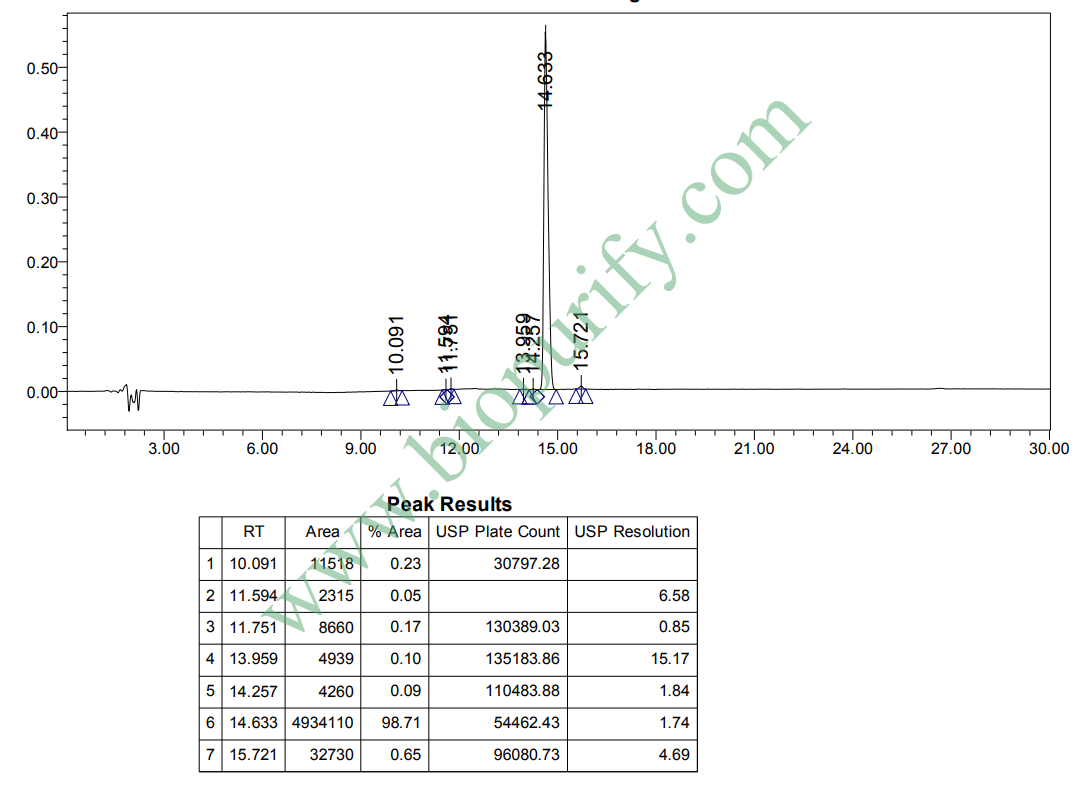
HPLC of Artemether
Storage conditions:Short-term storage at 2~8℃, long-term storage at -20 ~ -80℃
Artemether (CAS number: 71963-77-4), as a semi synthetic derivative of artemisinin, has attracted much attention since the late 20th century due to its excellent anti malarial activity. The discovery and application of artemisinin based drugs have greatly promoted the development of the treatment of malignant malaria, especially in the control of multidrug-resistant malaria parasite strains. Artemisinin methyl ether improves its pharmacokinetic properties and bioavailability by converting the lactone structure of artemisinin into endol methyl ether, making it one of the widely used antimalarial drugs in clinical practice.
In recent years, the pharmacological research of artemether has not only been limited to the field of anti malaria, but its potential activities in neurotoxicity, anti schistosomiasis, anti-cancer, and anti-tumor have also aroused widespread interest in the scientific research community. In addition, artemether, as a new type of sound sensitizer, has gradually shown its potential for application in photodynamic therapy. This article aims to comprehensively review the chemical structure, plant origin, pharmacological activity, mechanism of action, pharmacological evaluation, and clinical application prospects of artemether, aiming to provide systematic and in-depth reference materials for researchers in related fields.
Artemisinin methyl ether is a semi synthetic derivative of artemisinin, characterized by the conversion of the artemisinin lactone ring into the corresponding internal alcohol methyl ether, with a molecular formula of C16H26O5 and a molecular weight of 282.38. Its structure contains sesquiterpene skeleton, endol methyl ether group, and key organic peroxide bridging ring, which is the core structural unit of its biological activity.
In terms of physical and chemical properties, artemether exhibits high lipid solubility (LogP of approximately 3.0), which helps it penetrate cell membranes and reach its targets. Its polar surface area (TPSA) is 55.38 Å ² and the number of hydrogen bond acceptors is 5, indicating that its molecule has a moderate balance of polarity and hydrophilicity, which is conducive to in vivo distribution and absorption. Artemisinin methyl ether has high blood-brain barrier permeability, indicating its potential application in central nervous system related diseases.
From a safety perspective, artemether has a low risk of liver toxicity, no significant cardiac toxicity or hERG channel inhibition, and a negative Ames mutagenicity test result, indicating its high safety and suitability for clinical promotion and application. Its half-life is about 2 hours, indicating that the drug is metabolized rapidly in the body, and a reasonable dosing regimen needs to be designed to maintain effective concentration.
The natural precursor of artemether is artemisinin, mainly derived from the Asteraceae plant Artemisia annua L. Artemisinin was initially isolated from Artemisia annua by the team of Chinese scientist Tu Youyou, marking a major breakthrough in the research of natural product antimalarial drugs. The content of artemisinin is greatly affected by factors such as variety, planting environment, and harvesting period. High purity artemisinin is usually obtained through solvent extraction and chromatographic purification.
Artemisinin methyl ether is a semi synthetic product of artemisinin, and its preparation process includes the reduction reaction of artemisinin, which converts the lactone ring into an internal alcohol and then undergoes methylation to generate methyl ether. This process usually uses chemical reducing agents and methylation reagents, with mild conditions and high yields, suitable for industrial production. Compared with artemisinin, artemether has enhanced chemical stability and lipid solubility, making it easier for formulation development and clinical application.
The main pharmacological effect of artemether is anti malaria, especially showing significant inhibitory effects on multidrug-resistant strains of Plasmodium falciparum. Its mechanism of action depends on the cleavage of the peroxide bridge ring, which generates free radicals and reactive oxygen species, destroys the cell membrane and proteins of malaria parasites, and leads to parasite death. Artemisinin methyl ether is often used in combination with drugs such as phenylfluorenone to form artemisinin combination therapies (ACTs), which effectively delay the development of drug resistance and improve the success rate of treatment.
Artemisinin methyl ether has certain neurotoxicity, mainly manifested as damage to the nervous system at high doses. However, at moderate doses, artemether exhibits neuroprotective potential, possibly by regulating oxidative stress and inflammatory responses to alleviate nerve damage. Its high blood-brain barrier permeability provides a theoretical basis for its application in neurological diseases.
Research has shown that artemether has inhibitory effects on schistosomiasis parasites, can interfere with parasite development and survival, and alleviate pathological damage caused by infection. This provides new drug candidates for the treatment of schistosomiasis.
Artemisinin methyl ether exhibits anti-tumor activity in various cancer models, involving multiple mechanisms such as cell proliferation inhibition, induction of apoptosis, inhibition of angiogenesis, and regulation of the tumor microenvironment. Its characteristic as a sound sensitizer gives it unique advantages in photodynamic therapy, which can enhance the sensitivity of tumor cells to phototherapy and improve treatment effectiveness.
The biological activity of artemether mainly depends on its unique organic peroxide structure, which can generate free radicals in parasitic and tumor cells, causing cell damage and death. Its mechanism of action involves multiple molecular targets and signaling pathways, including:
Artemisinin methyl ether has excellent pharmacological properties, conforms to Lipinski's rules, and has good oral bioavailability and in vivo distribution characteristics. It has a moderate molecular weight, good lipid solubility, and moderate polarity, which is beneficial for penetrating cell membranes and the blood-brain barrier.
Pharmacokinetic studies have shown that artemether is rapidly absorbed after oral administration, with a plasma half-life of approximately 2 hours, indicating that it is metabolized rapidly in the body and needs to be maintained at an effective concentration through reasonable dosage and administration frequency. Its main metabolic pathway is liver metabolism, and the safety of metabolites is high with low risk of liver toxicity.
In terms of safety evaluation, artemether has no significant cardiac toxicity and does not inhibit hERG potassium channels. The Ames mutagenicity test is negative, indicating a low risk of genetic toxicity. The risk of liver toxicity is also at a low level, suitable for long-term clinical application.
The clinical application of artemether as an anti malaria drug has achieved significant results, especially in the treatment of multidrug-resistant strains of malignant malaria, which plays an irreplaceable role. Artemisinin combination therapy (ACTs), which is used in combination with drugs such as phenylfluorenone, has become a recommended standard treatment regimen by the World Health Organization.
In addition, the potential of artemether in the treatment of neurological diseases, schistosomiasis, and tumors is becoming increasingly prominent. The research on it as a new type of sound sensitizer has expanded its application prospects in photodynamic therapy and is expected to become a new treatment method for various refractory tumors.
Future research should focus on in-depth analysis of the mechanism of action of artemether, especially its regulatory network on multiple targets, as well as its pharmacological and safety evaluations in different disease models. Meanwhile, optimizing its pharmacokinetic properties, developing novel drug delivery systems and combination therapy strategies will further enhance its clinical efficacy and application scope.
Artemisinin methyl ether, as a semi synthetic derivative of artemisinin, has become an important drug in the field of anti malaria due to its unique chemical structure and diverse pharmacological activities. Its potential applications in anti-cancer, neuroprotection, and anti schistosomiasis demonstrate the broad prospects of natural product pharmacology research. Through systematic pharmacological evaluation and preclinical research, artemether is expected to become an important drug for the treatment of multiple diseases in the future. Continuous basic and applied research will provide a solid scientific basis for its clinical promotion and development of new indications.
