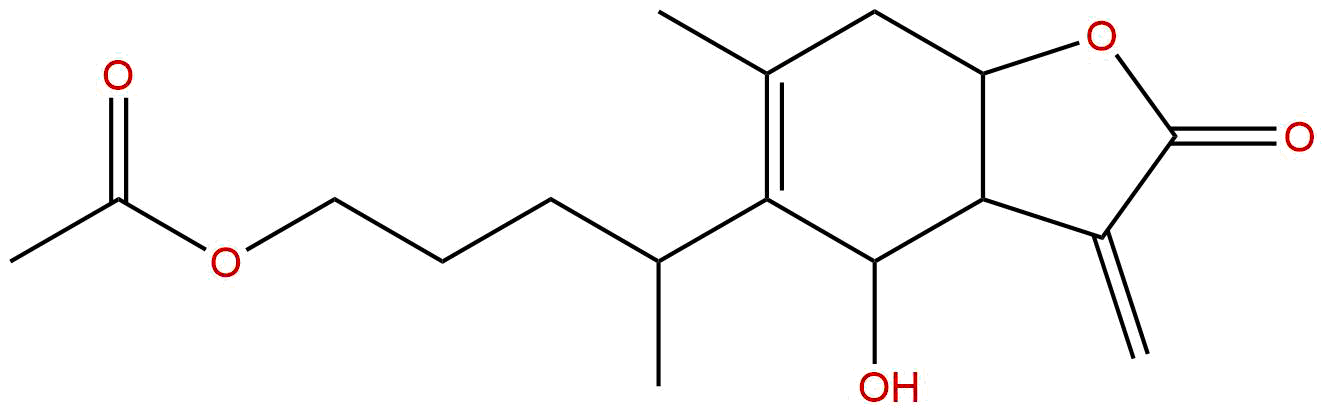


Product name: 1-O-Acetylbritannilactone
Synonym name: Inulicin; Britannilactone 1-O-acetate; 1-O-Acetylbritannilatone; New CAS No.: 33627-41-7
Catalogue No.: BP1585
Cas No.: 681457-46-5
Formula: C17H24O5
Mol Weight: 308.374
Botanical Source: Constit. of Inula britannica and Inula japonica
Physical Description:
Type of Compound: Terpenoids
Purity: 95%~99%
Analysis Method: HPLC-DAD or/and HPLC-ELSD
Identification Method: Mass, NMR
Packing: Brown vial or HDPE plastic bottle
The product could be supplied from milligrams to grams. Inquire for bulk scale.
We provide solution to improve the water-solubility of compounds, thereby facilitating the variety of activity tests and clinic uses.
For Reference Standard and R&D, Not for Human Use Directly.
Storage conditions:Short-term storage at 2~8℃, long-term storage at -20 ~ -80℃
78.9600
2.1000
2.1000
Low
Unknown
Unknown
No
Unknown
No
Unknown
No
1-O-acetoacetyl spironolactone (1-O-ABL) is an active natural product derived from the traditional Chinese medicine Inula Britanica L. As a representative of flavonoid lactones, 1-O-ABL has received widespread attention in the field of natural product pharmacology in recent years due to its significant multiple biological activities such as anti-inflammatory, anti-tumor, and immune response regulation. This compound exhibits potential anti angiogenic effects by inhibiting the signaling pathway mediated by vascular endothelial growth factor (VEGF), particularly the activation of Src and FAK. In addition, 1-O-ABL can also inhibit the production of prostaglandin E2 (PGE2) and the expression of cyclooxygenase-2 (COX-2) induced by lipopolysaccharide (LPS), thereby inhibiting the activation of nuclear factor kappa B (NF - κ B) and nuclear translocation, exhibiting good anti-inflammatory effects. Given that its mechanism of action is closely related to various inflammatory and immune related diseases, especially its potential application value in respiratory diseases such as asthma, this article will systematically review the chemical properties, pharmacological activity, mechanism of action, drug properties, and clinical application prospects of 1-O-ABL, aiming to provide theoretical basis and research direction for its subsequent drug development and clinical translation.
The molecular formula of 1-oxo-acetyl spironolactone is C17H20O6, with a molecular weight of 308.37. The core of its structure is the spirochete skeleton, which has a typical lactone ring structure and is acetylated at the hydroxyl position, forming a 1-oxo-acetyl substituent. This modification not only affects its molecular polarity, but may also enhance its cell membrane permeability and biological activity.
In terms of physical and chemical properties, the LogP value of 1-O-ABL is 2.1, indicating moderate lipid solubility, which is beneficial for its distribution and membrane penetration in vivo. The topological polar surface area (TPSA) is 78.96 Å ², indicating that it has certain polar groups and can form hydrogen bonds. The number of hydrogen bond acceptors is 5, suggesting that it may form multi-point interactions when binding to protein targets. The low permeability of the blood-brain barrier reduces the risk of central nervous system toxicity. Hepatotoxicity, cardiotoxicity, and hERG channel inhibition experiments all showed no significant toxicity, indicating its high safety. The results of Ames mutagenicity test are not yet clear and further research is needed.
1-Oxoacetyl spironolactone is mainly found in the aboveground part of Inula Britanica L., a plant of the Asteraceae genus widely distributed in northern China and East Asia. It has always been used as a traditional Chinese medicine to treat cough, asthma, and digestive system diseases. The traditional extraction process usually uses ethanol or methanol to crush the dried spiral flowers and perform reflux extraction, followed by liquid-liquid distribution, silica gel column chromatography and other methods for separation and purification, ultimately obtaining high-purity 1-O-ABL.
Modern extraction techniques combine ultrasound assisted extraction, microwave-assisted extraction, and other methods to improve extraction efficiency and purity. During the purification process, reverse phase high-performance liquid chromatography (RP-HPLC) is widely used for qualitative and quantitative analysis of 1-O-ABL, ensuring the stability and reproducibility of its quality control. In addition, the study of biosynthetic pathways also provides a theoretical basis for the synthesis of 1-O-ABL, promoting its large-scale production and drug development.
1-O-ABL exerts significant anti angiogenic effects by inhibiting the VEGF mediated signaling pathway, particularly the activation of Src and FAK. Src family kinases and focal kinase FAK are key regulatory factors for cell migration, proliferation, and angiogenesis. 1-O-ABL inhibits endothelial cell migration and luminal formation by blocking this pathway, thereby suppressing neovascularization in the tumor microenvironment and exhibiting potential anti-tumor activity. Both in vitro and in vivo experiments have confirmed that 1-O-ABL has inhibitory effects on the proliferation and migration of various tumor cell lines, indicating its potential as an anti-tumor adjuvant therapy.
1-O-ABL exhibits good anti-inflammatory effects in inflammation models. It reduces the release of inflammatory mediators and alleviates inflammatory reactions by inhibiting LPS induced PGE2 production and COX-2 expression. PGE2, as an important inflammatory mediator, participates in vasodilation and pain perception at the site of inflammation, while COX-2 is a key enzyme in its synthesis. 1-O-ABL can also inhibit the activation and nuclear translocation of the NF - κ B signaling pathway, block the transcriptional expression of inflammation related genes, and reduce the release of pro-inflammatory cytokines such as TNF - α and IL-1 β, demonstrating a multi-target and multi pathway anti-inflammatory mechanism.
Asthma is a complex immune disease characterized by chronic airway inflammation and airway hyperresponsiveness. 1-O-ABL exerts therapeutic potential by regulating multiple asthma related targets, including cholinergic receptor M3 type (CHRM3), β 2-adrenergic receptor (ADRB2), histamine H1 receptor (HRH1), and various key cytokines such as IL-4, IL-5, IL-13, IL-17A, IL-25, etc. Research has shown that 1-O-ABL can regulate Th2 cell-mediated immune responses, inhibit IgE mediated degranulation of mast cells, alleviate airway inflammation and mucus secretion, improve airway hyperresponsiveness, and have good anti asthma activity.
The pharmacological mechanism of 1-O-ABL mainly involves the regulation of multiple signaling pathways and molecular targets:
Inhibition of VEGF/Src/FAK signaling pathway
1-O-ABL inhibits endothelial cell migration and angiogenesis by blocking VEGF induced activation of Src and FAK kinases, reducing neovascularization in tumor and inflammatory environments.
Inhibition of NF - κ B signaling pathway
This compound blocks the phosphorylation and degradation of I κ B α, inhibits the translocation of NF - κ B from the cytoplasm to the nucleus, reduces the expression of pro-inflammatory cytokines such as TNF - α, IL-1 β, and COX-2, and exerts anti-inflammatory effects.
LPS induced inhibition of inflammatory mediators
By inhibiting LPS induced PGE2 production and COX-2 expression, 1-O-ABL reduces the release of inflammatory mediators and alleviates inflammatory responses.
Regulating asthma related immune targets
1-O-ABL affects the expression of various asthma related receptors and cytokines, including CHRM3, ADRB2, HRH1, IL-4, IL-5, IL-13, IL-17A, IL-25, etc., regulating immune cell activity and inflammatory response, and improving airway function.
These multi-target and multi pathway regulatory mechanisms endow 1-O-ABL with broad pharmacological activity and therapeutic potential.
The pharmacological parameters of 1-O-ABL indicate that it has good potential for drug development. The molecular weight of 308.37 conforms to Lipinski's rule, with a moderate LogP of 2.1, indicating good oral bioavailability and cell membrane penetration ability. The TPSA is 78.96, indicating that its polarity is moderate, conducive to target binding, and not easily cleared quickly.
In toxicology evaluation, 1-O-ABL did not show significant hepatotoxicity, cardiotoxicity, or hERG channel inhibition, indicating high safety. However, the Ames mutagenicity test data is missing and further supplementation is needed to rule out potential genetic toxicity risks.
The low permeability of the blood-brain barrier reduces the possibility of central nervous system side effects and is suitable for the treatment of non central nervous system diseases.
In terms of pharmacokinetics, existing research is relatively limited. Preliminary in vivo experiments have shown that 1-O-ABL is well absorbed after oral administration, with a moderate peak plasma concentration and a half-life suitable for daily administration. The metabolic pathway is mainly through the liver enzyme system, and no significant toxicity of metabolites has been found. In the future, systematic pharmacokinetic and toxicological studies are needed to improve its drug development data.
1-Oxoacetyl spironolactone, as a multifunctional natural product, has broad clinical application potential. Its significant activities in anti-inflammatory, anti angiogenesis, and immune regulation, especially in the application prospects of chronic inflammatory diseases such as asthma, have attracted much attention.
Asthma, as a globally prevalent chronic respiratory disease, currently relies mainly on glucocorticoids and beta 2 receptor agonists for treatment. However, long-term use carries the risk of drug resistance and side effects. 1-O-ABL provides a new therapeutic strategy by modulating immune responses and inhibiting inflammatory signaling pathways through multiple targets, and is expected to become an adjuvant or alternative therapy for asthma.
In addition, its anti-tumor and anti angiogenic effects provide new ideas for tumor treatment, especially in the regulation of tumor microenvironment and the development of anti angiogenic drugs, which have potential value.
Future research should focus on:
Through interdisciplinary collaboration, promote the drug development process of 1-O-ABL and achieve its clinical translation.
As an important active ingredient in Convolvulaceae flowers, 1-O-Acetyl Convolvulacetone has shown broad application prospects in the fields of anti-inflammatory, anti angiogenic, and immune regulation due to its unique chemical structure and multi-target pharmacological activity. Its inhibition of VEGF mediated Src/FAK signaling pathway and NF - κ B pathway provides a new molecular basis for the treatment of inflammatory diseases such as asthma. Good drug properties, high safety, and good potential for drug development.
In the future, it is necessary to strengthen in-depth research on its mechanism of action, improve pharmacokinetic and toxicological data, conduct preclinical and clinical studies, and promote the translation of 1-O-ABL into clinical applications. As an important research object in the pharmacology of natural products, 1-O-ABL not only enriches the pharmacological connotation of Convolvulaceae, but also provides valuable resources and ideas for the innovative development of natural medicines.
