Introduction/Overview
Pancreatic cancer, especially ductal adenocarcinoma of the pancreas, is one of the most malignant tumors of the digestive tract. Its onset is insidious, its progress is rapid, and its prognosis is very poor. It is known as the "king of cancer". The current clinical treatment mainly relies on surgical resection, supplemented by chemotherapy drugs such as gemcitabine, but there are serious challenges such as strong drug resistance, significant toxic side effects, and limited patient survival. Therefore, it has become an important direction of drug research and development to explore new lead compounds with high efficiency and low toxicity against pancreatic cancer from natural products. In recent years, sesquiterpene lactones have attracted much attention from researchers due to their wide range of biological activities, especially their significant anti-tumor potential. Among them, 6 α - (2-methylbutyryloxy) - Britannilactone (hereinafter referred to as 6 α - MB Brit), as a novel sesquiterpene lactone derivative, its CAS number is 1260151-65-2, which shows a remarkable prospect in the research of multi-target pharmacological activity against pancreatic cancer. The purpose of this paper is to systematically review the chemical characteristics, plant origin, pharmacological activity, mechanism of action, pharmaceutical evaluation and clinical application potential of this compound against pancreatic cancer, in order to provide a comprehensive academic reference for the in-depth research and development of this natural product.
Chemical structure and physicochemical properties
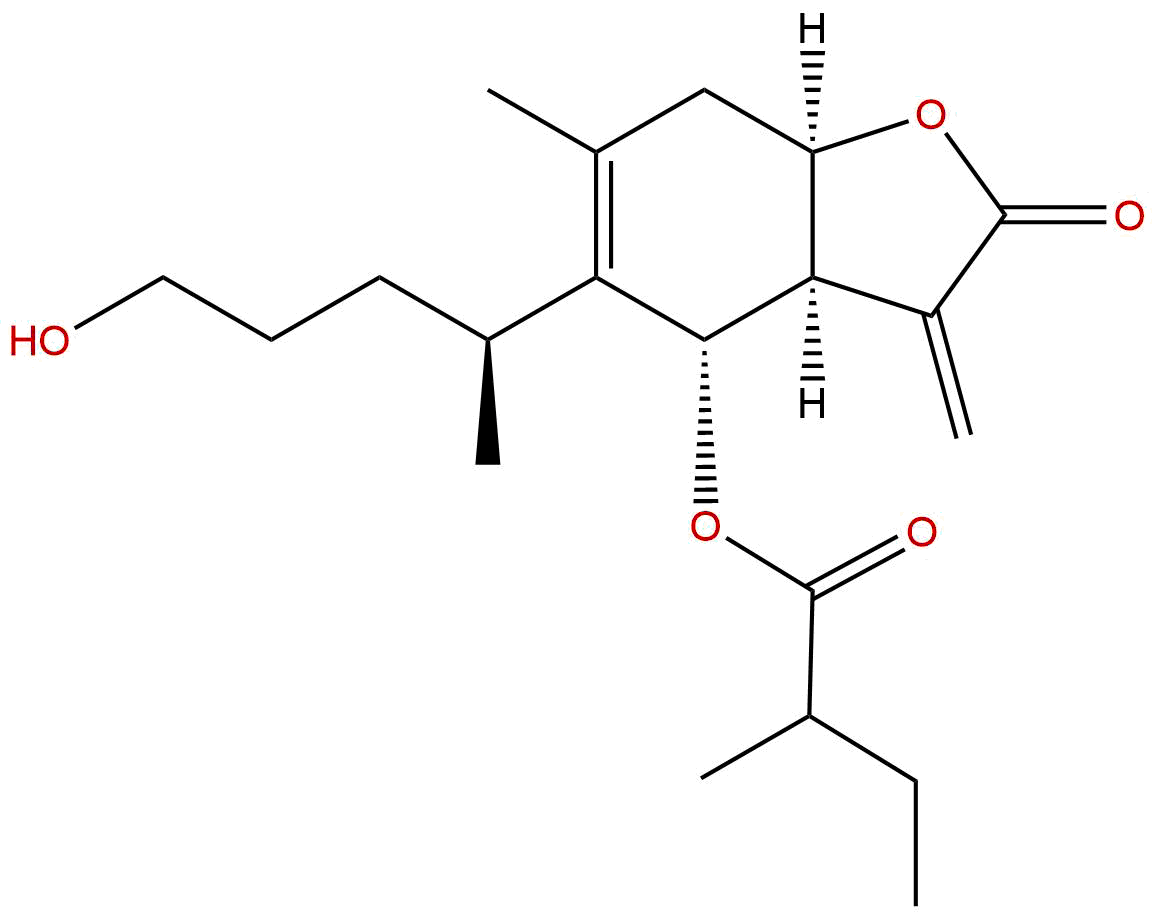
The molecular formula of 6 α - MB Brit is C20H30O5, with a molecular weight of 350.4550. Its core structure is the Britannilactone skeleton, which belongs to the guaiaceae type sesquiterpene lactone. The characteristic of this skeleton is the fusion of a five membered lactone ring and a ten membered carbon ring. The specific modification of this compound lies in the introduction of a 2-methylbutyryloxy group (- COCH (CH3) CH2CH3) on its C-6 hydroxyl group. This acylation modification significantly changes the polarity, spatial conformation, and interaction ability with biomolecules of the molecule, which may be the key to its biological activity being superior to that of the parent nucleus structure.
According to its pharmacological parameters analysis, the compound exhibits typical drug like characteristics. Its lipid water partition coefficient (LogP) is 3.2089, indicating that it has moderate lipophilicity, which is beneficial for transmembrane transport and intracellular distribution. The topologically polar surface area (TPSA) is 72.83 Å ², which is relatively low and further supports its good membrane permeability. The water solubility parameter is 0.0960, indicating that it belongs to insoluble compounds, which may be a key issue to be addressed in future formulation development. It is worth noting that its blood-brain barrier (BBB) penetration prediction is "high", which means that the compound may have the potential to treat brain metastases or central nervous system related diseases, but also suggests that its potential neurotoxic risks need to be evaluated in the early stages of development. In terms of preliminary safety prediction, hERG inhibition is' no ', reducing its risk of inducing QT interval prolongation and apical torsion ventricular tachycardia; The Ames test result is 0.0, indicating that there is no direct risk of genetic toxicity and mutagenesis, laying a good safety foundation for subsequent development.
Plant sources and extraction methods
6 α - MB Brit mainly comes from plants of the genus Inula in the Asteraceae family. This genus of plants is widely distributed worldwide, and many species are used in traditional medicine for anti-inflammatory, antibacterial, and anti-tumor purposes. Research has shown that this compound may exist in specific species such as Inula Britanica L. Plants of the genus Convolvulus are rich in a variety of structurally diverse sesquiterpene lactones, making them an important treasure trove for discovering such active ingredients.
Its extraction and separation usually follow the classic process of natural product chemistry. Firstly, dry plant materials (such as aboveground parts or inflorescences) are crushed and subjected to cold soaking or heating reflux extraction using medium polarity solvents such as methanol, ethanol, or acetone to fully extract secondary metabolites including sesquiterpene lactones. After vacuum concentration, the crude extract obtained was subjected to solvent partitioning using solvents such as petroleum ether, ethyl acetate, and n-butanol. The target compounds were mostly enriched in the ethyl acetate fraction. Further purification relies on various chromatographic techniques. Silica gel column chromatography is commonly used for preliminary separation, with different ratios of petroleum ether ethyl acetate or chloroform methanol gradient elution. Then, fine purification is carried out by combining reversed-phase silica gel (such as C18) column chromatography, Sephadex gel (LH-20) column chromatography and high performance liquid chromatography (HPLC, usually using C18 column, methanol water or acetonitrile water as mobile phase) until the monomer compound is obtained. The structural identification comprehensively utilizes modern spectroscopic techniques such as nuclear magnetic resonance (1H NMR, 13C NMR, 2D NMR), mass spectrometry (MS, HR-MS), and X-ray single crystal diffraction to ultimately confirm its planar and three-dimensional structure.
Pharmacological activity research
A large number of in vitro and a small number of in vivo studies have confirmed that 6 α - MB Brit has significant and multifaceted inhibitory activities on pancreatic cancer cells, and its pharmacological effects are mainly reflected in the following aspects:
-
Inhibition of cell proliferation and induction of cell cycle arrest: This compound can effectively inhibit the proliferation of many human pancreatic cancer cell lines (such as PANC-1, MIA PaCa-2, BxPC-3) in a dose and time-dependent manner. Its mechanism of action is closely related to interfering with the cell cycle process. Studies have shown that it can block cells in the G2/M or S phase, prevent cells from entering mitosis, and thus inhibit their malignant proliferation.
-
Inducing cell apoptosis The induction of tumor cell apoptosis is one of the core mechanisms of 6 α - MB Brit against pancreatic cancer. After treatment with this compound, pancreatic cancer cells can show typical morphological changes of apoptosis, such as cell shrinkage, chromatin agglutination, nuclear fragmentation, etc. Flow cytometry analysis revealed a significant increase in the proportion of apoptotic cells expressing Annexin V+/PI+. The induction of apoptosis involves the activation of mitochondrial and death receptor pathways.
-
Inhibit cell migration and invasion Metastasis is the main cause of death in patients with pancreatic cancer. Transwell and chamber experiments showed that 6 α - MB Brit could significantly weaken the migration and invasion ability of pancreatic cancer cells. This effect is closely related to its downregulation of matrix metalloproteinases (MMPs, such as MMP-2, MMP-9) expression and inhibition of epithelial mesenchymal transition (EMT) process (manifested as upregulation of E-cadherin, downregulation of N-cadherin, vimentin, etc.).
-
Reverse multidrug resistance Pancreatic cancer is prone to drug resistance to chemotherapy drugs, and the overexpression of drug efflux pumps such as ABCB1 (P-glycoprotein) is the key factor. Research has shown that 6 α - MB Brit can downregulate the expression or function of ABCB1, thereby increasing the accumulation of chemotherapy drugs (such as gemcitabine and doxorubicin) in cancer cells, synergistically enhancing their cytotoxicity, and providing new ideas for overcoming clinical drug resistance.
-
Angiogenesis inhibition In an in vitro angiogenesis model, 6 α - MB Brit can inhibit the luminal formation of human umbilical vein endothelial cells (HUVEC). The mechanism may be related to the inhibition of the vascular endothelial growth factor (VEGF) signaling pathway, which indirectly inhibits tumor growth and metastasis by interfering with the tumor's blood supply.
Mechanism of action and molecular targets
The anti pancreatic cancer effect of 6 α - MB Brit is not achieved through a single target, but is characterized by multi target and networked regulation, mainly involving the following key signal pathways and molecular targets:
-
Regulation of apoptotic pathway:
- BCL2 family By downregulating the expression of anti apoptotic protein BCL-2 and upregulating the expression of pro apoptotic proteins such as BAX, the mitochondrial membrane potential is disrupted, leading to the release of cytochrome C and subsequent activation CASP9 (cysteine protease-9) And its downstream effector caspases (such as CASP3) initiate the mitochondrial apoptosis pathway.
- Death receptor pathway Possible through upward adjustment TNF (tumor necrosis factor) The expression of family ligands or their receptors activates exogenous apoptotic pathways.
-
Inflammation and inhibition of survival signaling pathways:
- TLR4/STAT3 pathway Chronic inflammatory microenvironment often exists in pancreatic cancer. 6 α - MB Brit can inhibit TLR4 (Toll like receptor 4) Activate and subsequently block its downstream key transcription factors STAT3 (Signal Transduction and Transcription Activation Factor 3) Phosphorylation and nuclear translocation. The inactivation of STAT3 leads to downregulation of the expression of various pro survival and pro proliferation genes regulated by it, such as Cyclin D1, BCL-2, and Survivor.
- NF - κ B pathway This compound can also inhibit the activation of nuclear factor kappa B (NF - κ B), reduce the production of inflammatory factors and anti apoptotic proteins.
-
Kinase and stress response pathway intervention:
- MAPK/ERK pathway By inhibiting MAPK1 (ERK2, extracellular signal regulated kinase 2) Inhibiting the RAS/RAF/MEK/ERK signaling cascade that promotes proliferation through phosphorylation activity.
- PKC α signal:PRKCA (protein kinase C alpha) 6 α - MB Brit may play a role in tumor growth and drug resistance by interfering with its activity and affecting downstream signals.
- NRF2 antioxidant pathway Under specific conditions, this compound may regulate NFE2L2(NRF2) Its activity affects the oxidative stress response of cells, but its role in anti-tumor is bidirectional and requires specific analysis.
-
Directly acting on DNA and drug efflux pumps:
- TOP1 (Topoisomerase I)Preliminary research suggests that 6 α - MB Brit may interfere with DNA replication and transcription by inhibiting the activity of TOP1, leading to DNA damage.
- ABCB1 (P-glycoprotein)As mentioned earlier, directly or indirectly inhibiting the function of the drug efflux pump is the core mechanism for reversing multidrug resistance.
To sum up, 6 α - MB Brit works synergistically on the above multiple targets to interweave into a comprehensive network that inhibits tumor growth, promotes apoptosis, prevents metastasis, and overcomes drug resistance, demonstrating its great potential as a multi target anti pancreatic cancer drug.
Evaluation of drug properties and pharmacokinetics
Based on its physicochemical parameters and preliminary biological data, a preliminary evaluation of the pharmacological properties of 6 α - MB Brit is conducted
Clinical application prospects and prospects
As a natural lead compound with multi target anti pancreatic cancer activity, 6 α - MB Brit has broad prospects for clinical application, but it has a long way to go, and needs to focus on breakthroughs in the following directions:
-
Development as a new candidate drug for pancreatic cancer After completing preclinical pharmacological, pharmacokinetic, and toxicological studies of the system, it can be pushed into the clinical trial phase. In view of the urgency of pancreatic cancer treatment, it may first be combined with the existing standard chemotherapy scheme (such as gemcitabine+albumin binding paclitaxel) to evaluate its sensitization and toxicity reduction effect.
-
As a tool drug or combination drug component for overcoming tumor resistance: In view of its reversal of ABCB1 mediated multidrug resistance, the compound preparation of ABCB1 and a variety of chemotherapy drugs can be developed for the treatment of drug-resistant pancreatic cancer.
-
Expansion of new indications based on mechanism of action Its targets such as TLR4/STAT3 and NF - κ B are also key regulatory nodes in chronic inflammation, autoimmune diseases, and other types of tumors such as liver cancer and colon cancer. Therefore, its therapeutic indications are expected to expand to other inflammation related diseases and malignant tumors.
-
Structural modification and optimization Pharmaceutical chemists can use it as a template to prepare semi synthetic or fully synthetic derivatives. The modification sites may include acyl side chains at the C-6 position, lactone rings, and other functional groups on the parent nucleus, in order to obtain the next generation of compounds with stronger activity and better drug properties.
-
Exploring its biological functional network in depth By utilizing omics technologies (proteomics, metabolomics) and gene editing techniques, we can more accurately depict its global action network within cells, discover new targets and biomarkers, and guide precise drug use.
Conclusion
6 α - (2-methylbutyryl) - spironolactone is a novel and unique sesquiterpene lactone compound isolated from traditional medicinal plants. The existing research has fully revealed its great potential in anti pancreatic cancer. It can effectively inhibit the proliferation of tumor cells, induce apoptosis, resist metastasis and reverse drug resistance through multi target and multi pathway synergy. Despite facing challenges such as poor water solubility and unclear pharmacokinetics in drug development, its excellent preliminary activity data and safety prediction have laid a solid foundation for its subsequent development. In the future, 6 α - MB Brit is expected to become an important member of the family of anti pancreatic cancer drugs through interdisciplinary cooperation, in-depth preclinical research, rational structural optimization and pharmaceutical innovation, providing a new weapon to conquer this "king of cancer", and also providing a successful example for modern research and development of natural products.