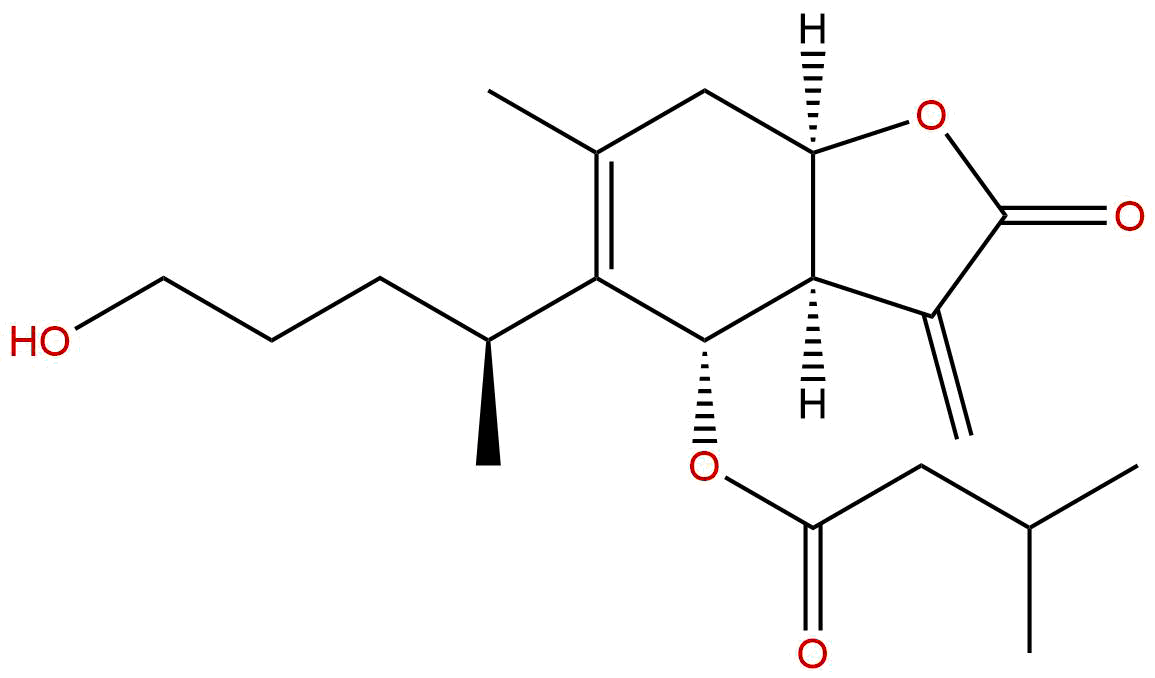


Storage conditions:Short-term storage at 2~8℃, long-term storage at -20 ~ -80℃
72.8300
3.2352
3.2358
.1012
2.9588
7.3692
High
76.7959
4.3865
No
No
No
No
No
No
0.0
No
No
No
No
Inflammatory bowel disease, especially ulcerative colitis, is a chronic and recurrent intestinal inflammatory disease. Its global incidence rate is on the rise, posing a serious threat to the quality of life of patients. Current clinical treatment drugs such as aminosalicylic acid, glucocorticoids, and immunosuppressants, although able to control symptoms, have problems such as insufficient efficacy, significant side effects, or susceptibility to drug resistance. Therefore, exploring efficient and low toxicity new anti colitis lead compounds from natural products has become an important direction for drug development. Plants of the genus Convolvulus are commonly used in traditional medicine to treat inflammation related diseases, and their abundant sesquiterpene lactones have been proven to have significant anti-inflammatory activity. Among them, 6 α - isovaleryloxy-Britannilactone (IVBL), as a structurally novel sesquiterpene lactone derivative isolated from flowers, has attracted much attention in recent years due to its excellent anti-inflammatory therapeutic effects in experimental colitis models. Its CAS number is 1259933-04-4. This article aims to systematically review the chemical structure, plant origin, pharmacological activity, multi-target mechanism of action, pharmacological characteristics, and clinical application potential of IVBL, in order to provide comprehensive scientific references for the in-depth research and development of this compound.
The molecular formula of 6 α - isovaleryl-2-spironolactone is C20H30O5, with a molecular weight of 350.4550. Its core structure is a derivative of spironolactone (a sesquiterpene lactone with a decahydronaphthofuranone skeleton), characterized by the introduction of an isovaleryloxy (- OCOCOCH2CH (CH3) 2) substituent on the 6 α - hydroxy group of the lactone ring. This structural modification significantly altered its physicochemical properties and biological activity.
From the analysis of parameters related to drug properties, this compound exhibits typical drug like characteristics. Its lipid water partition coefficient (LogP) is 3.2352, indicating that it has moderate lipophilicity, which is conducive to transmembrane absorption and distribution. The topologically polar surface area (TPSA) is 72.83 Å ², which is relatively low, further indicating its good membrane permeability. The water solubility parameter is 0.1012, belonging to the category of slightly soluble to poorly soluble, which is consistent with its lipophilic characteristics. Solubilization strategies may need to be considered during formulation development. It is worth noting that its blood-brain barrier permeability is predicted to be "high", indicating that the compound may easily enter the central nervous system. This is a double-edged sword that needs attention for anti colitis drugs that mainly act on the peripheral intestine. It may bring potential risks of neurological side effects and provide opportunities for the treatment of diseases accompanied by central inflammation. Preliminary toxicity predictions indicate that it has no inhibitory tendency on hERG potassium channels (hERG inhibition: No), and the Ames test result is 0.0, suggesting that it may not have significant cardiac or genetic toxicity and has a good safety starting point.
IVBL mainly comes from plants in the Asteraceae family, especially Eurasian spiral flowers(Inula britannica L. The inflorescence and aboveground parts. The genus Convolvulus is widely distributed worldwide and has abundant resources in China, with a long history of medicinal use.
The extraction of IVBL usually involves the use of organic solvent extraction combined with modern chromatographic separation techniques. The conventional process is as follows: first, the dried spiral flower plant material is crushed, and then subjected to cold soaking or heating reflux extraction with polar organic solvents such as methanol, ethanol, or acetone to obtain the crude extract. Subsequently, the crude extract was subjected to systematic solvent extraction using solvents such as petroleum ether, ethyl acetate, and n-butanol. IVBL is often enriched in the ethyl acetate extraction site due to its equipolarity. Further purification relies on column chromatography technology, often using silica gel column chromatography with different ratios of petroleum ether ethyl acetate or chloroform methanol gradient elution for preliminary separation. After obtaining a fraction rich in sesquiterpene lactones, high performance liquid chromatography (HPLC), especially preparative or semi preparative reverse phase HPLC (usually using a C18 column with methanol water or acetonitrile water as the mobile phase), is required for final purification to obtain high-purity IVBL monomer compounds. Structural identification is accomplished through spectroscopic methods such as nuclear magnetic resonance (NMR, including 1H NMR, 13C NMR, 2D NMR), mass spectrometry (MS), and infrared spectroscopy (IR), and confirmed by comparison with known data or single crystal X-ray diffraction.
Numerous preclinical studies have confirmed that the core pharmacological activity of IVBL is focused on its outstanding anti-inflammatory and immunomodulatory effects, particularly in colitis models.
In various experimental colitis models, such as acute/chronic colitis induced by dextran sulfate sodium (DSS) in mice and colitis induced by 2,4,6-trinitrobenzenesulfonic acid (TNBS), intravenous or intraperitoneal administration of IVBL can significantly improve disease activity index, manifested as reduced weight loss, reduced diarrhea and rectal bleeding symptoms, and inhibited colon length shortening. Histopathological analysis shows that IVBL treatment can effectively alleviate inflammatory cell infiltration, crypt structure damage, goblet cell reduction, and ulcer formation in colon mucosa. Its efficacy is comparable or superior to positive drugs such as mesalazine and dexamethasone, and has shown better safety in some studies, such as weaker inhibition of the adrenal axis.
Its anti-inflammatory effect is broad-spectrum. In vitro studies have shown that IVBL can dose dependently inhibit the production of nitric oxide (NO) and prostaglandin E2 (PGE2) by macrophages (such as RAW264.7 cells) stimulated by lipopolysaccharide (LPS), and downregulate the mRNA and protein expression of various pro-inflammatory cytokines (such as TNF - α, IL-1 β, IL-6). In addition, the study suggests that IVBL may have the potential to regulate oxidative stress (such as enhancing antioxidant enzyme activity) and inhibit intestinal fibrosis, which is of great significance for the long-term management and prevention of complications in colitis.
The anti colitis effect of IVBL is not achieved through a single pathway, but involves a complex multi-target regulatory network, which is consistent with the characteristics of its natural products. Existing research has revealed its interactions with multiple key targets:
Regulating lipid metabolism and signaling pathways IVBL has been proven to be an effective inhibitor of carboxylesterase 1 (CES1). CES1 is involved in the hydrolytic metabolism of various endogenous lipid mediators, such as endocannabinoids and lysophosphatidic acid. Inhibition of CES1 can lead to an increase in the levels of these signaling molecules, which in turn exert anti-inflammatory and mucosal protective effects through their corresponding receptors (such as cannabinoid receptors, lysophosphatidic acid receptors 2, LPAR2). At the same time, IVBL can also inhibit the activity of sphingosine kinase 1 (SPHK1), reduce the production of pro-inflammatory lipid mediator sphingosine-1-phosphate (S1P), and inhibit fatty acid amide hydrolase (FAAH), thereby increasing the level of endogenous cannabinoids with anti-inflammatory effects, such as cytarabine.
Inhibiting the classical inflammatory signaling pathway IVBL can significantly inhibit Toll like receptor 4 (TLR4) and its downstream signaling. TLR4 is the core receptor that recognizes LPS and initiates the innate immune response. After IVBL intervention, excessive activation of nuclear factor kappa B (NF - κ B) and mitogen activated protein kinase (MAPK) pathways can be blocked, thereby inhibiting the expression of pro-inflammatory factors such as TNF - α, IL-1 β, IL-6 at the transcriptional level. In addition, it can also inhibit the activity of protein kinase C alpha (PRKCA), which plays a key role in various inflammatory signaling pathways.
Regulating inflammation related enzymes and mediators IVBL can significantly downregulate the expression of inducible nitric oxide synthase (NOS2) and cyclooxygenase-2 (PTGS2, also known as COX-2), thereby reducing the production of excessive NO and PGE2, which are important mediators of inflammatory injury and pain. Meanwhile, it can also inhibit the activation of caspase-1 (CASP1). CASP1 is a key effector protein of inflammasomes, responsible for cleaving IL-1 β and IL-18 precursors into active forms. Its inhibition helps alleviate excessive inflammatory responses driven by inflammasomes.
Directly acting on key inflammatory factors Research has shown that IVBL can directly or indirectly inhibit the production and biological activity of tumor necrosis factor - α (TNF - α). TNF - α is a core pro-inflammatory cytokine in the pathological process of colitis and a major target of current biologics such as Infliximab.
In summary, IVBL synergistically regulates multiple downstream pathways such as NF - κ B, MAPK, and endocannabinoid system by simultaneously acting on multiple upstream targets such as CES1, TLR4, PRKCA, SPHK1, and FAAH. Ultimately, it converges to inhibit effector molecules such as CASP1, NOS2, PTGS2, and key inflammatory factors such as TNF - α, forming a three-dimensional and synergistic anti-inflammatory network. This may be the molecular basis for its efficient and low toxicity treatment of colitis.
Based on its physicochemical parameters and preliminary biological data, IVBL shows certain potential for development, but its comprehensive pharmacological evaluation still needs further exploration.
Advantage aspects Moderate LogP (3.24) and lower TPSA (72.83) indicate good oral absorption potential. The absence of hERG inhibition and Ames mutagenicity alert provides a good starting point for its safety assessment. Its multi-target mechanism of action may bring synergistic therapeutic effects and reduce the risk of drug resistance.
Challenges and unknowns:
1. Solubility and permeability Low water solubility (0.1012) may affect the dissolution and bioavailability of its oral formulations, and suitable formulation technologies such as solid dispersions, nanocrystals, liposomes, or cyclodextrin inclusion complexes need to be developed.
2. Pharmacokinetics (PK)Currently, there is very little publicly available data on the systematic PK research of IVBL. Key PK parameters such as metabolic stability, major metabolic pathways (possibly involving hydrolysis of CES1 itself and other phase I and II metabolism), in vivo half-life, tissue distribution (especially intestinal targeting), and excretion pathways urgently need to be elucidated. Its high blood-brain barrier permeability needs to be validated in disease models to determine whether it will lead to central side effects.
3. Possible prodrug The ester bond (isoamyl) in its structure may be a metabolic site. It may itself be a natural prodrug form, which is hydrolyzed by esterases in the body to produce the more active core of spironolactone and exert its effects; Or its complete structure is the main active form. This needs to be confirmed by comparing the activity and PK behavior of IVBL and its deacetylated products.
4. Safety spectrum Systematic preclinical toxicology studies are required, including acute toxicity, chronic toxicity, reproductive toxicity, etc., to comprehensively evaluate their safety window.
As a natural small molecule compound with clear anti colitis activity, IVBL has broad clinical application prospects, but the road to transformation is long and arduous.
Direct development The most direct path is to develop it into a novel oral or local (enema) drug for the treatment of ulcerative colitis and Crohn's disease. Its multi-target properties may be effective for refractory patients or patients who do not respond to existing biologics. Combined use with existing drugs may also produce synergistic and detoxifying effects.
structural optimization Based on its chemical structure, rational drug chemical modifications can be carried out to optimize drug properties. For example, by modifying isoamyl or lactone rings, the aim is to improve water solubility, metabolic stability, intestinal selectivity (reduce BBB permeability), or enhance affinity and selectivity for a key target (such as CES1, TLR4), in order to obtain better candidate drugs.
Mechanism deepening and biomarkers Future research needs to further utilize chemical biology methods such as affinity fishing, molecular docking, and kinetic simulations to accurately verify the direct interaction sites and patterns with the aforementioned targets. At the same time, exploring the differences in therapeutic efficacy among different subtypes of colitis (such as classification based on microbiome and immune characteristics), and searching for biomarkers that can predict its efficacy, laying the foundation for achieving precision medicine.
Expand indications Given that its core mechanism is anti-inflammatory and immune regulation, its indications can be extended to other chronic inflammatory diseases and autoimmune diseases related to excessive activation of the TLR4/NF - κ B pathway and lipid metabolism disorders, such as rheumatoid arthritis, psoriasis, non-alcoholic steatohepatitis (NASH), etc. Its high BBB permeability also suggests its exploratory value in neuroinflammatory related diseases such as multiple sclerosis and Alzheimer's disease.
6 α - isovaleryl-2-spironolactone is a highly valuable natural lead compound for anti colitis discovered from the traditional medicinal plant spironolactone. It, with its unique chemical structure, has constructed a multidimensional anti-inflammatory network that inhibits the CASP1-NOS2-PTGS2-TNF - α axis by acting on multiple targets such as CES1, TLR4, PRKCA, SPHK1, FAAH, etc. It has demonstrated significant therapeutic effects in experimental models. The preliminary drug like parameters provide a foundation for its further development. However, to truly transform it into clinically available drugs, there are still a series of scientific challenges such as systematic pharmacokinetic studies, formulation optimization, comprehensive preclinical safety evaluations, and in-depth validation of the mechanism of action. Future research should focus on these bottleneck issues and fully tap into the therapeutic potential of this natural molecule through structural optimization and indication expansion, bringing new hope to patients with inflammatory bowel disease and other inflammatory diseases.
Batch can search by a CAS number,one per line
