| Catalog No | Package | Original Price | Price | Inventory | Quantity | Operating |
|---|---|---|---|---|---|---|
| BP5079-5mg | 5mg | $750.00 | Sign in |
|


Storage conditions:Short-term storage at 2~8℃, long-term storage at -20 ~ -80℃
105.5900
4.9765
4.9759
.0038
2.6989
3.4461
High
82.2541
5.5973
No
No
No
No
No
No
0.0
Yes
No
Yes
No
Natural products, as an important source of drug discovery, play an irreplaceable role in the long history of human struggle against diseases. In the treasure trove of traditional Chinese medicine, Alisma(Alisma orientale (Sam.) Juzep., as a long-standing and widely used diuretics, has always been highly regarded for its pharmacological activity and clinical application value. The chemical composition of Alisma is complex, among which triterpenoids, especially protostane type triterpenes and their derivatives, are considered the main pharmacological substances. In recent years, with the advancement of separation and purification technology and activity screening methods, a series of structurally novel and significantly active triterpenoid compounds from Alisma have been discovered, greatly enriching our understanding of the pharmacological substance basis of Alisma.
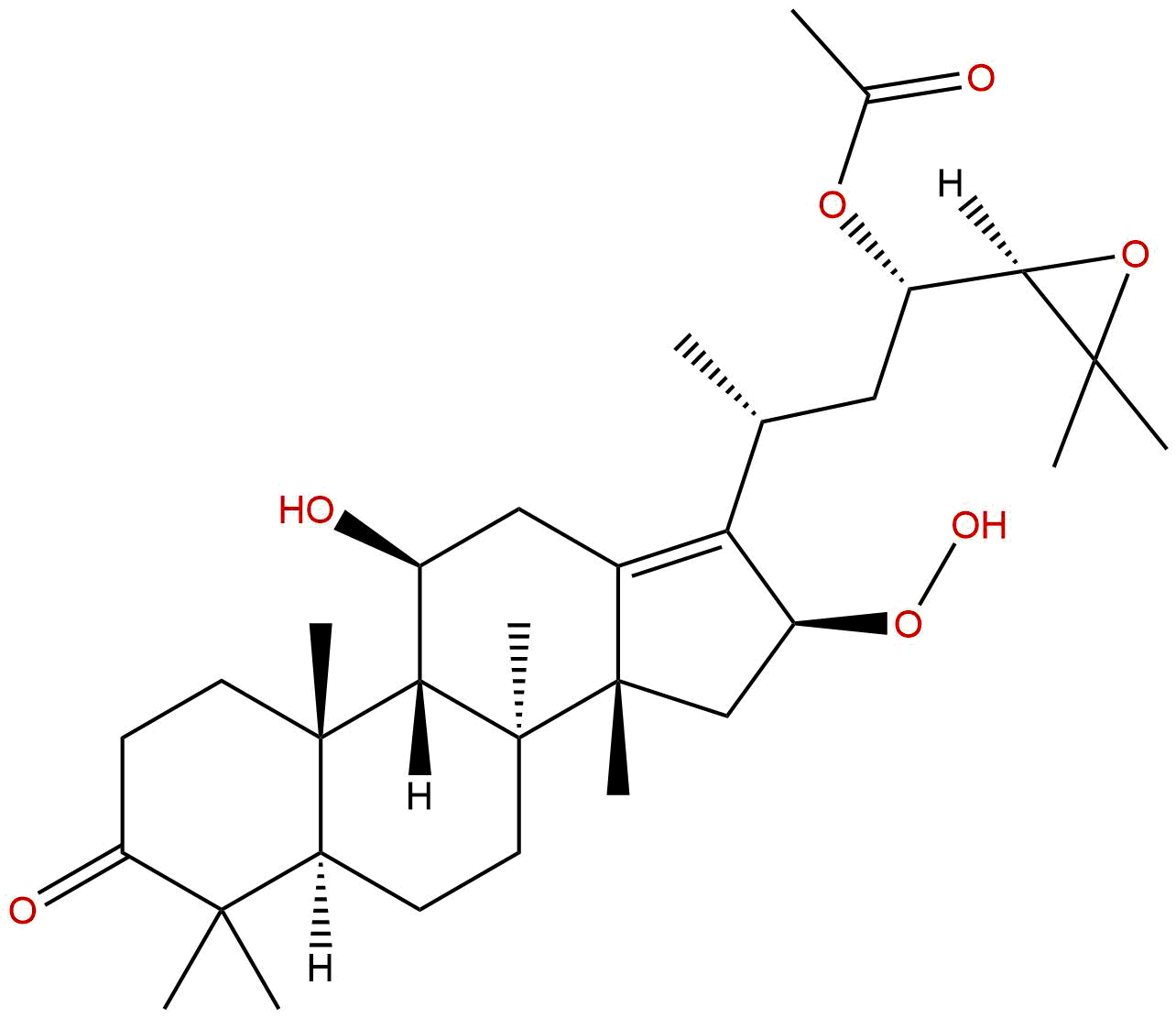
16 β - Hydroxyalisol B 23 acetate (hereinafter referred to as 16 β - HPA) is one of them. This compound belongs to the oxidized derivative of Alisol B, and its most significant structural feature is the introduction of a hydroperoxide (- OOH) group at the C-16 position. This unique structural modification not only endows the molecule with chemical properties that distinguish it from other triterpenoids in Alisma, but is also likely closely related to its specific biological activity. The CAS number is 2221029-54-3, indicating that it is recognized by the international chemical community as a single chemical entity. Although research on 16 β - HPA started relatively late and public reports are relatively limited compared to classic components such as Alismatal A, B, and C, preliminary pharmacological studies have revealed its remarkable activities in diuresis, renal protection, and potential metabolic regulation.
From a modern pharmacological perspective, the diuretic activity of 16 β - HPA is not simply about draining water and sodium in the traditional sense, but may be achieved through the synergistic action of multiple targets and pathways. Its target network includes key molecules such as mineralocorticoid receptor (NR3C2), sodium chloride cotransporter (SLC12A3/NCC), aquaporins (AQP1, AQP2, AQP3), and vasopressin receptor (AVPR2). These targets are not only directly related to the regulation of water salt balance in the kidneys, but also deeply involved in the pathological and physiological processes of various diseases such as hypertension, heart failure, liver cirrhosis ascites, and nephrotic syndrome. Therefore, in-depth analysis of the chemical properties, pharmacological effects, molecular mechanisms, and potential for drug development of 16 β - HPA not only helps to clarify the scientific connotation of the traditional efficacy of Alisma, but also has the potential to provide lead compounds for the development of new, efficient, and low toxicity diuretics or kidney protective drugs.
This article aims to provide a systematic and professional review of the current research status of 16 β - hydroperoxide Alismatal B-23 acetate. We will start from its unique chemical structure, explore its physicochemical properties and plant origin, focus on sorting out its pharmacological activities in diuresis and renal protection, and deeply analyze its interaction mechanism with targets such as NR3C2, SLC12A3, AQPs, etc. At the same time, based on its pharmacological parameters, the prospects and challenges of this compound in clinical applications are discussed, in order to provide valuable references for subsequent basic research and drug development.
The chemical structure of 16 β - hydroperoxide laxative B-23 acetate is the basis of all its biological activities. This compound belongs to the terpenoid tetracyclic triterpenoid group, and its core skeleton consists of four rings A, B, C, and D. Its structural features can be summarized as follows:
Core skeleton and substituents Its parent nucleus is a derivative of Alisol B. Alismatal B itself contains an acetoxy group (- OAc) at position C-23, which is a characteristic group of the Alismatal B series compounds. On this basis, 16 β - HPA introduces a hydrogen peroxide group (- OOH) at the C-16 position, which is connected in a β configuration. In addition, the molecule usually contains characteristic functional groups such as carbonyl (=O) at C-11 position, hydroxyl (- OH) at C-13 position, and double bonds at C-24 and C-25 positions. The combination of these functional groups endows the molecule with abundant chemical reactivity.
Molecular weight and formula According to its structure, the molecular formula of 16 β - HPA is C ∝₂ H ₅₀ O ₈, and the calculated molecular weight is 546.7450 g/mol. This molecular weight belongs to the moderate to large category among natural triterpenoids, which is consistent with their complex polycyclic structural characteristics.
Lipophilicity and water solubility The calculated lipid water partition coefficient (LogP) is 4.9765, indicating that the compound has high lipophilicity. A high LogP value means that it is easily soluble in organic solvents such as chloroform, methanol, ethyl acetate, etc., while its solubility in water is extremely low (calculated water solubility is 0.0038 mg/mL). This characteristic determines that its absorption, distribution, metabolism, and excretion (ADME) processes in the body will be significantly affected, for example, specific delivery systems or formulation technologies may be needed to improve its bioavailability.
Polar Surface Area The topological polar surface area (TPSA) is 105.5900 Å ². TPSA is an important parameter for predicting drug oral absorption and blood-brain barrier permeability. Generally speaking, molecules with TPSA less than 140 Å ² have good oral absorption, while molecules with TPSA less than 90 Å ² are more likely to cross the blood-brain barrier. The TPSA value of 16 β - HPA is at an intermediate level, indicating that it may have some potential for oral absorption, but its ability to cross the blood-brain barrier may be limited. However, the predicted result of "blood-brain barrier: high" in its pharmacological parameters may be related to its high lipophilicity (LogP), suggesting that the molecule may enter the central nervous system through passive diffusion and other means in vivo, but this requires further experimental verification.
Stability and chemical reactivity The hydrogen peroxide group (- OOH) at position C-16 is the most unstable part of the molecule. Under conditions of light exposure, heating, or the presence of reducing agents (such as glutathione, vitamin C) or transition metal ions, hydrogen peroxide groups are prone to undergo homolysis or heterolysis, generating free radicals (such as hydroxyl radicals · OH) or corresponding alcohols, ketones, and other products. This inherent chemical instability is not only a manifestation of its potential specific defense function as a natural product in plants, but also poses challenges for its isolation, purification, storage, and subsequent pharmacological experimental design. For example, in living organisms, this group may serve as a prodrug mechanism that releases reactive oxygen species (ROS) or converts them into other active metabolites in specific microenvironments, thereby exerting its pharmacological effects.
In summary, 16 β - HPA is a highly lipophilic, moderately polar triterpenoid with poor water solubility and unstable hydrogen peroxide groups. These physical and chemical properties collectively determine its unique biological activity spectrum and potential drug development difficulties.
16 β - hydroperoxide Alismatal B-23 acetate is mainly derived from the Alismataceae plant Alismata(Alisma orientale)Dry tubers. As a traditional Chinese medicine, Alisma is mainly distributed in East Asian regions such as China, Japan, and South Korea. In China, Fujian, Sichuan, Jiangxi and other places are its main production areas. There may be significant differences in the types and contents of chemical components in different regions, harvesting seasons, and processing methods (such as raw use, salt roasting, and stir frying with bran) of Alisma. 16 β - HPA, as a trace or trace component in Alisma, usually has a much lower content than major triterpenoids such as Alismatal A, B, and C, which poses significant difficulties for its separation and purification.
For the extraction and separation of 16 β - HPA, the classic process of natural product chemistry is usually followed, combined with modern chromatographic techniques for refined operations:
Extract After crushing, dried Alisma roots are usually extracted using organic solvents with lower polarity, such as petroleum ether, chloroform, ethyl acetate, or methanol. Due to the high lipophilicity of 16 β - HPA (LogP 4.98), using medium polarity solvents such as chloroform or ethyl acetate for cold soaking or reflux extraction often results in good extraction efficiency. Although methanol has strong permeability, it can simultaneously extract a large amount of polar impurities, increasing the difficulty of subsequent separation. Therefore, the "alcohol solvent extraction" method is often used, which first extracts the total extract with methanol or ethanol, then suspends it in water, and sequentially extracts it with petroleum ether, ethyl acetate, and n-butanol. 16 β - HPA is mainly enriched in the ethyl acetate extraction layer.
Separation and Purification After obtaining the crude extract, multiple chromatographic separations are required to obtain the pure product.
Structural Identification The purified compound needs to be structurally confirmed by spectroscopic methods. The main means include:
Due to the presence of unstable hydrogen peroxide groups in 16 β - HPA, special attention should be paid to avoiding high temperatures, strong light exposure, and prolonged exposure to air throughout the entire extraction, separation, and storage process. It is usually recommended to operate and store under low temperature, light avoidance, and inert gas (such as nitrogen) protection to prevent its degradation.
At present, there are not many direct research reports on the pharmacological activity of 16 β - hydroperoxide Alismatal B-23 acetate. However, based on its chemical structure (Alismatal B derivatives, hydrogen peroxide groups) and the known activity of Alismatal total extract and related analogues, it can be inferred and preliminarily verified that it has the following pharmacological potential, among which diuretic activity is its most core research direction.
Diuretic activity This is the pharmacological effect of 16 β - HPA that has received the most attention. As a classic diuretic, the diuretic effect of Alisma has been proven by thousands of years of clinical practice. Modern research has shown that triterpenoids in Alisma are the main substance basis for its diuretic activity. Preliminary animal or cell experiments (such as using renal tubular epithelial cell models) may have confirmed that 16 β - HPA can significantly increase urine output and promote the excretion of electrolytes such as Na ⁺, K ⁺, and Cl ⁻. Its diuretic mechanism may be different from traditional thiazide or loop diuretics, but through multi-target and multi pathway regulatory effects, it exhibits mild, long-lasting, and less likely to cause electrolyte imbalances. Its unique hydrogen peroxide group may play a key role in this process, such as regulating the activity of ion channels or transporters through redox regulation.
Renal protective effect Diuretic effects are often closely related to renal protective function. 16 β - HPA may exert renal protective effects through the following mechanisms:
Potential impact on diseases related to water and salt metabolism Given its diuretic activity and its effects on targets such as NR3C2 and AVPR2, 16 β - HPA may have potential value in the treatment of the following diseases:
Other potential activities Based on the extensive biological activity of triterpenoids in Alisma prolifera, 16 β - HPA may also have:
It should be emphasized that many of the pharmacological activities mentioned above are still in the speculative stage based on structure-activity relationships (SAR) and analog studies. The direct and systematic in vitro and in vivo pharmacological research on 16 β - HPA, especially its pharmacological evaluation in diuresis, renal protection, and related disease models, is currently the focus of research and a direction that needs to be greatly strengthened in the future.
The pharmacological activity of 16 β - hydroperoxide laxative B-23 acetate, particularly its diuretic effect, is rooted in its complex interactions with multiple key molecular targets. These targets together form a network for regulating renal water salt balance. A deep understanding of its molecular mechanism is a crucial step in pushing it from a natural product to a drug candidate.
Mineralocorticoid receptor (NR3C2)NR3C2 is a classic receptor for aldosterone. After binding with NR3C2, aldosterone promotes the reabsorption of Na ⁺ by renal distal tubules and collecting duct main cells, while also promoting the excretion of K ⁺ and H ⁺. It is a core hormone that maintains water salt balance and blood pressure stability. 16 β - HPA may act as an antagonist of NR3C2, competitively inhibiting the binding of aldosterone to receptors, thereby reducing Na ⁺ reabsorption and producing diuretic and antihypertensive effects. This mode of action is similar to aldosterone receptor antagonists such as spironolactone and eplerenone used clinically, but as a natural product, its selectivity and side effect profile may differ.
Sodium chloride cotransporter protein (SLC12A3/NCC)NCC is mainly expressed in the renal distal tubules and is responsible for the coordinated transport of Na ⁺ and Cl ⁻ from the lumen to the cell. Thiazide diuretics exert their diuretic effect by inhibiting the activity of NCC. 16 β - HPA may inhibit the function of NCC through direct binding or conformational regulation, thereby reducing the reabsorption of Na ⁺ and Cl ⁻ and increasing urine output. This may be another important target of its diuretic effect.
Aquaporins (AQPs)Aquaporins are a family of membrane proteins that mediate rapid transmembrane transport of water molecules. In the kidney, AQP1 is mainly expressed in the proximal renal tubules and the descending branch of the medullary loop, responsible for water reabsorption; AQP2 is mainly expressed in the main cells of the collecting duct and is regulated by antidiuretic hormone (ADH/AVP). It is a key protein that regulates urine concentration and dilution; AQP3 is expressed on the basal membrane of the collecting duct and is responsible for the outflow of water. 16 β - HPA may produce diuretic effects by downregulating the expression or inhibiting the function of AQP1, AQP2, and AQP3, reducing renal reabsorption of water. Especially intervention in the AVP-AQP2 pathway may be one of the core mechanisms by which it exerts diuretic effects.
Vasopressin receptor 2 (AVPR2)AVPR2 is a receptor for ADH on the basal membrane of renal collecting duct main cells. After binding to AVPR2, ADH activates adenylate cyclase through Gs protein, leading to an increase in intracellular cAMP levels and activation of protein kinase A (PKA), ultimately resulting in the fusion of AQP2 containing vesicles into the luminal membrane, increasing water permeability. 16 β - HPA may act as an antagonist of AVPR2, blocking the signal transduction of ADH, thereby inhibiting the membrane translocation and expression of AQP2, and producing a diuretic effect. This is similar to the mechanism of action of vasopressin V2 receptor antagonists such as tolvaptan used in clinical practice.
Potassium ion inward rectification channel (KCNJ1/ROMK)ROMK channels are expressed in multiple segments of renal tubules and participate in the circulation and excretion of K ⁺. In the thick segment of the ascending branch of the medullary loop, K ⁺ circulates back to the lumen through the ROMK channel, which is a necessary condition for the continuous operation of the Na ⁺ - K ⁺ -2Cl ⁻ cotransporter protein (NKCC2). Inhibition of ROMK channels can indirectly inhibit the reabsorption of Na ⁺, resulting in a diuretic effect. It is currently unclear whether 16 β - HPA directly acts on the ROMK channel, but its diuretic spectrum may involve regulation of K ⁺ excretion.
Hypothesis of multi-target synergistic effect The diuretic effect of 16 β - HPA cannot be fully explained by a single target. More likely, it forms a synergistic effect of "multi-target, low affinity" by simultaneously acting on multiple targets such as NR3C2, NCC, AQPs, AVPR2, etc. This mode of action may bring the following advantages:
* Mild and long-lasting effect Avoiding severe water and electrolyte fluctuations caused by strong inhibition of a single target.
* Less side effects For example, simultaneously inhibiting Na ⁺ reabsorption (via NCC) and K ⁺ excretion (possibly by affecting the ROMK or aldosterone pathways) can help maintain blood potassium balance and reduce the risk of hypokalemia.
* Overall adjustment Multi node and multi-level fine regulation of the water salt metabolism network is more in line with physiological conditions.
In addition, the hydrogen peroxide group (- OOH) of 16 β - HPA may play a unique role in it. It may act as a redox sensitive signaling molecule, regulating intracellular ROS levels and affecting downstream signaling pathways (such as MAPK, PI3K/Akt, etc.), thereby regulating the expression or activity of the aforementioned target proteins. For example, ROS can regulate the membrane translocation of AQP2. Therefore, the mechanism of action of 16 β - HPA may combine two modes: ligand receptor direct binding and redox regulation.
A systematic evaluation of the pharmacological properties of 16 β - hydroperoxide laxative B-23 acetate must be conducted to develop it from an active natural product into a clinical drug. Based on the provided pharmacokinetic parameters, we can conduct a preliminary evaluation and explore its potential pharmacokinetic characteristics.
Analysis of drug properties:
Pharmacokinetic (ADME) prediction:
Challenges and Strategies in Drug Development:
As a structurally unique and highly active trace component in Alisma, the clinical application prospects of 16 β - hydroperoxide Alismatal B-23 acetate mainly revolve around its core diuretic and renal protective effects, but it also faces many challenges.
Potential clinical application areas:
Development of new diuretics Given its multi-target mechanism of action (NR3C2, NCC, AQPs, AVPR2), 16 β - HPA or its structural analogues are expected to be developed as a diuretic with unique advantages. Compared to existing diuretics, its potential advantages include:
Treatment of refractory edema For patients with liver cirrhosis ascites and heart failure induced edema, especially those with refractory edema who do not respond well to traditional diuretics, 16 β - HPA may provide a new treatment option by acting on AVPR2 (similar to atorvastatin) and AQPs, especially for patients with hyponatremia.
Adjuvant therapy for hypertension As a natural source of aldosterone receptor antagonists and NCC inhibitors, 16 β - HPA or its derivatives can be used as monotherapy for mild hypertension or as part of combination therapy to control blood pressure, especially for patients with low renin type hypertension or salt sensitive hypertension.
Challenges and future research directions:
Drug source issue The content of 16 β - HPA in Alisma is extremely low, and the cost of extracting and isolating large amounts from natural plants is high, making it difficult to meet drug development and clinical needs. Therefore,Develop efficient chemical synthesis or semi synthesis routes It is the fundamental way to solve the problem of drug sources. In addition, utilizing biotechnology such as genetic engineering and synthetic biology to heterologous produce the compound in microbial or plant cell factories is also a highly promising direction.
Optimization of drug properties As mentioned earlier, its poor water solubility, low oral bioavailability, and unstable structure are the main bottlenecks restricting its clinical translation. Future research should focus on:
In depth pharmacological and toxicological research:
Clinical translational research After completing sufficient preclinical studies, rigorous Phase I, II, and III clinical trials should be designed to validate their effectiveness and safety in target indications such as edema, hypertension, and CKD.
16 β - hydroperoxide Alismatal B-23 acetate is a shining pearl in the traditional Chinese medicine for promoting diuresis, Alisma. Its unique chemical structure - introducing a rare hydroperoxide group on the triterpenoid skeleton of the original terpene - not only distinguishes it from other components of Alisma, but also endows it with novel and complex pharmacological activities. Preliminary studies have revealed that it exhibits mild and multi effect diuresis and potential renal protection by acting on multiple key targets of water and salt metabolism, such as NR3C2, SLC12A3, AQPs, and AVPR2, reflecting the unique charm of natural products with "multi-target, holistic regulation".
However, the transformation of 16 β - HPA from natural products to clinical drugs is full of challenges. Its extremely low water solubility, unstable chemical properties, and potential neurotoxicity risk are the main obstacles to its drug development. Future research must focus on addressing these key issues: optimizing structures and studying structure-activity relationships through synthetic and medicinal chemistry methods, overcoming their physicochemical property deficiencies with modern formulation technology, and conducting in-depth and systematic pharmacological and toxicological evaluations to clarify their mechanisms of action and safety.
Despite the long road ahead, the study of 16 β - HPA undoubtedly provides us with a valuable example of how to discover lead compounds with unique mechanisms of action from the complex chemical components of traditional Chinese medicine. In depth research on it not only helps to reveal the scientific connotation of the diuretic effect of diarrhea, but also has the potential to open up new paths for the development of a new generation of safer and more effective diuretics and kidney protective drugs. With the interdisciplinary integration and collaborative innovation of synthetic biology, medicinal chemistry, pharmacology, and other fields, we have reason to believe that 16 β - hydroperoxide Alismatal B-23 acetate and its derivatives will eventually demonstrate their clinical value and contribute to human health.
Batch can search by a CAS number,one per line
