


Product name: Britannin
Synonym name: Britanin; 2α,6α-diacetoxy-4β-hydroxy-11(13)-pseudoguaien-12,8α-olide
Catalogue No.: BPF0220
Cas No.: 33627-28-0
Formula: C19H26O7
Mol Weight: 366.41
Botanical Source:
Physical Description:
Type of Compound: Sesquiterpenoids
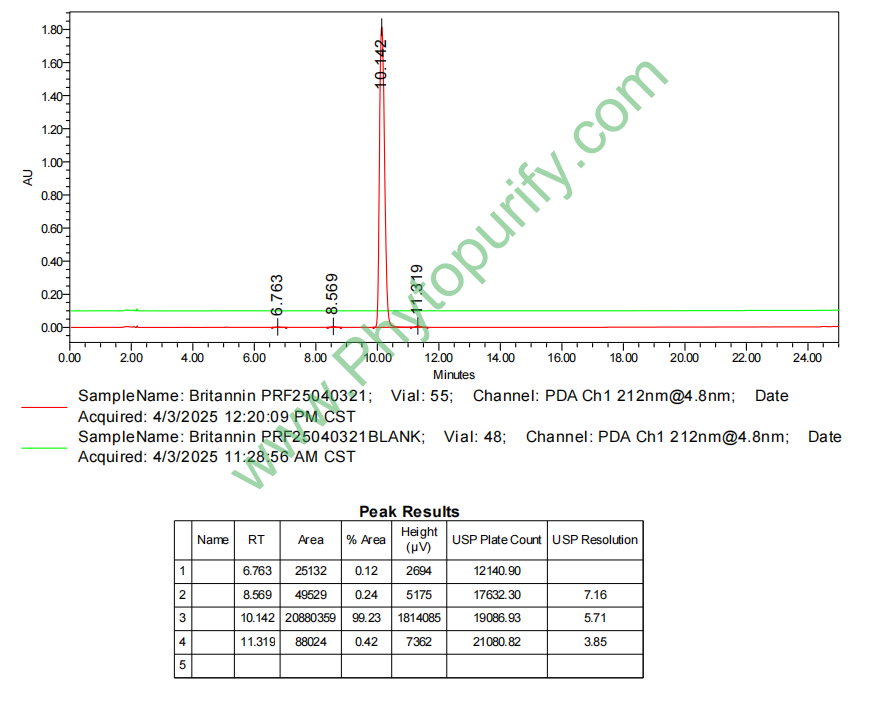
Purity: 95%~99%
Analysis Method: HPLC-DAD or/and HPLC-ELSD
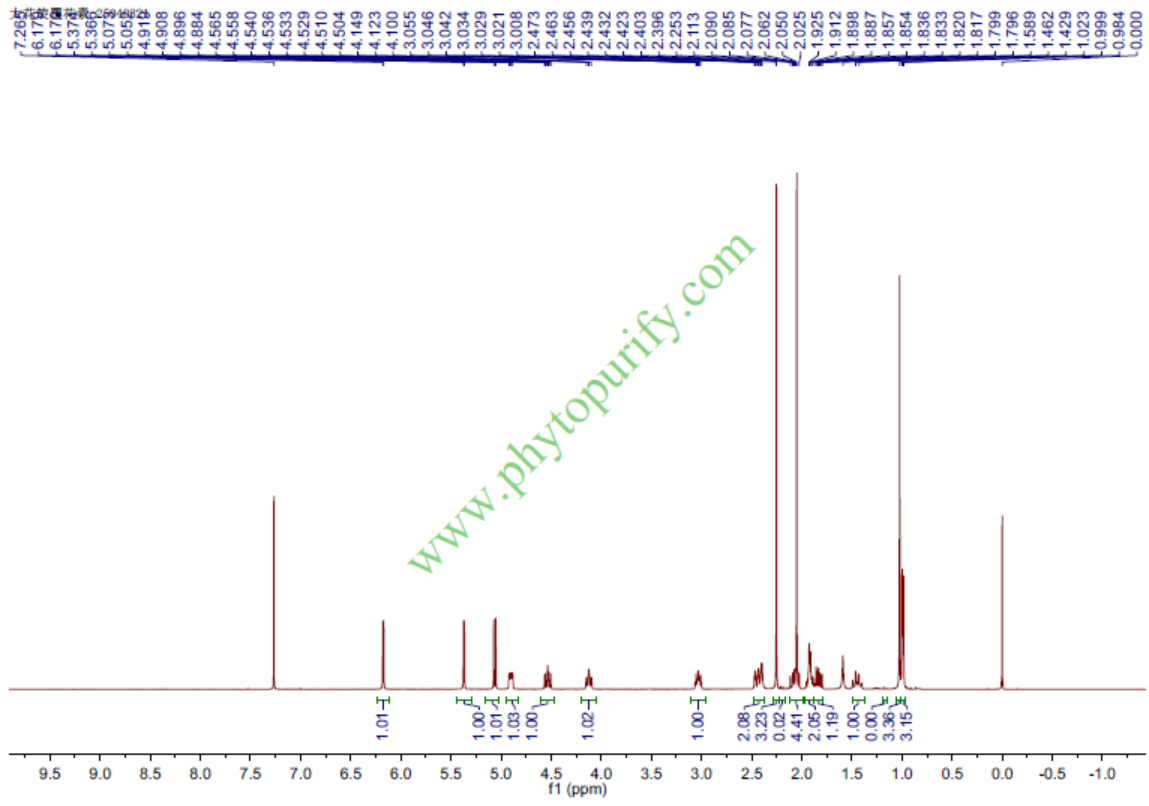
Identification Method: Mass, NMR
Packing: Brown vial or HDPE plastic bottle
Storage: Store in a well closed container, protected from air and light. Put into refrigerate or freeze for long term storage.
Whenever possible, you should prepare and use solutions on the same day. However, if you need to make up stock solutions in advance, we recommend that you store the solution as aliquots in tightly sealed vials at -20℃. Generally, these will be useable for up to two weeks.
The product could be supplied from milligrams to grams
Inquire for bulk scale.
For Reference Standard and R&D, Not for Human Use Directly.
HPLC of Britannin
HNMR of Britannin
Storage conditions:Short-term storage at 2~8℃, long-term storage at -20 ~ -80℃
99.1300
.9226
.9226
.6859
2.5906
2.6224
High
56.6626
4.7789
No
No
No
No
Yes
No
0.0
Yes
No
Yes
Yes
Natural products, as an important source of drug discovery, have long played an irreplaceable role in the prevention and treatment of human diseases. Among numerous natural compounds with biological activity, Britannin, a major compound from the Asteraceae family, has attracted widespread attention in recent years. Daphnetin is a sesquiterpene lactone compound with a unique chemical structure, with the molecular formula C ₁₉ H ₂₆ O ₇ and CAS number 33627-28-0. The compound was initially isolated and identified from Inula Britanica L., hence its name.
The genus Convolvulus has a long history of application in traditional medicine, often used to treat inflammatory diseases, respiratory infections, and digestive system diseases. As one of the characteristic active ingredients of this genus of plants, the pharmacological activity research of Dapagliflozin began in the late 20th century. In recent years, with a deeper understanding of the biology of inflammasomes, studies have found that magnolol can specifically inhibit the activation of NLRP3 inflammasomes, with a half maximal inhibitory concentration (IC50) of 3.630 μ M. This discovery provides a new candidate molecule for the treatment of inflammatory diseases.
What is even more remarkable is that Daphne grandiflorum exhibits various anti-tumor activities. Research has confirmed that this compound can enhance the anti-tumor immune response of cytotoxic T lymphocytes by blocking the interaction between HIF-1 α and Myc, inhibiting the expression of programmed death ligand 1 (PD-L1). In addition, Dapagliflozin can induce apoptosis and autophagy in liver cancer cells through the AMPK signaling pathway regulated by reactive oxygen species (ROS). These findings reveal the enormous potential of magnolol as a multi-target natural product, and its application prospects in anti-inflammatory and anti-tumor fields are promising.
This article will provide a systematic review of the research progress of Dapagliflozin from the aspects of chemical structure and physicochemical properties, plant sources and extraction methods, pharmacological activity research, mechanism of action and molecular targets, pharmacological evaluation and pharmacokinetics, clinical application prospects and prospects, in order to provide reference for the in-depth research and development of this compound.
Daphnetin belongs to the sesquiterpene lactone class of compounds, specifically pseudoguaianolide sesquiterpene lactones. Its chemical structure is based on a fifteen carbon skeleton composed of three isoprene units, containing an alpha, beta unsaturated gamma lactone ring, which is a characteristic structural unit shared by sesquiterpene lactones. The molecular structure of Dapagliflozin also contains multiple hydroxyl and acetoxy substituents, which are of great significance for its biological activity.
From the perspective of stereochemistry, crocetin has multiple chiral centers, and its absolute configuration has been determined by methods such as X-ray crystal diffraction and circular dichroism. The structural formula of this compound can be expressed as: 1 β, 4 β - dihydroxy-5 α, 7 β H-pseudoguaiacan-11 (13) - ene-12,8 β - lactone-8 α - acetate. The presence of the lactone ring makes the compound electrophilic and capable of undergoing Michael addition reactions with nucleophilic groups in biomolecules, such as thiol groups in cysteine residues, which is considered an important chemical basis for its pharmacological activity.
The molecular weight of Dapagliflozin is 366.4100 Da, which is a natural product with medium molecular weight. Its lipid water partition coefficient (LogP) is 0.9226, indicating that the compound has moderate lipophilicity, which is beneficial for transmembrane transport and interaction with target proteins. The topological polar surface area (TPSA) is 99.1300 Å ², which meets the basic requirements for oral drugs (usually TPSA<140 Å ²), indicating that it may have good oral bioavailability.
In terms of water solubility, the water solubility parameter of Daphne grandiflorum is 0.6859 mg/mL, which belongs to a slightly soluble compound. This characteristic may limit its formulation development, but through appropriate formulation techniques such as liposomes, nanoparticles, etc., it is expected to improve its solubility and bioavailability. It is worth noting that the compound has a high blood-brain barrier penetration ability, which provides a possibility for its application in the treatment of central nervous system diseases, but at the same time, it may also increase the risk of central nervous system toxicity.
In terms of safety prediction, computer simulation results show that Daphnetin does not have hERG potassium channel inhibitory activity, indicating a low risk of cardiac toxicity. The Ames test result was negative (0.0), indicating that the compound did not exhibit mutagenicity in bacterial reverse mutation assays, providing a safety basis for its further development.
The main source of the major floral compound is from the Asteraceae genus Inula plants. There are over 100 species of this genus of plants worldwide, widely distributed in temperate and tropical regions of Europe, Asia, and Africa. Among them, Inula Britanica L. is the main source plant of this compound. In addition, the presence of this compound has also been detected in closely related species such as Inula japonica Thunb. and Inula helenium L.
The large flowered spiral covered flower is a perennial herbaceous plant, with a height of 20-70 centimeters, upright stems, leaves that alternate, a head inflorescence diameter of 2.5-5 centimeters, yellow tongue shaped flowers, and bisexual tubular flowers. This plant is mainly distributed in Northeast, North, Northwest, and East China in China, and often grows in humid environments such as riverbanks, fields, and roadsides. Traditional Chinese medicine uses Xuanfu flower to treat cough, phlegm accumulation, chest and rib fullness, and other symptoms. Modern research has confirmed that it has various pharmacological activities such as anti-inflammatory, antibacterial, and anti-tumor effects.
The extraction of Daphne grandiflorum extract is usually carried out using organic solvent extraction method. Dry plant materials (usually aboveground parts) are crushed and soaked or refluxed with organic solvents such as methanol, ethanol, or ethyl acetate for extraction. After the extraction solution is concentrated under reduced pressure, crude extract is obtained. Due to the relatively low content of anthocyanins in plants, further isolation and purification steps are usually required.
Common separation and purification methods include silica gel column chromatography, preparative high-performance liquid chromatography (Prep HPLC), etc. Silica gel column chromatography often uses solvent systems such as chloroform methanol or petroleum ether ethyl acetate for gradient elution. In recent years, modern separation techniques such as high-speed countercurrent chromatography (HSCCC) and supercritical fluid chromatography (SFC) have also been applied to the separation and purification of anthocyanins, improving separation efficiency and purity.
It is worth noting that the extraction conditions (such as solvent type, temperature, time, etc.) have a significant impact on the extraction rate and stability of Daphne grandiflorum extract. Research has shown that using 70% ethanol for reflux extraction at 60 ℃ for 2 hours can achieve a higher extraction rate. In addition, due to the sensitivity of sesquiterpene lactones to heat and acidity, high temperature and extreme pH conditions should be avoided during the extraction process to prevent compound degradation.
The anti-inflammatory activity of Dapagliflozin is one of its most closely studied pharmacological effects. Research has shown that this compound can significantly inhibit lipopolysaccharide (LPS) - induced macrophage inflammatory response and reduce the production of pro-inflammatory cytokines such as tumor necrosis factor - α (TNF - α), interleukin-1 β (IL-1 β), and interleukin-6 (IL-6). In animal models, Dapagliflozin showed protective effects against acute inflammation models such as dextran sulfate sodium (DSS) - induced colitis and carrageenan induced toe swelling.
More importantly, magnolol has been identified as an NLRP3 inflammasome inhibitor. NLRP3 inflammasome is an important part of the innate immune system, and its abnormal activation is closely related to a variety of inflammatory diseases (such as gout, type 2 diabetes, Alzheimer's disease, etc.). The discovery that Daphnetin can inhibit the assembly and activation of NLRP3 inflammasomes with an efficacy of IC ₅₀ of 3.630 μ M provides a molecular basis for its application in the treatment of inflammatory diseases.
The anti-tumor activity of Echinacea grandiflorum Hance covers a variety of tumor types, including liver cancer, lung cancer, breast cancer, colorectal cancer, etc. In vitro experiments have shown that this compound can inhibit the proliferation of various tumor cell lines, induce cell cycle arrest and apoptosis. It is worth noting that the toxicity of Dapagliflozin to normal cells is relatively low, demonstrating a certain degree of selective anti-tumor activity.
In liver cancer research, magnolol induces autophagy and apoptosis in liver cancer cells by activating the AMPK signaling pathway. AMPK is a key regulatory factor in cellular energy metabolism, and its activation can inhibit the mTOR signaling pathway, thereby inducing autophagy. The study also found that the AMPK activation induced by Daphne grandiflorum depends on the production of ROS, suggesting that the ROS-AMPK axis plays an important role in its anti liver cancer activity.
In terms of immune regulation, magnolol can inhibit the expression of PD-L1 by blocking the interaction between HIF-1 α and Myc. PD-L1 is an important molecule for tumor cells to evade immune surveillance, and its downregulation can enhance the activity of cytotoxic T lymphocytes, thereby improving anti-tumor immune response. This discovery reveals the potential of magnolol as an immune checkpoint regulator, providing new ideas for tumor immunotherapy.
In addition to anti-inflammatory and anti-tumor activities, Dapagliflozin also exhibits various other pharmacological activities. Research has shown that the compound has antioxidant activity, can scavenge free radicals, and alleviate oxidative stress damage. In addition, Dapagliflozin also exhibits antibacterial, antiviral, and hepatoprotective effects, which may have synergistic effects with its anti-inflammatory and anti-tumor effects.
The mechanism by which magnolol inhibits NLRP3 inflammasome activation has been extensively studied. The assembly of NLRP3 inflammasomes requires the synergistic action of the three core components, NLRP3, ASC, and pro-caspase-1. In the resting state, NLRP3 is in a self inhibitory conformation; When stimulated by pathogen associated molecular patterns (PAMPs) or damage associated molecular patterns (DAMPs), NLRP3 undergoes conformational changes, recruiting ASC and pro-caspase-1 to form an active inflammasome complex.
Research has found that magnolol inhibits the assembly of inflammasomes by blocking the interaction between NLRP3 and NEK7. NEK7 is a member of the NIMA related kinase family and has been confirmed to be a key regulatory factor in NLRP3 inflammasome assembly. The binding of NEK7 to NLRP3 promotes the oligomerization of NLRP3 and the formation of inflammasomes. Dapagliflozin can directly bind to NLRP3 protein, interfering with its interaction with NEK7, thereby preventing the assembly of inflammasomes and subsequent activation of caspase-1 and secretion of IL-1 β.
The anti-tumor effect of Dapagliflozin involves multiple signaling pathways and molecular targets. In liver cancer cells, this compound activates the AMPK signaling pathway by increasing intracellular ROS levels. The activation of AMPK leads to the inhibition of mTORC1, which in turn induces autophagy. Meanwhile, AMPK activation can also promote cell apoptosis by phosphorylating downstream effector molecules such as p53. It is worth noting that ROS scavengers can reverse AMPK activation and cell death induced by magnolol, confirming the crucial role of ROS in this process.
In terms of immune regulation, magnolol inhibits the transcriptional expression of PD-L1 by blocking the interaction between HIF-1 α and Myc. HIF-1 α and Myc are two important transcription factors that can synergistically bind to the E-box element in the promoter region of the PD-L1 gene, activating the transcription of PD-L1. Dapagliflozin can disrupt the protein-protein interaction between HIF-1 α and Myc, reduce their binding to the PD-L1 promoter, and thus lower the expression level of PD-L1. The downregulation of PD-L1 weakens the immune suppression of tumor cells on T cells and enhances the killing activity of cytotoxic T lymphocytes.
In addition to the main mechanisms mentioned above, Dapagliflozin also acts on multiple molecular targets related to tumor occurrence and development. Research has shown that this compound can downregulate the expression of anti apoptotic proteins MCL1 and BCL2, while upregulating the expression of pro apoptotic protein Bax, thereby promoting tumor cell apoptosis. In addition, Dapagliflozin can also inhibit the activation of the STAT3 signaling pathway, which is a continuously activated oncogenic transcription factor in various tumors. Its inhibition can reduce the proliferation and survival ability of tumor cells.
In terms of tumor invasion and metastasis, Dapagliflozin can inhibit the expression and activity of matrix metalloproteinase 2 (MMP2), which is a key enzyme that degrades extracellular matrix and promotes tumor invasion and metastasis. In addition, the compound can inhibit the activity of topoisomerase I (TOP1) and topoisomerase II alpha (TOP2A), interfere with DNA replication and transcription processes, and exert anti proliferative effects.
Dapagliflozin also has a regulatory effect on the MAPK signaling pathway. The MAPK pathway (including ERK, JNK, and p38) plays an important regulatory role in cell proliferation, differentiation, and apoptosis. Research has shown that Dapagliflozin can inhibit the phosphorylation of ERK while activating JNK and p38. This differential regulation may be related to its ability to induce apoptosis in tumor cells.
In hormone related tumors, magnolol has a regulatory effect on estrogen receptor alpha (ESR1) and aromatase (CYP19A1). Aromatase is a key enzyme for estrogen synthesis. Its inhibition can reduce the level of estrogen and has therapeutic significance for estrogen dependent breast cancer. These multi-target action characteristics make magnolol a natural product with broad-spectrum anti-tumor activity.
A systematic evaluation of the pharmacological properties of Daphnetin was conducted based on computational medicinal chemistry methods. The molecular weight of this compound is 366.4100 Da, which meets the requirement of Lipinski's five rules for molecular weight less than 500. The LogP value is 0.9226, indicating that it has moderate lipophilicity and is beneficial for oral absorption. The TPSA is 99.1300 Å ², below the threshold of 140 Å ², indicating good intestinal permeability.
In terms of absorption, the water solubility of Dapagliflozin is 0.6859 mg/mL, which is a low solubility compound, which may limit its oral bioavailability. However, it is expected to improve its solubility and dissolution rate through formulation techniques such as solid dispersions, lipid nanoparticles, etc. This compound has a high blood-brain barrier penetration ability, which provides a possibility for its application in the treatment of central nervous system diseases, but potential central nervous system toxicity also needs to be considered.
In terms of safety, computer prediction results show that Daphnetin does not have hERG potassium channel inhibitory activity, indicating a low risk of cardiac toxicity. The Ames test result is negative, indicating that the compound does not have significant mutagenicity. These security data provide favorable conditions for its further development.
At present, there is insufficient research on the pharmacokinetics of Dapagliflozin. Preliminary studies suggest that this compound may undergo extensive metabolism in vivo, with major metabolic pathways including hydrolysis of lactone rings, glucuronidation and sulfation of hydroxyl groups. Due to the electrophilicity of sesquiterpene lactones, they may undergo binding reactions with nucleophilic molecules such as glutathione, which may be an important pathway for their metabolism and detoxification in vivo.
In terms of distribution, the high blood-brain barrier penetration ability of Daphnetin suggests that its distribution in the central nervous system may be relatively widespread. This feature has potential advantages for treating brain tumors or neuroinflammatory diseases, but attention should also be paid to possible central nervous system side effects.
The effect of magnolol on cytochrome P450 enzyme system has not been fully elucidated. Considering its characteristic as an electrophilic compound, this compound may have inhibitory or inducing effects on CYP450 enzymes, which requires systematic evaluation during drug development. In addition, further research is needed on the interaction between Dapagliflozin and commonly used drugs to ensure the safety of clinical use.
Based on the specific inhibitory effect of magnolol on NLRP3 inflammasome, this compound has broad application prospects in the treatment of inflammatory diseases. NLRP3 inflammatory bodies are associated with many diseases, including gout, type 2 diabetes, atherosclerosis, Alzheimer's disease, etc. As an NLRP3 inhibitor, Daphnetin may have therapeutic potential for these diseases.
It is worth noting that Dapagliflozin inhibits inflammasome activation by blocking the interaction between NLRP3 and NEK7, which is different from other NLRP3 inhibitors (such as MCC950, CY-09, etc.) and may have unique pharmacological properties and safety advantages. Future research should further evaluate its efficacy and safety in animal models of chronic inflammatory diseases, laying the foundation for clinical trials.
The discovery that Dapagliflozin enhances cytotoxic T lymphocyte activity by inhibiting PD-L1 expression provides a new strategy for tumor immunotherapy. Compared with traditional PD-1/PD-L1 antibody drugs, small molecule inhibitors have advantages such as oral administration, low cost, and good tissue permeability. As a natural product derived PD-L1 expression inhibitor, Dapagliflozin has the potential to be further developed as a tumor immunotherapy drug.
In addition, the multi-target anti-tumor activity of Dapagliflozin may lead to synergistic effects with other anti-tumor drugs. For example, combined use with chemotherapy drugs can enhance anti-tumor efficacy, while combined use with immune checkpoint inhibitors may improve the response rate of immunotherapy. These combination therapy strategies are worth further exploration.
Despite the various pharmacological activities and good pharmacological parameters of Daphne grandiflorum, its development still faces some challenges. Firstly, the low water solubility of this compound may affect its oral bioavailability. Improving its solubility and bioavailability through formulation techniques such as nanoparticles, liposomes, cyclodextrin inclusion complexes, etc. is an important research direction.
Secondly, as an electrophilic compound, Daphnetin may undergo non-specific binding with non target proteins, leading to off target effects and toxicity. Reducing its electrophilicity through structural modification or developing prodrug strategies may help improve its selectivity and reduce toxicity.
In addition, the pharmacokinetic characteristics of Dapagliflozin need further clarification, including its absorption, distribution, metabolism, and excretion processes in vivo, as well as possible drug interactions. These data are crucial for determining dosing regimens and predicting clinical efficacy.
In the future, research on the binding of anthocyanins to NLRP3 protein should focus on the following aspects: firstly, to clarify the molecular mechanism of its binding with NLRP3 protein, and to determine the binding site and binding mode through structural biology methods such as X-ray crystallography and molecular docking, providing guidance for structural optimization. Secondly, the system evaluates its efficacy and safety in various animal models of diseases, especially chronic inflammatory diseases and tumor models. Thirdly, conduct pharmaceutical chemistry research to enhance its activity, selectivity, and pharmacokinetic properties through structural modifications. Fourthly, explore its combined application strategies with other drugs, especially its synergistic effects with immunotherapy drugs. Fifth, develop formulations suitable for clinical applications to improve their bioavailability and therapeutic efficacy.
As a sesquiterpene lactone compound derived from traditional medicinal plants, Daphne grandiflorus exhibits various pharmacological activities and unique molecular mechanisms of action. As an NLRP3 inflammasome inhibitor, it exerts anti-inflammatory effects by blocking the interaction between NLRP3 and NEK7; Meanwhile, it exerts anti-tumor activity by regulating the HIF-1 α/Myc/PD-L1 axis and ROS/AMPK signaling pathway. These findings not only reveal the pharmacological basis of magnolol, but also provide new candidate molecules for the treatment of inflammatory diseases and tumors.
From the perspective of medicinal properties, Daphnetin has favorable characteristics such as moderate molecular weight, good lipid solubility, low cardiac toxicity, and low mutagenicity, and has the potential for further development. However, its low water solubility and potential off target effects remain challenges that need to be overcome. Through drug chemical modification, formulation optimization, and combination therapy strategies, it is expected to transform these challenges into opportunities.
In summary, as a natural product with multi-target action characteristics, Daphnetin has shown important research value and development prospects in the fields of anti-inflammatory and anti-tumor. With a deeper understanding of its pharmacological mechanism and pharmacokinetic characteristics, as well as advances in medicinal chemistry and formulation technology, Dapagliflozin is expected to become a new candidate drug for the treatment of inflammatory diseases and tumors. Future research should continue to deepen our understanding of its mechanism of action, optimize its pharmacological properties, and promote its translation into clinical applications.
