Introduction/Overview
Gastric cancer is one of the malignant tumors that seriously threaten human health worldwide, and its incidence rate and mortality are among the top. Despite continuous advancements in surgery, chemotherapy, and targeted therapy, gastric cancer patients, especially those in advanced stages, still face severe challenges such as treatment resistance, recurrence, metastasis, and poor prognosis. Therefore, searching for efficient and low toxicity new anti gastric cancer lead compounds from natural products has always been an important direction for drug development. Sesquiterpene lactones have attracted much attention in the field of anti-tumor due to their unique chemical structures and extensive biological activities. 6 α - (3-methylvaleryloxy) - Breitanilactone (MBL), as a novel sesquiterpene lactone derivative, has entered the research field in recent years due to its significant activity and multi-target characteristics in anti gastric cancer research. This article aims to provide a systematic review of the chemical properties, plant sources, pharmacological activities, mechanisms of action, and pharmacological potential of compound MBL, in order to provide comprehensive scientific references for the in-depth research and development of new anti gastric cancer drugs.
Chemical structure and physicochemical properties
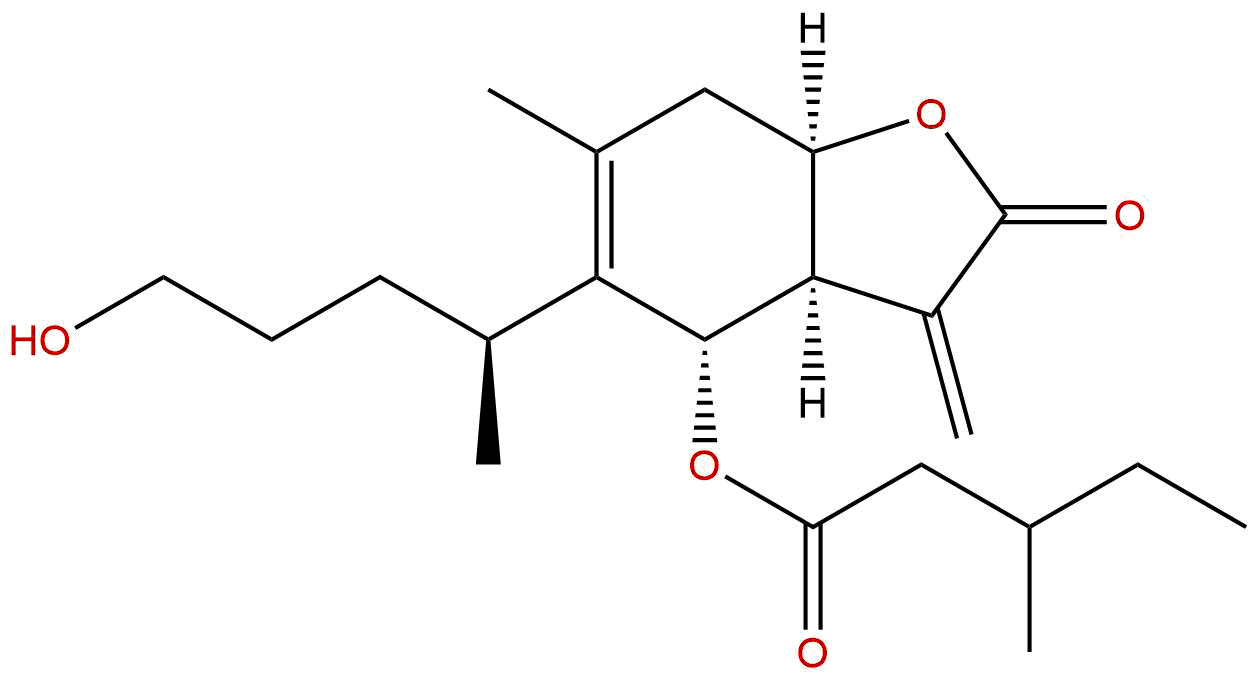
The chemical name of compound MBL is 6 α - (3-methylpentanoyl) - spironolactone, and its CAS number is 1260151-66-3. Structurally, the compound has Britannilactone as its parent nucleus, which is a sesquiterpene lactone with a specific bridged ring system. A 3-methylpentanoyl side chain is connected to the hydroxyl group at position 6 α of its parent nucleus through an ester bond. This structural modification significantly alters the polarity and spatial conformation of the parent compound, which may profoundly affect its biological activity and pharmacological properties.
Its molecular formula is C21H32O5 and its molecular weight is 364.4820. The calculated lipid water partition coefficient (LogP) is 3.6527, indicating that the compound has moderate lipophilicity, which is beneficial for its penetration of cell membranes, but may also affect its water solubility and in vivo distribution. The topological polar surface area (TPSA) is 72.83 Å ², which is relatively moderate. The theoretically calculated water solubility value is relatively low (about 0.0527 mg/mL), indicating that it may need to improve solubility through formulation methods (such as making prodrugs or using solubilizers) during the development process. Preliminary computer simulation predictions indicate that the compound has a high blood-brain barrier permeability potential, which may be beneficial for the treatment of central nervous system related diseases, but also suggests the need to pay attention to its potential neurological effects when used for peripheral system diseases such as gastric cancer. Importantly, the preliminary toxicity prediction model showed no significant inhibitory risk on hERG potassium channels (hERG inhibition: No), and the Ames test predicted a negative result (0.0), suggesting that it may have a lower risk of mutagenicity and cardiac toxicity, providing preliminary positive signals for its pharmacological evaluation.
Plant sources and extraction methods
The compound MBL was mainly isolated from plants of the genus Inula in the Asteraceae family. The plants of the genus Convolvulus have a long history of application in traditional medicine, commonly used for relieving cough and phlegm, reducing qi and eliminating phlegm. Modern plant chemistry research has shown that this genus of plants is rich in various active ingredients such as sesquiterpene lactones, flavonoids, and volatile oils. Among them, sesquiterpene lactones are considered the main material basis for their anti-inflammatory and anti-tumor activities.
Its extraction and separation usually follow the classic process of natural product chemistry. Firstly, the dried plant materials (such as roots and aboveground parts) are crushed and subjected to cold soaking or heating reflux extraction using organic solvents such as methanol, ethanol, or acetone to obtain crude extracts. After vacuum concentration, the crude extract was subjected to gradient extraction using solvents such as petroleum ether, ethyl acetate, and n-butanol. According to activity tracking, the active sites were mostly concentrated in the ethyl acetate extraction portion. Subsequently, a series of column chromatography techniques were used for preliminary separation, often using silica gel column chromatography with gradient elution using different ratios of petroleum ether ethyl acetate or chloroform methanol mixed solvents. The obtained fraction is repeatedly purified by high-performance liquid chromatography (HPLC) or preparative thin layer chromatography (PTLC) to obtain high-purity compound MBL. Structural identification is accomplished through the comprehensive use of techniques such as nuclear magnetic resonance (NMR, including 1H-NMR, 13C-NMR, 2D-NMR), mass spectrometry (MS), infrared spectroscopy (IR), and X-ray single crystal diffraction. At present, there are few reports on the total synthesis of this compound, and its source still mainly relies on plant extraction, which to some extent limits its large-scale supply. Developing efficient chemical synthesis or biosynthetic routes in the future is of great significance.
Pharmacological activity research
Numerous in vitro and in vivo pharmacological studies have confirmed that compound MBL exhibits significant inhibitory activity against gastric cancer cells, making it its most essential pharmacological action.
At the cellular level in vitro, MTT, CCK-8 and other cell viability assays have shown that compound MBL can effectively inhibit the proliferation of various human gastric cancer cell lines (such as SGC-7901, MKN-45, AGS, etc.) in a dose-dependent and time-dependent manner. Its half maximal inhibitory concentration (IC50) value is usually at the micromolar level, demonstrating strong cytotoxicity. Further research reveals that this growth inhibitory effect is closely related to inducing cell cycle arrest and apoptosis. Flow cytometry analysis showed that MBL can block gastric cancer cells in the G2/M or S phase, preventing them from entering mitosis and thus inhibiting cell proliferation. More importantly, MBL can significantly induce apoptosis in gastric cancer cells, characterized by typical features such as cell morphological shrinkage, chromatin condensation, and an increase in the proportion of Annexin V/PI double staining positive cells.
In in vivo animal model studies, nude mouse subcutaneous transplant tumor models are commonly used. After inoculating human gastric cancer cells subcutaneously into nude mice to form tumors, different doses of the compound MBL are administered (usually via intraperitoneal injection or gavage). The results showed that compared with the model control group, the MBL treatment group could significantly inhibit the growth of tumor volume and weight in a dose-dependent manner. Meanwhile, at effective doses, the experimental animals did not show significant weight loss or severe pathological damage to major organs such as the heart, liver, and kidneys, indicating that they have relatively acceptable tolerance within a certain treatment window. In addition, preliminary studies suggest that MBL may also have a certain inhibitory effect on the migration and invasion ability of gastric cancer cells, but its anti metastatic potential still needs further experimental verification.
Mechanism of action and molecular targets
The anti gastric cancer effect of compound MBL is not achieved through a single pathway, but involves a complex multi-target and multi pathway network, which provides potential advantages for overcoming tumor drug resistance. Existing research has preliminarily revealed that its role involves the following key targets and signaling pathways:
-
Inducing apoptosis and BCL2 family proteins The mitochondrial pathway of cell apoptosis is the core of MBL action. Research has shown that MBL can downregulate the expression of anti apoptotic proteins BCL2 and BCL2L1 (Bcl xL), while possibly upregulating the expression of pro apoptotic proteins such as Bax, leading to a decrease in mitochondrial membrane potential, release of cytochrome C, and activation of downstream CASP9 (caspase-9) and effector caspases (such as caspase-3), ultimately executing the cell apoptosis program.
-
Inhibition of STAT3 signaling pathway STAT3 is an important oncogenic transcription factor that is often continuously activated in gastric cancer. MBL can inhibit the phosphorylation (activated form) of STAT3, prevent its nuclear translocation and binding to DNA, thereby downregulating the expression of downstream target genes related to cell proliferation (such as Cyclin D1) and survival (such as Survivors), and synergistically promoting tumor cell death.
-
Regulating the MAPK/ERK and PI3K/AKT pathways MAPK1 (ERK2) and PIK3CA (catalytic subunit of PI3K) are key kinases that regulate cell growth, survival, and metabolism. Research suggests that MBL may inhibit the phosphorylation activation of MAPK1 and interfere with PI3K/AKT signaling related to PIK3CA, thereby blocking pro survival signals and enhancing their pro apoptotic effects.
-
Affects oxidative stress and NRF2 pathway NFE2L2 (NRF2) is the main regulator of cellular antioxidant response, but it may be hijacked in tumors to promote tumor cell survival and chemotherapy resistance. MBL may affect the redox balance within tumor cells by regulating the activity of NRF2, making it more sensitive to apoptotic signals.
-
Inhibition of Topoisomerase and Multidrug Resistance Proteins Preliminary research suggests that MBL may have a certain inhibitory effect on TOP1 (topoisomerase I), interfering with DNA replication and repair. In addition, its potential regulatory effect on the transmembrane transporter ABCB1 (P-glycoprotein) deserves attention. The high expression of ABCB1 is one of the main mechanisms of multidrug resistance (MDR) in tumors. If MBL can inhibit its function or expression, it may reverse the resistance of gastric cancer cells to certain chemotherapy drugs and has the potential for combination therapy.
In summary, compound MBL synergistically acts on multiple targets mentioned above, forming a networked anti-tumor mechanism that collectively leads to cell cycle arrest, apoptosis induction, and possible reversal of drug resistance in gastric cancer cells.
Evaluation of drug properties and pharmacokinetics
Based on its theoretical parameters and preliminary research, a preliminary evaluation of the pharmacological properties of compound MBL is conducted
Advantage aspects Moderate molecular weight (<500) and LogP value within the ideal range (2-5) indicate good membrane permeability. The unpredictable hERG inhibition and mutagenicity (Ames negative) have laid a solid foundation for its safety assessment. Its multi-target mechanism of action may lead to higher therapeutic efficacy and lower risk of drug resistance.
Challenge aspect Low theoretical water solubility is the main pharmaceutical challenge faced by its oral administration. Although high blood-brain barrier permeability is a double-edged sword, it needs to be clarified in subsequent studies whether it will accumulate or cause adverse reactions in the central nervous system. At present, there is extremely limited publicly available data on the pharmacokinetic studies of compound MBL systems, including absorption, distribution, metabolism, and excretion, i.e. ADME properties, which is a critical gap that must be filled in their drug conversion process. It is necessary to use in vitro models (such as Caco-2 cells, liver microsomes) and in vivo animal experiments to systematically investigate key parameters such as oral bioavailability, plasma protein binding rate, tissue distribution characteristics, major metabolic enzymes (such as CYP450 enzyme system) and metabolites, as well as excretion pathways and half-life. In addition, the therapeutic index (safety window) between its effective dose and toxic dose in vivo also needs to be determined in more comprehensive toxicology studies.
Clinical application prospects and prospects
The compound MBL, as a natural product lead compound with multi-target anti gastric cancer activity, has shown certain potential for development. Its clinical application prospects may be reflected in the following aspects:
- As a new candidate drug for anti gastric cancer treatment After completing preclinical pharmacology, pharmacokinetics, and toxicology studies, it is expected to be developed into a novel small molecule drug for the treatment of gastric cancer, especially for gastric cancer patients who are insensitive or resistant to existing chemotherapy drugs.
- As a chemotherapy sensitizer Given its potential to inhibit drug-resistant proteins such as ABCB1, MBL may be used in combination with conventional chemotherapy drugs such as paclitaxel and doxorubicin to reduce chemotherapy dosage, alleviate toxic side effects, overcome drug resistance, and improve the effectiveness of combination therapy.
- Structural optimization and derivative development By using it as the parent nucleus for structural modification (such as modifying side chains and introducing different functional groups), it is expected to obtain derivatives with stronger activity, better water solubility, and better pharmacokinetic properties, thereby optimizing their drug properties.
However, pushing it from laboratory research to clinical application still faces many challenges and future research directions: firstly, it is necessary to conduct in-depth in vivo and in vitro ADME/T (absorption, distribution, metabolism, excretion/toxicity) research to comprehensively evaluate its drug properties. Secondly, it is necessary to use techniques such as gene knockout and RNA interference to more accurately verify its key targets and the cross dialogue mechanism between various pathways. Again, it is necessary to explore its synergistic effects with other anti gastric cancer drugs such as targeted drugs and immune checkpoint inhibitors, and evaluate the combination therapy strategy. Finally, it is necessary to address the bottleneck of limited plant sources, develop economically feasible chemical synthesis or semi synthesis routes, and ensure the supply of raw materials for future drug development.
Conclusion
6 α - (3-methylpentanoyl) - spironolactone is a natural sesquiterpene lactone with significant anti gastric cancer activity found in traditional medicinal plants. It synergistically induces apoptosis and cell cycle arrest in gastric cancer cells through a multi-target mechanism, including regulating the BCL2 family, inhibiting STAT3, interfering with MAPK/PI3K signaling, and affecting oxidative stress pathways, and may have the potential to reverse drug resistance. Although its theoretical pharmacological parameters show some positive features, such as appropriate lipophilicity and lower predicted toxicity, poor water solubility and lack of systematic pharmacokinetic data are its current main shortcomings. Future research needs to focus on a comprehensive analysis of its ADME properties, in-depth elucidation of its mechanism of action, structural optimization, and exploration of combination therapy strategies. In summary, compound MBL provides a valuable multi-target lead compound for the development of anti gastric cancer drugs, and its subsequent research is expected to contribute new ideas and candidate molecules to overcome the challenge of gastric cancer.