Introduction/Overview
Forsythoside E, CAS number 93675-88-8, is a traditional Chinese medicine derived from Forsythia suspensa(Forsythia suspensa)Phenylethanoid glycosides isolated from fruits. Forsythia suspensa, as a representative medicinal herb for clearing heat and detoxifying, is widely used in the clinical practice of traditional Chinese medicine to treat diseases such as wind heat, cold, abscess, swelling, and sore throat. Its modern pharmacological research reveals that its rich active ingredients are the material basis for its therapeutic effect. Phenylethanoid glycosides are an important class of active ingredients in Forsythia suspensa, among which Forsythia suspensa glycoside E has attracted much attention due to its unique chemical structure and significant biological activity. In recent years, with the deepening development of systems pharmacology and molecular biology techniques, the pharmacological effects of Forsythia suspensa glycoside E in anti-inflammatory, antioxidant, antiviral and other aspects have been continuously elucidated, especially in the treatment potential of respiratory inflammatory diseases such as pneumonia, showing broad prospects. This article aims to provide a systematic review of the chemical structure, plant origin, pharmacological activity, mechanism of action, medicinal properties, and clinical application prospects of Forsythia suspensa glycoside E, in order to provide comprehensive scientific references for the in-depth research and development of this compound.
Chemical structure and physicochemical properties
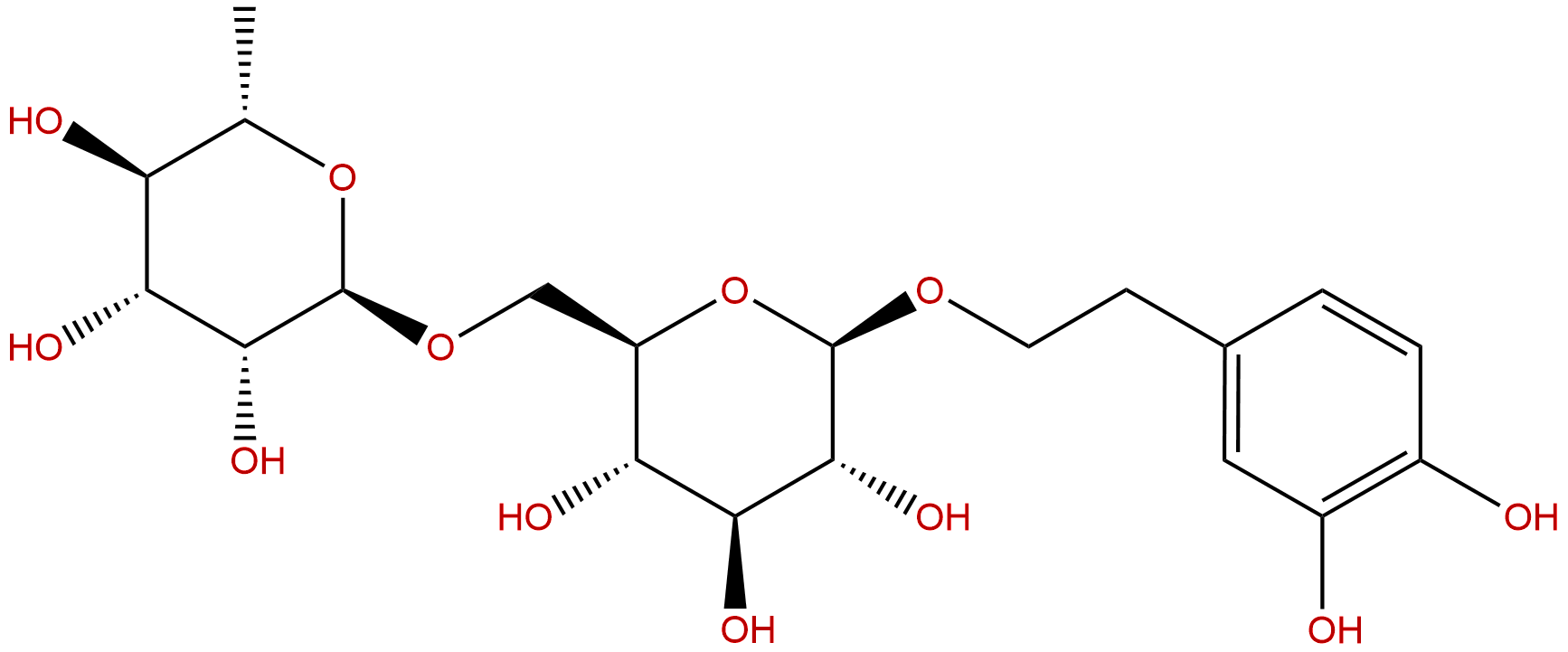
Forsythian glycoside E belongs to the phenylethanoid glycoside class, with a molecular formula of C20H30O12 and a molecular weight of 462.4480. Its basic structure consists of phenylethanolic glycosides (hydroxytyrosol) connected to caffeic acid through ester bonds, and further connected to one molecule of rhamnose and one molecule of glucose through glycosidic bonds, forming complex polyhydroxy and polyphenolic hydroxyl structures. This structure endows it with significant polarity and hydrophilicity.
The key physicochemical property parameters are as follows: the calculated lipid water partition coefficient (LogP) is -0.9665, indicating that the compound has a high degree of hydrophilicity, which is consistent with the structural characteristics of multiple hydroxyl and sugar groups in the molecule. The topologically polar surface area (TPSA) is as high as 198.7600 Å ², further confirming its strong polarity characteristics and indicating that its transmembrane permeability may be limited. The water solubility value is 21.4194 mg/mL, indicating good solubility in water, which is beneficial for its development in water-based formulations. Based on its physicochemical properties, it is predicted that the compound has a low ability to penetrate the blood-brain barrier and is mainly distributed in the peripheral system. In addition, preliminary pharmacological risk assessment showed no significant hERG potassium channel inhibitory activity (hERG inhibition: No), and the Ames test result was 0.0, indicating a low potential mutagenic risk and providing preliminary positive signals for subsequent safety evaluation.
Plant sources and extraction methods
Forsythia suspensa glycoside E is mainly derived from the plant Forsythia suspensa in the family Rhinoceros(Forsythia suspensa The dried fruit of Thunb. Vahl, also known as the traditional Chinese medicine "Forsythia suspensa" or "Qingqiao". The content of Forsythia suspensa glycoside E is relatively high in Forsythia suspensa fruit and is one of its characteristic components. In addition, in plants of the same genus such as the Golden Bell Flower(Forsythia viridissima)There have also been reports of similar phenylethanolic glycosides in some plants of the Hedyotis family (such as Cistanche deserticola), but Forsythia suspensa remains its main and most economically valuable source.
The extraction and separation method follows the conventional process of natural product chemistry. Firstly, alcohol solvents (such as methanol, ethanol) or alcohol water mixed solvents are used to reflux extract or ultrasound assisted extract the dried fruit powder of Forsythia suspensa, in order to fully extract the highly polar phenylethanolic glycosides. Subsequently, the crude extract was enriched and purified using macroporous adsorption resins (such as D101, AB-8 type), and gradient elution was performed using ethanol water solutions of different concentrations. Forsythia suspensa glycoside E is usually enriched in the high proportion aqueous phase or low concentration alcohol elution site. Further purification relies on modern chromatographic techniques, including silica gel column chromatography, reverse phase silica gel column chromatography (such as ODS-C18), as well as high-performance liquid chromatography (HPLC) and preparative high-performance liquid chromatography (pre HPLC). The chemical structure can be ultimately identified through spectroscopic techniques such as nuclear magnetic resonance (NMR) and mass spectrometry (MS). Optimizing the extraction process (such as solvent ratio, temperature, time) and using combined chromatography technology are key to improving the yield and purity of Forsythia suspensa glycoside E.
Pharmacological activity research
A large number of in vitro and in vivo pharmacological studies have shown that Forsythia suspensa glycoside E has multiple biological activities, with its core functions concentrated in anti-inflammatory, antioxidant, antibacterial, and immune regulatory aspects.
-
anti-inflammatory activity This is the most prominent pharmacological effect of Forsythia suspensa glycoside E. In the lipopolysaccharide (LPS) - induced macrophage (such as RAW264.7) inflammation model, Forsythian E can dose dependently inhibit the excessive production of nitric oxide (NO), prostaglandin E2 (PGE2), and key inflammatory mediators such as tumor necrosis factor - α (TNF - α), interleukin-6 (IL-6), and interleukin-1 β (IL-1 β). In various animal inflammation models, such as mouse ear swelling model, rat paw swelling model, and acute lung injury/pneumonia model, Forsythian E has also shown significant anti-inflammatory effects, reducing tissue edema, inflammatory cell infiltration, and histopathological damage.
-
antioxidant activity The phenolic hydroxyl structure in Forsythia suspensa glycoside E molecule makes it an effective free radical scavenger. In vitro experiments have confirmed that it has significant scavenging ability against 1,1-diphenyl-2-trinitrophenylhydrazine (DPPH) free radicals, 2,2 ` - diazobis (3-ethylbenzothiazoline-6-sulfonic acid) free radicals, and superoxide anions. In the cellular oxidative stress model, it can enhance the activity of intracellular antioxidant enzymes such as superoxide dismutase (SOD) and glutathione peroxidase (GSH Px), reduce the levels of lipid peroxidation products such as malondialdehyde (MDA), and protect cells from oxidative damage.
-
Antibacterial and antiviral activity Research has shown that Forsythia suspensa glycoside E has a certain inhibitory effect on various Gram positive and Gram negative bacteria. More importantly, it exhibits inhibitory activity against certain respiratory viruses such as influenza virus, respiratory syncytial virus, etc., which is consistent with its traditional efficacy in treating exogenous wind heat.
-
Other activities Some studies also suggest that Forsythia suspensa glycoside E may have potential activities such as liver protection and neuroprotection, but these effects still need further systematic research to confirm.
Mechanism of action and molecular targets
The anti-inflammatory and other pharmacological effects of Forsythia suspensa glycoside E are not achieved through a single target, but rather through the synergistic regulation of multiple targets and pathways. Based on system pharmacology analysis and experimental verification, its mechanism of action mainly involves the regulation of the following key targets and signaling pathways:
-
Regulating Toll like receptor (TLR) signaling pathway TLR4 and TLR2 are key receptors that recognize pathogen associated molecular patterns (such as LPS) and initiate innate immune responses. Forsythia suspensa glycoside E can inhibit downstream myeloid differentiation factor 88 (MyD88) - dependent signaling by intervening in the activation of TLR4 and TLR2, thereby blocking the overactivation of nuclear factor kappa B (NF - κ B) and mitogen activated protein kinase (MAPKs) pathways. This directly leads to a decrease in transcription of inflammatory cytokine genes (such as TNF, IL-6, NOS2).
-
Inhibition of NF - κ B signaling pathway NF - κ B is the core transcription factor of inflammatory response. Forsythia suspensa glycoside E can inhibit the phosphorylation and degradation of NF - κ B inhibitory protein (I κ B), prevent the transfer of NF - κ B subunits (such as RELA/p65) into the nucleus, thereby inhibiting their transcriptional activity and downregulating the expression of inflammatory mediators such as TNF - α, IL-1 β, and inducible nitric oxide synthase (iNOS/NOS2).
-
Regulating cell pyroptosis and inflammasome Cellular pyroptosis is a programmed cell death closely related to inflammation. Forsythian glycoside E may alleviate inflammatory damage caused by excessive activation of inflammasomes such as NLRP3 by inhibiting the activation of caspase-1 (CASP1), reducing the cleavage of gasdermin D protein and the mature release of IL-1 β and IL-18, which is particularly important in the pathological process of pneumonia.
-
Affects other key targets:
- SIRT1 Silencing information regulatory factor 1 (SIRT1) is an NAD+- dependent deacetylase with anti-inflammatory and antioxidant effects. Forsythian glycoside E may upregulate or activate SIRT1, deacetylate, and inhibit the activity of transcription factors such as NF - κ B.
- PTPN1 Protein tyrosine phosphatase 1B (PTP1B) is a negative regulator of the insulin and leptin signaling pathways and is also associated with inflammation. Forsythian glycoside E may indirectly regulate related inflammatory signals by inhibiting PTPN1.
- SMAD3 A key mediator in the transforming growth factor - β (TGF - β) signaling pathway, involved in the fibrosis process. Forsythian glycoside E may play a role in anti pulmonary fibrosis by regulating the activation of SMAD3.
- IDH1 Isocitrate dehydrogenase 1 is involved in cellular metabolism and oxidative stress response, and its specific correlation mechanism needs further exploration.
In summary, Forsythia suspensa E acts on multiple targets closely related to pneumonia, such as TLR4, CASP1, RELA, TNF, and NOS2, forming a multi-target regulatory network that synergistically exerts anti-inflammatory, antioxidant, and immune regulatory effects, thereby alleviating excessive inflammatory response and tissue damage in diseases such as pneumonia.
Evaluation of drug properties and pharmacokinetics
Although Forsythia suspensa glycoside E exhibits good activity in vitro, its drug like and pharmacokinetic properties are key factors in its successful development as a drug.
Based on its physicochemical properties, it is predicted that the high hydrophilicity (low LogP) and large polar surface area (high TPSA) of Forsythia suspensa glycoside E may pose challenges to its oral bioavailability. These compounds typically have poor gastrointestinal permeability and are easily hydrolyzed or first pass metabolized by gut microbiota. Existing pharmacokinetic studies (mostly based on animal experiments) preliminarily indicate that Forsythian E is rapidly absorbed but to a limited extent after oral administration, with low blood drug concentrations. Its distribution in the body is mainly in organs with abundant blood flow such as the kidneys and liver, making it difficult to penetrate the blood-brain barrier, which is consistent with its predictive properties. It mainly undergoes II phase metabolic reactions such as hydrolysis (ester and glycosidic bond cleavage), glucuronic acid binding, and sulfation in the body, and the prototype drug is excreted quickly.
Therefore, in order to enhance its medicinal properties, the following strategies may need to be adopted:
1. Prodrug design To modify the phenolic hydroxyl or carboxyl groups in the molecule through esterification, amidation, etc., to prepare precursor drugs with higher lipid solubility, in order to improve their membrane permeability and oral absorption, and then convert them into active prototypes in vivo.
2. New drug delivery system Develop delivery systems such as nanoliposomes, polymer micelles, solid dispersions, or self microemulsions to improve their solubility, enhance stability, promote intestinal lymphatic absorption, or achieve targeted delivery.
3. Exploration of administration routes Given its good water solubility, developing injectable (such as intravenous injection) or inhaled formulations (directly acting on the lungs) may be a more direct and effective approach, especially for the treatment of pneumonia.
4. In depth research on PK/PD A systematic pharmacokinetic pharmacodynamic (PK/PD) correlation study is needed in disease models to clarify its effective exposure level and window of action, providing a basis for dosage form design and dosing regimen optimization.
Clinical application prospects and prospects
As an active ingredient derived from classic Chinese medicine, Forsythia suspensa glycoside E has great potential in clinical applications mainly focusing on its core anti-inflammatory, antiviral, and antioxidant effects, especially in the field of respiratory diseases.
- Pneumonia and related respiratory infectious diseases This is the most promising application direction of Forsythia suspensa glycoside E. For bacterial pneumonia, viral pneumonia (such as influenza virus pneumonia) or acute lung injury, Forsythian E can be used as an anti-inflammatory adjuvant therapy drug, combined with antibiotics or antiviral drugs, aimed at controlling excessive inflammatory response (i.e. "cytokine storm"), reducing lung tissue damage, and improving prognosis. Its multi-target mechanism of action meets the therapeutic needs of complex inflammatory diseases.
- Chronic inflammatory diseases Based on its role in regulating broad-spectrum anti-inflammatory pathways such as NF - κ B and SIRT1, its therapeutic value for other chronic inflammatory diseases such as arthritis, colitis, dermatitis, etc. is also worth exploring.
- As a health supplement or functional food additive Its strong antioxidant activity makes it have the potential to be developed as a health product in delaying aging and preventing chronic diseases related to oxidative stress.
- Quality markers of traditional Chinese medicine Forsythia suspensa glycoside E can be used as one of the key indicator components for quality control of Forsythia suspensa medicinal materials and their preparations (such as Shuanghuanglian oral liquid, Lianhua Qingwen capsules, etc.), ensuring the uniformity and effectiveness of the product.
Future research prospects should focus on:
* Deep exploration of mechanisms Using techniques such as gene knockout, proteomics, metabolomics, etc., to more accurately elucidate its direct targets and upstream and downstream signaling networks.
* Optimization of drug formulation system Concentrate efforts to overcome the bottleneck of poor oral absorption and develop candidate drugs with good pharmacokinetic characteristics through rational drug chemical modification or advanced formulation technology.
* Preclinical systematic review Complete a standardized GLP toxicology evaluation to clarify the safety of long-term use.
* Clinical translational research On the basis of obtaining sufficient preclinical data support, promote its entry into clinical trials to verify its safety and effectiveness in humans.
Conclusion
Forsythia suspensa glycoside E is a phenylethanolic glycoside compound extracted from traditional Chinese medicine Forsythia suspensa, which has a clear chemical structure and rich pharmacological activity. It exhibits unique advantages in the treatment of inflammatory diseases such as pneumonia by synergistically exerting anti-inflammatory, antioxidant, and antibacterial effects through multiple targets and pathways. Although it faces the challenge of low oral bioavailability in drug development, it is expected to overcome these obstacles through the optimization of modern medicinal chemistry and pharmacology methods. Thoroughly and systematically conducting research on the mechanism of action, pharmacokinetics, and innovative formulations of Forsythia suspensa glycoside E not only helps to promote its own development towards innovative drugs, but also provides important examples and ideas for interpreting the scientific connotation of Forsythia suspensa and other traditional Chinese medicines, and achieving the goal of modernization and internationalization of traditional Chinese medicine.