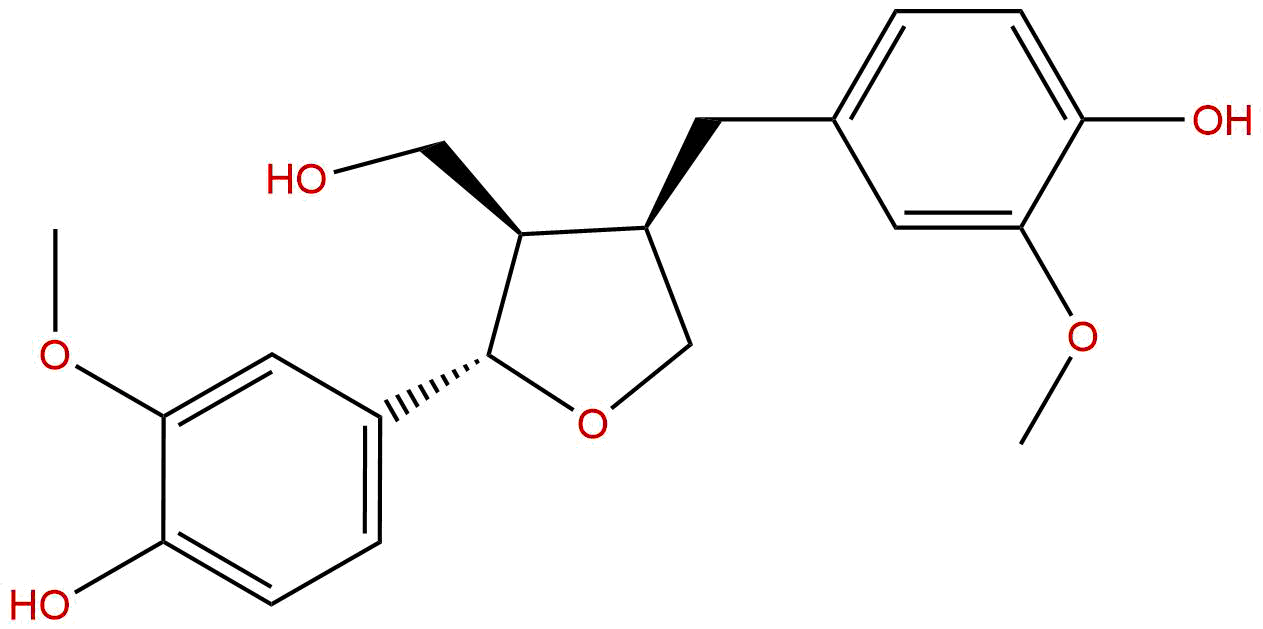


Product name: (+)-Lariciresinol
Synonym name:
Catalogue No.: BP2235
Cas No.: 27003-73-2
Formula: C20H24O6
Mol Weight: 360.406
Botanical Source:
Type of Compound:
Purity: 95%~99%
Analysis Method: HPLC-DAD or/and HPLC-ELSD
Identification Method: Mass, NMR
Packing: Brown vial or HDPE plastic bottle
Storage: Store in a well closed container, protected from air and light. Put into refrigerate or freeze for long term storage.
Whenever possible, you should prepare and use solutions on the same day. However, if you need to make up stock solutions in advance, we recommend that you store the solution as aliquots in tightly sealed vials at -20℃. Generally, these will be useable for up to two weeks.
The product could be supplied from milligrams to grams
Inquire for bulk scale.
For Reference Standard and R&D, Not for Human Use Directly.
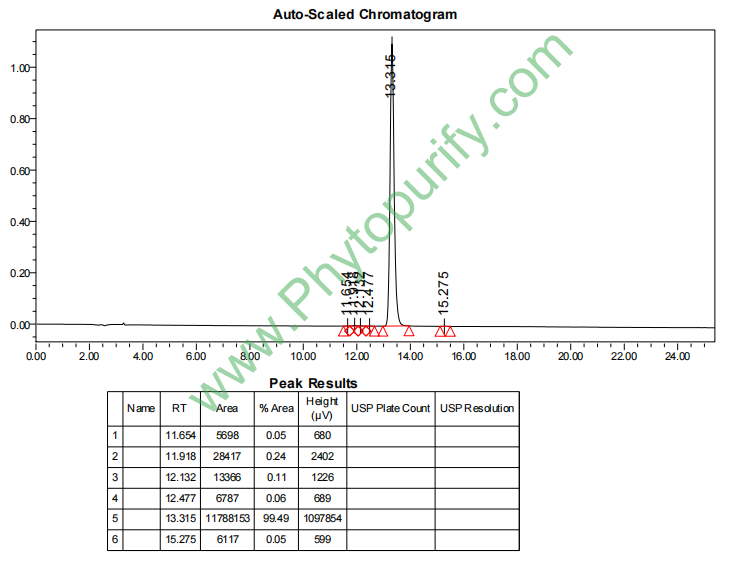
HPLC of (+)-Lariciresinol
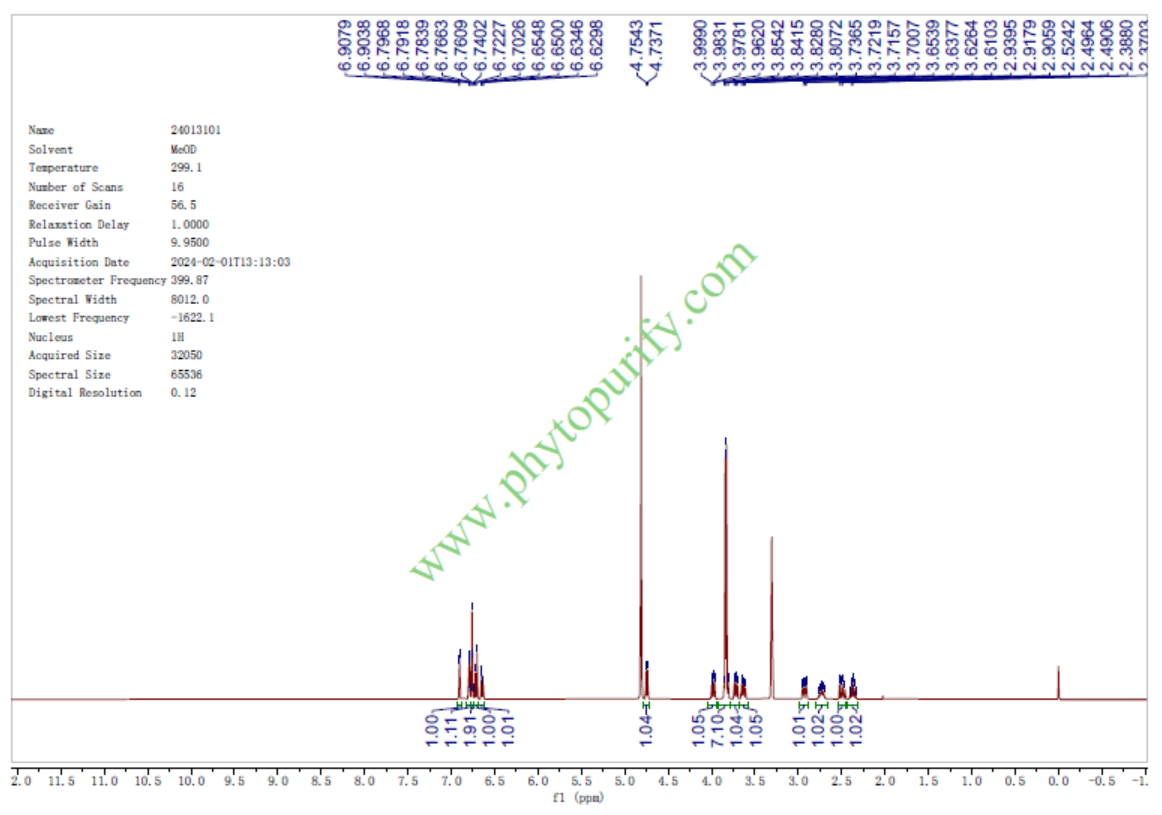
HNMR of (+)-Lariciresinol
Storage conditions:Short-term storage at 2~8℃, long-term storage at -20 ~ -80℃
88.3800
2.3285
2.3251
.1770
6.2443
3.2615
High
89.4783
3.4327
No
No
No
No
Yes
No
0.0
Yes
No
No
No
(+) - Laricin, as a naturally occurring tetrahydrofuran type lignan, is an important member of plant secondary metabolites. Its CAS number is 27003-73-2, molecular formula is C20H24O6, and molecular weight is 360.4060 g/mol. This compound is mainly derived from traditional medicinal plants such as Forsythia suspensa(Forsythia suspensa)And Schisandra chinensis(Schisandra chinensis)These plants have long been recorded in traditional Chinese medicine literature for their use in clearing heat and detoxifying, astringency and astringency. Modern pharmacological research has revealed the biological activity of (+) - larch resin far beyond traditional understanding. It is not only defined as a plant metabolite and antifungal agent, but has also been proven to be an important precursor of human lactone lignans. In recent years, its potential therapeutic value in anti-inflammatory, anti-tumor, and especially for diseases such as arthritis has attracted widespread attention in the field of natural product pharmacy. This article will start from its chemical essence, systematically sort out its plant origin, multi-target pharmacological mechanism, pharmacological evaluation, and prospect its research prospects, aiming to provide a professional and comprehensive compound analysis report for researchers in related fields.
(+) - Lycopene is chemically defined as a diastereomer of the (2S, 3R, 4R) - configuration. Its SMILES string (COc1cc (C [C @ H] 2CO)C@H[C @ H] 2CO) ccc1O clearly depicts its stereochemical core: a tetrahydrofuran ring (oxacyclopentane) is replaced by 4-hydroxy-3-methoxyphenyl (guaiacyl), hydroxymethyl, and 4-hydroxy-3-methoxybenzyl at positions 2, 3, and 4, respectively. This structure endows it with multiple functional groups such as phenolic hydroxyl, primary alcohol hydroxyl, aromatic ether, and tetrahydrofuran ring, determining its unique physicochemical properties and biological activity.
From the analysis of the provided pharmacological parameters:
- Molecular weight (MW):360.4060 g/mol, Meets the standard that small molecule drugs typically have a molecular weight of less than 500 Da.
- Lipid water partition coefficient (LogP/LogD)The values of 2.3285 and 2.3251 respectively indicate that the compound has moderate lipophilicity, which is beneficial for penetrating cell membranes, but will not cause metabolic and distribution problems due to excessive lipophilicity.
- Topological Polarity Surface Area (TPSA)88.38 Å ² reflects the surface area occupied by polar atoms (oxygen atoms) in the molecule, which is within an acceptable range for oral absorption (typically<140 Å ²).
- Water solubility:0.1770 mg/mL, Belonging to micro solubility, this may be a limiting factor for its natural form bioavailability, but can be improved through pharmaceutical methods.
- Permeability The permeability of Caco-2 cells is 3.2615 (usually measured in x 10 ⁻⁶ cm/s), indicating moderate to good intestinal absorption potential. The Peff value (6.2443) further supports its good effective permeability.
- Blood-brain barrier (BBB) penetrability Marked as "high", this suggests that (+) - larch resin may have the potential to act on the central nervous system, which is a characteristic worth exploring in depth.
Overall, its chemical structure gives it the basis as an active molecule, and its physicochemical parameters preliminarily outline a profile with good drug like properties.
(+) - Lycopene is mainly isolated from Forsythia suspensa and Schisandra chinensis.
- Weeping Forsythia Classic Chinese medicine herbs for clearing heat, commonly used to treat wind heat colds, the onset of warm diseases, carbuncles, swelling, and toxins. Modern research has confirmed that lignans are one of the important material foundations for the anti-inflammatory and antibacterial activities of Forsythia suspensa, with (+) - larch resin being a key member.
- schisandra Known for its "five flavors in one", it has the effects of astringency, tonifying qi and producing fluids, and nourishing the kidneys and heart. Schisandra chinensis is rich in various lignans, such as schisandrin esters A and B. As a part of its metabolic network, (+) - larch resin may synergistically exert antioxidant, hepatoprotective, and neuroprotective effects with other components.
The traditional applications of these two plants are mostly based on compound and whole plant extracts. Although they do not directly target the single component (+) - quercetin, they provide valuable traditional medical clues and material sources for the discovery of their modern pharmacological activities such as anti-inflammatory and antibacterial effects. Exploring active lead compounds from plants is a classic pathway in natural medicine research.
(+) - Lycopene exhibits various pharmacological activities, and its mechanism of action is closely related to the regulation of multiple key biological targets. According to the provided target information, its anti-inflammatory mechanism is particularly prominent and directly related to the disease of "arthritis".
Core pharmacological activity:
1. Antifungal activity As one of its clear roles, (+) - larch resin can destroy fungal cell membranes and exert bactericidal effects. This provides a chemical basis for its development as a new type of antifungal drug, especially for combating drug-resistant fungal infections.
2. Antitumor activity: Studies have shown that dietary larvicin (as a precursor) can reduce the growth of human MCF-7 breast cancer xenografts and chemically induced breast tumors in rats, and reduce the vascular density in tumor tissue. This indicates that it may exert anti-cancer effects through multiple pathways such as anti angiogenesis and direct inhibition of tumor cell proliferation.
3. Anti inflammatory and immune regulatory activity This is currently the most promising direction revealed by research. Its mechanism of action can be elucidated through the following target network:
Mechanism of action and target analysis:
The five targets provided - TNF (tumor necrosis factor - α), PTGS2 (prostaglandin endoperoxide synthase 2, COX-2), NFKB1 (nuclear factor kappa B p105 subunit), IL6 (interleukin-6), and IL1B (interleukin-1 β) - together form a classic pro-inflammatory signaling network, particularly in acute and chronic inflammatory diseases arthritis It occupies a central position in the pathogenesis process.
- TNF-α、IL-1β、IL-6 It is a key pro-inflammatory cytokine. In diseases such as rheumatoid arthritis, they are produced in large quantities by activated immune cells (such as macrophages and synovial cells), leading to synovial inflammation, cartilage destruction, and bone erosion. If larch resin can inhibit the production or release of these cytokines, it will directly alleviate the inflammatory cascade reaction.
- NF-κB It is the "master switch" that regulates the expression of the aforementioned cytokine genes. In the resting state, NF - κ B binds to its inhibitory protein I κ B and exists in the cytoplasm. When stimulated by inflammation (such as TNF - α activation itself), I κ B is phosphorylated and degraded, and NF - κ B (such as the p50/p65 dimer, of which p50 encoded by the NFKB1 gene is a component) enters the nucleus, initiating transcription of genes such as TNF, IL6, IL1B, and PTGS2.
- PTGS2 (COX-2)It is an inducible cyclooxygenase that is highly expressed at the site of inflammation and is responsible for catalyzing the production of inflammatory mediators such as prostaglandin E2 (PGE2) from arachidonic acid, causing pain, fever, and vasodilation.
Scientific correlation explanation:
(+) - Lycopene is likely to intervene in the NF - κ B signaling pathway, inhibit its activation, and thus regulate transcription at the transcriptional level Collaborative reduction The expression of TNF - α, IL-1 β, IL-6, and COX-2. This multi-target, upstream regulated mode of action may have more fundamental and network regulatory advantages than simply inhibiting a downstream factor (such as only inhibiting COX-2), and is expected to block the pathological process of arthritis from multiple links: reducing immune cell infiltration, lowering inflammatory mediator levels, relieving pain, and protecting joint tissue. This provides a solid molecular pharmacology basis for its application in the treatment of diseases such as rheumatoid arthritis and osteoarthritis.
Based on the provided detailed pharmacological parameters, combined with classic standards such as the "Lipinski Rule of Five," a preliminary evaluation of the potential of (+) - larch resin as an oral drug lead compound can be conducted
Lipinski Five Rule Compliance:
Absorption, distribution, metabolism, excretion (ADME) characteristics:
Comprehensive Assessment:
(+) - Lycopene in fallen leaves Oral absorption, structural drug similarity It has excellent performance in various aspects and its multi-target anti-inflammatory mechanism is also quite attractive. The main pharmaceutical challenges are:Higher plasma protein binding rate may affect therapeutic efficacy, and Key chromosomal aberration positive signals The latter is one of the "veto power" factors that determine whether it can further advance towards drug development, and must be confirmed and risk assessed through more standardized in vitro and in vivo genetic toxicity testing combinations (such as micronucleus tests, comet assays, etc.) in subsequent research.
At present, research on (+) - larch resin has progressed from early plant chemical isolation and identification to pharmacological activity screening and mechanism exploration. Its activity in antifungal, anti-tumor, especially anti-inflammatory and immune regulation has been preliminarily validated, and the target network of action is gradually becoming clearer. However, most research is still at the level of cellular and animal experiments.
Future research directions and prospects:
1. Deepening the mechanism of action It is necessary to use techniques such as gene knockout, reporter genes, and co precipitation to accurately verify the specific action nodes and molecular binding targets of NF - κ B signaling pathways (are they direct action targets?).
2. Optimization of drug properties Regarding its general water solubility, high protein binding rate, and most importantly, potential genetic toxicity issues Structural modification Improving its ADME/T (toxicity) properties while retaining its pharmacophores (such as phenolic hydroxyl groups and tetrahydrofuran rings) through semi synthetic methods is the only way to push it towards preclinical research.
3. Disease model validation Systematically evaluate the efficacy, dose-response relationship, and long-term safety of collagen induced arthritis in animal models closer to human diseases, such as the mouse model.
4. Development direction:
- New anti-inflammatory/anti arthritis natural medicine As a multi-target anti-inflammatory agent, it is suitable for autoimmune inflammatory diseases such as rheumatoid arthritis.
- lead compound Using it as a template, optimize the structure and develop new small molecule drugs with independent intellectual property rights.
- Functional food/health supplement additives As one of the standard components of Schisandra chinensis and Forsythia suspensa extracts, it is used to develop health products with immune regulation and antioxidant functions.
- Drug combination components By utilizing its antifungal mechanism and combining it with other antifungal drugs, it may reduce the development of drug resistance.
In summary, (+) - larch resin is a natural lead compound with novel structure, diverse activities, and good medicinal basis. Despite facing challenges such as genetic toxicity, its unique multi-target mechanism demonstrated in the field of anti-inflammatory, especially arthritis treatment, still holds significant research value and development prospects. Future research requires rigorous scientific verification and rational risk control to deeply explore its therapeutic potential and promote the transformation of this natural treasure into a drug that benefits humanity.
