


Synonym name: Phillygenol; Forsythinol
Catalogue No.: BP1086
Cas No.: 487-39-8
Formula: C21H24O6
Mol Weight: 372.417
Botanical Source: fruit of Forsythia suspensa. Also from Phillyrea spp., Lancea tibetica and Piper sylvaticum
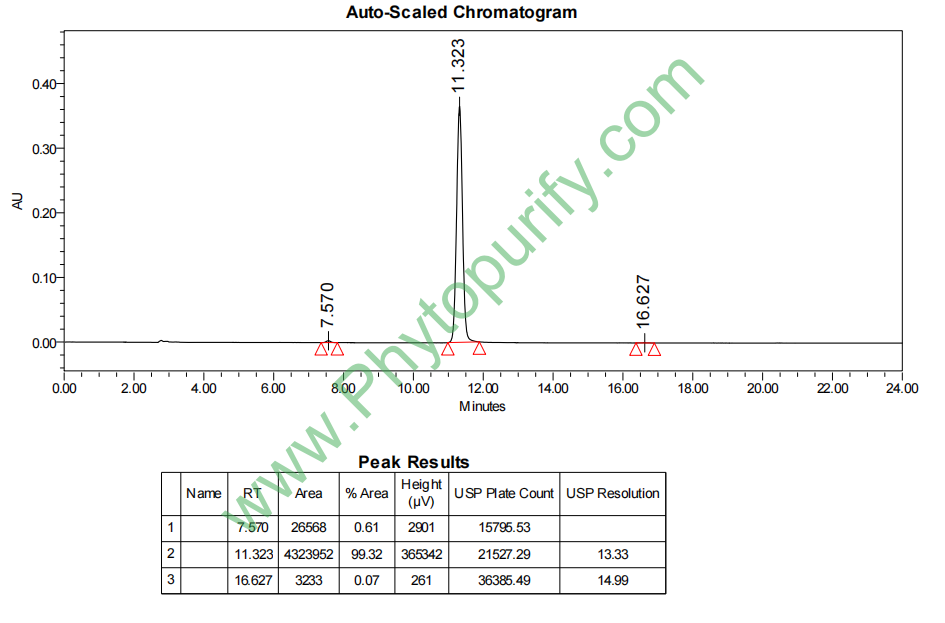
Purity: 95%~99%
Analysis Method: HPLC-DAD or/and HPLC-ELSD
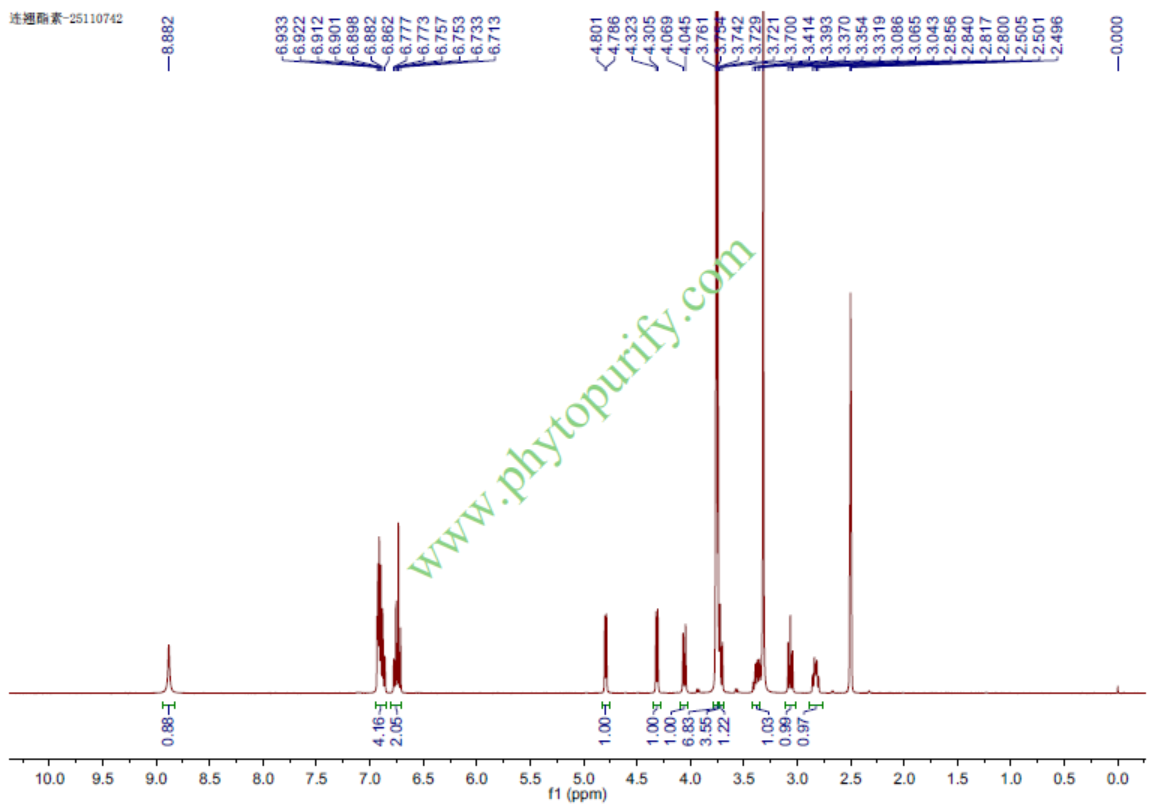
Identification Method: Mass, NMR
Packing: Brown vial or HDPE plastic bottle
Can be supplied from milligrams to grams.
For Reference Standard and R&D, Not for Human Use Directly.
Inquire for bulk scale.
Description:
Phillyrin, (+)-Phillygenin, and (-)-phillygenin exert the strongest inhibitory activities on NO production with IC(50) values.
References:
Spectrochim Acta A Mol Biomol Spectrosc. 2012 Jan;85(1):120-6.
Interaction between phillygenin and human serum albumin based on spectroscopic and molecular docking.
METHODS AND RESULTS:
In this paper, the interaction of human serum albumin (HSA) with Phillygenin was investigated by fluorescence, circular dichroism (CD), UV-vis spectroscopic and molecular docking methods under physiological conditions. The Stern-Volmer analysis indicated that the fluorescence quenching of HSA by Phillygenin resulted from static mechanism, and the binding constants were 1.71×10(5), 1.61×10(5) and 1.47×10(4) at 300, 305 and 310K, respectively. The results of UV-vis spectra show that the secondary structure of the protein has been changed in the presence of Phillygenin. The CD spectra showed that HSA conformation was altered by Phillygenin with a major reduction of α-helix and an increase in β-sheet and random coil structures, indicating a partial protein unfolding. The distance between donor (HSA) and acceptor (Phillygenin) was calculated to be 3.52nm and the results of synchronous fluorescence spectra showed that binding of Phillygenin to HSA can induce conformational changes in HSA. Molecular docking experiments found that Phillygenin binds with HSA at IIIA domain of hydrophobic pocket with hydrogen bond interactions. The ionic bonds were formed with the O (4), O (5) and O (6) of Phillygenin with nitrogen of ASN109, ARG186 and LEU115, respectively. The hydrogen bonds are formed between O (2) of Phillygenin and SER419. In the presence of copper (II), iron (III) and alcohol, the apparent association constant K(A) and the number of binding sites of Phillygenin on HSA were both decreased in the range of 88.84-91.97% and 16.09-18.85%, respectively.
CONCLUSIONS:
In view of the evidence presented, it is expected to enrich our knowledge of the interaction dynamics of Phillygenin to the important plasma protein HSA, and it is also expected to provide important information of designs of new inspired drugs.
HPLC of Phillygenin
HNMR of Phillygenin
Storage conditions:Short-term storage at 2~8℃, long-term storage at -20 ~ -80℃
66.3800
2.9117
2.9098
.0354
7.2206
7.1579
High
90.9178
3.5781
No
Yes
No
No
Yes
No
0.0
No
No
No
No
In the treasure trove of traditional Chinese medicine, Forsythia suspensa(Forsythia suspensa)As an essential medicine for clearing heat and detoxifying, reducing swelling and dispersing nodules, it has a history of over two thousand years of application. Modern plant chemistry and pharmacology research constantly reveal the material basis for its therapeutic effects, among which lignans are considered as one of its core active components. Phillygenin (CAS number: 487-39-8), as a representative tetrahydrofuran type lignan isolated from Forsythia suspensa, has attracted much attention in recent years due to its wide and unique biological activities. Early studies have confirmed that it has significant antioxidant, hypolipidemic and inhibitory effects on LDL oxidation, which provides potential for the prevention and treatment of cardiovascular diseases such as atherosclerosis. With the deepening of research, especially the challenge of emerging infectious diseases worldwide, Forsythia suspensa has shown remarkable activity in the field of antiviral therapy, demonstrating inhibitory potential against various viruses (such as herpes virus, human immunodeficiency virus, etc.) and their key targets. This article aims to systematically review the chemical properties, plant sources, pharmacological activities, especially the antiviral mechanism and molecular targets of Forsythia suspensa, and scientifically prospect its clinical application prospects based on its pharmacological parameters, in order to provide comprehensive academic references for the deep development and transformation research of this natural product.
Forsythia suspensa, chemical name (7S, 8R, 7'S, 8'S) -4,4 ', 9-trihydroxy-3,3' - dimethoxy-7,9 '- epoxy lignin, molecular formula C21H24O6, molecular weight 372.4170. Its structure belongs to the classic lignans, consisting of two phenylpropanoid units (C6-C3) connected by side chain β - carbon atoms (C8-C8 '), and further forming a tetrahydrofuran ring (7-O-9') structure. There are hydroxyl (- OH) and methoxy (- OCH3) substituents attached to its benzene ring, which have a decisive impact on its biological activity and physicochemical properties.
From the analysis of parameters related to drug properties, the lipid water partition coefficient (LogP) of Forsythia suspensa is 2.9117, indicating that it has moderate lipophilicity and is conducive to transmembrane absorption. Its topological polar surface area (TPSA) is 66.3800 Å ², relatively small, which is related to the limited number of polar groups (hydroxyl groups) in its molecule. The water solubility parameters show that its solubility is low (0.0354 mg/mL), making it a poorly soluble compound. This may be a limiting factor for its oral bioavailability, and solubilization strategies need to be considered in formulation development. It is worth noting that its blood-brain barrier permeability is predicted to be "high", indicating that the compound may have therapeutic potential for central nervous system diseases such as certain viral encephalitis. In terms of preliminary safety evaluation, hERG inhibition was predicted as' no ', reducing the likelihood of inducing QT interval prolongation in the heart; The Ames test predicted a value of 0.0, indicating that it may not be mutagenic, providing a favorable safety starting point for subsequent development.
Forsythia suspensa is mainly derived from the plant Forsythia suspensa in the family Rhinoceros(Forsythia suspensa The dried fruit of (Thunb.) Vahl, also known as Chinese medicine Forsythia suspensa. In addition, within the same genus of plants, the Golden Bell Flower(Forsythia viridissima)And some other plant species such as Osmanthus fragrans There are also a small number of discoveries. In Forsythia suspensa, Forsythians often coexist with their glycoside forms (such as Forsythians glycosides), which can be converted into Forsythians through enzymatic or acid hydrolysis in vitro and in vivo.
The extraction of Forsythia suspensa extract mainly adopts solvent extraction method. Traditional methods include using ethanol, methanol, or ethanol water solutions in different proportions for hot reflux extraction or ultrasound assisted extraction. In order to obtain higher purity Forsythia suspensa extract, it is usually necessary to further separate and purify the crude extract. The conventional separation process includes: first, using macroporous adsorption resins (such as D101, AB-8) for enrichment to remove large polar impurities such as sugars and proteins; Then, fine separation was performed using techniques such as silica gel column chromatography, ODS reverse phase column chromatography, and preparative high-performance liquid chromatography (HPLC). In recent years, some green and efficient extraction techniques such as supercritical CO2 fluid extraction and microwave-assisted extraction have also been explored and applied to the extraction of lignans from Forsythia suspensa. These methods have the advantages of high extraction efficiency and low solvent residue, but the cost is relatively high. The optimization of extraction process usually takes the yield and purity of Forsythia suspensa as indicators, and needs to comprehensively consider factors such as solvent type, concentration, solid-liquid ratio, temperature, and time.
Forsythia suspensa has demonstrated various pharmacological activities, and its research has expanded from early antioxidant and cardiovascular protection to anti-inflammatory and antiviral fields.
Antioxidant and cardiovascular protective effects This is one of the earliest activities of Forsythia suspensa that has been extensively studied. It can effectively eliminate free radicals such as DPPH and ABTS, exhibiting strong antioxidant capacity. More importantly, it can significantly inhibit the oxidative modification of low-density lipoprotein (LDL). Oxidative LDL is the key initial factor of atherosclerosis. By inhibiting LDL oxidation and reducing the formation of foam cells, phillyrin plays an anti atherosclerotic role. Animal experiments have shown that it can reduce serum total cholesterol, triglycerides, and LDL levels in hyperlipidemic model animals, while increasing high-density lipoprotein (HDL) levels.
anti-inflammatory effect Forsythian suspensa has inhibitory effects on various acute and chronic inflammation models. Its mechanism involves downregulating pro-inflammatory mediators such as tumor necrosis factor - α (TNF - α), interleukin-6 (IL-6), nitric oxide (NO), and prostaglandin E2 (PGE2) production, and inhibiting the expression of inducible nitric oxide synthase (iNOS) and cyclooxygenase-2 (COX-2). These effects are consistent with its traditional efficacy in the treatment of infectious diseases.
Antiviral effect (core activity)In recent years, research highlights have focused on the broad-spectrum antiviral potential of Forsythia suspensa extract.
Other activities There are also studies indicating that Forsythia suspensa has potential activities such as liver protection and neuroprotection, and these studies are still in the exploratory stage.
The multiple pharmacological activities of Forsythia suspensa stem from its interactions with various biomolecule targets, and its mechanism of action exhibits the characteristics of multiple pathways and targets.
Antioxidant and anti-inflammatory pathways Its antioxidant effect is not only derived from its direct free radical scavenging ability, but also related to the activation of the cell's own antioxidant defense system, such as regulating the nuclear factor E2 related factor 2 (Nrf2)/antioxidant response element (ARE) signaling pathway, upregulating the expression of phase II detoxifying enzymes such as heme oxygenase-1 (HO-1). The anti-inflammatory effect is mainly related to the inhibition of the activation of nuclear factor kappa B (NF - κ B) and mitogen activated protein kinases (MAPKs) signaling pathways, thereby inhibiting the expression of downstream inflammatory factors at the transcriptional level.
Molecular targets for antiviral effects This is the current focus of mechanism research. Based on existing information, its antiviral target network can be summarized as follows:
It should be pointed out that the direct binding evidence, binding affinity (Ki/IC50 value), and precise mode of action of most of the above targets with Forsythia suspensa still need to be confirmed through biophysical and structural biology methods such as surface plasmon resonance (SPR), isothermal titration calorimetry (ITC), and co crystallization X-ray diffraction.
Based on the pharmacological parameters mentioned earlier, Forsythia suspensa exhibits a "drug like" molecular profile with potential for development but also faces challenges.
Advantage aspects Moderate LogP value (2.91) and lower TPSA are beneficial for its passive diffusion across biofilms, indicating that it may have good intestinal absorption and cell permeability. The extremely high blood-brain barrier permeability prediction is its significant advantage over many natural products, providing a unique opportunity for the development of central nervous system antiviral (such as HSV encephalitis) or neuroprotective drugs. The absence of hERG inhibition and mutagenicity warning has laid a solid foundation for its safety assessment.
Challenge aspect The most prominent issue is poor water solubility (0.0354 mg/mL). Low solubility usually leads to slow dissolution rate, incomplete absorption, and large variability after oral administration, thereby limiting its bioavailability. This is the primary pharmaceutical challenge that must be addressed to transition from active compounds to drug candidate molecules. The strategy may include the production of nanocrystals, solid dispersions, cyclodextrin inclusion complexes, or prodrugs (such as phosphate prodrugs).
At present, there are relatively limited reports on pharmacokinetic studies of the Forsythia suspensa system. Existing animal (rat) pharmacokinetic studies have shown that it is absorbed quickly after oral administration, but its absolute bioavailability may be at a medium to low level due to first pass effects and solubility limitations. It is widely distributed in the body, and its high BBB permeability needs to be experimentally verified in animal models. Forsythians undergo extensive metabolism in the body, including glucuronidation and sulfation binding reactions (targeting phenolic hydroxyl groups), as well as possible phase I metabolism such as demethylation and oxidation. Its prototype and metabolites are mainly excreted through the kidneys and bile. Identifying the main metabolic enzymes (such as UGT, SULT subtypes) and whether there is a risk of drug drug interactions is an important direction for future preclinical pharmacokinetic research.
As an active molecule derived from traditional Chinese medicine, Forsythia suspensa has broad prospects for its application in modern medicine due to its multi-target and multi activity characteristics. However, there are also clear conversion pathways that need to be explored.
Potential clinical application directions:
Future research prospects and challenges:
Forsythia suspensa, a natural lignan derived from the classic Chinese medicine Forsythia suspensa, is bringing new vitality to modern pharmacology from its traditional "clearing heat and detoxifying" effects. It not only inherits classic activities such as antioxidant and cardiovascular protection, but also demonstrates remarkable multi-target inhibition potential in the field of antiviral, covering key links from virus entry, replication to integration. Its unique physicochemical properties, especially the predicted high blood-brain barrier permeability, provide a unique advantage for its treatment of central nervous system viral infections. Despite facing challenges such as poor water solubility in terms of drug properties, its good safety warning starting point has laid the foundation for subsequent development. In the future, through in-depth analysis of its molecular mechanism of action, rational design of derivatives, innovative formulation strategies, and systematic preclinical research, Forsythia suspensa is expected to develop from an excellent active lead compound into a new drug candidate for the treatment of viral infections, cardiovascular and inflammatory diseases, fully demonstrating the modern value of traditional Chinese medicine's "ancient for modern use, integration of Chinese and Western medicine". Its research and development process will also provide useful references for the deep development and transformation of other active ingredients in traditional Chinese medicine.
