


Product name: Forsythiaside
Synonym name: Forsythoside A
Catalogue No.: BP0594
Cas No.: 79916-77-1
Formula: C29H36O15
Mol Weight: 624.592
Botanical Source: Forsythia suspensa (Thunb.) Vahl
Physical Description:
Type of Compound: Phenylpropanoids
Purity: 95%~99%
Analysis Method: HPLC-DAD or/and HPLC-ELSD
Identification Method: Mass, NMR
Packing: Brown vial or HDPE plastic bottle
Storage: Store in a well closed container, protected from air and light. Put into refrigerate or freeze for long term storage.
Whenever possible, you should prepare and use solutions on the same day. However, if you need to make up stock solutions in advance, we recommend that you store the solution as aliquots in tightly sealed vials at -20℃. Generally, these will be useable for up to two weeks.
The product could be supplied from milligrams to grams
Inquire for bulk scale.
Description:
Forsythoside A possesses strong antibacterial, antiinflammatory, antioxidant and antiviral effects. it has the potential to prevent IBV infection in vitro, it can promote the expression of IFN-α and Mx1 significantly.Forsythoside A has inductive effects on the activities of CYP1A2 and CYP2C11, without affecting CYP2D1 and CYP3A1/2 activities.
References:
Phytother Res. 2011 Mar;25(3):338-42.
Forsythoside a inhibits the avian infectious bronchitis virus in cell culture.
Forsythoside A is a polyphenolic constituent of the fruits of Forsythia suspensa Vahl. which is widely used as an antiinflammatory agent in traditional Chinese medicine.
METHODS AND RESULTS:
In the present study, the effects of Forsythoside A on cell infection by avian infectious bronchitis virus were assessed. A real-time fluorescence quantitative PCR assay was used to determine mRNA content of IBV N gene. The pretreatment of cells with Forsythoside A, adding Forsythoside A post infection of cells, and treatment of virus with Forsythoside A were analysed. The inhibitory effect of Forsythoside A was confirmed by infecting primary chicken embryo kidney cells. Infected cells were inhibited by Forsythoside A treatment.
CONCLUSIONS:
The data indicated that Forsythoside A has the potential to prevent IBV infection in vitro.
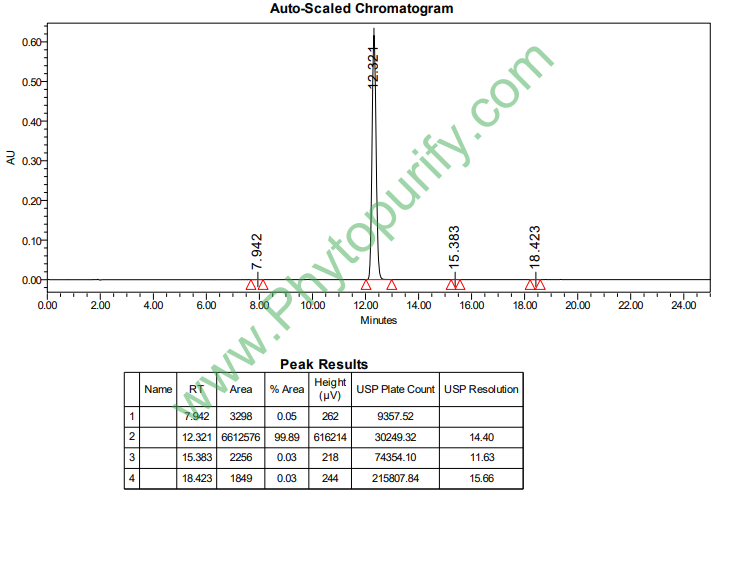
HPLC of Forsythoside A
Storage conditions:Short-term storage at 2~8℃, long-term storage at -20 ~ -80℃
Forsythia suspensa, as an important natural product, is widely present in plants such as Forsythia suspensa and has attracted much attention from the pharmacological community due to its significant biological activity. Forsythian glycoside A belongs to hydroxycinnamic acid ester glycosides and has various pharmacological effects, especially showing great potential in the field of antiviral therapy. With the global prevalence of viral diseases, finding safe and effective antiviral natural products has become an important direction for drug development. This article will systematically review the chemical structure and physicochemical properties, plant sources and extraction methods, pharmacological activity and mechanism of action, pharmacological evaluation and pharmacokinetic characteristics of Forsythia suspensa glycoside A, and explore its clinical application prospects and future research directions.
The molecular formula of Forsythia suspensa glycoside A is C29H36O15, with a molecular weight of 624.5920 and a CAS number of 79916-77-1. The core of its structure is the combination of hydroxycinnamic acid and glycosides, which is a typical phenylpropanoid ester glycoside structure. The molecule contains multiple hydroxyl and ester bonds, giving it high polarity and water solubility.
In terms of physicochemical properties, the LogP value of Forsythia suspensa glycoside A is 0.3231, indicating its low lipid solubility and good water solubility (5.1483), which is beneficial for its distribution in aqueous media. Its topological polar surface area (TPSA) is as high as 245.29 Å ², reflecting that the molecule has a large number of polar groups, which may limit its ability to pass through the cell membrane. The low permeability of the blood-brain barrier suggests its limited distribution in the central nervous system. The hERG channel inhibition test result was negative, indicating a low risk of cardiac toxicity, while the Ames mutagenicity test result was 0.0, indicating a low risk of genotoxicity.
Forsythia suspensa, a plant belonging to the Oleaceae family and widely distributed in China and East Asia, is mainly found in Forsythia suspensa. It is commonly used in traditional Chinese medicine for clearing heat, detoxifying, reducing swelling, and dispersing nodules. The fruit and leaves of Forsythia suspensa are rich in Forsythia suspensa glycosides A.
The extraction method usually adopts water extraction and alcohol precipitation, combined with ultrasound assisted extraction or microwave-assisted extraction to improve the extraction efficiency. The specific steps include: crushing the dried Forsythia suspensa fruit, extracting it with 70% ethanol or water as a solvent, concentrating the extract, precipitating it with ethanol to remove impurities, and purifying it with high purity Forsythia suspensa glycoside A by high performance liquid chromatography (HPLC). In addition, counter current chromatography and column chromatography techniques are also commonly used for separation and purification.
The pharmacological activity research of Forsythia suspensa glycoside A covers multiple aspects such as antiviral, anti-inflammatory, antioxidant, and immune regulation, with antiviral effects being the most prominent.
Forsythian glycoside A exhibits inhibitory effects on various viruses, especially on human immunodeficiency virus (HIV), herpes simplex virus (HSV), and influenza virus. Its antiviral mechanism involves multiple stages of the virus replication cycle, including virus adsorption, invasion, gene expression, and assembly processes.
In the HIV infection model, Forsythia suspensa glycoside A can effectively inhibit the activity of HIV1-PR, block the maturation of viral proteins, and reduce viral replication. Meanwhile, by interfering with the function of viral integrase (INT), the integration of the viral genome into the host chromosome is inhibited. In addition, Forsythia suspensa glycoside A has a certain inhibitory effect on viral envelope protein gD and viral enzymes UL42, UL54, ICP27, TK and other targets, blocking key steps in the viral life cycle.
In addition, Forsythia suspensa glycoside A inhibits the binding of HIV virus to cells and reduces the efficiency of virus invasion by regulating the host cell surface receptors CCR5 and CXCR4. Its regulatory effect on myeloperoxidase (MPO) also helps alleviate the inflammatory response caused by viral infection.
Forsythia suspensa glycoside A can significantly inhibit the expression of inflammatory factors such as TNF - α, IL-6, and IL-1 β, and alleviate inflammatory reactions. By regulating the NF - κ B signaling pathway, inhibiting the transcription of pro-inflammatory genes, and exerting immune regulatory effects. In addition, its antioxidant properties help to eliminate free radicals and protect cells from oxidative damage.
The study also showed that Forsythia suspensa glycoside A has certain antibacterial, anti-tumor, and neuroprotective effects, but the relevant mechanisms still need further clarification.
The antiviral mechanism of Forsythia suspensa glycoside A is complex, involving multi-target and multi pathway regulation. The main targets include:
The multiple effects of these targets give Forsythia suspensa glycoside A potential advantages in antiviral therapy, especially in the inhibition of multidrug-resistant viral strains.
The pharmacological parameters of Forsythia suspensa glycoside A show that it has good safety and low risk of toxic side effects. Its LogP value is low, indicating strong hydrophilicity, but this also limits its ability to pass through lipid membranes, which may affect oral absorption and bioavailability. A high TPSA value indicates limited cell membrane permeability, especially low blood-brain barrier permeability, which limits its application in the central nervous system.
The hERG channel inhibition experiment was negative, reducing the risk of cardiac toxicity. The Ames test showed no mutagenicity, indicating a low risk of genetic toxicity.
Pharmacokinetic studies have shown that Forsythia suspensa glycoside A is absorbed slowly after oral administration, with a moderate plasma half-life, and is mainly metabolized by the liver and excreted by the kidneys. Its water solubility is good, which is beneficial for in vivo distribution, but its bioavailability is limited, and it may need to be improved through drug formulation optimization or administration route improvement to enhance efficacy.
Forsythia suspensa glycoside A, as a natural antiviral active ingredient, has broad clinical application prospects. Its multi-target antiviral mechanism provides a new approach for the treatment of HIV, HSV, and other viral infections. Combined with its good safety, Forsythia suspensa glycoside A is expected to become an important candidate molecule for antiviral drug development.
Future research should focus on the following aspects:
Forsythia suspensa glycoside A, as a natural hydroxycinnamic acid glycoside, has shown significant potential as a novel antiviral drug due to its multi-target antiviral activity and good safety. Although research on its pharmacokinetics and clinical applications is still in its early stages, its unique chemical structure and biological activity provide valuable research examples for natural product pharmacology. In the future, through interdisciplinary collaboration and technological innovation, Forsythia suspensa glycoside A is expected to play a greater role in the field of antiviral therapy, promoting the clinical translation and application of natural product drugs.
