


Product name: Notoginsenoside Fc
Synonym name:
Catalogue No.: BP1008
Cas No.: 88122-52-5
Formula: C58H98O26
Mol Weight: 1211.4
Botanical Source: Panax notoginseng(Burk.)F.H.Chen
Physical Description:
Type of Compound: Triterpenoids
Purity: 95%~99%
Analysis Method: HPLC-DAD or/and HPLC-ELSD
Identification Method: Mass, NMR
Packing: Brown vial or HDPE plastic bottle
Storage: Store in a well closed container, protected from air and light. Put into refrigerate or freeze for long term storage.
Whenever possible, you should prepare and use solutions on the same day. However, if you need to make up stock solutions in advance, we recommend that you store the solution as aliquots in tightly sealed vials at -20℃. Generally, these will be useable for up to two weeks.
The product could be supplied from milligrams to grams
Inquire for bulk scale.
Description:
Notoginsenoside Fc has perfect anti-platelet aggregatory effect.
References:
J Pharm Biomed Anal. 2015 May 10;109:150-7.
Pharmacokinetics, bioavailability, and metabolism of Notoginsenoside Fc in rats by liquid chromatography/electrospray ionization tandem mass spectrometry.
Notoginsenoside Fc (NGFc) is a protopanaxadiol-type (PPD-type) saponin from Panax notoginseng, which has perfect anti-platelet aggregatory effect. However, its pharmacokinetics and metabolism in vivo remain unknown.
METHODS AND RESULTS:
In this study, a simple and sensitive liquid chromatography/electrospray ionization tandem mass spectrometry (LC-MS/MS) method was first developed for the determination of NGFc in rat plasma. After methanol-mediated protein precipitation, separation was achieved on a C18 column with MS detection operated in negative SRM mode at m/z 604.56→m/z 783.90 and m/z 799.93→m/z 637.64 for NGFc and IS, respectively. The assay was linear over the concentration range (r>0.995) with the LLOQ of 0.002μg/ml. The intra- and inter-day precisions (R.S.D.) were 2.45-12.36% and 3.67-14.22%, respectively; whereas accuracy ranged from (R.R.) 93.90% to 99.41%. The extraction recovery, stability, and matrix effect were within the acceptable limits.
CONCLUSIONS:
The validated LC-MS/MS method was successfully applied to the pre-clinical pharmacokinetic studies of NGFc in rat. After oral and intravenous administration, NGFc showed dose-independent pharmacokinetic behaviors with a t1/2 of >22h and its oral bioavailability was 0.10-0.14%. In addition, a total of 10 metabolites were detected and structurally characterized by UPLC-Q/TOF-MS technique, which suggested that deglycosylation was the major metabolic pathway for NGFc in rats.
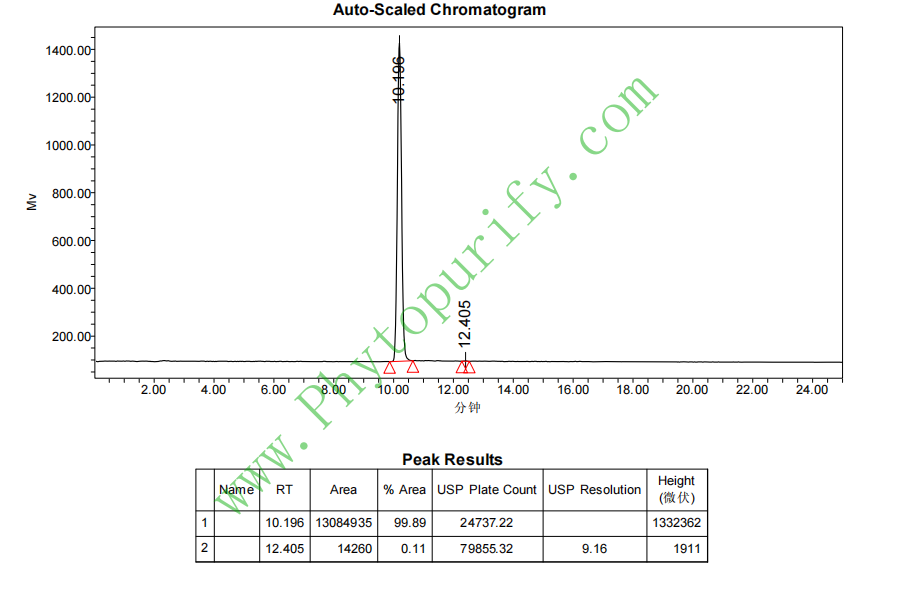
HPLC of Notoginsenoside Fc
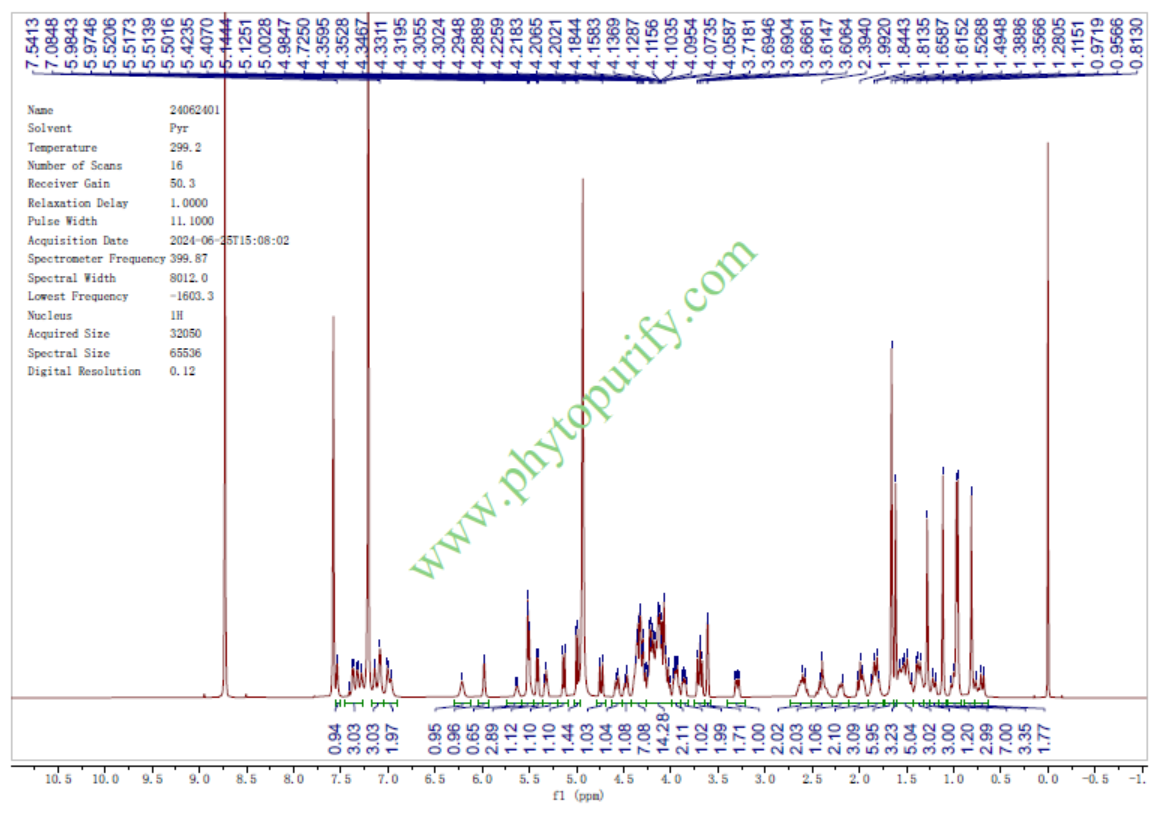
HNMR of Notoginsenoside Fc
Storage conditions:Short-term storage at 2~8℃, long-term storage at -20 ~ -80℃
415.9800
1.6717
1.6717
.2953
.4670
.1049
Low
67.8256
7.2605
Yes
No
No
No
No
No
0.0
Yes
No
No
No
Cardiovascular disease (CVD) is the main cause of death and disability worldwide. Its pathological process involves atherosclerosis, thrombosis, endothelial dysfunction, inflammatory reaction and other complex links. In the process of searching for efficient and low toxicity cardiovascular treatment drugs, natural products have always been an important treasure trove for drug development due to their structural diversity and multi-target action characteristics. Sanqi(Panax notoginseng (Burk.) F. H. Chen), As a precious traditional Chinese medicinal herb, its effects of promoting blood circulation, removing blood stasis, reducing swelling, and relieving pain have been verified by medical professionals throughout history, and it is widely used in the prevention and treatment of cardiovascular and cerebrovascular diseases. Modern pharmacological studies have shown that the main active ingredients of Panax notoginseng are dammarane type triterpenoid saponins, among which ginsenosides Rb1 and Rg1 are the most well-known. However, there are still a large number of rare saponins in Sanqi, and its unique biological activity is gradually being revealed.
Notoginsenoside Fc (CAS number: 88122-52-5) is a rare protoporphyrin diol (PPD) type saponin isolated from Panax notoginseng leaves. Early studies found that it has significant antiplatelet aggregation activity. In recent years, with the deepening of research, its potential in promoting endothelial cell regeneration, improving vascular function and other aspects has become increasingly prominent, especially in the model of refractory diseases such as diabetes vascular complications. This article aims to systematically review the chemical structure, plant origin, pharmacological activity, mechanism of action, medicinal properties, and clinical application prospects of Panax notoginseng saponin Fc, in order to provide comprehensive scientific references for the in-depth research and development of this compound.
Panax notoginseng saponins Fc are a type of dammarane type tetracyclic triterpenoid saponin, belonging to the protoporphyrin diol (PPD) type saponin. Its molecular formula is C59H100O26, and its molecular weight is 1211.3960 g/mol. Its basic skeleton is PPD, with sugar chains connected at both C-3 and C-20 positions. Specifically, its C-3 position is connected to a disaccharide chain (Glc (β 1-2) Glc) composed of two molecules of glucose (Glc), while its C-20 position is connected to a more complex sugar chain containing xylose (Xyl), glucose (Glc), and arabinose (Ara), forming the structure of Xyl (β 1-6) Glc (β 1-?) - Ar (p). This polysaccharide based structure results in high molecular polarity, with a theoretical topological polar surface area (TPSA) of up to 415.98 Å ².
In terms of physicochemical properties, the calculated lipid water partition coefficient (LogP) is 1.6717, indicating that the compound has a certain degree of lipophilicity, but due to its large sugar group and multiple hydroxyl groups, it still belongs to hydrophilic molecules as a whole. The predicted water solubility value is 0.2953 mg/mL, which belongs to the category of slight solubility, indicating that solubilization strategies may need to be considered in formulation development. The prediction of medicinal properties shows that the ability of Panax notoginseng saponins Fc to penetrate the blood-brain barrier (BBB) is relatively low, and it mainly acts on the peripheral system. In addition, its hERG channel inhibition risk prediction is negative, and the preliminary Ames test prediction value is 0.0, indicating that it may not have mutagenicity and significant cardiac toxicity risks, providing preliminary positive signals for its safety evaluation.
Panax notoginseng saponins Fc mainly come from Panax notoginseng, a plant of the Panax genus in the Araliaceae family(Panax notoginseng)Leaves, flowers, roots, and other parts of the plant. Compared with the main root of Panax notoginseng, its aboveground parts (leaves and flowers) have a more complex saponin composition and are the main source of various rare saponins (such as Panax notoginseng saponins Fc, Fe, R2, etc.). This provides direction for the comprehensive utilization of Sanqi resources and the development of high value-added products.
The extraction and isolation of Panax notoginseng saponins Fc from plant materials usually follow the conventional process of natural product chemistry, but optimization is needed to address its high polarity and relatively low content. The main steps include:
1. Extract Alcohol extraction is commonly used, such as heating and reflux extraction or ultrasound assisted extraction of dried and crushed Sanqi leaves with 70% -80% ethanol or methanol. This method can effectively extract most saponin components.
2. Enrichment and Coarse Separation After the extraction solution is concentrated under reduced pressure, the resulting paste is dispersed in an appropriate amount of water, and then extracted sequentially with organic solvents such as petroleum ether, ethyl acetate, and n-butanol. Sanqi saponin Fc is mainly enriched in the n-butanol extraction site.
3. Separation and Purification The n-butanol fraction is further separated and purified using various chromatographic techniques. Macroporous adsorption resin (such as D101, AB-8) column chromatography is often used for initial decolorization and grouping, and then silica gel column chromatography, reverse phase silica gel column chromatography (such as ODS, C18), dextran gel column chromatography (such as Sephadex LH-20), and high performance liquid chromatography (HPLC) or preparative high performance liquid chromatography (prep HPLC) are used for repeated separation to finally obtain high-purity Panax notoginseng saponin Fc monomer. Modern technologies such as high-speed countercurrent chromatography (HSCCC) have also demonstrated high efficiency in the separation of rare saponins.
The pharmacological activity research of Panax notoginseng saponins Fc mainly focuses on cardiovascular system protection and extends to the field of metabolic related diseases. Its main activities are summarized as follows:
Antiplatelet aggregation and antithrombotic formation This is the earliest discovered activity of Panax notoginseng saponins Fc. Research has shown that it can significantly inhibit in vitro platelet aggregation induced by inducers such as adenosine diphosphate (ADP), arachidonic acid (AA), collagen, etc. Its strength of action is comparable to or more potential than the classic antiplatelet drug aspirin. In animal thrombus models, Panax notoginseng saponins Fc can prolong thrombus formation time, reduce thrombus weight, and exhibit clear antithrombotic effects. This provides experimental evidence for its use in the prevention and treatment of arterial thromboembolic diseases such as myocardial infarction and cerebral infarction.
Protection and regeneration of vascular endothelium Endothelial dysfunction is the initiating link and common pathological basis of various cardiovascular diseases. Research has found that Panax notoginseng saponins Fc have a significant protective effect on damaged vascular endothelial cells. Especially in pathological conditions such as diabetes, high glucose, oxidative stress and other factors lead to endothelial cell apoptosis and regeneration blocked. Panax notoginseng saponin Fc can effectively promote the regeneration and repair of endothelial cells after vascular injury in diabetes rats, accelerate the re endothelialization process, so as to maintain the integrity of vascular wall, prevent intimal hyperplasia and the formation of atherosclerotic plaque.
Lipid regulation and anti atherosclerosis Sanqi saponin Fc has a certain regulatory effect on lipid metabolism. It can reduce the levels of total cholesterol (TC), triglycerides (TG), and low-density lipoprotein cholesterol (LDL-C) in the serum of animals with hyperlipidemia models, while possibly increasing high-density lipoprotein cholesterol (HDL-C). Panax notoginseng saponin Fc can slow down the formation and development of atherosclerotic plaque by regulating blood lipids, inhibiting vascular inflammation and endothelial cell adhesion.
Anti inflammatory and antioxidant properties Inflammation and oxidative stress run through the entire process of cardiovascular disease. Panax notoginseng saponins Fc can inhibit the expression of pro-inflammatory factors such as tumor necrosis factor - α (TNF - α) and interleukin-6 (IL-6), while reducing intracellular reactive oxygen species (ROS) levels and enhancing the activity of antioxidant enzymes such as superoxide dismutase (SOD) and glutathione peroxidase (GSH Px), thereby reducing inflammation and oxidative damage to vascular walls.
Myocardial protection Preliminary research suggests that Panax notoginseng saponins Fc may have a protective effect on myocardial tissue by improving myocardial energy metabolism, inhibiting myocardial cell apoptosis, and reducing ischemia/reperfusion injury. However, its specific effects and mechanisms need to be further explored.
The cardiovascular protective effect of Panax notoginseng saponins Fc involves synergistic regulation of multiple targets and pathways, and some of its molecular mechanisms have been preliminarily elucidated
Promote autophagy and protect endothelial cells Autophagy is a key mechanism for cells to maintain internal environmental stability. Autophagy flow is often damaged in vascular injury of diabetes. Research has shown that Panax notoginseng saponins Fc can Activate the AKT1 (protein kinase B) signaling pathway Furthermore, upregulation of autophagy related proteins such as Beclin-1 and LC3-II promotes the occurrence of functional autophagy. This process helps to clear damaged organelles and misfolded proteins, alleviate endoplasmic reticulum stress and oxidative damage, thereby promoting the survival, proliferation, and migration of endothelial cells and accelerating the re endothelialization of damaged blood vessels.NOS3 (endothelial nitric oxide synthase) Activation may also be an important downstream event in improving endothelial function and promoting vasodilation.
Multi target effect of inhibiting platelet activation Its antiplatelet aggregation effect may be related to interference with platelet signaling. Potential targets include impacts SELP (P-selectin) To inhibit the adhesion of platelets to white blood cells and endothelial cells through the expression of; It may also indirectly exert its effect by affecting calcium ion channels or arachidonic acid metabolism pathways.
Regulating lipid metabolism and nuclear receptors The lipid-lowering effect of Panax notoginseng saponins Fc may be related to its influence HMGCR (3-hydroxy-3-methylglutaryl-CoA reductase) The enzyme is related to its activity and is the rate limiting enzyme for cholesterol synthesis. In addition, as a natural product, it may act as a ligand to influence PPARG (Peroxisome proliferator activated receptor gamma) The activity. PPARG plays a central role in regulating adipocyte differentiation, glucose and lipid metabolism, and inflammatory response. Its activation helps improve insulin resistance and metabolic disorders, indirectly protecting blood vessels.
Intervention of renin-angiotensin system (RAS) and adhesion molecules:ACE (angiotensin converting enzyme) It is a key enzyme in the RAS system, and its inhibition can reduce the production of angiotensin II, thereby producing effects such as blood pressure reduction and anti proliferation. It is worth studying whether Sanqi saponin Fc directly affects ACE activity. Meanwhile, it can downregulate vascular cell adhesion molecules-1(VCAM1) And intercellular adhesion molecules-1(ICAM1) These two are the key mediators for monocytes to adhere to and infiltrate into the vascular intima, and their down-regulation has a clear anti atherosclerosis effect.
Other potential targets: Yes ADRB2 (β 2-adrenergic receptor) The potential regulation may affect vascular tone and myocardial function; Correct KCNH2 (hERG potassium channel) If there is no significant inhibition, it confirms the advantage of its cardiac safety from the opposite side.
In summary, Sanqi saponin Fc acts on multiple targets such as SELP, AKT1, NOS3, PPARG, VCAM1, ICAM1, forming a synergistic network from inhibiting platelet thrombus formation, protecting and repairing endothelium, to regulating metabolism and inhibiting inflammation, jointly exerting cardiovascular protective effects.
Although the pharmacological activity of Panax notoginseng saponins Fc is clear, its drug like and pharmacokinetic (PK) properties are the key factors determining its successful development as a drug.
Drug analysis As mentioned earlier, its molecular weight exceeds 1000 Da and its TPSA value is extremely high, which is in line with the typical characteristics of natural saponin compounds, but also brings challenges in oral absorption. The higher polarity may result in poorer cell membrane permeability and lower predicted oral bioavailability. The characteristic of its slight solubility also requires the use of nanocrystals, phospholipid complexes, cyclodextrin inclusion or prodrug strategies in its formulation design to improve solubility and bioavailability. The low permeability of the blood-brain barrier limits its function mainly to the peripheral cardiovascular system, which may not be the best choice for preventing central cardiovascular events, but it also avoids potential central side effects. The lack of hERG inhibition and prediction of Ames mutagenicity risk are its prominent safety advantages.
Pharmacokinetic study Currently, there are relatively few reports on the pharmacokinetic studies of the Fc system of Panax notoginseng saponins, which remains a weak link in the development of this compound. Referring to studies on similar PPD type saponins (such as ginsenoside Rb1), it can be inferred that their possible PK behavior is:
In the future, in-depth in vivo pharmacokinetic studies are needed to clarify its absolute bioavailability, tissue distribution, major metabolites, and excretion pathways, providing key data for drug administration design and formulation optimization.
Based on its unique pharmacological activity and multi-target mechanism of action, Panax notoginseng saponin Fc has broad clinical application prospects in the following fields:
However, there are still many challenges to overcome in order to move towards clinical application:
* Formulation and delivery technology Solving the problem of poor solubility and oral absorption is the primary technical challenge. New nano drug delivery systems (such as liposomes, polymer nanoparticles) or prodrug design are important research and development directions.
* Systematic and in-depth preclinical research Standardized pharmacological evaluations (more disease models), toxicological studies (acute toxicity, long-term toxicity, reproductive toxicity, etc.), and the aforementioned pharmacokinetic studies need to be completed.
* Deep exploration of the mechanism of action Using proteomics, metabolomics, and network pharmacology methods, comprehensively map its target network and clarify its core signaling pathway.
* clinical research Ultimately, its safety, efficacy, and optimal medication regimen in humans need to be validated through rigorous Phase I-IV clinical trials.
Panax notoginseng saponins Fc, as a rare PPD type saponin discovered from traditional medicinal herb Panax notoginseng, has become a highlight in the field of natural product drug development due to its significant anti platelet aggregation, promotion of endothelial regeneration, lipid-lowering and anti-inflammatory effects, and other multiple cardiovascular protective activities. The mechanism of synergistic action of multiple targets, such as regulating AKT1 mediated autophagy and affecting adhesion molecule expression, reflects the advantages of natural product multi pathway integrated therapy. Despite facing common challenges such as oral bioavailability in drug development, its good preliminary safety prediction has laid a positive foundation for its development. With the in-depth application of modern pharmaceutics, pharmacokinetics and molecular biology technology, and through preparation innovation and mechanism deepening research, Panax notoginseng saponin Fc is expected to move from laboratory to clinical, providing a new drug choice derived from traditional wisdom for the prevention and treatment of cardiovascular diseases, especially vascular complications related to diabetes. Future research should focus on the combination of industry, academia, and research to accelerate the transformation process from "compounds" to "candidate drugs".
