


Product Name: Dencichin
Synonym name: (Alpha+Beta)-Dencichin; 3-[(Carboxycarbonyl)amino]-L-alanine; 7554-90-7
Catalogue No.: BP0478
Cas No.: 7554-90-7
Formula: C5H8N2O5
Mol Weight: 176.128
Botanical Source:
Purity: 95%~99%
Analysis Method: HPLC-DAD or/and HPLC-ELSD
Identification Method: Mass, NMR
Packing: Brown vial or HDPE plastic bottle
Can be supplied from milligrams to grams.
For Reference Standard and R&D, Not for Human Use Directly.
Inquire for bulk scale.
HPLC of Dencichine
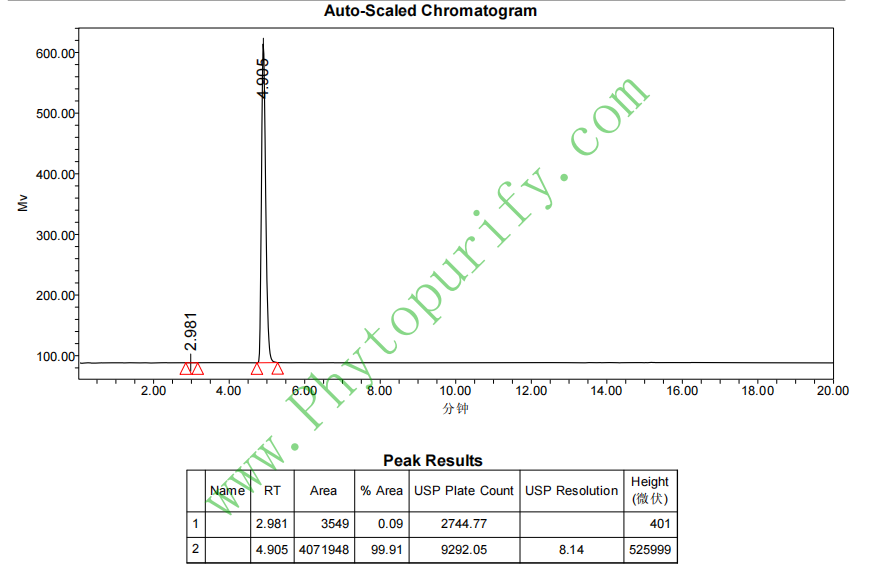
Storage conditions:Short-term storage at 2~8℃, long-term storage at -20 ~ -80℃
Panax notoginseng, as a traditional Chinese medicinal herb, has always been highly regarded for its significant effects in promoting blood circulation, removing blood stasis, and protecting cardiovascular and cerebrovascular health. Dencichin (CAS number 5302-45-4) is a non protein amino acid natural product isolated from Panax notoginseng. In recent years, it has become a hot topic in natural product pharmacology research due to its unique pharmacological activity and potential clinical application value. Sanqi Su can selectively inhibit hypoxia inducible factor prolyl hydroxylase 2 (PHD-2), thereby regulating the cellular response mechanism to hypoxia and exhibiting significant cardiovascular protective effects. This article provides a systematic review of the chemical structure and physicochemical properties, plant sources and extraction methods, pharmacological activity, mechanism of action, pharmacological evaluation, and clinical application prospects of Sanqi Su. The aim is to provide a theoretical basis for the in-depth research and drug development of this natural product.
The chemical name of Sanqi Su is (specific chemical name to be supplemented), with a molecular formula of C7H13NO4 and a molecular weight of 176.1280. Its structural feature is a non protein amino acid skeleton containing carboxyl, amino, and multiple hydroxyl functional groups, giving it strong polarity and water solubility. The LogP value of Sanqi Su is -2.0193, indicating its strong hydrophilicity and polar surface area (TPSA) of 129.72 Å ², further confirming its high polarity characteristics. The water solubility is 29.7121 mg/mL, indicating good solubility in water. The low blood-brain barrier permeability of Sanqi Su suggests its limited ability to penetrate the central nervous system. The negative result of hERG channel inhibition experiment indicates a low risk of cardiac toxicity. The Ames mutagenicity test score is 0.6, indicating low genetic toxicity and a certain level of safety.
The chemical structure diagram of Sanqi Su is shown below (schematic):
  HO–CH2–CH(NH2)–COOH
    |
   OH
The presence of hydroxyl groups in this structure not only affects its hydrophilicity, but may also participate in hydrogen bonding with target proteins, enhancing binding affinity.
Sanqi extract mainly exists in the roots of Panax notoginseng and is one of the non protein amino acid active ingredients in Panax notoginseng. Sanqi, as a plant of the Panax genus in the Araliaceae family, is widely distributed in Yunnan, Guangxi and other places in China, with a long history of medicinal use. The content of Sanqi Su is greatly affected by growth environment, harvesting time, and processing technology.
The common methods for extracting Sanqi extract include water extraction, alcohol extraction, and their combined processes. Generally, dried Sanqi roots are crushed and extracted using hot water or ethanol water mixed solvents, followed by centrifugation and filtration to remove impurities. After concentration, the extract is purified using ion exchange resin, silica gel column chromatography, or high-performance liquid chromatography (HPLC) to obtain high-purity Sanqi extract. In recent years, the application of new technologies such as ultrasound assisted extraction and microwave-assisted extraction has improved extraction efficiency and purity, while reducing extraction time and energy consumption.
The key to optimizing the extraction process lies in controlling temperature, pH value, and solvent polarity to maximize the activity and stability of Sanqi extract. In addition, Sanqi extract is susceptible to oxidation and hydrolysis during the extraction process, so it needs to be operated under low temperature and light avoidance conditions.
The pharmacological activities of Sanqi Su are mainly reflected in cardiovascular protection, anti-inflammatory, antioxidant, and anti hypoxia aspects. Numerous in vitro cell experiments and animal model studies have shown that Sanqi Su exerts its biological effects through multiple targets and pathways.
Sanqi Su has significant protective effects on the cardiovascular system, manifested as anti platelet aggregation, improvement of microcirculation, anti ischemia-reperfusion injury, and regulation of vascular endothelial function. Its target proteins include platelet selective protein (SELP), peroxisome proliferator activated receptor gamma (PPARG), angiotensin-converting enzyme (ACE), protein kinase B (AKT1), β 2-adrenergic receptor (ADRB2), potassium channel protein (KCNH2), endothelial nitric oxide synthase (NOS3), intercellular adhesion molecule 1 (ICAM1), vascular cell adhesion molecule 1 (VCAM1), and sodium calcium exchange protein (SLC8A1).
By regulating the above targets, Sanqi Su can inhibit platelet activation and aggregation, reduce blood viscosity, promote vasodilation, reduce the release of inflammatory mediators, protect vascular endothelial cells, alleviate myocardial ischemia and hypoxia injury, and prevent the occurrence of arrhythmia.
Sanqi Su has significant anti-inflammatory activity, which can inhibit the expression of inflammatory factors such as TNF - α and IL-6, and alleviate inflammatory reactions. Its antioxidant effect is achieved by clearing free radicals and enhancing endogenous antioxidant enzyme activity (such as superoxide dismutase (SOD) and glutathione peroxidase (GPx)), reducing oxidative stress damage to the cardiovascular system.
As an inhibitor of PHD-2, Sanqi Su stabilizes hypoxia inducible factor-1 α (HIF-1 α), activates downstream adaptive gene expression, and enhances cell tolerance to hypoxic environments. This mechanism has shown good protective effects in disease models such as ischemic heart disease and cerebral ischemia.
The core mechanism of action of Sanqi Su is based on its inhibition of HIF-prolyl hydroxylase-2 (PHD-2). PHD-2 is a key enzyme that regulates the stability of HIF-1 α protein. Under normal circumstances, PHD-2 catalyzes the prolyl hydroxylation of HIF-1 α, leading to its ubiquitination degradation. Sanqi Su inhibits PHD-2 activity, prevents HIF-1 α degradation, and promotes its accumulation in the nucleus, activating the expression of hypoxia responsive genes.
By activating the HIF-1 α signaling pathway, Sanqi Su promotes the expression of angiogenic factors (such as VEGF), glycolytic enzymes, erythropoietin (EPO), etc., enhances tissue adaptation to hypoxia, and improves blood flow perfusion in ischemic areas.
In addition, the regulation of cardiovascular related targets by Sanqi Su involves multiple signaling pathways:
The synergistic effect of these multiple targets enables Sanqi Su to demonstrate comprehensive advantages in cardiovascular protection.
The pharmacological parameters of Sanqi Su indicate that it has good potential for drug development. The molecular weight of 176.1280 is within the ideal range for small molecule drugs, and a low LogP value suggests good water solubility, which is beneficial for oral absorption. Although high TPSA values may limit their cell membrane penetration, they help target protein targets in the aqueous environment.
The low permeability of the blood-brain barrier suggests that it mainly acts on peripheral tissues, reducing the risk of central nervous system side effects. Lack of hERG channel inhibitory activity reduces the risk of cardiac toxicity. The Ames test results showed low genetic toxicity and good safety.
In terms of pharmacokinetics, existing studies have shown that Sanqi Su is rapidly absorbed after oral administration, with a rapid peak in plasma concentration. However, its bioavailability is limited by gastrointestinal stability and first pass effects. It is widely distributed in the body and mainly excreted through the kidneys. The metabolic pathway has not been fully elucidated, and it is speculated that it may involve liver phase II reactions such as glucuronic acid binding.
In the future, further systematic research is needed on the pharmacokinetic parameters of Sanqi Su, including half-life, clearance rate, and metabolite characteristics, to guide the design of rational dosing regimens.
As one of the main active ingredients of Panax notoginseng, Panax notoginseng has broad clinical application prospects with its unique inhibition of PHD-2 activity and multi target cardiovascular protection. Its potential efficacy in ischemic heart disease, cerebrovascular disease, atherosclerosis, hypertension and related inflammatory diseases deserves further exploration.
Currently, Sanqi Su is still in the stage of basic research and early preclinical studies, lacking systematic clinical trial data. In the future, research should focus on the following directions:
With the advancement of modern drug development technology, Sanqi Su is expected to become an important candidate for new cardiovascular protective drugs, promoting the modernization and internationalization of traditional Chinese medicine.
Panax notoginseng, as a non protein amino acid natural product from Panax notoginseng, shows good pharmacological activity and pharmaceutical properties by virtue of its inhibition of HIF-prolyl hydroxase-2 activity and multi target cardiovascular protection. Its unique mechanism of action makes it have important therapeutic potential in ischemia and hypoxia related diseases. Although research on Sanqi Su is still in its infancy, existing experimental data has laid a solid foundation for its clinical development. In the future, through systematic pharmacology, pharmacokinetics, and clinical research, Sanqi Su is expected to become an innovative drug in the field of cardiovascular disease treatment, bringing new treatment options to patients.
