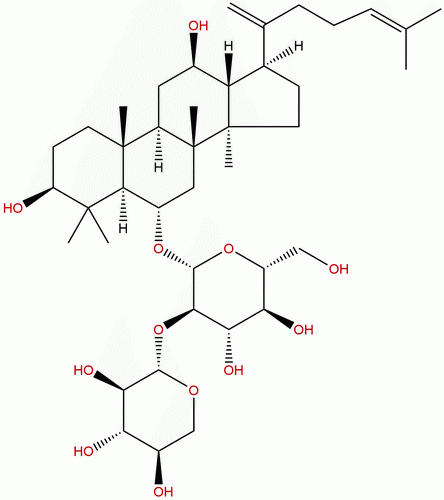


Product name: Notoginsenoside T5
Synonym name: Notoginsenoside T5
Catalogue No.: BPF2824
Cas No.: 769932-34-5
Formula: C41H68O12
Mol Weight: 752.983
Botanical Source:
Physical Description:
Type of Compound: Alkaloids
Purity: 95%~99%
Analysis Method: HPLC-DAD or/and HPLC-ELSD
Identification Method: Mass, NMR
Packing: Brown vial or HDPE plastic bottle
The product could be supplied from milligrams to grams
Inquire for bulk scale.
For Reference Standard and R&D, Not for Human Use Directly.
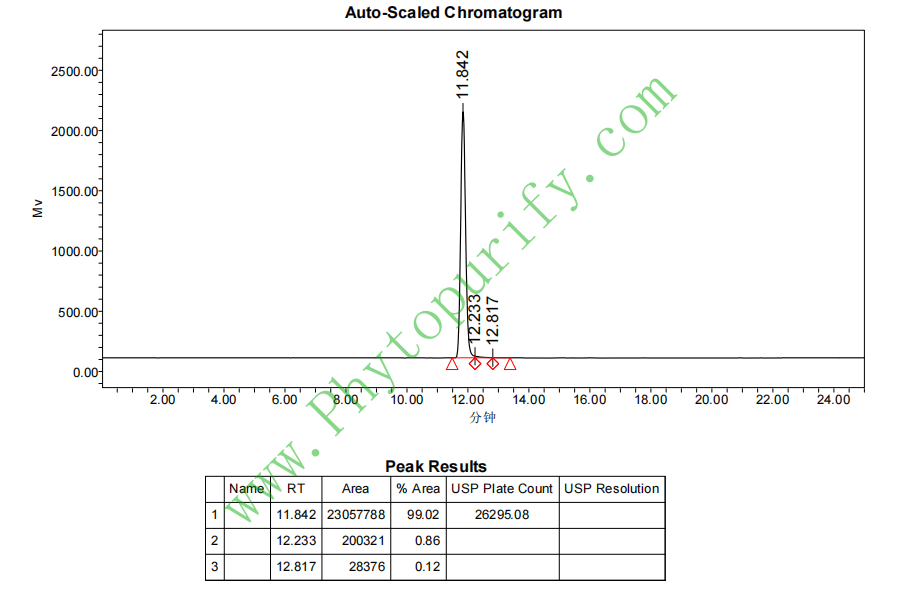
HPLC of Notoginsenoside T5
Storage conditions:Short-term storage at 2~8℃, long-term storage at -20 ~ -80℃
224.2700
-1.5000
No
No
No
Unknown
Unknown
No
Unknown
Notoginsenoside T5 (CAS number: 769932-34-5) is a traditional precious Chinese medicine derived from Panax notoginseng(Panax notoginseng)Dammarane glycoside compounds isolated from the middle. Sanqi, as the dried root and rhizome of the Panax genus in the Araliaceae family, has a medicinal history of hundreds of years in China and is widely used in the prevention and treatment of cardiovascular and cerebrovascular diseases. It has the unique effect of "stopping bleeding without leaving blood stasis, removing blood stasis without damaging the upright". Modern pharmacological research has shown that the main active ingredients of Panax notoginseng include notoginsenosides and ginsenosides. Among them, ginsenoside T5, a rare saponin discovered during acidic deglycosylation, has gradually attracted the attention of researchers in natural product chemistry and pharmacology in recent years.
The discovery of Panax notoginseng saponins T5 originated from the analysis of the products obtained from acidic hydrolysis or deglycosylation treatment of Panax notoginseng saponins (PNS). Compared with the main saponins with higher content in Panax notoginseng (such as ginsenoside Rb1, Rg1, ginsenoside R1, etc.), Panax notoginseng saponin T5 has extremely low content in natural plants, but its unique sugar chain structure and glycoside skeleton endow it with potential biological activity. From a chemical structure perspective, Panax notoginseng saponin T5 belongs to the dammarane type tetracyclic triterpenoid saponin, with a 20 (S) - protopanaxadiol (PPD) type maternal nucleus. The sugar chain connection mode differs from known saponins, and this structural specificity may determine its pharmacological spectrum of action different from conventional saponins.
In recent years, with the advancement of separation and purification technology and the application of activity oriented separation strategies, the potential of Panax notoginseng saponin T5 in anti-inflammatory, anti-tumor, neuroprotective, and cardiovascular protection has gradually been revealed. However, due to the extremely low content of this compound in plants, the difficulty of isolation, and the lack of systematic pharmacokinetic and toxicological evaluation, its pharmacological research is still in the early stages. This article will provide a systematic review of the research progress of Panax notoginseng saponin T5 from the aspects of chemical structure, plant origin, pharmacological activity, mechanism of action, medicinal evaluation, and clinical application prospects, in order to provide reference for the further development of this natural product.
The chemical structure of Panax notoginseng saponin T5 belongs to the damaane type tetracyclic triterpenoid saponin, and its aglycone is 20 (S) - protopanaxadiol. Compared with classic protopanaxadiol type saponins such as ginsenoside Rb1, Rd, etc., the sugar chain linkage of Panax notoginseng saponin T5 is unique. Specifically, its sugar chain consists of two glucose groups (Glc) and one xylose group (Xyl), with the xylose group connected to the glucose group through specific glycosidic bonds, forming a branched structure. This arrangement of sugar chains is relatively rare in the Sanqi saponin family and may be closely related to its unique biological activity.
From the molecular formula, the molecular weight of Panax notoginseng saponin T5 is 792.9700 Da, and the molecular formula is speculated to be C ₄₂ H ₇₂ O ₁₄ (specific structure needs to be confirmed). The LogP of its lipid water partition coefficient is -1.5000, indicating that the compound has strong hydrophilicity and high solubility in water, but low solubility in lipid soluble media. This characteristic determines that its oral absorption may be poor, but it is beneficial for maintaining a high free concentration in the blood. The topological polar surface area (TPSA) is 224.2700 Å ², which is much higher than the recommended upper limit of 140 Å ² for oral drugs, further indicating its limited transmembrane absorption capacity. The number of hydrogen bond receptors is 12, indicating that the molecule has abundant hydrogen bond formation sites, which are conducive to interacting with biomolecules such as proteins and nucleic acids, but may also lead to a decrease in its affinity for the lipid bilayer of the cell membrane.
In terms of physicochemical stability, Sanqi saponin T5, as a glycoside compound, may undergo glycosidic bond hydrolysis under acidic conditions, generating secondary glycosides or aglycones; Under alkaline conditions, isomerization or degradation may occur. There is still a lack of systematic research on its stability to heat and light, but generally saponin compounds are more stable under light avoidance and low temperature conditions. In addition, due to the presence of multiple hydroxyl groups in the molecule, Panax notoginseng saponin T5 may have strong hygroscopicity, and moisture prevention should be taken into account during storage.
It is worth noting that the blood-brain barrier (BBB) penetration prediction result of Panax notoginseng saponin T5 is "No", which is consistent with its high polarity, high molecular weight, and high TPSA value. This characteristic limits its potential application in the treatment of central nervous system diseases, but also reduces its potential toxicity risk to the central nervous system. At present, toxicological data on the hepatotoxicity, cardiotoxicity, hERG inhibitory activity, and Ames mutagenicity of Sanqi saponin T5 are labeled as "Unknown", indicating that the safety evaluation of this compound is still blank and systematic research is urgently needed.
Sanqi saponin T5 was originally derived from Sanqi(Panax notoginseng)It can be isolated from the rhizomes of plants, but its content in natural plants is extremely low and usually needs to be obtained through chemical or biological transformation methods. The main saponin components in Panax notoginseng include ginsenosides Rb1, Rg1, Re, Rd, and Panax notoginseng saponin R1. The content of these components in total saponins can reach 5% -10%, while the content of Panax notoginseng saponin T5 is usually less than 0.01%. Therefore, directly extracting and purifying naturally occurring Sanqi saponin T5 is costly and yields extremely low.
At present, the acquisition of Panax notoginseng saponins T5 mainly relies on acidic deglycosylation treatment of total saponins in Panax notoginseng. Specifically, the total saponins of Panax notoginseng are heated under mild acidic conditions (such as dilute hydrochloric acid or acetic acid) to selectively hydrolyze some glycosidic bonds, thereby generating a series of secondary saponins and rare saponins. Panax notoginseng saponin T5 is one of them. The principle of this method is that there are differences in the sensitivity of different glycosidic bonds to acids. By controlling the reaction conditions (such as acid concentration, temperature, reaction time), the target product can be selectively enriched. However, this method also has problems such as multiple side reactions, complex products, and difficult separation and purification.
In terms of separation and purification, commonly used techniques include silica gel column chromatography, reverse phase silica gel column chromatography (such as ODS), macroporous adsorption resin chromatography, high performance liquid chromatography (HPLC), and high-speed countercurrent chromatography (HSCCC). Due to the similar polarity of Panax notoginseng saponins T5 and other saponins, it is often difficult to achieve complete separation using a single chromatographic technique, and multiple chromatographic methods need to be combined for gradient elution. For example, macroporous adsorption resin (such as D101 type) can be used for preliminary separation to remove pigments and sugar impurities; Then, gradient elution was performed using a chloroform methanol water system through silica gel column chromatography; Finally, preparative HPLC was used to refine using acetonitrile water or methanol water as the mobile phase. In recent years, new separation techniques such as supercritical fluid chromatography (SFC) and hydrophilic interaction chromatography (HILIC) have also been attempted for the separation of saponin compounds, but have not yet been widely used in the preparation of Sanqi saponin T5.
It is worth noting that biotransformation provides a new approach for the preparation of Sanqi saponin T5. By screening microorganisms or enzyme preparations with specific glycosidase activity, specific glycosidic bonds in total saponins of Panax notoginseng can be selectively hydrolyzed, thereby efficiently generating target rare saponins. For example, β - glucosidase and β - xylosidase produced by certain fungi (such as Aspergillus and Trichoderma) or bacteria (such as lactic acid bacteria) may catalyze the production of ginsenoside T5 in Panax notoginseng. In addition, using genetic engineering methods to construct engineering strains and express specific glycoside hydrolases is also an important direction for achieving large-scale production of Panax notoginseng saponin T5 in the future.
Although the research on Sanqi saponin T5 started relatively late, preliminary studies have revealed its potential pharmacological activity in multiple disease models. The following is a review from several aspects, including anti-inflammatory, anti-tumor, cardiovascular protection, and neuroprotection.
Inflammation is the common pathological basis of many chronic diseases (such as cardiovascular diseases, diabetes, neurodegenerative diseases). Research has shown that Sanqi saponin T5 exhibits significant anti-inflammatory effects in both in vitro and in vivo models. In the macrophage RAW264.7 model stimulated by lipopolysaccharide (LPS), Sanqi saponin T5 can dose dependently inhibit the production of nitric oxide (NO) and prostaglandin E2 (PGE2), while reducing the mRNA expression levels of pro-inflammatory cytokines such as tumor necrosis factor - α (TNF - α), interleukin-1 β (IL-1 β), and interleukin-6 (IL-6). Its anti-inflammatory mechanism may be related to the inhibition of the activation of the nuclear factor kappa B (NF - κ B) signaling pathway, manifested by the inhibition of phosphorylation and degradation of I κ B α, as well as nuclear translocation of p65 subunit.
In animal models, Panax notoginseng saponin T5 has inhibitory effects on carrageenan induced foot swelling in rats and acetic acid-induced increased peritoneal capillary permeability in mice, suggesting its potential acute anti-inflammatory activity. In addition, in chronic inflammation models such as collagen induced arthritis models, Sanqi saponin T5 can alleviate joint swelling and bone destruction, reduce serum levels of inflammatory factors, and demonstrate therapeutic potential for rheumatoid arthritis.
Sanqi saponin T5 exhibits proliferation inhibition and induces apoptosis in various tumor cell lines. In vitro experiments, Panax notoginseng saponin T5 showed certain cytotoxicity to human hepatoma cell HepG2, human breast cancer cell MCF-7, human lung cancer cell A549, and human colon cancer cell HT-29, and the IC50 value was usually within the range of 10-50 μ M. Its anti-tumor mechanism may involve multiple aspects: firstly, Sanqi saponin T5 can induce cell apoptosis through the mitochondrial pathway, manifested as a decrease in mitochondrial membrane potential, release of cytochrome c, and activation of caspase-3 and caspase-9; Secondly, it can inhibit the PI3K/Akt/mTOR signaling pathway, thereby blocking the proliferation and survival signals of tumor cells; In addition, Sanqi saponin T5 can induce cell cycle arrest in the G0/G1 phase and inhibit unrestricted proliferation of tumor cells.
It is worth noting that Sanqi saponin T5 has relatively low toxicity to normal cells, indicating its selective anti-tumor activity. In tumor bearing mouse models, Sanqi saponin T5 (intraperitoneal injection or oral administration) can inhibit tumor growth, prolong survival, and no significant weight loss or organ toxicity was observed. However, current research is still mainly based on in vitro experiments, and there is insufficient data on in vivo anti-tumor activity. More animal models and preclinical studies are needed to verify this.
Based on the traditional use of Panax notoginseng, cardiovascular protection is one of the key research directions of Panax notoginseng saponin T5. Preliminary studies have shown that Sanqi saponin T5 has a protective effect on myocardial ischemia-reperfusion injury. In the H9c2 myocardial cell hypoxia/reoxygenation model, pre-treatment with ginsenoside T5 can reduce lactate dehydrogenase (LDH) release, decrease reactive oxygen species (ROS) levels, and improve cell survival rate. The mechanism may be related to the activation of the PI3K/Akt signaling pathway and the inhibition of mitochondrial permeability transition pore (mPTP) opening.
In terms of vascular function, Sanqi saponin T5 can inhibit the proliferation and migration of vascular smooth muscle cells induced by angiotensin II (Ang II), which may be related to its inhibition of phosphorylation of the ERK1/2 and JNK signaling pathways. In addition, Sanqi saponin T5 can improve high glucose induced endothelial cell dysfunction, increase the production of nitric oxide (NO), and reduce the expression of endothelin-1 (ET-1), thereby exerting a vascular protective effect. These findings suggest that PNS T5 may have potential value in the prevention and treatment of vascular diseases such as hypertension and atherosclerosis.
Although the blood-brain barrier penetration prediction of Sanqi saponin T5 is negative, there are still studies exploring its potential in neuroprotection. In the glutamate induced PC12 cell injury model, Sanqi saponin T5 can alleviate cell damage, reduce intracellular calcium ion concentration, and inhibit oxidative stress response. In addition, in the SH-SY5Y cell model induced by β - amyloid protein (A β), Sanqi saponin T5 can reduce the aggregation of A β and the excessive phosphorylation of tau protein, suggesting its potential intervention effect on Alzheimer's disease. However, due to poor BBB penetration, there are still doubts about whether ginsenoside T5 can effectively reach central nervous system targets in vivo. In the future, it may be necessary to improve its brain delivery efficiency through strategies such as nano formulations, liposomes, or prodrug design.
The pharmacological effects of Sanqi saponin T5 involve multiple signaling pathways and molecular targets, and its mechanism of action exhibits the characteristics of multi-target and multi pathway. The following will elaborate on the main signaling pathways and molecular targets.
NF - κ B signaling pathway Sanqi saponin T5 can inhibit the activity of I κ B kinase (IKK), prevent the phosphorylation and ubiquitination degradation of I κ B α, thereby inhibiting the nuclear translocation of NF - κ B p65 subunit and reducing the transcription of downstream pro-inflammatory genes (such as TNF - α, IL-1 β, COX-2, iNOS). This is one of the core mechanisms of its anti-inflammatory effect.
PI3K/Akt/mTOR pathway Sanqi saponin T5 can activate the PI3K/Akt signaling pathway, promote Akt phosphorylation, and subsequently activate downstream mTOR and GSK-3 β, exerting anti apoptotic and pro survival effects. This mechanism is particularly important in myocardial protection. However, in tumor cells, Sanqi saponin T5 actually inhibits the PI3K/Akt/mTOR pathway, leading to cell growth arrest and apoptosis, suggesting that its effect is cell type dependent.
MAPK signaling pathway The regulation of Sanqi saponin T5 on MAPK family members (ERK, JNK, p38) presents complexity. In the inflammatory model, it inhibits the phosphorylation of JNK and p38, thereby reducing the production of inflammatory factors; In tumor cells, it may induce apoptosis by activating p38 or JNK. This bidirectional regulation may be the basis for its selective pharmacological activity.
Mitochondrial apoptosis pathway Sanqi saponin T5 promotes mitochondrial release of cytochrome c, activates caspase-9 and caspase-3, and ultimately leads to cell apoptosis by downregulating Bcl-2 and upregulating Bax. This is one of the main mechanisms of its anti-tumor activity.
At present, the direct molecular target of Sanqi saponin T5 has not been fully identified. Based on structural similarity analysis, it is speculated that it may act on the following targets:
In the future, through techniques such as surface plasmon resonance (SPR), drug affinity response target stability (DARTS), or thermal proteomics (TPP), it is expected to identify the direct binding protein of Panax notoginseng saponin T5 and elucidate its precise molecular mechanism.
Based on the Lipinski Rule of Five and Veber Rule, there are certain challenges to the pharmacological properties of Panax notoginseng saponin T5. Its molecular weight (792.97 Da) far exceeds the threshold of 500 Da, LogP (-1.50) is below the recommended range of -0.4, TPSA (224.27 Å ²) is much higher than 140 Å ², and the number of hydrogen bond acceptors (12) exceeds 10. These parameters suggest that the oral bioavailability of the compound may be low and its transmembrane permeability may be poor. In addition, the BBB penetration prediction is negative, which limits its application in central nervous system diseases.
In terms of toxicity prediction, liver toxicity, cardiac toxicity, hERG inhibition, and Ames test results are all "unknown", indicating a lack of experimental data support. Considering that saponin compounds usually have hemolytic activity, Sanqi saponin T5 may also have a certain risk of hemolysis and requires special attention when administered intravenously. In addition, its long-term toxicity, reproductive toxicity, and immune toxicity also need to be systematically evaluated.
At present, pharmacokinetic studies on Sanqi saponin T5 are extremely limited. Based on known data of similar saponins (such as ginsenoside Rb1, Rg1), it can be inferred that the pharmacokinetic characteristics of Sanqi saponin T5 are as follows:
To enhance the pharmacological properties of Panax notoginseng saponins T5, the following strategies can be considered: ① Nanoformulations (such as liposomes, polymer nanoparticles) to improve oral absorption and targeted delivery; ② Pre drug design, by introducing lipophilic groups to enhance membrane permeability; ③ Structural modifications, such as sugar chain simplification or glycoside modification, to reduce molecular weight and optimize pharmacokinetic parameters; ④ Combination therapy using P-glycoprotein inhibitors to enhance oral bioavailability.
Panax notoginseng saponin T5, as a rare dammarane type saponin in Panax notoginseng, although research is still in its early stages, its unique chemical structure and preliminary pharmacological activity make it potentially valuable for clinical applications. Below are several perspectives on its future development direction.
Based on its significant anti-inflammatory activity, Sanqi saponin T5 is expected to be developed as a candidate drug for the treatment of chronic inflammatory diseases such as rheumatoid arthritis, inflammatory bowel disease, and chronic obstructive pulmonary disease. Its mechanism of action is closely related to the inhibition of the NF - κ B pathway, and may have a synergistic effect with other anti-inflammatory drugs such as nonsteroidal anti-inflammatory drugs and glucocorticoids, while reducing side effects. In addition, its immunomodulatory role in autoimmune diseases also deserves further exploration.
Sanqi saponin T5 has inhibitory effects on various tumor cells and low toxicity to normal cells, suggesting that it may be used as a chemotherapy sensitizer or adjuvant therapy drug. For example, when used in combination with chemotherapy drugs such as cisplatin and paclitaxel, it may improve efficacy by inhibiting the PI3K/Akt pathway or reversing multidrug resistance. In addition, its mechanism of inducing apoptosis and cycle arrest makes it potential in preventing tumor recurrence and metastasis.
Based on the traditional use of Panax notoginseng and preliminary research results, Panax notoginseng saponin T5 has development prospects in cardiovascular diseases such as myocardial ischemia, atherosclerosis, hypertension, etc. Its cardioprotective effect may be achieved by activating the PI3K/Akt pathway, while its vascular protective effect is related to improving endothelial function. In the future, it may be considered to develop it as an oral or injectable cardiovascular protective agent for rehabilitation treatment after acute myocardial infarction or long-term management of chronic cardiovascular disease.
Although poor BBB penetration is its main obstacle, Sanqi saponin T5 may still be used for the treatment of neurodegenerative diseases such as Alzheimer's disease and Parkinson's disease through nano delivery systems or nasal administration routes. Its antioxidant, anti-inflammatory, and anti apoptotic effects may have a protective effect on neurons. In addition, its metabolites (such as protopanaxadiol) may have better BBB penetration and are worthy of further investigation.
Despite its broad prospects, the clinical translation of Panax notoginseng saponin T5 still faces many challenges: ① limited sources, extremely low natural content, and high costs for chemical synthesis or biotransformation; ② Poor pharmacokinetic properties and low oral bioavailability; ③ Lack of toxicology data and insufficient safety evaluation; ④ The molecular target is unclear, and the mechanism of action needs to be further elucidated.
In response to these challenges, future research directions should focus on: ① developing efficient and low-cost biotransformation or synthetic biology methods to achieve large-scale preparation of Panax notoginseng saponin T5; ② Using medicinal chemical methods for structural optimization to improve metabolic stability and membrane permeability; ③ Conduct systematic preclinical toxicology studies, including acute toxicity, long-term toxicity, reproductive toxicity, and genetic toxicity; ④ Using omics techniques such as proteomics and metabolomics, as well as chemical biology methods, to identify their direct targets and provide a basis for precision drug design.
Panax notoginseng saponin T5, as a rare dammarane type saponin in Panax notoginseng, has become a new hotspot in natural product pharmacology research due to its unique chemical structure and preliminary discovery of anti-inflammatory, anti-tumor, cardiovascular protective, and neuroprotective activities. However, the research on this compound is still in its infancy, and there is still a huge gap between basic research and clinical translation. Its extremely low natural content, poor pharmacokinetic properties, and blank toxicological data are the main bottlenecks restricting its pharmacological development.
In the future, with the advancement of separation and purification technology, the maturity of biotransformation methods, and the innovation of drug chemical modification strategies, Sanqi saponin T5 is expected to break through these limitations and become an innovative drug lead compound with independent intellectual property rights. Meanwhile, in-depth elucidation of its molecular targets and mechanisms of action will provide a theoretical basis for structure based drug design. The study of Panax notoginseng saponin T5 not only helps to reveal the material basis of traditional pharmacological effects of Panax notoginseng, but also provides a new paradigm for the development of dammarane type saponin compounds. We look forward to the near future when this rare saponin can move from the laboratory to clinical practice, contributing to the cause of human health.
