


Product name: Notoginsenoside Fe
Synonym name:
Catalogue No.: BP1009
Cas No.: 88105-29-7
Formula: C47H80O17
Mol Weight: 917.14
Botanical Source: Panax notoginseng(Burk.)F.H.Chen
Physical Description:
Type of Compound: Triterpenoids
Purity: 95%~99%
Analysis Method: HPLC-DAD or/and HPLC-ELSD
Identification Method: Mass, NMR
Packing: Brown vial or HDPE plastic bottle
Storage: Store in a well closed container, protected from air and light. Put into refrigerate or freeze for long term storage.
Whenever possible, you should prepare and use solutions on the same day. However, if you need to make up stock solutions in advance, we recommend that you store the solution as aliquots in tightly sealed vials at -20℃. Generally, these will be useable for up to two weeks.
The product could be supplied from milligrams to grams
Inquire for bulk scale.
Description:
Notoginsenoside Fe can induce gap junction-mediated intercellular communication (GJIC) reductions; and gap junctions have been shown or are believed to be involved in the pathogenesis of many inherited and acquired human diseases, agents that regulate the GJIC function may facilitate prevention and treatment of GJIC-involved diseases.
References:
Planta Med., 2001, 67(5):417-22.
Effects of ginsenosides from Panax ginseng on cell-to-cell communication function mediated by gap junctions.
Gap junctions have been shown or are believed to be involved in the pathogenesis of many inherited and acquired human diseases. Agents that regulate the gap junction-mediated intercellular communication (GJIC) function may facilitate prevention and treatment of GJIC-involved diseases.
METHODS AND RESULTS:
In the present study we examined the effects of 27 ginsenosides isolated from Panax ginseng on GJIC. The results show that compounds 1 (oleanolic acid), 2 (ginsenoside-R0), 3 (ginsenoside-Rb1), 5 (ginsenoside-Rb2), 7 (ginsenoside-Rd), 8 (ginsenoside-Rg3), 12 (panaxadial), 13 (notoginsenoside-R4), 17 [ginsenoside-Rg2 (20S)], 18 (ginsenoside-Rf), and 26 (ginsenoside-F3) did not obviously affect GJIC, whereas compounds 4 (ginsenoside-Rc), 6 (ginsenoside-Rb3), 9 (ginsenoside-Rd2), 10 (Notoginsenoside Fe), 11 (ginsenoside-Rh2),14 (ginsenoside-Ra1), 15 (ginsenoside-Re), 16 [ginsenoside-Rg2 (20R)], 19 (ginsenoside-Ia), 20 [ginsenoside-Rh1 (20S)], 21 [ginsenoside-Rh1 (20R)], 22 (ginsenoside-F1), 23 (protopanaxatriol), 24 (panaxatriol), 25 (ginsenoside-Rg1), and 27 (chikusetsaponin-L8) induced GJIC reductions at various degrees. Compounds 2, 7, and 8 protected against the tyrosine phosphatase inhibitor vanadate-induced GJIC reduction, while compounds 1, 5, 7, and 17 inhibited the cytokine interleukin 1 alpha (IL-1alpha)-induced reduction in GJIC. Nevertheless, no compounds protected against the protein kinase C (PKC) activator 12-O-tetradecanoylphorbol-13-acetate (TPA)-induced GJIC inhibition. On the other hand, GJIC reductions induced by compounds 6, 9,10, 20, 21, 22, 24, and 25 were inhibited by the tyrosine kinase (TK) inhibitor genistein, while GJIC reductions induced by compounds 6, 9, 14, 16, 19, 21, and 24 were attenuated in the presence of the PKC inhibitor calphostin C. However, GJIC reductions induced by compounds 4, 23, and 27 were not inhibited either by genistein or by calphostin C.
CONCLUSIONS:
These data indicate that various mechanisms are responsible for effects of ginsenosides on GJIC.
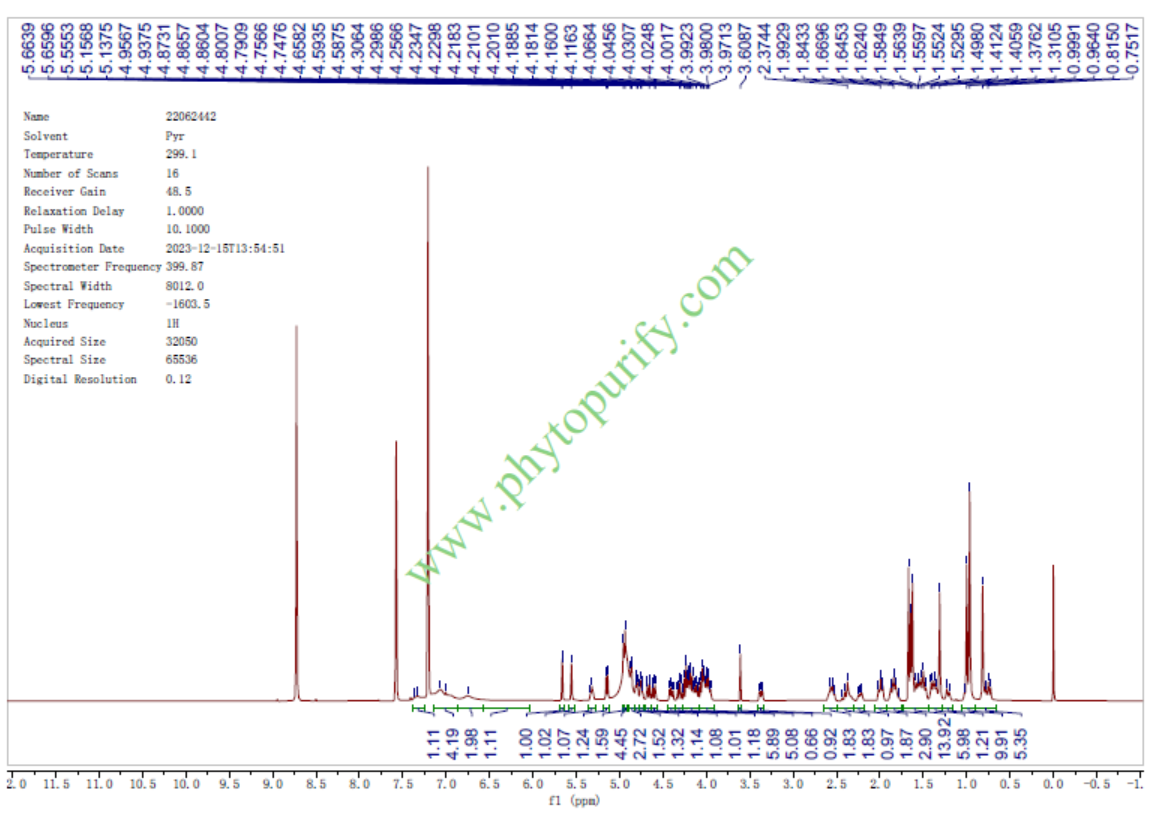
HNMR of Notoginsenoside Fe
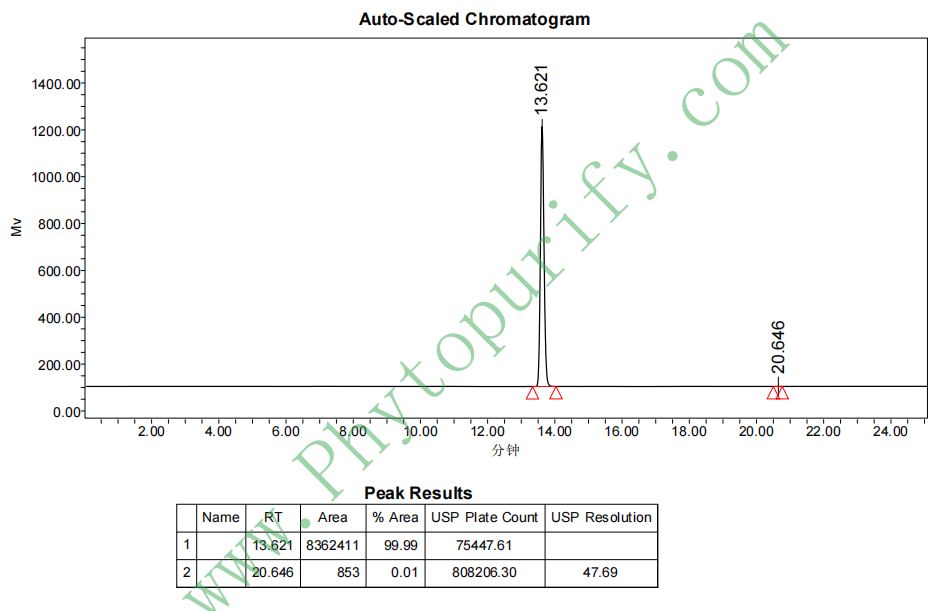
HPLC of Notoginsenoside Fe
Storage conditions:Short-term storage at 2~8℃, long-term storage at -20 ~ -80℃
Panax notoginseng, as a traditional Chinese medicinal herb, occupies an important position in clinical application of traditional Chinese medicine due to its significant effects of promoting blood circulation, removing blood stasis, stopping bleeding, and reducing swelling. Panax notoginseng saponins, as the main active ingredient in Panax notoginseng, have received widespread attention in recent years due to their diverse pharmacological activities. Notoginsenoside Fe is a natural triterpenoid saponin isolated from Panax notoginseng, which has a unique chemical structure and significant biological activity, especially showing potential therapeutic value in the field of neuroprotection. This article aims to systematically review the chemical structure, physicochemical properties, plant sources, and extraction methods of Panax notoginseng saponins Fe. Combining its pharmacological activity, mechanism of action, drug evaluation, and clinical application prospects, it comprehensively reviews the research progress of this compound and provides theoretical basis for subsequent basic and clinical research.
The molecular formula of Sanqi saponin Fe is C48H78O18, with a molecular weight of 917.14 Da, belonging to the pentacyclic triterpenoid saponin class. The core of its structure is the typical skeleton of ginsenosides, which connects multiple sugar residues to form a complex glycoside structure. The LogP value is 2.6873, indicating moderate lipid solubility and suitability for membrane penetration. The extremely high polar surface area (TPSA 277.91 Å ²) indicates strong molecular polarity and low water solubility (0.0674), which may limit its oral absorption and blood-brain barrier (BBB) penetration ability. The pharmacological analysis showed that Sanqi saponin Fe does not have hERG channel inhibitory effect, and the Ames test result is 0, indicating that its genetic toxicity risk is low and its safety is good.
Sanqi saponin Fe mainly comes from the roots and rhizomes of Sanqi, and is an important component of the Sanqi saponin population. Traditional extraction methods often use alcohol extraction combined with liquid chromatography separation technology. The specific process includes:
In recent years, the application of new technologies such as ultrasound assisted extraction and microwave-assisted extraction has improved extraction efficiency and purity, reduced extraction time and solvent usage, and provided technical support for industrial production.
Sanqi saponin Fe exhibits significant pharmacological activity in various disease models, especially in the field of neuroprotection where there are abundant research achievements.
Sanqi saponin Fe reduces nerve cell damage, inhibits neuroinflammation, and promotes nerve repair by regulating multiple signaling pathways. Its main manifestations are:
In addition to neuroprotection, Sanqi saponin Fe also exhibits antiplatelet aggregation, anti-inflammatory, anti-tumor, and cardiovascular protection effects, but the relevant mechanisms need further clarification.
The neuroprotective effect of Sanqi saponin Fe involves multi-target and multi pathway synergistic regulation, with the main targets including:
The synergistic regulation of these targets demonstrates the promising therapeutic potential of Sanqi saponin Fe in neurodegenerative diseases such as Alzheimer's disease and Parkinson's disease.
The pharmacological analysis of Sanqi saponin Fe shows that:
In terms of pharmacokinetics, there are relatively few existing studies. Preliminary data shows that the absorption of Sanqi saponin Fe is slow after oral administration, with a long plasma half-life. It is mainly metabolized by the liver and excreted through bile and urine. Its low blood-brain barrier permeability suggests that in the future, targeting of the central nervous system can be enhanced through drug delivery systems or structural modifications.
Based on the multi-target effects and good safety of Sanqi saponin Fe in the field of neuroprotection, it has broad clinical application prospects, especially in the following areas:
Treatment of neurodegenerative diseases
By regulating A β metabolism, tau protein phosphorylation, and oxidative stress, Sanqi saponin Fe is expected to become a potential therapeutic drug for cognitive disorders such as Alzheimer's disease.
Cerebral ischemia-reperfusion injury
The antioxidant and anti-inflammatory effects help alleviate neurological damage after stroke and promote neurological function recovery.
Parkinson's disease and other movement disorders
By regulating SNCA and anti apoptotic mechanisms, it is possible to slow down neuronal degeneration.
Combination therapy strategy
Can be used in combination with existing drugs to achieve synergistic effects and enhance therapeutic efficacy.
Future research should focus on the pharmacokinetic optimization of Panax notoginseng saponins Fe, innovative administration routes (such as nanocarriers and brain targeted delivery systems), and clinical safety and efficacy evaluation. In addition, in-depth analysis of its molecular mechanism and multi-target synergistic effects can help promote its clinical translation.
Sanqi saponin Fe, as an important active ingredient in Sanqi, has demonstrated broad medicinal value due to its unique chemical structure and multi-target neuroprotective effects. Despite the limitations of high molecular weight and low blood-brain barrier permeability, Sanqi saponin Fe is expected to become a new candidate drug for the treatment of neurodegenerative diseases through modern drug design and delivery technology improvements. In the future, it is necessary to strengthen its pharmacokinetics, mechanism research, and preclinical evaluation to lay a solid foundation for its clinical application and promote the innovative development of natural product pharmacology in the field of neurological disease treatment.
