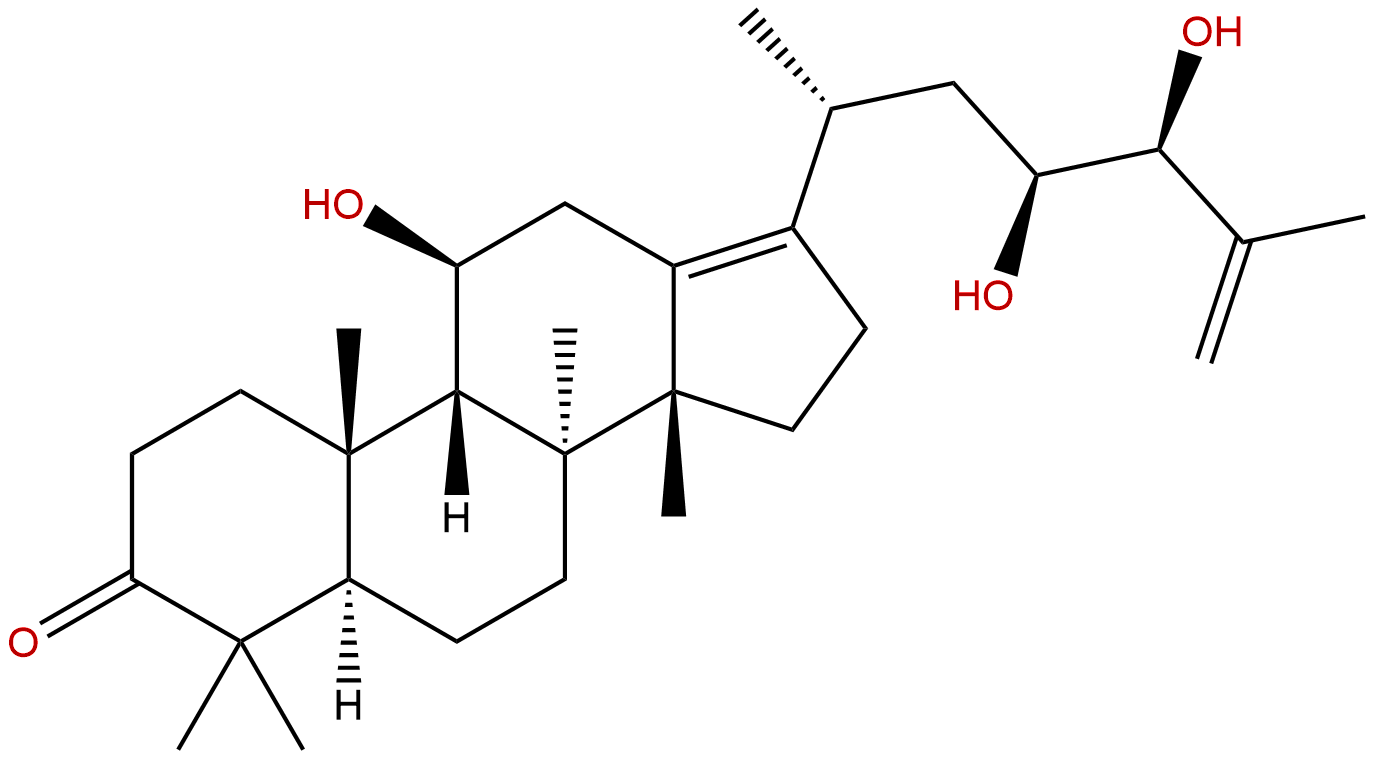


Product name: Alisol G
Synonym name:
Catalogue No.: BP3062
Cas No.: 155521-46-3
Formula: C30H48O4
Mol Weight: 472.71
Botanical Source:
Physical Description: Powder
Type of Compound: Triterpenoids
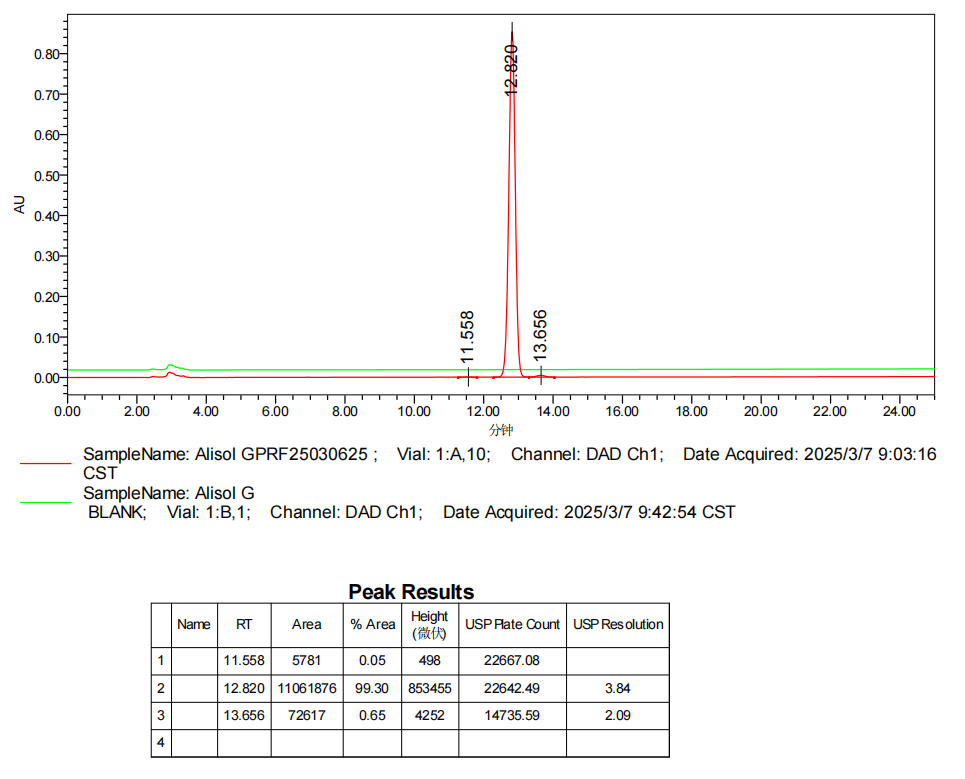
Purity: 95%~99%
Analysis Method: HPLC-DAD or/and HPLC-ELSD
Identification Method: Mass, NMR
Packing: Brown vial or HDPE plastic bottle
The product could be supplied from milligrams to grams. Inquire for bulk scale.
We provide solution to improve the water-solubility of compounds, thereby facilitating the variety of activity tests and clinic uses.
For Reference Standard and R&D, Not for Human Use Directly.
HPLC of Alisol G
Storage conditions:Short-term storage at 2~8℃, long-term storage at -20 ~ -80℃
77.7600
4.6843
4.6849
.0054
2.8484
3.8080
High
83.3470
5.1757
No
No
No
No
No
No
0.0
No
No
No
No
Hypertensive edema is a common complication in the progression of hypertension, which is closely related to the disorder of renal water and salt metabolism, seriously affecting the quality of life of patients and increasing the risk of cardiovascular events. At present, although first-line diuretics are effective in clinical practice, long-term use often accompanies side effects such as electrolyte imbalance and elevated uric acid. It is urgent to develop new therapeutic drugs with novel mechanisms of action and better safety. In this context, searching for active lead compounds from traditional Chinese medicine has become an important research direction. Alisma(Alisma orientale (Sam.) Juzep., as a key diuretic, its modern pharmacological research reveals that its triterpenoid components are the key material basis for exerting diuretic effects. Among them, Alisol G (also known as 25 dehydrated Alisol A), as a type of triterpenoid, has attracted much attention in recent years due to its unique potential in regulating water and salt metabolism. This article aims to systematically review the chemical properties, plant sources, pharmacological activities, mechanisms of action, pharmacological properties, and application prospects of Alismatal G in diseases such as hypertensive edema, in order to provide comprehensive academic references for the in-depth research and development of this compound.
Alismatal G, with the chemical name (24R) -25-dehydrated Alismatal A, has a CAS registration number of 155521-46-3. From a chemical structure perspective, it belongs to the tetracyclic triterpenoid compound of the original terpenoid type, with a molecular formula of C ∝₀ H ₄₈ O ₄ and a molecular weight of 472.7100. Its core structure consists of a steroid like four ring system (A/B/C/D ring) and one side chain, characterized by an R configuration at the C-24 position and a dehydrated structure at the C-25 position (i.e. lacking a hydroxyl group), which is the key structural difference that distinguishes it from other diarrheal alcohol compounds (such as diarrheal alcohol A, B, C). C-3, C-16, and C-23 positions are usually connected to oxygen atoms (hydroxyl or carbonyl), and these functional groups have a decisive impact on their biological activity and physicochemical properties.
According to the provided pharmacological parameters, the lipid water partition coefficient (LogP) of Alismatal G is 4.6843, indicating its strong lipophilicity. The topological polar surface area (TPSA) is 77.7600 Å ², which is relatively low. Its water solubility is poor, only 0.0054 mg/mL, which is consistent with its high LogP value, suggesting that solubilization strategies may need to be considered in formulation development. It is worth noting that its blood-brain barrier permeability is predicted to be "high", indicating that it may be easy to enter the central nervous system, which is of great significance for acting on central related targets or evaluating their central nervous system side effects. In addition, the prediction of hERG inhibition is' no ', indicating a low risk of cardiac toxicity; The Ames test result was 0.0, indicating that there were no mutagenic alerts in this predictive model, providing preliminary computer simulation support for its safety.
Alismatal G is mainly derived from the plant Alismata in the Alismataceae family(Alisma orientale Dried tubers of (Sam.) Juzep. Alisma, as a traditional Chinese medicine, has a history of over two thousand years of application. It is mainly used to treat conditions such as difficulty urinating, edema, fullness, diarrhea, oliguria, and phlegm induced dizziness. Modern plant chemistry research has confirmed that the tubers of Alisma officinalis are rich in various triterpenoids of the original terpenoid and eucalyptoid types, among which Alisma alcohol G is one of the important active ingredients.
Its extraction and separation usually follow the conventional process of natural product chemistry. Firstly, the dried tubers of Alisma were crushed and subjected to reflux extraction or ultrasound assisted extraction using polar solvents such as methanol, ethanol, or aqueous ethanol to obtain the total extract. Subsequently, using the system solvent extraction method (such as sequentially extracting with petroleum ether, ethyl acetate, and n-butanol), Alismatal G was enriched in the ethyl acetate extraction site due to its equipolarity. Further purification relies on various chromatographic techniques. Silica gel column chromatography is commonly used for preliminary separation, with different ratios of petroleum ether ethyl acetate or chloroform methanol gradient elution. After obtaining the stream rich in the target component, fine purification is carried out through reverse phase silica gel column chromatography (such as ODS, with methanol water as the mobile phase), preparative high performance liquid chromatography (HPLC) or gel column chromatography (such as Sephadex LH-20), and finally the high-purity Alismatol G monomer is obtained. Structural identification involves the comprehensive use of nuclear magnetic resonance (NMR, including ¹ H, ¹ ³ C, 2D NMR), mass spectrometry (MS), infrared spectroscopy (IR), and X-ray single crystal diffraction techniques.
Numerous in vitro and in vivo pharmacological studies have shown that Alismatal G has multiple biological activities, among which the most prominent are its diuretic and anti edema effects, which are closely related to the improvement of hypertensive edema.
Diuretic and anti edema effects This is the most essential pharmacological activity of Alismatal G. In various animal models, such as saline loaded rats and spontaneously hypertensive rats, Alismatal G has shown significant effects in promoting urine excretion and reducing edema. Its diuretic properties may differ from some traditional diuretics, and research suggests that its effect is more focused on regulating the balance of aquaporins and ion channels, rather than strong sodium excretion, which helps reduce the risk of electrolyte imbalance.
Renal protective effect Research has shown that Alismatal G has a protective effect on the kidneys. In hypertensive kidney injury or drug-induced nephrotoxicity models, it can alleviate renal tissue pathological damage (such as tubular dilation and interstitial fibrosis), reduce urinary protein excretion, and improve renal function indicators (such as serum creatinine and urea nitrogen). This protective effect is related to its anti-inflammatory, antioxidant, and regulation of renal hemodynamics mechanisms.
Anti inflammatory and immune regulatory activity Inflammatory response is an important driving factor for the progression of diseases such as hypertensive edema. Zexiechun G can inhibit the production of pro-inflammatory factors such as TNF - α, IL-6, IL-1 β in cell models such as lipopolysaccharide stimulated macrophages. The mechanism involves inhibiting the activation of inflammatory signaling pathways such as NF - κ B.
Other potential activities: Some studies also suggest that alisol G may have the effects of lowering blood lipid, anti atherosclerosis and slight blood pressure. These effects are related to the improvement of metabolism and vascular function, and have potential synergistic value for the comprehensive management of hypertension and its complications.
The therapeutic effect of Alismatal G on hypertensive edema is not achieved through a single pathway, but through the synergistic regulation of water and salt reabsorption in the kidneys through multiple targets and pathways. Based on the provided target information, its mechanism of action can be further elucidated as follows:
Regulation of mineralocorticoid receptor (NR3C2)NR3C2 is a key nuclear receptor that regulates the sodium potassium balance in the kidneys. Aldosterone promotes the reabsorption of Na ⁺ and excretion of K ⁺ in the renal distal tubules and collecting ducts by activating NR3C2. Research has shown that Alismatal G may act as a regulator of NR3C2, interfering with the aldosterone-NR3C2 signaling axis, thereby reducing sodium reabsorption, producing a diuretic effect, and potentially alleviating edema and hypertension caused by it.
Regulation of sodium chloride cotransporter (SLC12A3, NCC) and sodium potassium chloride cotransporter (SLC12A1, NKCC2)SLC12A3 is expressed in the renal distal tubules and is a target of thiazide diuretics; SLC12A1 is expressed in the thick segment of the ascending branch of the medullary loop and is a target of loop diuretics such as furosemide. They are jointly responsible for the reabsorption of Na ⁺ and Cl ⁻ by the renal tubules. Alismatal G may inhibit the activity or expression of these transporters directly or indirectly, reduce sodium chloride reabsorption, increase urinary solute load, and thus produce osmotic diuresis.
Downregulation of aquaporin 2 (AQP2)AQP2 is a water channel protein regulated by antidiuretic hormone (ADH/AVP) and located on the main cells of the collecting duct. It is responsible for water reabsorption and is a key molecule determining urine concentration and dilution. In pathological conditions such as hypertensive edema, AQP2 expression or membrane localization may be abnormally increased. Research has shown that Alismatal G can downregulate the protein and mRNA expression levels of renal AQP2, and may affect its phosphorylation and membrane translocation processes, thereby reducing the reabsorption of water by the collecting ducts, promoting water excretion, and directly combating edema.
The influence of inward rectifying potassium channel (KCNJ1, ROMK)KCNJ1 is located in the luminal membrane of renal tubules (especially the thick segment of the ascending branch of the medullary loop and the collecting duct), responsible for potassium secretion. It is crucial for maintaining a positive potential in the lumen and driving the reabsorption of Na ⁺ and Cl ⁻ ions. Zetiamol G may regulate the activity of KCNJ1, affect the transmembrane potential difference of renal tubular epithelial cells, indirectly interfere with the coordinated transport of Na ⁺ and Cl ⁻, and participate in the fine regulation of diuretic process.
In summary, Alismatal G synergistically acts on multiple key targets such as NR3C2, SLC12A3, SLC12A1, AQP2, and KCNJ1, comprehensively regulating the water salt metabolism homeostasis of the kidneys from hormone receptors, ion transport, to water channels, providing a solid molecular pharmacology basis for its treatment of hypertensive edema.
Based on the physical and chemical properties described earlier and existing research, a preliminary evaluation of the pharmacological properties of Alismatal G is conducted
Advantage aspects Moderate molecular weight (<500) and clear structure. The absence of hERG inhibition and Ames mutagenicity alerts indicates a low risk of cardiac and genetic toxicity, and a good safety threshold. If its high blood-brain barrier permeability targets central related targets (such as certain blood pressure regulation centers), it may become advantageous.
Challenge aspect The main challenge lies in its poor performance Water solubility(0.0054 mg/mL), This may lead to poor oral absorption and low bioavailability. tall LogP The value (4.68) also suggests that it may have the characteristics of large distribution volume and slow elimination, and attention should be paid to the accumulation risk. If high BBB permeability is unrelated to its therapeutic target, potential central nervous system side effects need to be evaluated.
Regarding Alismatal G pharmacokinetics The research is currently relatively limited and is a key gap that must be filled in future development. Based on its physicochemical properties, it can be inferred that after oral administration, its absorption in the gastrointestinal tract may be affected by solubility and first pass effects. After absorption, due to its lipophilicity, it may be widely distributed to various tissues, including fat, liver, and possibly enter the central nervous system through the blood-brain barrier. In terms of metabolism, as a triterpenoid compound, it is expected to be mainly metabolized by the liver cytochrome P450 enzyme system (CYP450), and may undergo hydroxylation, oxidation, and binding reactions (such as glucuronidation and sulfation). The excretion pathway may mainly be through bile and feces, with some metabolites excreted through the kidneys. The study of ADME (absorption, distribution, metabolism, excretion) in the system, including absolute bioavailability, plasma protein binding rate, identification of major metabolites, interactions mediated by major metabolic enzymes and transporters, is a key step in advancing its preclinical development.
Zexiechun G has shown unique application prospects in the treatment of hypertensive edema. Its multi-target mechanism of action, especially the regulation of AQP2, complements traditional diuretics and is expected to provide a new treatment option for patients who have poor response to traditional diuretics or are prone to electrolyte imbalances. In addition, its dual renal protection and anti-inflammatory effects may have the potential to treat both symptoms and root causes for patients with hypertension and kidney injury.
Looking ahead to the future, research and development of Alismatal G should focus on the following directions:
1. In depth mechanism research Using techniques such as gene knockout/knock in animals, chromatin immunoprecipitation (ChIP), proteomics, etc., accurately elucidate whether it directly binds or indirectly regulates targets such as NR3C2 and AQP2, and draw a complete signal network map.
2. Systematic pharmacokinetic and toxicological evaluation Pre clinical ADME and GLP toxicology studies that meet the requirements for new drug registration must be completed to clarify their safety window, target organ toxicity, and reversibility, providing a basis for clinical trials.
3. Formulation technology research and development To address the issue of poor water solubility, new drug delivery systems such as nanocrystals, liposomes, solid dispersions, cyclodextrin inclusion complexes, etc. need to be developed to improve their oral bioavailability.
4. Exploring expanded indications Based on its core mechanism of regulating water and salt metabolism, we can explore its application value in edema caused by heart failure, nephrotic syndrome, cirrhosis ascites and other pathological water retention diseases.
5. Structural optimization and derivative development Using it as a lead compound, structural modification and structure-activity relationship studies are conducted with the aim of enhancing activity, improving water solubility and pharmacokinetic properties, and discovering candidate drugs with greater development potential.
As a triterpenoid compound isolated from the traditional Chinese medicine Alisma, Alismatal G has shown significant research value and development potential in the treatment of hypertensive edema due to its unique mechanism of regulating water and salt metabolism through multiple targets (NR3C2, SLC12A3, AQP2, etc.). Despite facing challenges such as poor water solubility in drug development, its clear mechanism of action and good preliminary safety prediction have laid a solid foundation for its subsequent development. In the future, through interdisciplinary collaboration and in-depth pharmacological, pharmaceutical, toxicological, and clinical research, Alismatal G is expected to be successfully transformed from an active ingredient in traditional Chinese medicine into a modern innovative drug for the treatment of water salt metabolism disorders, providing patients with new treatment options and serving as a model for the modernization of Chinese medicine research.
