


Synonym name: 23-O-Acetylalisol B; Alisol B,23-acetate
Catalogue No.: BP0136
Cas No.: 26575-95-1
Formula: C32H50O5
Mol Weight: 514.747
Botanical Source: Alisma plantago-aquatica
Purity: 95%~99%
Analysis Method: HPLC-DAD or/and HPLC-ELSD
Identification Method: Mass, NMR
Packing: Brown vial or HDPE plastic bottle
Can be supplied from milligrams to grams.
For Reference Standard and R&D, Not for Human Use Directly.
Inquire for bulk scale.
Description:
Alisol B 23-acetate, a partial non-competitive inhibitor of P-gp, it may be a potential MDR reversal agent. Alisol B 23-acetate produces protective effects against ANIT-induced hepatotoxity and cholestasis, due to FXR-mediated gene regulation; it obviously inhibits proliferation of the three ovarian cancer cell lines, possesses anti-proliferation, anti-migration and anti-invasion activities as a single agent on ovarian cancer cells.
References:
Biochem Pharmacol. 2004 Sep 1;68(5):843-55.
Reversal of P-glycoprotein-mediated multidrug resistance by Alisol B 23-acetate.
Herbal drugs were screened for their activity in reversing multidrug resistance (MDR) in P-glycoprotein (P-gp) over-expressing cancer cells.
METHODS AND RESULTS:
Through bio-assay guided fractionation an active compound was isolated from Rhizoma Alismatis, the underground part of Alisma orientale and the chemical structure of the isolate compound was confirmed by HPLC, LC-MS and NMR as Alisol B 23-acetate (ABA). ABA restored the sensitivity of MDR cell lines HepG2-DR and K562-DR to anti-tumor agents that have different modes of action but are all P-gp substrates. It restored the activity of vinblastine, a P-gp substrate, in causing G2/M arrest in MDR cells. In a dose-dependent manner, ABA increased doxorubicin accumulation and slowed down the efflux of rhodamin-123 from MDR cells. ABA inhibited the photoaffinity labeling of P-gp by [125I]iodoarylazidoprazosin and stimulated the ATPase activity of P-gp in a concentration-dependent manner, suggesting that it could be a transporter substrate for P-gp. In addition, ABA was also a partial non-competitive inhibitor of P-gp when verapamil was used as a substrate.
CONCLUSIONS:
Our results suggest that ABA may be a potential MDR reversal agent and could serve as a lead compound in the development of novel drugs.
Food Funct. 2015 Apr 8;6(4):1241-50.
Protective effects of alisol B 23-acetate from edible botanical Rhizoma alismatis against carbon tetrachloride-induced hepatotoxicity in mice.
Carbon tetrachloride (CCl4)-induced hepatotoxicity is a common syndrome with simultaneous severe hepatocyte death and acute cholestasis.
METHODS AND RESULTS:
The purpose of the present study is to investigate the hepatoprotective effect of Alisol B 23-acetate (AB23A), a natural triterpenoid from edible botanical Rhizoma alismatis, on acute hepatotoxicity induced by CCl4 in mice, and further to elucidate the involvement of farnesoid X receptor (FXR), signal transducers and activators of transcription 3 (STAT3) in the hepatoprotective effect. H&E staining, BrdU immunohistochemistry and TUNEL assay were used to identify the amelioration of histopathological changes, hepatocyte proliferation and apoptosis. Real-time PCR and western blot assay were used to elucidate the mechanisms underlying Alisol B 23-acetate hepatoprotection. The results indicated that Alisol B 23-acetate treatment in a dose-dependent manner resulted in protection against hepatotoxicity induced by CCl4via FXR activation. Through FXR activation, Alisol B 23-acetate promoted hepatocyte proliferation via an induction in hepatic levels of FoxM1b, Cyclin D1 and Cyclin B1. Alisol B 23-acetate also reduced hepatic bile acids through a decrease in hepatic uptake transporter Ntcp, bile acid synthetic enzymes Cyp7a1, Cyp8b1, and an increase in efflux transporter Bsep, Mrp2 expression. In addition, Alisol B 23-acetate induced the expression of STAT3 phosphorylation, and STAT3 target genes Bcl-xl and SOCS3, resulting in decreased hepatocyte apoptosis.
CONCLUSIONS:
In conclusion, Alisol B 23-acetate produces a protective effect against CCl4-induced hepatotoxicity, due to FXR and STAT3-mediated gene regulation.
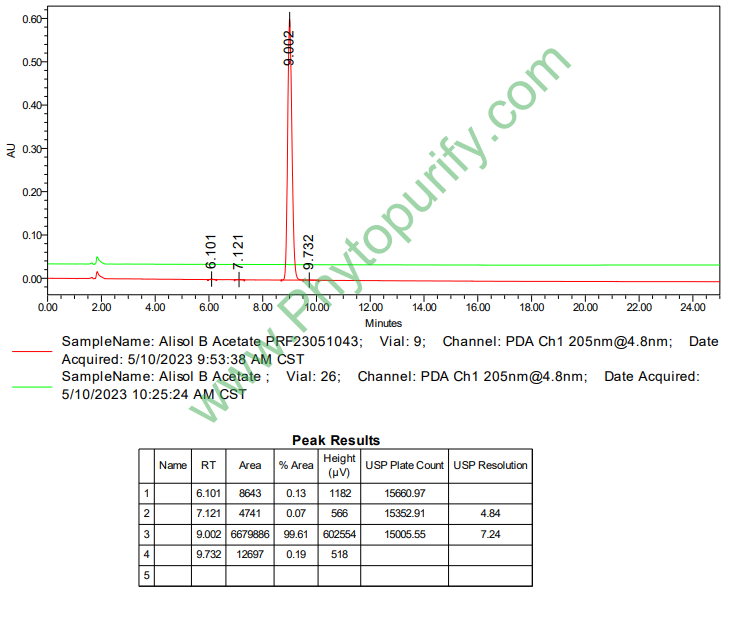
HPLC of 23-O-Acetylalisol B
Storage conditions:Short-term storage at 2~8℃, long-term storage at -20 ~ -80℃
76.1300
6.0047
6.0053
.0019
4.1493
4.2435
High
86.4127
5.2441
No
No
No
No
No
No
0.0
No
No
No
No
As a key risk factor of atherosclerotic cardiovascular disease, hyperlipidemia has become a major global public health problem. The current mainstream lipid-lowering drugs, such as statins and betas, have significant therapeutic effects, but still have certain adverse reactions, individual efficacy differences, and "statin intolerance" issues. Therefore, exploring novel structures, unique mechanisms of action, and good safety of lipid-lowering active ingredients from natural products has always been an important direction for drug development. Triterpenoids have become a hot topic in the pharmacological research of natural products due to their wide range of biological activities and diverse chemical structures. 23 Acetyl Alisol B Acetate (ABA), as a triterpenoid compound isolated from the traditional Chinese medicine Alisma, has attracted much attention in recent years due to its outstanding activity in regulating lipid metabolism. Its unique chemical structure endows it with the potential to intervene in metabolic disorders through multiple targets and pathways, not only limited to lipid-lowering, but also demonstrating comprehensive benefits in anti-inflammatory, antioxidant, and hepatoprotective aspects. This article aims to systematically review the chemical properties, plant sources, pharmacological activities, molecular mechanisms of action, pharmacological characteristics, and clinical application prospects of ABA, in order to provide comprehensive scientific references for the in-depth research and development of this natural product.
The chemical name of 23 acetyl Alistin B is (24R) -11 β, 24-epoxy-3 β, 23-dihydroxyalistane-16,21-dione 23 acetate, and its CAS number is 26575-95-1. Its molecular formula is C32H50O6 and its molecular weight is 514.7470. Structurally speaking, ABA belongs to the tetracyclic triterpenoid class of terpenes, with a core skeleton composed of six isoprene units and a characteristic A/B, B/C, C/D cyclic trans condensation system. The structural modification sites mainly include: the β - hydroxyl group at C-3 position, the ketone carbonyl groups at C-16 and C-21 positions, the acetoxy group at C-23 position, and the unique epoxyethane ring formed between C-11 and C-24. These functional groups play a decisive role in their biological activity and physicochemical properties.
In terms of physicochemical properties, the lipid water partition coefficient (LogP) of ABA is 6.0047, indicating its high lipophilicity. Its topological polar surface area (TPSA) is 76.1300 Å ², which is relatively small. Based on its high LogP value, it is predicted that its water solubility is extremely low, with a calculated value of approximately 0.0019 mg/mL. These parameters collectively determine the absorption and distribution characteristics of ABA in organisms: it is easy to penetrate cell membranes, and oral bioavailability may be limited by solubility and first pass effects; Meanwhile, its high lipophilicity also suggests that it may have a higher tissue distribution volume. It is worth noting that the drug prediction model shows that ABA has a high blood-brain barrier permeability, which provides a structural basis for its potential central nervous system related applications, such as affecting systemic metabolism by regulating central metabolic regulatory points. In addition, preliminary toxicity predictions indicate that the hERG inhibition risk is "no", and the Ames test predicted a value of 0.0, suggesting that it may have lower risks of cardiac and genetic toxicity, providing preliminary positive signals for its safety evaluation.
23 Acetyl Alismatal B is mainly derived from the plant Alismata in the Alismataceae family(Alisma orientale Dried tubers of (Sam.) Juz. Alisma, as a traditional Chinese medicine, was first recorded in the "Shennong Bencao Jing" and is classified as a top-grade herb. It has the effects of promoting diuresis, relieving heat, dispelling turbidity, and lowering blood lipids. It is commonly used in clinical practice to treat edema, difficulty urinating, phlegm retention, diarrhea, and hyperlipidemia. ABA is one of the key active ingredients in Alisma that exert lipid-lowering and other pharmacological effects, often coexisting with structurally similar compounds such as Alismatal A, C, and their acetylates.
The extraction and separation of ABA from Alisma usually use organic solvent extraction combined with various chromatographic techniques. The conventional extraction process is as follows: after crushing the dried tubers of Alisma, high concentration ethanol (such as 95% ethanol) or methanol is first used for reflux extraction or ultrasound assisted extraction to fully extract the triterpenoid lipid soluble components, including ABA. The extract is concentrated under reduced pressure to obtain a paste. This extract is usually subjected to gradient extraction using organic solvents such as petroleum ether and ethyl acetate, with ABA mainly enriched in the ethyl acetate fraction. Subsequently, preliminary separation is carried out by silica gel column chromatography, often using gradient elution systems such as petroleum ether ethyl acetate or chloroform methanol. The flow containing ABA is further purified by reversed-phase silica gel column chromatography (such as ODS column, methanol water as mobile phase), preparative high performance liquid chromatography (HPLC) or repeated gel column chromatography (such as Sephadex LH-20) to finally obtain high-purity ABA monomer. Modern technologies such as high-speed countercurrent chromatography (HSCCC) are increasingly being used for efficient preparation and separation of ABA due to their advantages of irreversible adsorption and high recovery rate. The optimization of extraction processes, such as enzyme assisted extraction and microwave-assisted extraction, aims to improve the yield and purity of ABA, which is a fundamental step in related research.
A large number of preclinical studies have confirmed that 23 acetyl laxative alcohol B has a wide range of pharmacological activities, with regulating lipid metabolism as the core and extending to anti-inflammatory, antioxidant, hepatoprotective, anti-tumor and other aspects.
1. Lipid regulating and anti atherosclerosis effects: This is the most in-depth direction of ABA research. In various animal models induced by high-fat diet, such as ApoE -/- mice, golden hamsters, and rats, oral administration of ABA can significantly reduce serum total cholesterol (TC), triglycerides (TG), and low-density lipoprotein cholesterol (LDL-C) levels, while increasing high-density lipoprotein cholesterol (HDL-C) levels. Its strength of action is equivalent to or better than positive drugs such as fenofibrate. More importantly, ABA can effectively reduce the area of atherosclerotic plaque, improve vascular endothelial function, inhibit vascular inflammatory reaction, and show a clear anti atherosclerosis effect.
2. Liver protection and anti fatty liver effects: ABA has a significant improvement effect on non-alcoholic fatty liver disease (NAFLD). It can reduce lipid deposition in the liver of high-fat model animals (lowering liver TC and TG content), alleviate hepatic steatosis, ballooning, and inflammatory infiltration. Its hepatoprotective effect is not only derived from lipid-lowering, but also closely related to inhibiting the activation of hepatic stellate cells and anti liver fibrosis.
3. Anti inflammatory and immune regulatory effects: ABA exhibits strong anti-inflammatory activity in various acute and chronic inflammation models. For example, in the lipopolysaccharide (LPS) - induced macrophage inflammation model, ABA can dose dependently inhibit the production of pro-inflammatory cytokines such as nitric oxide (NO), prostaglandin E2 (PGE2), tumor necrosis factor - α (TNF - α), interleukin-6 (IL-6), etc. Its anti-inflammatory effect is one of the important mechanisms for its prevention and treatment of metabolic diseases and atherosclerosis.
4. Antitumor activity: Recent studies have found that ABA can inhibit proliferation, induce apoptosis and autophagy in a variety of tumor cells, such as liver cancer, colon cancer, breast cancer, lung cancer cells, etc. Its anti-tumor mechanism involves cell cycle arrest, activation of mitochondrial apoptosis pathway, regulation of reactive oxygen species (ROS) levels, etc., indicating its potential as an anti-tumor lead compound.
5. Other activities: The study also suggests that ABA may have activities such as improving insulin resistance and kidney protection, but its role in lowering blood sugar and diuresis still requires more evidence to support.
The pharmacological effects of ABA are not achieved through a single target, but through a complex multi-target network that works synergistically, especially in its intervention of hyperlipidemia and related metabolic diseases. Existing research has revealed its interactions with multiple key protein targets:
1. Regulating lipid synthesis and metabolism:
* Targeting PTPN1 (protein tyrosine phosphatase 1B): PTPN1 is a key negative regulator of the insulin and leptin signaling pathways. ABA has been proven to be an effective inhibitor of PTPN1. By inhibiting PTPN1, ABA can enhance tyrosine phosphorylation of insulin receptor substrates (IRS), activate the PI3K/Akt pathway, promote glucose uptake and utilization in liver and adipose tissue, and inhibit hepatic gluconeogenesis. Improving insulin sensitivity indirectly benefits the normalization of lipid metabolism.
* Activate NR1H4 (farnesol X receptor, FXR): FXR is a core nuclear receptor for bile acid metabolism and lipid homeostasis. ABA has been identified as an FXR agonist. After activating FXR, the expression of small heterodimeric chaperone (SHP) can be upregulated, thereby inhibiting the transcription of steroid regulatory element binding protein-1c (SREBP-1c), which is a key transcription factor regulating fatty acid and triglyceride synthesis. Meanwhile, FXR activation can also promote the conversion of cholesterol to bile acids (by upregulating CYP7A1) and excretion, effectively reducing cholesterol levels.
* Inhibition of HSD11B1 (11 β - hydroxysteroid dehydrogenase type 1): HSD11B1 can convert inactive corticosterone into active cortisol, locally amplifying the action of glucocorticoids, promoting visceral fat accumulation and insulin resistance. ABA can inhibit the activity of HSD11B1, reduce local glucocorticoid regeneration, and help improve metabolic abnormalities.
2. Anti inflammatory and antioxidant:
* Inhibition of STAT3 signaling pathway: STAT3 is an important inflammatory and cell survival signaling protein. ABA can inhibit the phosphorylation (activation) of STAT3 and the expression of downstream target genes such as Bcl-2 and Cyclin D1. This is directly related to its anti-inflammatory and induction of tumor cell apoptosis effects.
* Activate NFE2L2 (nuclear factor E2 related factor 2, Nrf2): Nrf2 is the main regulator of cellular antioxidant stress response. Research has shown that ABA can promote Nrf2 nuclear translocation, upregulate the expression of phase II detoxifying enzymes and antioxidant enzymes such as heme oxygenase-1 (HO-1) and quinone oxidoreductase 1 (NQO1), thereby enhancing cellular antioxidant defense capabilities and reducing oxidative stress damage.
* Inhibition of HIF1A (hypoxia inducible factor-1 α): Hypoxia often exists in metabolic disorders and tumor microenvironments. The activation of HIF1A promotes inflammation, glycolysis, and angiogenesis. ABA can downregulate the expression of HIF1A, which helps improve the hypoxic inflammatory state of metabolic tissues and inhibit tumor growth.
3. Other potential targets:
* SIRT1 (Silent Information Regulating Factor 1): SIRT1 is an NAD+- dependent deacetylase involved in the regulation of energy metabolism, inflammation, and aging. There are studies suggesting that ABA may exert its metabolic protective effect by upregulating SIRT1 expression.
* ABCB1 (P-glycoprotein): ABCB1 is an important drug efflux pump. ABA may act as a substrate or regulator, affecting the pharmacokinetics of itself or other drugs.
* IDH1 (isocitrate dehydrogenase 1) and TOP1 (topoisomerase I): These targets are more closely related to the potential anti-tumor mechanisms of ABA, involving cellular metabolic reprogramming and DNA damage repair processes.
In summary, ABA forms a synergistic network pharmacology mode of action by simultaneously acting on multiple targets such as PTPN1, FXR, STAT3, Nrf2, etc., from improving insulin sensitivity, inhibiting lipid synthesis, promoting cholesterol excretion, anti-inflammatory and antioxidant effects, etc. This may be the molecular basis for its efficient improvement of hyperlipidemia and its complications.
Although ABA exhibits excellent pharmacological activity in vitro and animal models, its drug like and pharmacokinetic (PK) properties are key factors determining its successful development as a drug.
Analysis of pharmacological parameters: As mentioned earlier, ABA has the characteristics of high lipophilicity (LogP>5) and extremely low water solubility. Although this is beneficial for its penetration of cell membranes and blood-brain barriers, it also poses challenges for its oral administration: low solubility may lead to incomplete absorption in the gastrointestinal tract and limited bioavailability. Its molecular weight (514.7) is slightly higher than the recommended upper limit of the "Five Rules for Similar Drugs" (500), but still within an acceptable range. The moderate TPSA value indicates good membrane permeability. The preliminary toxicity warning (no hERG inhibition, Ames negative) provides early positive signals for its safety, but complete preclinical toxicology studies are still needed to validate it.
Progress in pharmacokinetic research: The pharmacokinetic research on ABA is currently relatively limited, mainly focused on the animal level. Existing research indicates that:
* Absorption and bioavailability: After oral administration of ABA in rats, absorption is slower, peak time (Tmax) is longer, and absolute bioavailability is lower, which is related to its low solubility and possible first pass effects (intestinal and liver metabolism). Preparing it into novel drug delivery systems, such as nanocrystals, liposomes, solid dispersions, or self microemulsions, is an effective strategy to improve its solubility and oral bioavailability.
* Distribution: ABA can be widely distributed in multiple tissues after oral administration, especially at high concentrations in the liver, fat, and kidneys, which is highly consistent with its pharmacological target organs. The prediction of high blood-brain barrier permeability has also received indirect support from some experiments.
* Metabolism: ABA mainly undergoes phase I metabolism (such as hydroxylation and deacetylation) and phase II binding reactions (such as glucuronidation) in the body. Deacetylation to produce Alismatal B is an important metabolic pathway. The cytochrome P450 (CYP) enzyme system, especially CYP3A4, may be involved in its metabolic processes. Its interaction with nuclear receptors such as FXR may also affect the expression of its own metabolic enzymes, leading to self-regulation.
* Excretion: ABA and its metabolites are mainly excreted through feces and bile, with less excretion in the kidneys.
Overall, the core pharmacological challenge of ABA lies in its solubility and oral absorption. Future pharmaceutical research is crucial for promoting its development. At the same time, more systematic in vitro models (such as Caco-2, liver microsomes) and in vivo studies are needed to elucidate their detailed ADME (absorption, distribution, metabolism, excretion) characteristics and potential drug drug interactions.
As a natural triterpenoid compound with multi-target effects, 23 acetyl Alismatal B has shown broad application prospects in the prevention and treatment of various diseases, but also faces a series of challenges.
Potential clinical application directions:
1. Comprehensive treatment drugs for metabolic diseases: ABA is most likely to be developed as an innovative drug to treat hyperlipidemia, nonalcoholic fatty liver disease (NAFLD) and its related atherosclerotic cardiovascular disease (ASCVD). Its multi-target action characteristics may bring comprehensive benefits that are superior to single target drugs, such as improving insulin resistance while lowering cholesterol, alleviating liver inflammation and fibrosis. It may be used as first-line medication or in combination with statins to reduce statin dosage, minimize side effects, and enhance efficacy.
2. Anti inflammatory adjuvant therapy drugs: Based on its strong anti-inflammatory effect, ABA may be used as an adjuvant therapy for diseases associated with chronic low-grade inflammation, such as metabolic inflammation, certain autoimmune diseases, or arthritis.
3. Candidate anti-tumor drugs or sensitizers: Its anti-tumor activity and potential impact on ABCB1 (multidrug resistance protein) make it possible for it to be used as a lead compound for structural optimization in anti-tumor treatment or as a chemotherapy sensitizer to reverse multidrug resistance in tumors.
Challenges and future research directions:
1. Breakthrough in Pharmaceutical Science: The urgent task is to develop a new drug delivery system that can significantly improve the oral bioavailability of ABA. Nanotechnology and prodrug strategies are important research directions.
2. In depth study of the mechanism of action: It is necessary to use chemical biology methods such as photoaffinity labeled probes and proteomics to more accurately identify its direct target and elucidate the mechanism of cross talk between its multi-target networks.
3. Pre clinical and clinical evaluation of the system: It is necessary to complete systematic pharmacological, pharmacokinetic, and toxicological evaluations in accordance with new drug development standards, especially for long-term toxicity, reproductive toxicity, etc. Ultimately, rigorous clinical trials (stages I-IV) are required to validate its safety, efficacy, and optimal medication regimen in humans.
4. Structural modification and optimization: It is an important task for medicinal chemists to use it as the parent nucleus for rational structural modification, aiming to improve activity, enhance water solubility and pharmacokinetic properties, and reduce potential toxicity.
23 Acetyl Alismatal B is a valuable gift bestowed upon modern drug development by the traditional Chinese medicine Alisma. As a triterpenoid with a prototerpene skeleton, it has built a synergistic network regulating lipid metabolism, inflammation and oxidative stress by acting on multiple key targets such as PTPN1, FXR, STAT3, Nrf2, etc. with its unique chemical structure, and has shown significant comprehensive pharmacological advantages in anti hyperlipidemia, atherosclerosis, fatty liver, etc. Although its inherent low solubility and potentially low bioavailability are bottlenecks that must be overcome in the process of drug conversion, modern pharmaceutical and medicinal chemistry technologies provide feasible solutions for this. With a more refined analysis of its mechanism of action, continuous optimization of its pharmacological properties, and subsequent rigorous clinical verification, 23 acetyl Alismatal B is expected to successfully transform from an excellent natural active molecule into an innovative drug for the prevention and treatment of metabolic syndrome and related cardiovascular and cerebrovascular complications, achieving a magnificent transformation from traditional Chinese medicine wisdom to modern clinical value, and contributing new strength to human health.
