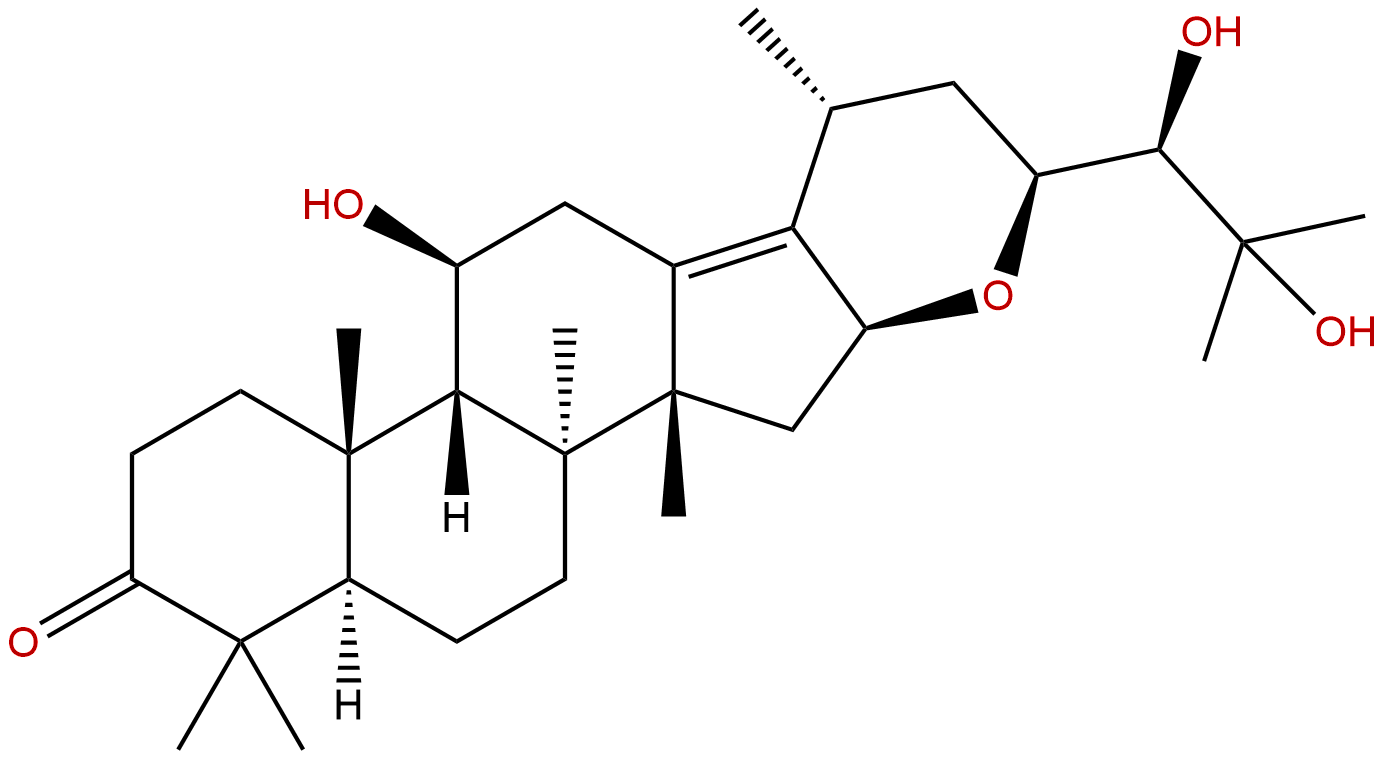


Product name: Alisol F
Synonym name:
Catalogue No.: BP3060
Cas No.: 155521-45-2
Formula: C30H48O5
Mol Weight: 488.709
Botanical Source:
Physical Description: Cryst.
Type of Compound: Triterpenoids
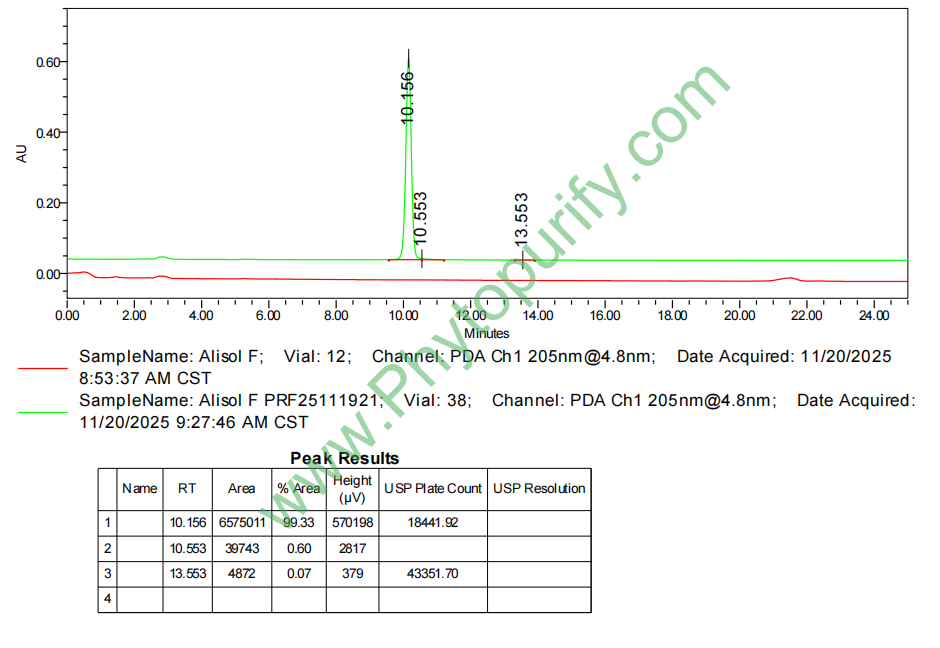
Purity: 95%~99%
Analysis Method: HPLC-DAD or/and HPLC-ELSD
Identification Method: Mass, NMR
Packing: Brown vial or HDPE plastic bottle
The product could be supplied from milligrams to grams. Inquire for bulk scale.
We provide solution to improve the water-solubility of compounds, thereby facilitating the variety of activity tests and clinic uses.
For Reference Standard and R&D, Not for Human Use Directly.
HPLC of Alisol F
Storage conditions:Short-term storage at 2~8℃, long-term storage at -20 ~ -80℃
86.9900
4.1437
4.1434
.0061
2.1308
7.0130
Low
81.7742
5.3992
No
No
No
No
No
No
0.0
Yes
No
No
No
Natural products have always been an important source of innovative drug discovery, among which triterpenoids have attracted much attention due to their structural diversity and wide range of biological activities. Alisol F (CAS number: 155521-45-2) is a triterpenoid of the original terpenoid type, mainly derived from the traditional Chinese medicine Alisol(Alisma orientale Dried tubers of (Sam.) Juzep. As an essential medicine for promoting diuresis and promoting diuresis, Alisma is used in traditional Chinese medicine to treat symptoms such as edema, difficulty urinating, phlegm retention, and diarrhea. Modern pharmacological studies have revealed that its active ingredients have multiple effects, including anti-inflammatory, antiviral, hepatoprotective, and anti-tumor effects. In recent years, with the deepening of research on Alismatal F, its significant anti-inflammatory, anti hepatitis B virus (HBV), and potential anti-tumor activities, especially its interaction with renal cell carcinoma related targets, have made it an emerging hotspot in natural product pharmacology research. This article aims to systematically review the chemical structure, plant origin, pharmacological activity, mechanism of action, pharmacological properties, and clinical application prospects of Alismatal F, in order to provide comprehensive scientific references for the in-depth research and development of this compound.
Zexiechun F belongs to the terpenoid tetracyclic triterpenoid class of compounds. Its basic skeleton consists of six isoprene units, with a characteristic cyclopentane and polyhydrogen phenanthrene core, and contains multiple oxygen-containing functional groups such as hydroxyl and carbonyl, which are crucial for its biological activity and physicochemical properties.
According to the provided pharmacological parameters, the molecular weight of Alismatal F is 488.7090, indicating that it is a medium-sized molecule. The calculated lipid water partition coefficient (LogP) is 4.1437, indicating that the compound has high lipophilicity, which is consistent with its triterpenoid structural characteristics and suggests that it may have good cell membrane permeability. The topological polar surface area (TPSA) is 86.99 Å ², which is relatively low and further supports its good membrane permeability potential. However, its low water solubility parameter (0.0061) may be a limiting factor for its oral bioavailability and a challenge that needs to be overcome in formulation development. In terms of preliminary safety prediction, the lack of inhibition of hERG potassium channels by Alismatal F suggests a low potential risk of cardiac toxicity, while an Ames test result of 0.0 suggests no mutagenicity. These data provide favorable early safety signals for its subsequent development. In addition, its blood-brain barrier permeability is low, indicating that its main function may be concentrated in the peripheral system.
Zexie alcohol F is mainly isolated from the dried tubers of the traditional Chinese medicine Zexie. Alisma is the tuber of the plant Alisma orientalis in the family Alismataceae, mainly distributed in East Asia such as China, Japan, and South Korea. Its medicinal parts are usually harvested when the stems and leaves begin to wither in autumn, after removing the fibrous roots and rough skin, and dried for later use.
The extraction of triterpenoids in Alisma is often carried out using organic solvent extraction method. The classic process includes heating and refluxing the dried powder of Alisma with high concentration ethanol (such as 95% ethanol) for extraction, combining the extracts, and concentrating them under reduced pressure to obtain a paste. Subsequently, various chromatographic techniques were used for separation and purification, such as silica gel column chromatography, reverse phase silica gel column chromatography (ODS), high performance liquid chromatography (HPLC), and preparative thin-layer chromatography. Solvent systems often use different ratios of petroleum ether ethyl acetate, chloroform methanol, or water methanol gradient elution. The separation and identification of Alismatal F require the use of modern spectroscopic techniques, such as nuclear magnetic resonance (NMR, including 1H-NMR, 13C-NMR, 2D-NMR), mass spectrometry (MS), and X-ray single crystal diffraction, to accurately determine its planar and three-dimensional structure. Optimizing the extraction process, such as using ultrasound assisted extraction, microwave-assisted extraction, or supercritical fluid extraction techniques, is expected to improve the extraction efficiency and purity of Alismatal F.
A large number of in vitro and in vivo studies have shown that Alismatal F has various pharmacological activities, among which anti-inflammatory, antiviral, and hepatoprotective effects are the most prominent.
anti-inflammatory activity Alismatal F exhibits strong anti-inflammatory potential. In the lipopolysaccharide (LPS) - induced inflammation model of macrophages (such as RAW264.7 cells), resveratrol F can dose dependently inhibit the production of nitric oxide (NO) and key pro-inflammatory cytokines, including tumor necrosis factor - α (TNF - α), interleukin-6 (IL-6), and interleukin-1 β (IL-1 β). This is closely related to its ability to downregulate the protein expression levels of inducible nitric oxide synthase (iNOS) and cyclooxygenase-2 (COX-2). In animal models of acute liver injury, pretreatment with Alismatal F significantly reduced the levels of alanine aminotransferase (ALT) and aspartate aminotransferase (AST) in mouse serum induced by acetaminophen or LPS/D-galactosamine, and significantly improved pathological damage to liver tissue, such as reducing hepatocyte necrosis and inflammatory cell infiltration, confirming its anti-inflammatory and hepatoprotective effects in vivo.
Anti hepatitis B virus (HBV) activity Research has shown that Alismatal F has an inhibitory effect on HBV replication. In HBV transfected liver cell lines (such as HepG2.2.15 cells), it can reduce the level of HBV DNA in the cell culture supernatant and the secretion of hepatitis B surface antigen (HBsAg) and e antigen (HBeAg), suggesting that it may play an antiviral role by interfering with the life cycle of the virus.
Potential anti-tumor activity (especially focusing on renal cancer)Although there are relatively few research reports on the direct anti renal cell carcinoma effect of Alismatal F, its anti-tumor potential value needs to be further explored based on its core pharmacological effects (anti-inflammatory, regulating apoptosis) and potential interactions with multiple key targets closely related to the occurrence and development of renal cell carcinoma (see the next section for details). Triterpenoids generally have the ability to induce apoptosis, inhibit proliferation and metastasis of tumor cells, and Alismatal F may also have similar properties.
The pharmacological effects of Alismatal F, especially its anti-inflammatory activity, involve the regulation of multiple intracellular signaling pathways.
The core signaling pathway of anti-inflammatory effect Research has shown that the anti-inflammatory mechanism of Alismatal F is mainly achieved by inhibiting the mitogen activated protein kinase (MAPK) pathway and nuclear factor kappa B (NF - κ B) pathway. Under LPS stimulation, resveratrol F can effectively inhibit the phosphorylation activation of extracellular signal regulated kinase (ERK), c-Jun N-terminal kinase (JNK), and p38 MAPK. Meanwhile, it can also inhibit the phosphorylation of signal transduction and transcription activator 3 (STAT3). Most importantly, Alismatal F blocks the phosphorylation and nuclear translocation of the key subunit p65 of NF - κ B, thereby inhibiting the transcriptional expression of numerous downstream pro-inflammatory mediators (iNOS, COX-2, TNF - α, IL-6, etc.). This multi-target and multi pathway characteristic makes it a potent inhibitor of inflammatory response.
Potential association with renal cell carcinoma related targets Although direct evidence is still needed, there is a theoretical intersection between the characteristics of the action of Alismatal F and the key targets of renal cancer treatment. For example:
These associations suggest that Alismatal F may act as a multi-target lead compound, exerting potential anti renal cell carcinoma effects by regulating apoptosis, hypoxia response, cell cycle and other networks associated with the occurrence and development of renal cell carcinoma. This requires future research to validate through experiments such as molecular docking, surface plasmon resonance, gene knockout/overexpression, etc.
Based on the calculation parameters provided earlier, the preliminary analysis of the pharmacological properties of Alismatal F is as follows:
* Advantage Moderate molecular weight and lipophilicity (LogP~4.14) are beneficial for penetrating cell membranes. Low TPSA suggests better membrane permeability, and the absence of hERG inhibition and mutagenicity warning (Ames negative) provides preliminary safety assurance.
* challenge The extremely low water solubility (0.0061) is the main obstacle to its conversion to drugs, which may lead to poor oral absorption and low bioavailability. The low permeability of the blood-brain barrier limits its application in central nervous system diseases, but for its peripheral effects such as anti-inflammatory, hepatoprotective, and anti renal cancer effects, this may reduce central side effects.
At present, there are relatively limited public reports on the pharmacokinetic studies of the F system of Alismatal (such as absorption, distribution, metabolism, excretion, i.e. ADME properties). This is a critical data gap that must be filled during its development process. Future research requires the establishment of sensitive and specific biological analysis methods (such as LC-MS/MS) to observe the drug time curve, tissue distribution, plasma protein binding rate, major metabolites, and excretion pathways after oral and intravenous administration in animal models (rats, mice). Given its low water solubility, it is crucial to develop suitable drug delivery systems, such as nanocrystals, liposomes, solid dispersions, cyclodextrin inclusion complexes, or self microemulsions, to improve its solubility and oral bioavailability. In addition, its metabolic stability in vivo, the presence of first pass effects, and whether it is a substrate or inhibitor/inducer of major drug metabolizing enzymes (such as CYP450) also require further research to assess potential drug drug interaction risks.
Alismatal F exhibits broad potential for clinical application development:
1. liver disease Based on its clear anti-inflammatory and hepatoprotective effects, Alismatal F is expected to be developed for the treatment of acute liver injury, drug-induced liver injury, viral hepatitis (especially hepatitis B), and the early stages of liver fibrosis caused by it. It can be considered as an auxiliary hepatoprotective drug or in combination with existing antiviral drugs.
2. Inflammatory diseases Its powerful multi-channel anti-inflammatory mechanism makes it promising in the treatment of chronic inflammatory diseases associated with excessive activation of NF - κ B and MAPK pathways, such as rheumatoid arthritis, inflammatory bowel disease, acute pancreatitis, etc.
3. Tumor adjuvant therapy (especially renal cancer)As a natural product with multi-target effects, Alismatal F may play a unique role in the prevention and treatment of kidney cancer. It may be used as an adjuvant therapy drug, in combination with targeted drugs (such as targeting the VHL-HIF pathway, MET pathway) or immune checkpoint inhibitors, to enhance efficacy, reduce drug resistance, or alleviate treatment-related inflammatory side effects. Its dual effects of regulating the tumor microenvironment (anti-inflammatory) and inducing apoptosis may bring synergistic benefits.
4. Structural optimization as a lead compound Although Alismatal F has significant activity, its low water solubility and possible other pharmacokinetic defects require structural optimization through medicinal chemical methods. It is possible to improve the solubility, metabolic stability, and bioavailability of candidate drugs by introducing polar groups, preparing prodrugs, or modifying the skeleton while retaining their active pharmacophores, thus obtaining more valuable candidate drugs for development.
Future research directions should focus on: ① further elucidating the specific effects and direct molecular targets of its anti-tumor activities such as anti renal cancer; ② Comprehensive and systematic preclinical pharmacokinetic and toxicological evaluation; ③ Research on rational drug combination strategies based on mechanism of action; ④ The development of advanced formulation technology to overcome its physical and chemical defects.
As a triterpenoid compound isolated from traditional Chinese medicine Alisma, Alismatal F has become an important molecule in the pharmacological research of natural products due to its significant anti-inflammatory, anti HBV, and hepatoprotective activities, as well as its clear mechanism of regulating multiple key signaling pathways such as MAPK, STAT3, and NF - κ B. Its potential association with the target network related to renal cell carcinoma has further expanded its imaginative space as an anti-tumor lead compound. Despite facing challenges such as poor water solubility in drug development, these obstacles are expected to be overcome through modern pharmaceutical chemistry, pharmacology, and pharmacokinetic research methods. The continuous in-depth research on Alismatal F not only helps to reveal the modern scientific connotation of its traditional efficacy, but also provides valuable candidate molecules and scientific basis for the development of innovative drugs for the treatment of liver diseases, chronic inflammation, and tumors (especially kidney cancer).
