


Synonym name: Alisol C Monoacetate
Catalogue No.: BP0139
Cas No.: 26575-93-9
Formula: C32H48O6
Mol Weight: 528.73
Botanical Source:
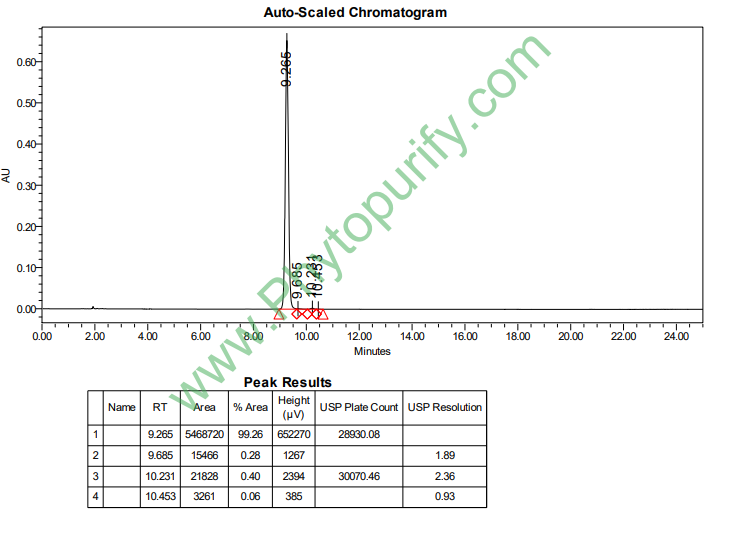
Purity: 95%~99%
Analysis Method: HPLC-DAD or/and HPLC-ELSD
Identification Method: Mass, NMR
Packing: Brown vial or HDPE plastic bottle
Can be supplied from milligrams to grams.
For Reference Standard and R&D, Not for Human Use Directly.
Inquire for bulk scale.
HPLC of 23-乙酰泽泻醇C
Storage conditions:Short-term storage at 2~8℃, long-term storage at -20 ~ -80℃
99.2000
5.3400
No
No
No
Unknown
Unknown
No
Unknown
23 Acetyl Alisol C Monoacetate is a triterpenoid natural product derived from plants of the Alisma genus. As one of the important active ingredients in Alisma, 23 acetyl Alismatal C has received widespread attention in the fields of natural medicine chemistry and pharmacology research in recent years due to its unique chemical structure and diverse biological activities. Previous studies have shown that this compound exhibits significant antibacterial activity and potential therapeutic value in various disease models, particularly in tumor related diseases such as thymoma, where its mechanism of action is gradually being revealed.
As a tumor originating from thymic epithelial cells, thymoma has limited clinical treatment options and is prone to recurrence and metastasis. Molecular targets such as STAT3, PTGES, ESR1, GSK3B, and NR3C1 play a key role in the occurrence and development of thymoma. 23 Acetyl Alismatal C exhibits potential anti-tumor activity by regulating these targets, suggesting its potential application prospects in the treatment of thymoma.
This article will provide a systematic review of the chemical structure and physicochemical properties, plant sources and extraction methods, pharmacological activity and mechanism of action, pharmacological evaluation and pharmacokinetic characteristics of 23 acetyl laxative C, and explore its clinical application prospects and future research directions, providing reference and inspiration for researchers in related fields.
23 Acetyl Alismatal C belongs to the triterpenoid class, with a molecular formula of C32H50O6 and a molecular weight of 530.7000. Its structure is based on a tetracyclic triterpenoid skeleton, and the 23rd hydroxyl group is acetylated to form an acetyl group, endowing it with specific chemical properties. The LogP value of this compound is 5.34, indicating its high lipid solubility, which is beneficial for penetrating lipid membranes, but may also affect its water solubility and bioavailability. The topological polar surface area (TPSA) is 99.2 Å ², indicating that it has certain polar groups and can participate in hydrogen bonding interactions.
23 Acetyl Alismatal C contains 6 hydrogen bond receptors, suggesting that it may enhance affinity with biomolecules through hydrogen bonds when binding. Its high molecular weight and large hydrophobicity pose challenges to drug design, especially in pharmacokinetic optimization. In addition, there is currently no clear ability to penetrate the blood-brain barrier, and safety indicators such as hepatotoxicity, cardiotoxicity, and hERG channel inhibition have not been fully evaluated, requiring further research.
23 Acetyl Alisma Alcohol C is mainly present in Alisma Orientale and its related species. Alisma is a perennial aquatic herbaceous plant belonging to the Alismataceae family, widely distributed in East Asia. Its dried tubers are commonly used in traditional Chinese medicine, and have the effects of promoting diuresis, reducing blood lipids, and lowering blood pressure.
The commonly used methods for extracting 23 acetyl Alismatal C include solvent extraction, column chromatography separation, and high-performance liquid chromatography (HPLC) purification. Generally, ethanol or methanol is used as the extraction solvent to obtain the crude extract through reflux extraction, and then separated and purified using silica gel column chromatography or reverse phase C18 column. The structure of the purified compound was confirmed by mass spectrometry (MS), nuclear magnetic resonance (NMR) and other methods. In recent years, ultrasound assisted extraction and supercritical fluid extraction techniques have also been applied to improve extraction efficiency and purity.
23 Acetyl Alismatal C exhibits strong antibacterial activity, especially against Gram positive bacteria and certain Gram negative bacteria. In vitro experiments have shown that the compound can effectively inhibit the growth of pathogenic bacteria such as Staphylococcus aureus and Streptococcus pneumoniae, and the mechanism may involve the destruction of bacterial cell membranes and inhibition of metabolic enzyme activity. The antibacterial activity makes it potentially valuable for the development of anti infective drugs.
In recent years, the potential of 23 acetyl laxative C in tumor treatment has gradually emerged. Especially in thymoma models, this compound inhibits tumor cell proliferation, induces apoptosis, and suppresses metastasis by regulating multiple signaling pathways. Both in vitro cell experiments and in vivo animal models have confirmed its anti-tumor effect, and it exhibits a synergistic effect when combined with traditional chemotherapy drugs.
In addition to antibacterial and anti-tumor effects, 23 acetyl Alismatal C also has the potential to have anti-inflammatory, antioxidant, and immune regulating properties. It may play an adjuvant therapeutic role in inflammatory and immune related diseases by inhibiting the release of inflammatory factors and regulating immune cell activity.
The pharmacological effects of 23 acetyl laxative alcohol C are closely related to its key molecular targets for regulation. For thymoma, research focuses on the following targets:
STAT3 (Signal Transduction and Transcription Activation Factor 3)STAT3 is abnormally activated in various tumor cells, promoting cell proliferation, anti apoptosis, and immune escape. 23 Acetyl Alismatal C can inhibit the phosphorylation and nuclear translocation of STAT3, block its downstream gene expression, and thus inhibit tumor cell growth.
PTGES (Prostaglandin E Synthase)PTGES is involved in inflammatory response and regulation of tumor microenvironment. This compound inhibits the expression of PTGES, reduces the production of pro-inflammatory prostaglandin E2, and lowers the inflammatory state promoted by tumors.
ESR1 (estrogen receptor alpha)ESR1 is expressed in some thymoma cells and regulates cell proliferation and differentiation. 23 Acetyl Alismatal C may affect hormone dependent growth of tumor cells by regulating the ESR1 mediated signaling pathway.
GSK3B (glycogen synthase kinase 3 β)GSK3B is involved in multiple cellular signaling pathways, including the Wnt/β - catenin pathway, regulating cell cycle and apoptosis. The regulation of GSK3B activity by 23 acetyl laxative C helps to restore intracellular signal balance and inhibit tumor development.
NR3C1 (glucocorticoid receptor)NR3C1 regulates cellular stress response and immune regulation. This compound may regulate the tumor microenvironment and immune response by affecting NR3C1 mediated gene expression.
Overall, 23 acetyl laxative C exerts its anti-tumor and antibacterial activities through multi-target and multi pathway synergistic effects, reflecting the diverse pharmacological mechanisms of natural products.
The pharmacological evaluation of 23 acetyl laxative C shows that it has certain advantages and challenges. Its molecular weight of 530.7 and LogP 5.34 indicate that the compound is relatively hydrophobic, which may affect oral absorption and bioavailability. The TPSA is 99.2 Å ² and the number of hydrogen bond receptors is 6, which meets the ideal range of some drug designs, but still needs to be optimized to improve solubility and membrane permeability.
At present, there is no clear ability to penetrate the blood-brain barrier, indicating limitations in its application in central nervous system diseases. The safety indicators such as hepatotoxicity, cardiotoxicity, and hERG channel inhibition have not been fully evaluated, and further confirmation of safety is needed through in vitro and in vivo toxicology studies.
In terms of pharmacokinetics, existing data is relatively limited. Due to its high lipid solubility, 23 acetyl laxative C may be metabolized by liver metabolic enzymes such as cytochrome P450, and the metabolites and their activities require further investigation. In the future, systematic ADME (absorption, distribution, metabolism, excretion) research needs to be conducted to guide dosage form design and optimize dosing regimens.
As a natural triterpenoid compound with multiple biological activities, 23 acetyl Alismatal C exhibits broad clinical application potential. Its antibacterial activity provides candidate molecules for the development of new anti infective drugs, especially in the context of increasingly severe drug-resistant bacteria, which is of great significance.
In the field of tumor therapy, especially in the targeted treatment of thymoma, 23 acetyl laxative C has the potential to become a novel anti-tumor drug by regulating tumor cell proliferation and apoptosis through multiple targets. In the future, modern drug design technology can be combined to optimize its structure to improve activity and bioavailability.
In addition, its anti-inflammatory and immune regulatory effects suggest potential for development in inflammatory and immune related diseases. With the in-depth analysis of pharmacological mechanisms and the improvement of safety evaluation, 23 acetyl Alismatal C is expected to enter the clinical trial stage.
Future research should focus on the following aspects: firstly, systematic pharmacokinetic and toxicological studies to ensure their safety and efficacy; The second is structural modification and dosage form optimization to enhance its drug properties; Thirdly, mechanism research based on molecular targets is conducted to explore their potential applications in various diseases; The fourth is to conduct preclinical animal models and clinical trials to promote their clinical translation.
As an important triterpenoid active ingredient in Alisma, 23 acetyl Alismatal C has become a hot topic in natural product pharmacology research due to its unique chemical structure and diverse biological activities. Its potential in antibacterial, anti-tumor, and immune regulation provides valuable resources for the development of new drugs. Although there are still some challenges in terms of drug development and safety, with the advancement of modern drug research and development technology and a deeper understanding of its mechanism of action, 23 acetyl Alismatal C is expected to become an important candidate molecule for future natural drug development. We look forward to more systematic and interdisciplinary research to promote its clinical application and realize its value in disease treatment.
