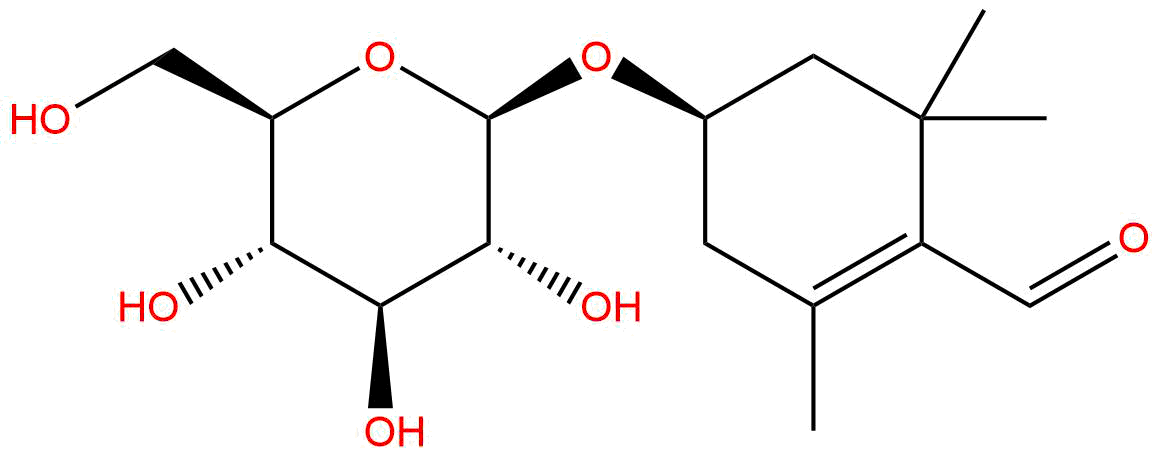


Synonym name: Safranbitter; Saffronbitter
Catalogue No.: BP1097
Cas No.: 138-55-6
Formula: C16H26O7
Mol Weight: 330.377
Botanical Source: saffron (stamens of Crocus sativus)
Purity: 95%~99%
Analysis Method: HPLC-DAD or/and HPLC-ELSD
Identification Method: Mass, NMR
Packing: Brown vial or HDPE plastic bottle
Can be supplied from milligrams to grams.
For Reference Standard and R&D, Not for Human Use Directly.
Inquire for bulk scale.
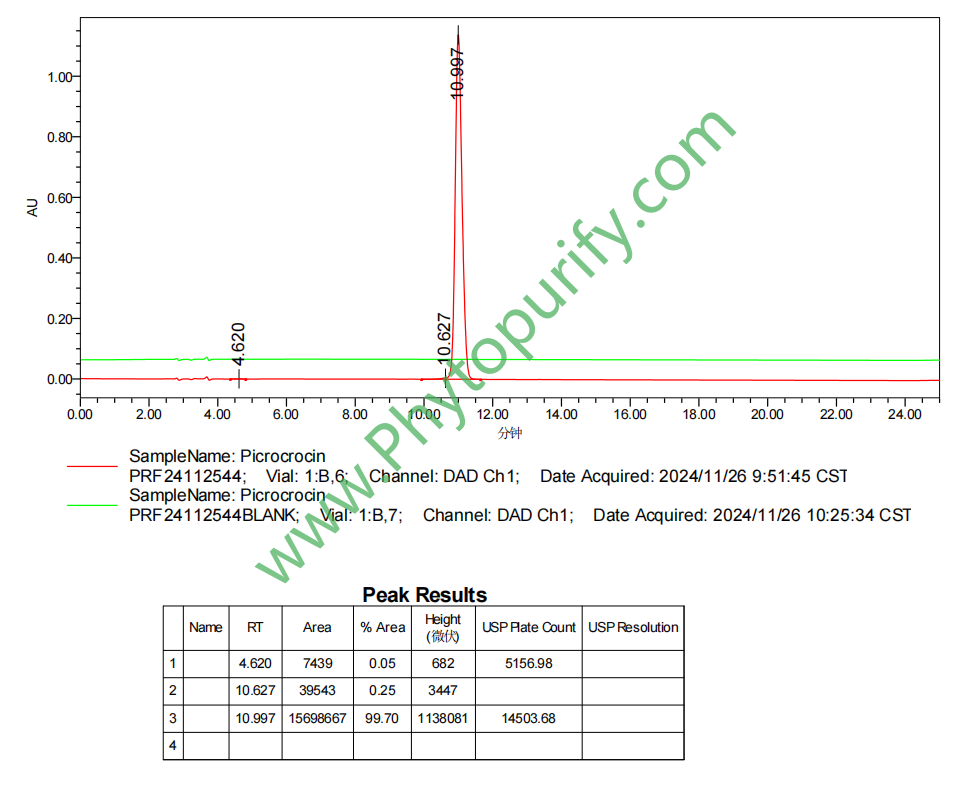
HPLC of Picrocrocin
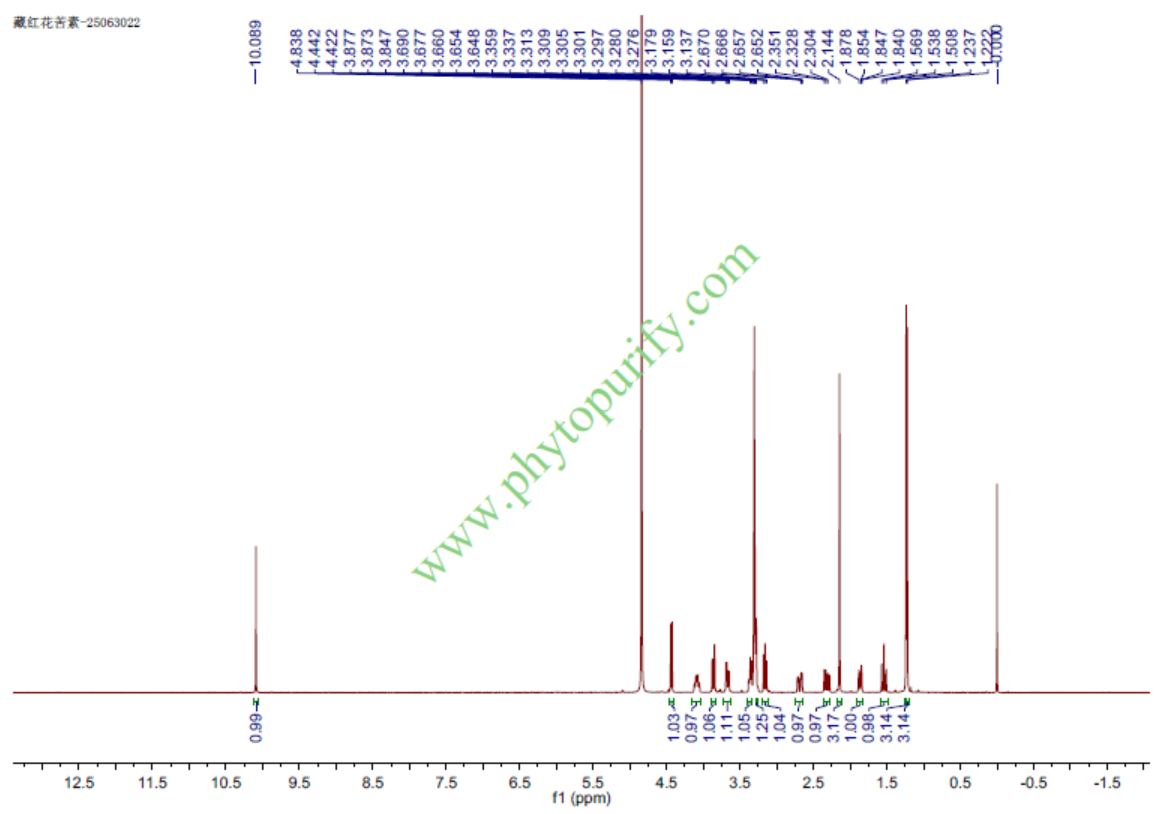
HNMR of Picrocrocin
Storage conditions:Short-term storage at 2~8℃, long-term storage at -20 ~ -80℃
116.4500
-.0337
-.0334
21.4194
.5575
.5443
Low
40.8413
4.3194
Yes
No
No
No
No
No
0.0
Yes
Yes
Yes
No
Crocus sativus L., as a precious spice and medicinal plant with a long history, owes its unique color, flavor, and medicinal value mainly to a series of water-soluble carotenoid derivatives. Among them, crocin gives it a bright golden yellow color, while picrocrocin (also known as crocin, CAS number: 138-55-6) is the main source of saffron's characteristic bitter taste. For a long time, research has focused on the antioxidant, antidepressant, and neuroprotective activities of crocetin acid and saffron aldehyde (safranal, produced by the degradation of crocin). However, crocin itself, as the most abundant bitter glycoside component in saffron, has gradually gained attention from the international pharmacology community in recent years for its independent biological activity and pharmacological value.
Modern pharmacological research reveals that saffron bitterness is far more than just a flavor precursor substance. It exhibits various potential biological activities including anti-tumor, anti-inflammatory, and neuroprotective effects, especially in the field of anti-tumor. It shows significant growth inhibitory activity against multiple human cancer cell lines, such as SKMEL-2 human malignant melanoma cells, indicating its enormous potential as a new type of natural anti-tumor lead compound. However, compared to other components of saffron, a systematic review of saffron bitterness is still insufficient. This article aims to comprehensively review the chemical characteristics, plant sources, extraction methods, pharmacological activities, mechanisms of action, pharmacological evaluation, and clinical application prospects of saffron bitterness, in order to provide a systematic scientific reference for the in-depth research and development of this natural product.
Saffron extract is a cyclic monoterpene glycoside, chemically classified as a degradation product of carotenoids. Its molecular formula is C16H26O7 and its molecular weight is 330.3770. The core of its structure is a cyclic monoterpene (crocin glycoside) containing an alkene bond, which is connected to a molecule of glucose through a glycosidic bond. This structure is the basis for its water solubility and bitterness characteristics.
The key physicochemical properties and pharmacological parameters are as follows:
* solubility Thanks to the presence of glucose groups, crocin has good water solubility (calculated value of about 21.4 mg/mL), which is beneficial for its absorption and distribution in organisms, but may also limit its transmembrane diffusion efficiency.
* Lipophilic nature The calculated LogP value is approximately -0.0337, indicating that it is an amphiphilic molecule with slightly higher hydrophilicity than lipophilicity, which is consistent with its glycosidic structure.
* Polar Surface Area The topologically polar surface area (TPSA) is as high as 116.45 Å ², mainly derived from multiple oxygen atoms (hydroxyl and sugar rings) in the molecule, which further confirms its strong polarity and affects its membrane permeability.
* Stability Saffron bitterness is relatively stable under dry and dark conditions, but it is prone to hydrolysis in aqueous solution, heating, or under the action of enzymes (such as β - glucosidase), removing the glucose group to generate unstable aglycones, which are then non enzymatically converted into the main aromatic component of saffron - saffron aldehyde. This transformation process has a significant impact on its biological activity, as it is not only the key to its flavor formation, but may also be related to some of its pharmacological effects, such as neuroprotection.
* Preliminary Safety Prediction Based on computational models, saffron bitterness shows a tendency towards lower blood-brain barrier permeability, which may affect its direct therapeutic effect on central nervous system diseases. However, its hERG inhibition risk prediction was negative ("no"), indicating a lower potential risk of cardiac toxicity. The Ames test predicted a value of 0.0, indicating that it may not have direct genetic toxicity, providing preliminary positive signals for its safety.
Saffron bitterness is a characteristic component of saffron stigma and is almost non-existent in other plants. Its content varies depending on the variety, origin, harvesting time, and processing and storage conditions of saffron, usually accounting for 1% to 13% of the dry stigma weight. It is the most abundant glycoside compound in saffron.
The extraction of crocin from saffron is mainly based on its polarity and water solubility characteristics. Common methods include:
1. Water extraction method The most traditional and commonly used method. By utilizing the good water solubility of saffron extract, it can be extracted with hot water or room temperature water. This method is simple, low-cost, and environmentally friendly, but its selectivity is poor. It can simultaneously extract multiple water-soluble components such as saffron acid, protein, and polysaccharides, which require complex separation and purification steps in the future.
2. Organic solvent extraction method Extract using methanol, ethanol, or ethanol water mixed solvents. Ethanol aqueous solutions (such as 70% -80% ethanol) are widely used due to their high efficiency in extracting crocin and low extraction of proteins and polysaccharides. The extraction efficiency of this method is usually higher than that of pure water, and the solvent is easy to recover.
3. Modern assisted extraction technology:
* Ultrasonic assisted extraction The use of ultrasonic cavitation effect to destroy plant cell walls, accelerate solvent penetration and component dissolution, can significantly shorten extraction time, reduce temperature, and improve yield.
* Microwave assisted extraction Microwave heating vaporizes water inside cells, creating pressure that rapidly ruptures the cells and efficiently releases target components. This method has the advantages of being fast, efficient, and energy-saving.
* Supercritical fluid extraction Mainly using supercritical CO ₂. Although this method has excellent extraction efficiency for non-polar components, its extraction efficiency for highly polar saffron bitters is limited, and often requires the addition of entrainers (such as ethanol) to increase yield, resulting in high equipment costs.
The crude extract after extraction usually needs further purification, and common techniques include macroporous adsorption resin chromatography (such as AB-8, D101 resin), silica gel column chromatography, preparative high-performance liquid chromatography, etc., to obtain high-purity saffron bitter extract for pharmacological research.
In recent years, in vitro and in vivo studies have confirmed that crocin has diverse biological activities.
Antitumor activity This is the pharmacological effect of saffron extract that has received the most attention. Research has confirmed that it has inhibitory effects on proliferation and induces apoptosis in various cancer cell lines.
Anti inflammatory and antioxidant activity Saffron extract can effectively scavenge free radicals such as DPPH and ABTS, demonstrating strong in vitro antioxidant capacity. In cellular and animal inflammation models (such as lipopolysaccharide induced macrophage inflammation model), it can downregulate the expression of pro-inflammatory factors (such as TNF - α, IL-1 β, IL-6, COX-2, iNOS), and its anti-inflammatory effect may be related to the inhibition of NF - κ B signaling pathway activation.
Neuroprotective activity Although its blood-brain barrier permeability is low, some studies suggest that crocin or its metabolites may be beneficial to the nervous system. In Alzheimer's disease cell models, it has shown the potential to reduce neurotoxicity induced by β - amyloid protein. Its degradation product saffron aldehyde has been widely proven to have anti anxiety, anti seizure, and neuroprotective effects, so saffron bitterness as a prodrug may also indirectly contribute to neuroprotective effects.
Other activities Preliminary studies also suggest that crocin may have the potential to have antidepressant, anti anxiety (possibly related to regulating the GABAergic system), hypoglycemic, and improved learning and memory abilities, but these effects require further in vivo experimental verification.
The pharmacological effects of saffron extract, especially its anti-tumor activity, are achieved by intervening in multiple cellular signaling pathways and molecular targets, reflecting the characteristics of multi-target action.
Inducing cell apoptosis This is the core mechanism of its anti-tumor effect.
Block cell cycle Can block cancer cells at specific cell cycle checkpoints (such as G0/G1 phase or G2/M phase), preventing them from undergoing mitosis. This is usually associated with regulating the expression of cyclins and cyclin dependent kinases (CDKs), such as downregulating Cyclin B1, CDK1, etc.
Inhibit metastasis and invasion By downregulating the expression and activity of matrix metalloproteinases (MMPs, such as MMP-2 and MMP-9), cancer cells can inhibit their ability to degrade and migrate extracellular matrix.
Regulating key signaling pathways:
Induce autophagy In some cancer cells, crocin can induce protective autophagy, but sustained or excessive autophagy may also lead to autophagic cell death, and its specific role is cell type and concentration dependent.
Although saffron bitterness has shown good biological activity, its drug like and pharmacokinetic (PK) properties are obstacles that must be overcome for its clinical application.
At present, there is still a significant lack of preclinical pharmacokinetic studies on the crocin system (such as ADME studies in rats, dogs, and other animals), which is a gap that must be filled in future translational research.
The research on saffron bitterness is still in the preclinical stage, but its multi-target anti-tumor and other activities have depicted broad prospects for its clinical application.
Potential application areas:
Future research directions:
Saffron bitterness, a long neglected characteristic bitter component of saffron, is attracting increasing scientific attention due to its unique chemical structure and diverse pharmacological activities, especially its clear anti-tumor effects. From a chemical structure perspective, it is a polar carotenoid glycoside; From a pharmacological perspective, it is a multi-target natural compound that exerts its effects by intervening in multiple pathways such as apoptosis, cycle, and inflammation. Although it faces challenges such as low bioavailability and stability in terms of pharmaceutical properties, the development of modern medicinal chemistry, pharmacy, and nanotechnology provides powerful tools to overcome these obstacles.
The current research has outlined a potential pathway for it to move from the laboratory to clinical practice. In the future, through in-depth interdisciplinary cooperation, saffron bitterness is expected to transform from a traditional spice ingredient into a modern drug or functional formulation for the prevention and treatment of major diseases such as tumors, based on elucidating its precise molecular mechanism, completing systematic preclinical evaluation, and developing efficient delivery systems. This fully interprets the natural drug development concept of "originating from tradition, surpassing tradition" and contributes new strength to human health. The research process also enlightens us that in-depth exploration of non major or characteristic components in traditional medicinal plants may discover unexpected drug lead compounds.
