


Product name: Crocetine dimethyl ester
Synonym name: Dimethylcrocetin;Crocetin, dimethyl ester
Catalogue No.: BP2068
Cas No.: 5892-54-6
Formula: C22H28O4
Mol Weight: 356.462
Botanical Source: Crocus sativus L.
Type of Compound: Diterpenoids
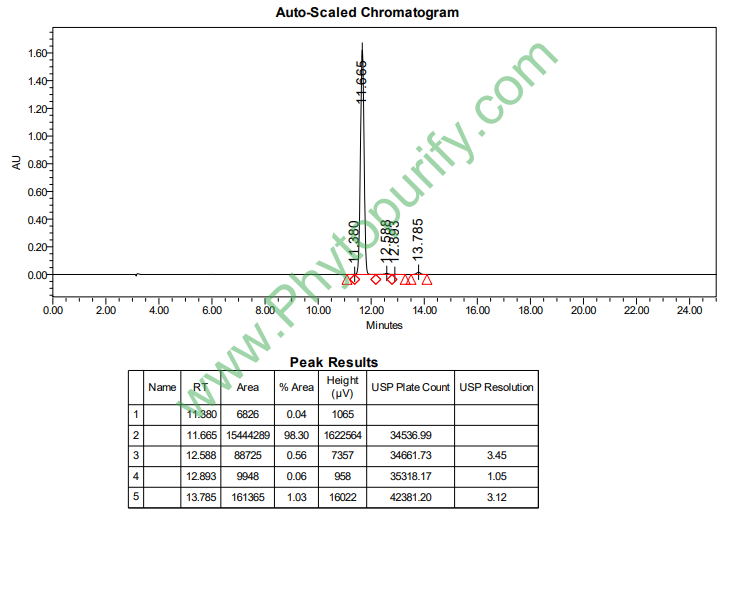
Purity: 95%~99%
Analysis Method: HPLC-DAD or/and HPLC-ELSD
Identification Method: Mass, NMR
Packing: Brown vial or HDPE plastic bottle
Storage: Store in a well closed container, protected from air and light. Put into refrigerate or freeze for long term storage.
Whenever possible, you should prepare and use solutions on the same day. However, if you need to make up stock solutions in advance, we recommend that you store the solution as aliquots in tightly sealed vials at -20℃. Generally, these will be useable for up to two weeks.
The product could be supplied from milligrams to grams
Inquire for bulk scale.
Chengdu Biopurify Phytochemicals Ltd. is a leading company in the research, development, manufacture and marketing of High Quality Phytochemicals and Extracts(especially Active Ingredients from Traditional Chinese Medicine,TCM), Natural Active Pharmaceutical Ingredients worldwide.
The main services:
A. Supply active ingredients and reference standards of TCM, from mgs to kgs scale
B. Custom extraction and purification, target Herb Active Ingredients
C. Custom synthesis and semi-synthesis for Natural Active Ingredients
D. CR(contract research), CM(contract manufacture) and PD(process development) services from lab scale, pilot scale to commercial scale(GMP is also available)
E. TCM compounds library for drug screen,more than 3000 compounds available, many of them are rare and unique.
HPLC of Crocetine dimethyl ester
Storage conditions:Short-term storage at 2~8℃, long-term storage at -20 ~ -80℃
52.6000
4.6731
4.6731
.0043
4.5841
10.0894
High
91.7176
3.3475
Yes
Yes
No
No
No
Yes
0.3
No
Yes
Yes
Yes
Crocetine dimethyl ester (CAS number: 5892-54-6) is a natural product obtained by esterification modification of crocin extracted from the stigma of saffron (Crocus sativus L.). As one of the main carotenoid derivatives in saffron, dimethyl crocetin has attracted much attention in recent years in the field of neurodegenerative diseases, especially Alzheimer's disease (AD), due to its significant antioxidant activity and multi-target regulatory ability. AD, as a complex disease characterized by cognitive dysfunction and progressive loss of neurons, involves multiple signaling pathways and molecular targets. Dimethyl crocetin exhibits potential neuroprotective effects by regulating key targets such as AMPK, BCL2 family proteins, NOTCH1, APP, and BACE1.
This article aims to systematically review the chemical structure and physicochemical properties, plant sources and extraction methods, pharmacological activity and mechanism of action, pharmacological evaluation and pharmacokinetic characteristics of dimethyl crocetin. Combined with its application prospects in neurodegenerative diseases such as AD, it explores the potential and challenges of its development as a natural product drug.
The molecular formula of dimethyl crocetin is C20H28O4, with a molecular weight of 356.4620. Its chemical structure is based on the core skeleton of crocin, which is modified by esterification of two carboxyl methyl groups to form a dimethyl ester structure. This structure endows it with high lipid solubility (LogP=4.6731), which is beneficial for penetrating biological membranes, especially the blood-brain barrier (BBB). Its BBB permeability is predicted to be high, demonstrating good potential for central nervous system (CNS) drugs.
The polar surface area (TPSA) of dimethyl crocetin is 52.6 Å ², which is in the moderate range and balances the compatibility of the molecule with both aqueous and lipid phases. Low water solubility (0.0043 mg/mL) suggests limited solubility in aqueous phase, which may affect oral bioavailability, but its lipid solubility facilitates membrane penetration. The negative result of hERG channel inhibition experiment indicates a low risk of cardiac toxicity. The Ames test result is 0.3, indicating a low risk of genotoxicity.
Overall, dimethyl crocetin has good drug compatibility and safety foundation, making it suitable for further pharmacological and pharmacokinetic studies.
Saffron dimethyl ester mainly comes from the dried stigma of saffron. As a traditional Chinese medicinal herb and spice, saffron contains abundant derivatives of carotenoids, among which crocin is the main water-soluble pigment. Dimethyl crocetin is a product of hydrolysis and esterification of crocin, naturally present in saffron or obtained through chemical modification of crocin.
The extraction method generally includes the following steps:
Modern extraction techniques such as ultrasound assisted extraction, microwave-assisted extraction, and high-performance liquid chromatography (HPLC) purification have further improved extraction efficiency and purity, meeting pharmaceutical standards.
The pharmacological activity of dimethyl crocetin is mainly reflected in its strong antioxidant, anti-inflammatory, and neuroprotective effects, especially its performance in Alzheimer's disease models has attracted much attention.
Dimethyl crocetin can effectively scavenge free radicals and alleviate oxidative stress. The conjugated double bonds and carboxymethyl groups in its structure endow it with excellent free radical scavenging ability, inhibit lipid peroxidation, and protect cell membrane integrity. In vitro experiments have shown that it has a significant protective effect against hydrogen peroxide induced cell damage.
By regulating the inflammatory signaling pathway, dimethyl crocetin can inhibit the expression of pro-inflammatory cytokines (such as TNF - α, IL-1 β) and alleviate neuroinflammatory responses. Its regulation of the TLR4 signaling pathway reduces the activation status of microglia and alleviates neuroinflammation mediated nerve damage.
Dimethyl crocetin has shown effects in promoting cell survival and inhibiting apoptosis in various neural cell models. By regulating the expression of anti apoptotic protein BCL2 and pro apoptotic protein MCL1, cellular homeostasis is maintained. In addition, it activates the AMPK signaling pathway, promotes energy metabolism, and enhances neuronal tolerance.
In the AD model, dimethyl crocetin can inhibit the expression of β - amyloid (A β) precursor protein (APP) and β - secretase 1 (BACE1), reduce the generation and deposition of A β, and alleviate neurotoxicity. Its regulation of NOTCH1 and retinoic acid receptor alpha (RARA) contributes to neuronal differentiation and repair. By inhibiting IDO1, reducing neurotoxic metabolites, and improving cognitive function.
Animal experiments have shown that dimethyl crocetin can significantly improve cognitive impairment in AD model mice and alleviate neuronal damage in the hippocampus, suggesting its potential value in AD treatment.
The multi-target mechanism of action of dimethyl crocetin is the basis of its pharmacological activity, involving multiple signaling pathways and key proteins.
AMP activated protein kinase (AMPK) serves as a core regulator of cellular energy metabolism, involved in regulating neuronal energy homeostasis and autophagy processes. Dimethyl crocetin activates AMPK, promotes energy metabolism, enhances cellular antioxidant capacity, and reduces neuronal damage.
MCL1 and BCL2 are anti apoptotic proteins of the BCL2 family, regulating the pathway of cell apoptosis. Dimethyl crocetin upregulates the expression of these two proteins, inhibits apoptosis signals, and protects neurons from oxidative stress and toxic damage.
The NOTCH signaling pathway plays an important role in neuronal development and regeneration. Dimethyl crocetin regulates NOTCH1 expression, promotes neuronal differentiation and repair, and helps maintain neurological function.
RARA, as a nuclear receptor, regulates gene expression and affects the development and function of neurons. Dimethyl crocetin promotes neuronal survival and functional recovery by regulating RARA.
Indoleamine 2,3-dioxygenase 1 (IDO1) is involved in tryptophan metabolism and overactivation leads to the accumulation of neurotoxic metabolites. Dimethyl crocetin inhibits IDO1 activity, reduces neurotoxicity, and improves cognitive function.
The abnormal metabolism of APP and BACE1 mediated β - secretion are the core mechanisms of AD pathogenesis. Dimethyl crocetin inhibits BACE1 activity, reduces A β production, and alleviates neurotoxic deposition.
The inflammatory response mediated by TLR4 plays a crucial role in AD. Dimethyl crocetin inhibits TLR4 signaling and reduces inflammation levels. PTPN1, as a protein tyrosine phosphatase, regulates multiple signaling pathways, and its regulation helps maintain cellular function and metabolic balance.
In summary, dimethyl crocetin achieves protection and functional regulation of neurons through multi-target and multi pathway synergistic effects.
The pharmacological evaluation of dimethyl crocetin shows that it has good potential for drug development.
The molecular weight of 356.46 is moderate, with a LogP of 4.67, which is in line with the ideal range of lipophilic drugs and beneficial for cell membrane penetration. The TPSA is 52.6 Å ², suitable for crossing the blood-brain barrier and supporting the localization of central nervous system drugs.
HERG channel inhibition is negative, reducing the risk of cardiac toxicity. The Ames test results are low, indicating a low risk of genetic toxicity and good safety.
Dimethyl crocetin has high blood-brain barrier permeability and can effectively enter the central nervous system, exerting neuroprotective effects. Its low water solubility may limit oral absorption, and its bioavailability needs to be improved through formulation optimization (such as liposomes, nanoparticles).
The metabolism in the body is mainly hydrolyzed by liver esterases to crocetin, which is further metabolized and excreted. Moderate half-life, suitable for daily administration.
At present, there is limited research on its interaction with commonly used AD drugs such as acetylcholinesterase inhibitors and NMDA receptor antagonists, and further evaluation is needed to guide clinical combination therapy.
Dimethyl crocetin, as a natural product, has shown potential for application in Alzheimer's disease and other neurodegenerative diseases due to its multi-target regulation and good safety. At present, it has shown significant neuroprotective and cognitive function improvement effects in preclinical research.
The key to future clinical applications lies in:
In addition, the advantages of dimethyl crocetin in antioxidant, anti-inflammatory, and metabolic regulation also provide a theoretical basis for its application in Parkinson's disease, stroke, and other neurological diseases.
Dimethyl crocetin, as an important natural derivative of saffron, has become a hot topic in the treatment of neurodegenerative diseases due to its unique chemical structure and multiple pharmacological activities. Its multi-target regulatory role in Alzheimer's disease, combined with good drug efficacy and safety, provides strong support for the development of new natural product drugs. In the future, through in-depth mechanism research and clinical validation, dimethyl crocetin is expected to become an effective candidate drug for the treatment of AD and related neurological diseases, promoting the development of natural product pharmacology.
