


Product name: Crocin II
Synonym name: Crocin-2
Catalogue No.: BP0407
Cas No.: 55750-84-0
Formula: C38H54O19
Mol Weight: 814.831
Botanical Source: Crocus sativus L.; Fructus Gardeniae
Physical Description:
Type of Compound: Diterpenoids
Purity: 95%~99%
Analysis Method: HPLC-DAD or/and HPLC-ELSD
Identification Method: Mass, NMR
Packing: Brown vial or HDPE plastic bottle
Storage: Store in a well closed container, protected from air and light. Put into refrigerate or freeze for long term storage.
The product could be supplied from milligrams to grams
Inquire for bulk scale.
Description:
Crocin has antihyperlipidemic, antidepressant , anti-inflammatory and anti-apoptotic effects. It can reduce the protein expression of iNOS and caspase-3, and increase CREB, BDNF and VGF levels in hippocampus.
References:
Braz.J.Pharm.Sci., 2015, 51(3):637-642
A preliminary study of the anti-inflammatory and anti-apoptotic effects of crocin against gastric ischemia-reperfusion injury in rats
The aim of the present study was to investigate the protective effect of crocin on gastric mucosal lesions caused by ischemia-reperfusion (I/R) injury in rats.
METHODS AND RESULTS:
Thirty-two male rats were randomly divided into sham, I/R, I/R + crocin pretreatment and crocin alone groups. To induce I/R lesions, the celiac artery was clamped for 30 min, and the clamp was then removed to allow reperfusion for 3 h. Crocin-pretreated rats received crocin (15 mg/kg, i.p.) 30 min prior to the induction of I/R injury. Samples of gastric mucosa were collected to quantify the protein expression of caspase-3, an apoptotic factor, and inducible nitric oxide synthase (iNOS), a pro-inflammatory protein, by Western blot. Pretreatment with crocin decreased the total area of gastric lesions and decreased the protein expression levels of caspase-3 and iNOS induced by I/R injury.
CONCLUSIONS:
Our findings showed a protective effect of crocin in gastric mucosa against I/R injury. This effect of crocin was mainly mediated by reducing the protein expression of iNOS and caspase-3.
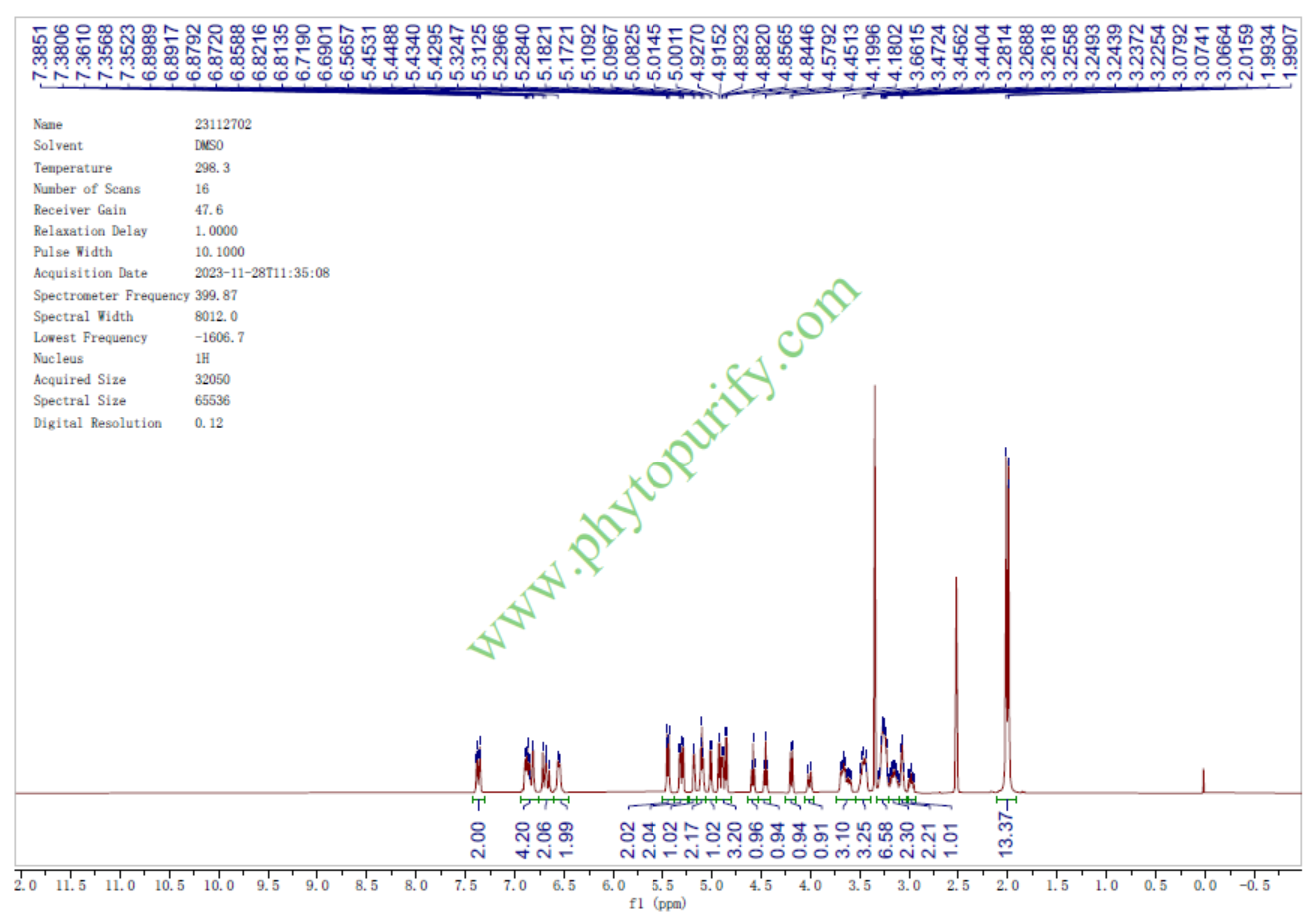
HNMR of Crocin II
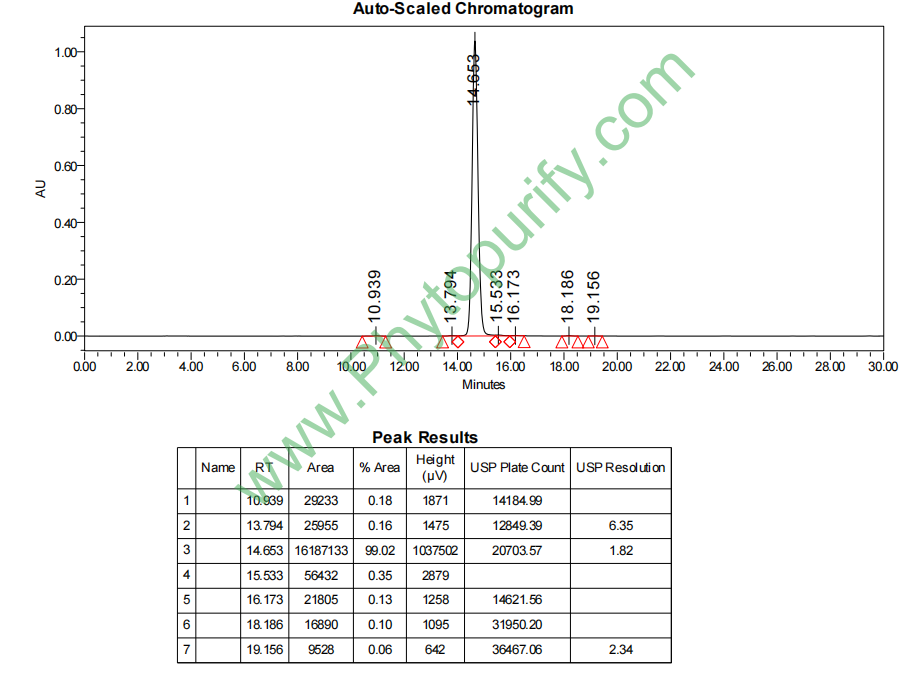
HPLC of Crocin II
Storage conditions:Short-term storage at 2~8℃, long-term storage at -20 ~ -80℃
312.0500
.0149
.0151
12.4824
.4346
.2696
Low
55.7030
5.7578
Yes
Yes
No
No
No
No
0.3
Yes
Yes
Yes
Yes
Natural products, as an important source of drug discovery and development, play an irreplaceable role in the history of human disease prevention and treatment. Among them, saffron (Crocus sativus L.) and its main active ingredients, crocin compounds, have attracted much attention since ancient times due to their bright color and wide pharmacological activities. Crocin II, as one of the core members of the crocin family, is a water-soluble carotenoid glycoside isolated from the fruit of Gardenia jasminoides Ellis. Its CAS number is 55750-84-0, and it has become a hot topic in modern pharmacological research due to its excellent multiple biological activities such as antioxidant, anti-inflammatory, anticancer, and neuroprotective properties. With the advancement of modern separation and identification techniques and the deepening of molecular pharmacology research, the targets and signaling pathway network of crocin II have gradually become clear, especially in regulating core pathological and physiological processes such as oxidative stress and inflammatory response. This article aims to systematically review the chemical properties, plant sources, pharmacological activities, molecular mechanisms of action, pharmacological evaluation, and clinical application potential of crocin II, in order to provide comprehensive scientific references for the deep development and transformation research of this natural product.
Saffron II is a typical disaccharide ester compound, whose chemical structure is based on crocetin, a conjugated polyene dicarboxylic acid mother nucleus. Specifically, the chemical name of crocin II is di (β - D-gentian disaccharide) crocetin ester. In its molecular structure, the carboxyl groups at both ends of saffron acid are connected to a molecule of β - D-gentiobiose through ester bonds, forming a symmetrical glycoside structure. This unique structure gives it a distinct orange red color and special water solubility.
Its molecular formula is C38H54O19 and its molecular weight is 814.8310. The calculated lipid water partition coefficient (LogP) is approximately 0.0149, indicating that the molecule has a high degree of hydrophilicity, which is closely related to the presence of multiple hydroxyl groups in the sugar moiety of the structure. Its topological polar surface area (TPSA) is as high as 312.0500 Å ², further confirming its strong polarity characteristics. The theoretically calculated water solubility value is 12.4824 mg/mL, indicating that it has good solubility in aqueous media, which provides a favorable physical and chemical basis for its development as an oral or injectable dosage form. However, its large molecular weight and polarity also pose challenges to its biofilm permeability, especially its ability to penetrate the blood-brain barrier (BBB) is predicted to be "low", suggesting that it may need to rely on delivery systems or structural modifications to improve brain distribution in the treatment of central nervous system diseases.
Saffron II is mainly enriched in the dried stigma of Crocus sativus L., a plant in the Iridaceae family, and in the mature fruit of Gardenia jasminoides Ellis, a plant in the Rubiaceae family. Due to the scarcity and high price of saffron resources, gardenia has become a more economically feasible and important source for obtaining crocin compounds through industrialization. In gardenia fruit, crocin II often coexists with other analogues such as crocin I (monosaccharide ester).
The traditional method for extracting crocin II is mainly based on solvent extraction. Water or ethanol/methanol aqueous solutions of different concentrations are commonly used as extraction solvents, and their good water solubility is utilized for leaching. In order to improve extraction efficiency and selectivity, modern extraction techniques have been widely applied:
1. Ultrasound assisted extraction (UAE) and microwave-assisted extraction (MAE): Utilizing physical field effects to destroy plant cell walls significantly shortens extraction time and improves the dissolution rate of target components.
2. Supercritical fluid extraction (SFE): Supercritical CO ₂ is usually used, but due to its weak polarity, it is often necessary to add entrainers (such as ethanol) to enhance the extraction ability of crocin II. This method has the advantages of no solvent residue and low operating temperature, which is conducive to the preservation of thermosensitive components.
3. Enzyme assisted extraction: Using cellulases, pectinases, and other enzymes to hydrolyze cell wall polysaccharides and increase the release of active ingredients.
The crude extract after extraction needs to undergo further separation and purification to obtain high-purity crocin II. Conventional purification strategies include macroporous adsorption resin (such as AB-8, D101 type) column chromatography, which utilizes its adsorption and desorption properties for enrichment, followed by fine separation using techniques such as silica gel column chromatography, preparative high-performance liquid chromatography (HPLC), or high-speed countercurrent chromatography (HSCCC). Mass spectrometry (MS) and nuclear magnetic resonance (NMR) techniques are key methods for identifying its chemical structure.
Numerous in vitro and in vivo pharmacological experiments have confirmed that crocin II has broad and significant biological activities.
Antioxidant activity: Saffron II is a potent antioxidant. The conjugated double bond system in its structure can effectively quench singlet oxygen and scavenge various free radicals (such as DPPH, ABTS ⁺ free radicals, superoxide anions, hydroxyl radicals). In cell models, it can significantly enhance the survival rate of cells damaged by oxidative stress, reduce levels of reactive oxygen species (ROS) and malondialdehyde (MDA), and increase the activity of endogenous antioxidant enzymes such as superoxide dismutase (SOD), catalase (CAT), and glutathione peroxidase (GPx).
Anti inflammatory activity: Saffron II exhibits clear anti-inflammatory effects. In the lipopolysaccharide (LPS) - induced macrophage (such as RAW 264.7) inflammation model, it can dose dependently inhibit the production of nitric oxide (NO), with an IC50 value of 31.1 μ M. In addition, it can also inhibit the release of key inflammatory mediators such as prostaglandin E2 (PGE2), tumor necrosis factor - α (TNF - α), interleukin-6 (IL-6), and IL-1 β.
Antitumor activity: Studies have shown that crocin II can inhibit the proliferation and induce apoptosis of many cancer cell lines (such as breast cancer, lung cancer, colon cancer and leukemia cells). Its anti-cancer mechanism involves inducing cell cycle arrest (such as G0/G1 phase or G2/M phase), activating caspase cascade reaction, regulating Bcl-2/Bax protein ratio, inducing mitochondrial membrane potential depolarization, etc.
Neuroprotective and antidepressant activity: Although the blood-brain barrier permeability is low, some studies still suggest that crocin II or its metabolites may exert neuroprotective effects through indirect mechanisms. In a chronic unpredictable mild stress (CUMS) - induced depression animal model, treatment with crocetin II can improve behavioral distress in animals, which may be related to regulating hypothalamic pituitary adrenal (HPA) axis function, increasing levels of monoamine neurotransmitters (such as 5-hydroxytryptamine and norepinephrine) in the brain, and promoting the expression of neurotrophic factors.
Other activities: In addition, studies have reported that crocin II has potential activities such as protecting against myocardial ischemia-reperfusion injury, improving metabolic syndrome (such as lowering blood lipids and improving insulin resistance), protecting the liver from chemical damage, and alleviating retinal lesions.
The multiple pharmacological activities of crocin II stem from its precise regulation of multiple intracellular signaling pathways, and its core mechanism of action revolves around two main axes: antioxidant and anti-inflammatory.
Activate Nrf2/ARE antioxidant pathway: This is the core molecular mechanism by which crocin II exerts antioxidant effects. In the resting state, the transcription factor NFE2-related factor 2 (Nrf2, encoded by the NFE2L2 gene) binds to its inhibitory protein Keap1 in the cytoplasm and is ubiquitinated and degraded. Saffron II can induce the dissociation and translocation of Nrf2 from Keap1 to the nucleus by modifying cysteine residues on Keap1 or promoting Nrf2 phosphorylation. In the nucleus, Nrf2 binds to antioxidant response elements (ARE), initiating gene transcription and expression of a series of downstream phase II detoxifying enzymes and antioxidant proteins, including:
Inhibition of NF - κ B-mediated inflammatory pathway: The anti-inflammatory effect of crocin II is mainly achieved by inhibiting the nuclear factor kappa B (NF - κ B) signaling pathway. Under stimulation such as LPS, the I κ B kinase (IKK) complex is activated, leading to phosphorylation and degradation of I κ B α protein, thereby releasing NF - κ B (usually p65/p50 dimer) into the nucleus. Saffron II can inhibit the activity of IKK and the degradation of I κ B α, preventing the nuclear translocation of NF - κ B. In the nucleus, it can also inhibit the binding activity between NF - κ B and DNA. As a result, the transcription of a series of pro-inflammatory mediator genes downstream of NF - κ B was significantly inhibited, including:
Cross talk and multi-target regulation: There is a complex cross-talk between the Nrf2 and NF - κ B pathways. Activated Nrf2 and its downstream products (such as HO-1) can negatively regulate the activity of NF - κ B, forming a synergistic anti-inflammatory antioxidant effect. In addition, crocin II may exert its pharmacological effects at multiple levels by regulating signaling pathways such as MAPK (such as ERK, JNK, p38), PI3K/Akt, as well as directly affecting mitochondrial function, endoplasmic reticulum stress, and other pathways.
Preliminary analysis of the pharmacological parameters of crocin II has yielded mixed results.
Advantages: Its good water solubility (12.4824 mg/mL) is beneficial for the development of the formulation. The key toxicity risk screening showed no significant inhibitory effect on hERG potassium channels (hERG inhibition: No), indicating a low risk of causing QT interval prolongation in the heart. The Ames test result is 0.3, indicating that no significant mutagenicity was observed under the experimental conditions, and the genetic toxicity risk is controllable.
Challenge aspect: Its large molecular weight (814.8310) and high polarity (high TPSA, low LogP) result in poor membrane permeability and expected low oral bioavailability. This has been confirmed by some pharmacokinetic studies: after oral administration, crocin II may be partially hydrolyzed by microbial enzymes in the gastrointestinal tract to metabolites such as crocetin, and the absorption of the original drug is limited and quickly cleared from the plasma. Its low blood-brain barrier permeability also limits its direct therapeutic effect on central nervous system diseases. In addition, as ester compounds, they may be susceptible to esterase metabolism in vivo.
Overview of pharmacokinetic (PK) research: Existing animal PK studies (mainly conducted in rats) have shown that intravenous injection of crocin II rapidly distributes in the body, but its elimination is also fast, manifested by limited distribution volume, high clearance rate, and short half-life. After oral administration, the blood drug concentration is extremely low and the peak time is short. Its main metabolic pathways may include hydrolysis of ester bonds (generating crocetinic acid and glycosides), glucuronic acid binding or sulfation, and other II binding reactions. Metabolites may contribute to some of the in vivo activity.
Improvement strategy: In order to enhance its medicinal properties, researchers are exploring various strategies: 1)Prodrug design Improve its lipid solubility and membrane permeability through chemical modifications such as esterification and preparation of phospholipid complexes; 2)New drug delivery system Develop delivery systems such as nanoparticles, liposomes, microemulsions, and solid dispersions to improve their solubility, stability, and bioavailability, and even achieve targeted delivery; 3)Structural similarity screening Search for derivatives with equivalent activity but better pharmacokinetic properties.
Saffron II, as a multi-target and multifunctional natural active molecule, has shown broad clinical application prospects in multiple disease fields.
Adjuvant treatment for neurological disorders: Although BBB has poor permeability, its strong antioxidant and anti-inflammatory effects, as well as indirect mechanisms such as peripheral regulation of the HPA axis and increased neurotrophic factors, make it effective in Depression, anxiety disorder, Alzheimer's disease, Parkinson's disease There is potential in the adjuvant treatment of neurological and psychiatric disorders. Consider developing plant-based drug formulations or dietary supplements for mild to moderate depression.
Inflammatory related diseases: Based on its clear inhibitory effects on iNOS, COX-2, and pro-inflammatory cytokines, crocin II can be used for Arthritis, colitis, atherosclerosis Prevention and treatment of chronic inflammatory diseases. As a natural anti-inflammatory agent, it may have better safety than traditional nonsteroidal anti-inflammatory drugs (NSAIDs).
Metabolic diseases and cardiovascular protection: Its role in improving insulin resistance, regulating blood lipids, and protecting endothelial function suggests its potential in Type 2 diabetes, non-alcoholic fatty liver disease, hypertension and myocardial ischemia It has practical value in metabolic syndrome related diseases.
Prevention and adjuvant therapy of tumors: Its anti-cancer activity makes it possible to use it as a chemopreventive agent or in combination with conventional chemotherapy/radiotherapy to enhance efficacy and reduce side effects. Further preclinical and clinical studies are needed to validate its safe and effective dosage and regimen.
Functional food and cosmetic additives: With its bright natural pigment properties, excellent antioxidant capacity, and known safety, crocin II has been widely used as an anti-aging and whitening active ingredient in food coloring agents and high-end cosmetics.
Future research prospects:
* In depth mechanism research: Using omics technologies (proteomics, metabolomics) and gene editing tools, comprehensively elucidate its functional network and discover new molecular targets.
* Pharmacokinetic optimization: Accelerate the development and evaluation of new drug delivery systems to solve the bottleneck problem of low bioavailability.
* Clinical translational studies: Conduct rigorously designed clinical trials to evaluate their effectiveness and safety in specific indications, and determine the optimal route and dosage of administration.
* Structural Modification and Synthetic Biology: Efficiently producing crocin II and its more active derivatives in microorganisms through semi synthetic or synthetic biology methods to ensure resource sustainability.
Saffron II, as a natural carotenoid glycoside derived from gardenia and saffron, has become a star molecule in natural product pharmacology research due to its unique chemical structure and multiple pharmacological effects. The core mechanism of enhancing cellular antioxidant defense and inhibiting NF - κ B pathway to alleviate inflammatory response by activating the Nrf2 pathway provides scientific basis for the treatment of various diseases with oxidative stress and chronic inflammation as the common pathological basis. Although it faces challenges such as low oral bioavailability and poor blood-brain barrier penetration in terms of drug efficacy, these obstacles are expected to be gradually overcome through the intervention of modern pharmacology and medicinal chemistry methods. With the continuous deepening of basic research and the continuous exploration of translational applications, crocin II is expected to develop from a traditional natural pigment into a candidate drug or functional ingredient with important value in the fields of neuroprotection, anti-inflammatory, anti-tumor, and metabolic regulation, contributing its unique value to human health. Future research should focus on promoting its transition from the laboratory to clinical practice, achieving a leap from "active compounds" to "effective drugs".
