
Product name: Crocetin
Synonym name: trans-Crocetin; alpha-Crocetin
Catalogue No.: BP0405
Cas No.: 27876-94-4
Formula: C20H24O4
Mol Weight: 328.408
Botanical Source: Crocus sativus L.
Physical Description:
Type of Compound: Diterpenoids
Purity: 95%~99%
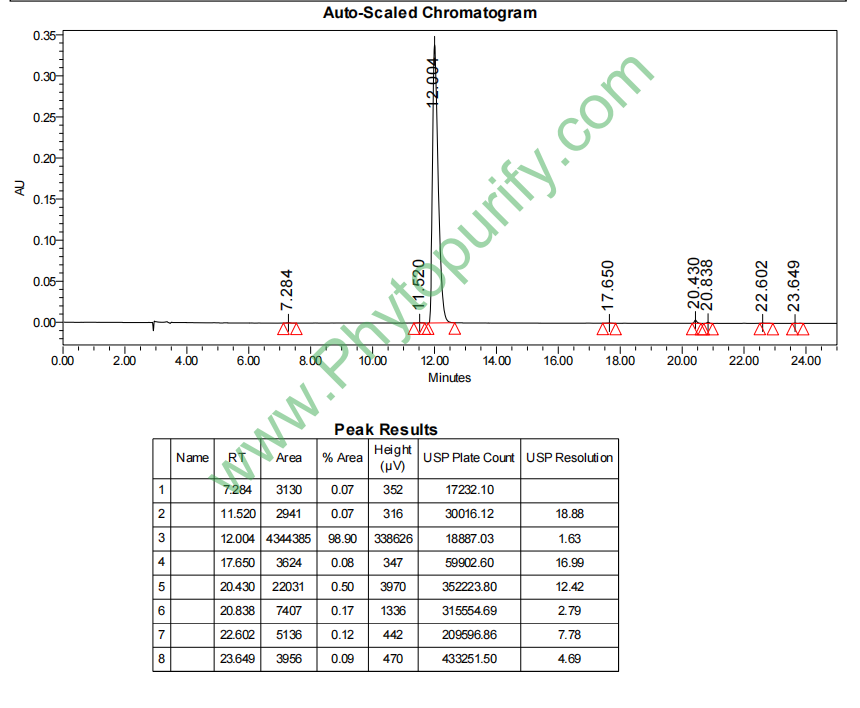
Analysis Method: HPLC-DAD or/and HPLC-ELSD
Identification Method: Mass, NMR
Packing: Brown vial or HDPE plastic bottle
The product could be supplied from milligrams to grams, up to kilograms.
Inquire for bulk scale.
Chengdu Biopurify Phytochemicals Ltd. is a leading company in the research, development, manufacture and marketing of High Quality Phytochemicals and Extracts(especially Active Ingredients from Traditional Chinese Medicine,TCM), Natural Active Pharmaceutical Ingredients worldwide.
The main services:
A. Supply active ingredients and reference standards of TCM, from mgs to kgs scale
B. Custom extraction and purification, target Herb Active Ingredients
C. Custom synthesis and semi-synthesis for Natural Active Ingredients
D. CR(contract research), CM(contract manufacture) and PD(process development) services from lab scale, pilot scale to commercial scale(GMP is also available)
E. TCM compounds library for drug screen,more than 3000 compounds available, many of them are rare and unique.
HPLC of Crocetin
Storage conditions:Short-term storage at 2~8℃, long-term storage at -20 ~ -80℃
74.6000
4.0000
.1900
Low
No
No
No
Unknown
No
Unknown
No
Crocetin (CAS number: 27876-94-4), as one of the main glycoside components of saffron (Crocus sativus L.), has attracted widespread attention in the field of natural product pharmacology in recent years. Saffron, as a traditional Chinese medicine and spice, mainly consists of active ingredients such as crocin, crocin, and saffron aldehyde. Among them, crocin has become a research hotspot due to its unique molecular structure and significant biological activity. Saffron acid not only has good oral bioavailability, but also can penetrate the blood-brain barrier, demonstrating its potential application value in neurological diseases. Numerous in vitro and in vivo studies have shown that crocetin has multiple pharmacological effects, including antioxidant, anti-inflammatory, anti apoptotic, anti-tumor, and anti-aging. Its mechanism of action involves multiple signaling pathways and molecular targets, particularly exhibiting strong affinity and channel opening activity towards NMDA receptors. This article will provide a systematic review of the chemical structure, sources, pharmacological activity, mechanism of action, pharmacological evaluation, and clinical application prospects of crocetin, aiming to provide theoretical basis and reference for its subsequent drug development and clinical research.
The chemical name of crocetin is (3R, 3aS, 6S, 6aR) -3,6-bis (2-carboxyethyl) -3,3a, 6,6a-tetrahydro-1H-cyclopenta [c] pyran-1,4-dione, with a molecular formula of C20H24O4 and a molecular weight of 328.39. It contains two carboxyl groups and one cyclopentenone ring in its structure, and belongs to the class of carotenoid diterpenoid compounds. The LogP value of crocetin is about 4.0, indicating its good lipid solubility, which is beneficial for penetrating cell membranes and the blood-brain barrier. Its topological polar surface area (TPSA) is 74.6 Å ² and the number of hydrogen bond acceptors is 4, indicating its polarity and hydrogen bond forming ability in intermolecular interactions.
In terms of physical and chemical properties, crocetin is a yellow crystalline powder with high stability and good solubility, especially in polar organic solvents. The carboxyl group in its structure endows the molecule with a certain acidity and is prone to form salt or ester derivatives, which facilitates structural modification and drug formulation development. It is worth noting that crocetin has a low risk of hepatotoxicity and cardiotoxicity, and has no significant hERG channel inhibitory effect, demonstrating good safety characteristics.
Saffron acid mainly exists in the style and style filaments of saffron, and is the glycoside part of saffron glycoside. Saffron, as a traditional precious Chinese medicinal herb, its harvesting and processing techniques directly affect the content and quality of crocetin acid. Natural saffron has a relatively low content of crocetin, which is usually extracted through methods such as water extraction and alcohol extraction, and then purified through multiple steps.
Common extraction methods include:
Solvent extraction method Extract saffron using ethanol, water, or ethanol water mixed solvents, and achieve preliminary separation by utilizing the polarity and solubility differences of crocetin acid.
Liquid-liquid distribution method Using the distribution coefficients of different solvents, further purify crocetin to remove impurities and other carotenoid components.
Column chromatography separation High purity crocetin acid is obtained through fine separation using silica gel columns, C18 reverse phase columns, or ion exchange columns.
Ultrasound assisted extraction and microwave-assisted extraction In recent years, ultrasound and microwave technology have been introduced to improve extraction efficiency and purity, shorten extraction time, and reduce solvent usage.
In addition, the study of biosynthetic pathways also provides the possibility for the bioengineering production of crocetin, and the use of microbial fermentation or plant cell culture technology to achieve its large-scale production has become a future development trend.
Saffron acid has become a hot molecule in anti-inflammatory, antioxidant, neuroprotective, and anti-tumor research due to its multi-target and multi mechanism pharmacological activities.
Saffron acid can significantly scavenge free radicals, reduce oxidative stress levels, and protect cells from oxidative damage. It activates the NFE2L2 (NRF2) signaling pathway, induces the expression of downstream antioxidant enzymes such as superoxide dismutase (SOD1, SOD2), catalase (CAT), glutathione peroxidase (GPX1), and heme oxygenase 1 (HMOX1), enhances cellular antioxidant defense ability, and reduces oxidative stress-induced cell damage.
Saffron acid can downregulate the expression of pro-inflammatory cytokines such as TNF - α, IL-1 β, and IL-6, inhibit cyclooxygenase-2 (COX-2) and its mediated inflammatory response, and alleviate inflammatory tissue damage. Its anti-inflammatory effect has been validated in various inflammatory models, demonstrating broad potential for application.
Saffron acid can penetrate the blood-brain barrier and directly act on the central nervous system. It has high affinity for N-methyl-D-aspartate receptors (NMDA receptors), promotes receptor channel opening, regulates glutamate mediated neural signal transmission, and protects neurons from excitotoxic damage. In addition, crocetin can inhibit cell apoptosis and mitogen activated protein kinase (MAPK) signaling pathway, slow down neurodegenerative diseases and cerebral ischemia-reperfusion injury.
Saffron acid exhibits inhibitory activity on proliferation and induces apoptosis in various tumor cell lines, especially in solid tumors such as cervical cancer, demonstrating good anti-cancer potential. Its mechanism includes regulating the cell cycle, inhibiting pro-inflammatory factors and related signaling pathways, interfering with the tumor microenvironment, and enhancing immune response.
Saffron acid reduces oxidative stress and inflammatory response, inhibits cell apoptosis, promotes cell repair, and delays the aging process of the brain and the whole body. Animal model studies have shown that crocetin can improve cognitive function, prolong lifespan, and has potential value in the development of anti-aging drugs.
The multiple pharmacological effects of crocetin depend on its regulation of multiple molecular targets, and the specific mechanism is as follows:
Saffron acid has a high affinity for NMDA receptors, which can promote the opening of receptor channels, regulate neuronal excitability, prevent excessive excitotoxicity, and protect the functional integrity of nerve cells. This mechanism is of great significance for the treatment of ischemic brain injury and neurodegenerative diseases.
Saffron acid activates NFE2L2/NRF2 transcription factors, promotes the expression of antioxidant enzyme genes, enhances the ability of cells to clear reactive oxygen species (ROS), and alleviates oxidative stress damage. This pathway plays a central role in the occurrence and development of various diseases and is a key mechanism for the antioxidant and anti-inflammatory properties of crocetin.
Saffron acid can inhibit the activation of NF - κ B signaling pathway, reduce the expression of pro-inflammatory cytokines (TNF - α, IL-1 β, IL-6) and COX-2, and alleviate inflammatory response. This mechanism helps alleviate chronic inflammation related diseases.
Saffron acid inhibits the activation of the MAPK signaling pathway (including ERK, JNK, and p38), reduces the expression of apoptosis related proteins, and protects cell survival. This mechanism is reflected in both neuroprotection and anti-tumor effects.
Saffron acid may also participate in various biological effects by regulating cell cycle proteins, immune regulatory factors, and mitochondrial function. The specific mechanism still needs further in-depth research.
The molecular weight of crocetin is 328.39, with a LogP value of 4.0, indicating its moderate lipid solubility, which is beneficial for oral absorption and tissue distribution. Its TPSA is 74.6 and the number of hydrogen bond acceptors is 4, which meets the ideal parameters for drug molecules in terms of membrane permeability. Saffron acid can penetrate the blood-brain barrier, although its blood-brain barrier permeability is rated as "low", its actual central nervous system activity indicates that it still has effective brain distribution ability.
Toxicological evaluation shows that crocetin has no significant hepatotoxicity or cardiotoxicity, and does not inhibit hERG channels, reducing the risk of arrhythmia. The results of Ames mutagenicity test are not yet clear, and further systematic genetic toxicity research is needed.
In terms of pharmacokinetics, crocetin is well absorbed after oral administration, with a moderate plasma half-life and the ability to reach effective concentrations in the body. Its metabolic pathway mainly involves the liver enzyme system, and its metabolites need further identification. In vivo distribution studies have shown that crocetin has a high concentration in brain tissue, supporting its neuroprotective effect.
Overall, crocetin has a good pharmacological basis, but its pharmacokinetic properties and formulation process still need to be optimized to improve its bioavailability and clinical application potential.
Saffron acid, as a natural active ingredient, has shown broad application prospects in various disease fields due to its multi-target and multi mechanism pharmacological effects.
Saffron acid is expected to be used as an adjuvant therapy for Alzheimer's disease, Parkinson's disease, cerebral ischemia-reperfusion injury, and other neurodegenerative diseases by regulating NMDA receptors and antioxidant and anti-inflammatory mechanisms. In the future, its clinical safety and efficacy evaluation should be strengthened, and relevant clinical trials should be promoted.
The anti-tumor activity of crocetin in cervical cancer and other solid tumors provides a theoretical basis for its development as an adjuvant anti-cancer drug. The combination therapy strategy with chemotherapy drugs may further enhance efficacy and reduce side effects.
The anti-inflammatory effect of crocetin makes it potentially applicable in chronic inflammatory diseases such as rheumatoid arthritis and inflammatory bowel disease. In the future, in-depth research should be conducted on specific inflammatory models to clarify their clinical indications.
The anti-aging effect of crocetin supports its development as a functional health ingredient, especially in improving cognitive function and delaying age-related diseases, with market potential.
Although crocetin has achieved rich results in basic research, its clinical translation still faces challenges such as pharmacokinetic optimization, formulation development, systematic toxicology evaluation, and large-scale clinical trials. By combining modern drug design technology and nano delivery systems, it is expected to enhance its bioavailability and targeting, promoting it as a new type of natural medicine.
Saffron acid, as an important active ingredient of saffron, has shown broad research and application prospects in antioxidant, anti-inflammatory, neuroprotective, and anti-tumor fields due to its unique chemical structure and diverse biological effects. Its mechanism of action involves multiple key pathways such as NMDA receptor regulation, NFE2L2/NRF2 signaling activation, and MAPK pathway inhibition, reflecting the advantages of multi-target regulation of natural products. The pharmacological evaluation shows that crocetin has good safety and pharmacokinetic characteristics, but further optimization and clinical validation are still needed. In the future, with the deepening of molecular mechanism research and the advancement of drug formulation technology, crocetin is expected to become an effective natural medicine for the treatment of neurological diseases, tumors, and inflammatory diseases, providing new strategies and choices for the prevention and treatment of related diseases.


