


Product name: β-Crocetin
Synonym name: CCrocetin methylester; Beta-Crocetin
Catalogue No.: BP2061
Cas No.: 25368-09-6
Formula: C21H26O4
Mol Weight: 342.435
Botanical Source: Crocus sativus L.
Type of Compound: Diterpenoids
Purity: 95%~99%
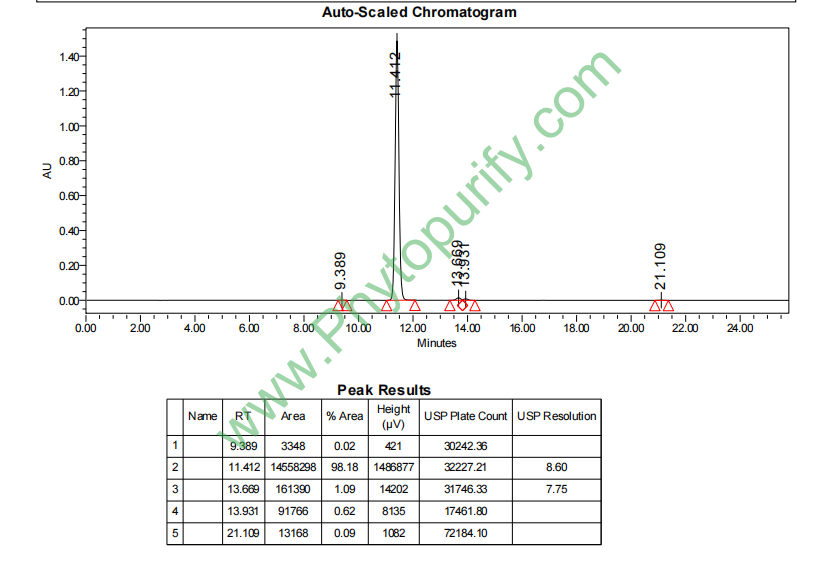
Analysis Method: HPLC-DAD or/and HPLC-ELSD
Identification Method: Mass, NMR
Packing: Brown vial or HDPE plastic bottle
Storage: Store in a well closed container, protected from air and light. Put into refrigerate or freeze for long term storage.
Whenever possible, you should prepare and use solutions on the same day. However, if you need to make up stock solutions in advance, we recommend that you store the solution as aliquots in tightly sealed vials at -20℃. Generally, these will be useable for up to two weeks.
The product could be supplied from milligrams to grams
Inquire for bulk scale.
Chengdu Biopurify Phytochemicals Ltd. is a leading company in the research, development, manufacture and marketing of High Quality Phytochemicals and Extracts(especially Active Ingredients from Traditional Chinese Medicine,TCM), Natural Active Pharmaceutical Ingredients worldwide.
The main services:
A. Supply active ingredients and reference standards of TCM, from mgs to kgs scale
B. Custom extraction and purification, target Herb Active Ingredients
C. Custom synthesis and semi-synthesis for Natural Active Ingredients
D. CR(contract research), CM(contract manufacture) and PD(process development) services from lab scale, pilot scale to commercial scale(GMP is also available)
E. TCM compounds library for drug screen,more than 3000 compounds available, many of them are rare and unique.
HPLC of β-Crocetin
Storage conditions:Short-term storage at 2~8℃, long-term storage at -20 ~ -80℃
63.6000
4.0991
1.6401
.0269
3.1511
8.1507
Low
95.0631
3.4048
Yes
Yes
Yes
No
No
Yes
0.3
No
Yes
Yes
Yes
Crocetin methyl ester (CAS number: 25368-09-6), also known as Transcrocetin, is one of the important active ingredients in saffron (Crocus sativus L.) and exists as a glycoside form of crocetin acid. In recent years, with the deepening of natural product pharmacology and neuropharmacology research, crocetin methyl ester has attracted much attention due to its unique biological activity and good oral bioavailability. It not only exhibits the ability to regulate multiple targets of the central nervous system (CNS), but also demonstrates multiple pharmacological effects such as anti-inflammatory, anti apoptotic, and anti-aging, especially in the treatment research of neurodegenerative diseases, cancer, and inflammatory diseases, showing broad application prospects.
This review aims to systematically summarize the chemical structure and physicochemical properties, plant sources and extraction processes, pharmacological activity and mechanism of action, pharmacological evaluation and pharmacokinetic characteristics of crocetin monomethyl ester. Combined with its clinical application potential, it comprehensively reviews the research progress of this natural product, in order to provide theoretical support and reference for subsequent basic and clinical research.
The molecular formula of crocetin methyl ester is C19H26O4, with a molecular weight of 342.4350, and it belongs to the class of carotenoid derivatives. Its structure is based on the dicarboxylic acid skeleton of crocetin, which forms a monomethyl ester through carboxymethylation, endowing it with high lipid solubility. The chemical structure contains a conjugated double bond system, endowing it with unique optical properties and antioxidant activity.
In terms of physical and chemical properties, the LogP value of crocetin methyl ester is 4.0991, indicating its strong lipid solubility, which is beneficial for penetrating cell membranes and the blood-brain barrier. The polar surface area (TPSA) is 63.6 Å ², indicating that its molecular polarity is moderate and facilitates binding to protein targets. Low water solubility (0.0269 mg/mL) suggests limited solubility in aqueous phase, which may affect the design of oral formulations. The hERG channel inhibition experiment showed a negative result, indicating a low risk of cardiac toxicity. The Ames mutagenicity test score is 0.3, indicating a low risk of genotoxicity and meeting safety requirements.
Saffron methyl ester mainly exists in the style and stamen of saffron, and is a hydrolysis product of various carotenoids in saffron. Saffron, as a traditional Chinese medicine and spice, has a long history of use, and the extraction and purification techniques of its active ingredients are constantly optimized.
Traditional extraction methods often use organic solvents such as methanol and ethanol for extraction, combined with liquid-liquid extraction and column chromatography separation, to obtain high-purity crocetin methyl ester. Modern technologies such as ultrasound assisted extraction and supercritical CO ₂ extraction are gradually being applied in the extraction process of crocetin methyl ester due to their high efficiency and environmental friendliness. In addition, countercurrent chromatography and high-performance liquid chromatography (HPLC) techniques are widely used for the separation, purification, and quantitative analysis of this compound.
The optimization of extraction process not only improves the yield and purity, but also lays the foundation for the pharmacological research and formulation development of crocetin methyl ester.
Saffron methyl ester exhibits diverse pharmacological activities, covering multiple aspects such as neuroprotection, anti-inflammatory, anti-tumor, and anti-aging.
Saffron methyl ester can penetrate the blood-brain barrier and directly act on the central nervous system. Research has shown that it has a high affinity for NMDA receptors, can activate receptor channels, regulate glutamate mediated neural signal transduction, reduce excitotoxicity, and protect neurons from damage caused by excessive excitation. In addition, crocetin methyl ester can inhibit neuronal apoptosis, slow down neurodegenerative diseases, and demonstrate potential therapeutic value for diseases such as Parkinson's disease, Alzheimer's disease, and ischemic brain injury.
Saffron methyl ester can significantly downregulate the expression of pro-inflammatory cytokines (such as TNF - α, IL-1 β, IL-6) and cyclooxygenase-2 (COX-2), inhibit the activation of inflammatory signaling pathways, and alleviate inflammatory responses. Its anti-inflammatory mechanism involves inhibiting the activation of the MAPK pathway, reducing the release of inflammatory mediators, and thus exerting tissue protective effects.
In various tumor models, crocetin methyl ester exhibits activity in inhibiting tumor cell proliferation, inducing cell apoptosis, and suppressing tumor metastasis. Especially in cervical cancer cells, it induces cell cycle arrest and apoptosis by regulating the expression of cell cycle proteins and apoptosis related proteins, demonstrating good anti-cancer potential.
Saffron methyl ester delays the aging process of brain and systemic tissues through antioxidant, anti-inflammatory, and regulation of cellular signaling pathways. It can protect mitochondrial function, reduce oxidative stress, maintain cellular homeostasis, and prolong cell lifespan.
The multi-target mechanism of action of crocetin methyl ester provides a molecular basis for its complex pharmacological effects.
Saffron methyl ester exhibits strong affinity for NMDA receptors, promoting receptor channel opening, regulating glutamate mediated excitatory nerve conduction, reducing excitotoxicity, and protecting neuronal function.
By inhibiting the activation of MAPK (including ERK, JNK, p38) pathways, crocetin methyl ester reduces the expression of pro-inflammatory cytokines and COX-2, alleviates inflammatory responses, and protects tissues from inflammatory damage.
Saffron methyl ester can regulate the expression of Bcl-2 family proteins, inhibit the release of cytochrome c, block the apoptotic signal of mitochondrial pathway, and reduce cell apoptosis. In addition, it also inhibits the activation of caspase enzyme and enhances cell survival.
Saffron methyl ester acts on various neurotransmitter system related targets, including monoamine oxidase A/B (MAOA, MAOB), glycogen synthase kinase 3 β (GSK3B), serotonin transporter (SLC6A4), 5-hydroxytryptamine 1A receptor (HTR1A), GABA_A receptor subunit (GABRA1), cAMP response element binding protein 1 (CREB1), and brain-derived neurotrophic factor (BDNF), regulating neurotransmitter balance and neuroplasticity, and exerting antidepressant effects.
Saffron methyl ester may also affect the activity of enzymes such as catechol-O-methyltransferase (COMT), participate in dopamine metabolism regulation, and further affect neurological function.
The pharmacological parameters of crocetin methyl ester show that it has certain potential for drug development:
Pharmacokinetic studies have shown that crocetin methyl ester is well absorbed after oral administration, with a moderate plasma half-life and the ability to maintain effective blood drug concentrations. Its metabolic pathway mainly involves the liver enzyme system, and the activity of metabolites still needs further research. The main excretion pathways are bile and urine.
Saffron methyl ester has broad clinical application potential in the fields of neurological diseases, tumors, and inflammatory diseases due to its multi-target and multi mechanism pharmacological properties.
As an NMDA receptor modulator and anti-inflammatory anti apoptotic agent, crocetin methyl ester has shown promising prospects in the treatment of diseases such as Alzheimer's disease, Parkinson's disease, ischemic brain injury, and depression. It can improve neurological function, slow down pathological progression, and enhance patients' quality of life.
Saffron methyl ester has shown anti proliferative and pro apoptotic effects in cervical cancer and other tumor models, and is expected to be used as an adjuvant anti-cancer drug in combination with existing treatment regimens to improve efficacy and reduce side effects.
By regulating the inflammatory signaling pathway, crocetin methyl ester can be used for the treatment of chronic inflammatory diseases, such as rheumatoid arthritis and inflammatory bowel disease, to alleviate inflammatory reactions and protect tissue function.
Its antioxidant and anti-aging effects provide new ideas for delaying the aging of the nervous system and the whole body, and have potential health promotion and disease prevention value.
In the future, the clinical translation of crocetin methyl ester still needs to overcome problems such as poor water solubility and limited bioavailability. By combining new drug delivery systems such as nanocarriers and liposomes, optimizing the administration route and dosage form design, it will further promote its clinical application.
As an important active ingredient in saffron, crocetin monomethyl ester has shown extensive potential in various fields such as neuroprotection, anti-inflammatory, anti-tumor, and anti-aging due to its unique chemical structure and multi-target pharmacological activity. Its mechanism of action covers NMDA receptor regulation, inflammation signal inhibition, anti apoptosis, and neurotransmitter system regulation, constructing a complex and effective pharmacological network.
Although significant progress has been made in the research of crocetin methyl ester, its pharmacological properties and clinical applications still face certain challenges. In the future, it is necessary to strengthen the research on its pharmacokinetic characteristics, optimize formulation technology, conduct systematic clinical trials, and verify its safety and effectiveness.
In summary, as a potential natural drug candidate molecule, crocetin monomethyl ester is worth further exploration and development, and is expected to provide new treatment strategies and drug choices for neurological diseases, inflammation, and tumor treatment.
