


Synonym name:
Catalogue No.: BP0230
Cas No.: 58798-95-1
Formula: C46H74O17
Mol Weight: 899.081
Botanical Source: Bacopa monnieri
Purity: 95%~99%
Analysis Method: HPLC-DAD or/and HPLC-ELSD
Identification Method: Mass, NMR
Packing: Brown vial or HDPE plastic bottle
Can be supplied from milligrams to grams.
For Reference Standard and R&D, Not for Human Use Directly.
Inquire for bulk scale.
HPLC of Bacoside A2
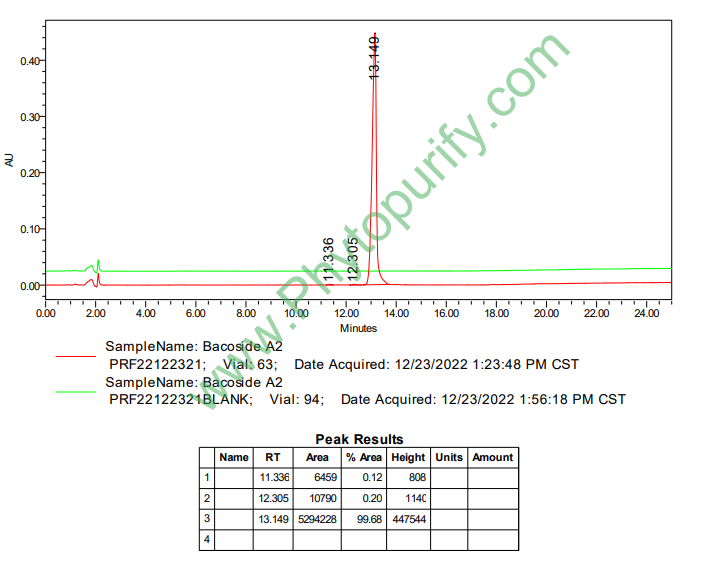
Storage conditions:Short-term storage at 2~8℃, long-term storage at -20 ~ -80℃
255.9100
2.1292
2.1290
.0298
.5300
.3586
Low
68.9735
3.4763
No
No
No
No
No
No
0.3
Yes
No
No
No
Natural products have always been an important source of innovative drug discovery, among which triterpenoid saponins have attracted much attention due to their wide range of biological activities. Bacoside A2 (CAS number: 58798-95-1) is a major active triterpenoid saponin component isolated from the traditional puzzle medicinal plant Bacopa monnieri. Pseudopurslane is known as "Brahmi" in Ayurvedic medicine and has long been used to enhance memory, cognition, and treat neurological disorders. Modern pharmacological research has revealed that extracts of Portulaca oleracea and its main saponins (including Bacoside A2) exhibit multiple pharmacological activities such as neuroprotection, antioxidant, anti-inflammatory, and anti-tumor. In recent years, with the deepening understanding of the mechanisms of tumor occurrence and development, the potential intervention role of Bacoside A2 in tumor related diseases such as adenomas has gradually become a research hotspot. This article aims to systematically review the chemical structure, plant origin, pharmacological activity of Bacoside A2, and focus on its multi-target mechanism of action, drug evaluation, and clinical application prospects in the prevention and treatment of adenomas, in order to provide scientific reference for the in-depth research and development of this compound.
Pseudopurslane saponin A2 is a damaane type triterpenoid saponin with a molecular formula of C ₄₇ H ₇ O ₁₇ and a molecular weight of 899.0810. Its basic skeleton consists of hydrophobic triterpenoid glycosides (such as purslane glycosides) and hydrophilic sugar chains. The sugar chain is usually connected to the C-3 position of the aglycone and is composed of multiple sugar groups (such as glucose, arabinose, etc.), which determines its amphiphilicity. The calculated lipid water partition coefficient (LogP) is 2.1292, indicating that the compound has a certain degree of lipophilicity, but not high hydrophobicity. The topologically polar surface area (TPSA) is as high as 255.9100 Å ², which is mainly attributed to the abundant hydroxyl and glycosidic bonds in the molecule, leading to its high polarity. The water solubility parameter is 0.0298, indicating that it has low solubility in water and belongs to insoluble compounds. These physicochemical parameters (high TPSA, moderate LogP, low water solubility) collectively affect its bioavailability and pharmacokinetic behavior, and are key factors to consider in formulation development.
The saponin A2 of Bacopa monnieri (L.) Wettst. is mainly derived from the whole plant of Bacopa monnieri (L.) in the family Scrophulariaceae. This plant is widely distributed in wetland environments in tropical and subtropical regions around the world. As a traditional medicinal plant, quality control and standardized extraction are key.
The extraction method mainly relies on solvent extraction and chromatographic separation techniques. The standard procedure is as follows:
1. Preprocessing and Extraction Grind the dried whole plant of Portulaca oleracea, usually using methanol, ethanol, or ethanol water mixed solvents for reflux extraction or ultrasound assisted extraction to efficiently extract saponin components.
2. Preliminary enrichment After vacuum concentration of the extract, the resulting paste can be suspended in water and sequentially subjected to liquid-liquid distribution using organic solvents such as petroleum ether and ethyl acetate to remove lipid soluble impurities and medium polarity impurities. Saponins are mainly enriched in the n-butanol extraction site or water layer.
3. Separation and purification The enriched parts are separated using various column chromatography techniques, such as silica gel column chromatography, reverse phase silica gel (such as C18) column chromatography, macroporous adsorption resin (such as D101) column chromatography, etc. High performance liquid chromatography (HPLC), especially preparative HPLC, is the ultimate key step in obtaining high-purity Bacoside A2. Chromatography separation often uses acetonitrile water or methanol water systems as mobile phases.
The optimization of extraction process aims to improve the yield and purity of target saponins while maintaining their biological activity. The content of Bacoside A2 in standardized extracts is often used as an important indicator for quality control.
A large number of in vitro and in vivo studies have confirmed that saponins A2 from Portulaca oleracea have multiple pharmacological activities, and their core functions are closely related to antioxidant, anti-inflammatory, and apoptosis regulation.
1. Neuroprotection and cognitive enhancement activity This is the most classic function of Bacoside A2. Research has shown that it can improve cognitive function in animal models of learning and memory deficits induced by scopolamine, stress, or aging. Its mechanism involves enhancing cholinergic neurotransmission, promoting synaptic development in hippocampal neurons, reducing oxidative stress and neuroinflammation.
2. antioxidant activity Bacoside A2 can effectively scavenge free radicals such as DPPH and ABTS, enhance the intracellular antioxidant defense system, such as upregulating the activity of superoxide dismutase (SOD) and glutathione peroxidase (GPx), and reducing the level of lipid peroxidation product malondialdehyde (MDA).
3. anti-inflammatory activity Bacoside A2 exhibits significant anti-inflammatory effects in various acute and chronic inflammation models. It can inhibit pro-inflammatory mediators such as tumor necrosis factor - α (TNF - α), interleukin-6 (IL-6), nitric oxide (NO), as well as the expression of inflammatory key enzymes cyclooxygenase-2 (COX-2) and inducible nitric oxide synthase (iNOS).
4. Antitumor and anti adenoma activity In recent years, research has focused on its anti proliferative and pro apoptotic effects. In cell and animal models such as colon adenoma and lung adenoma, Bacoside A2 can inhibit tumor cell proliferation, induce cell cycle arrest (such as G0/G1 phase or G2/M phase), and activate mitochondrial dependent and death receptor dependent apoptosis pathways. Its potential preventive and therapeutic effects on adenomas are closely related to its regulation of multiple key target proteins.
The potential intervention effect of purslane saponin A2 on adenomas is not achieved through a single target, but through the synergy of multiple targets and pathways. Its mechanism of action is closely related to the following key molecular targets:
* Starch like precursor protein (APP) is associated with Alzheimer's disease The abnormal metabolism of APP is associated with neurodegenerative diseases, indirectly suggesting that Bacoside A2 may play a role in adenomas with neuroendocrine characteristics by affecting APP metabolism related pathways. However, direct evidence of this pathway in adenomas still needs to be explored.
* Signal Transduction and Transcription Activation Factor 3 (STAT3)STAT3 is an important oncogenic transcription factor that is continuously activated in various adenomas, promoting cell proliferation, survival, and immune escape. Bacoside A2 can exert anti adenomatous effects by inhibiting the activation of upstream kinases (such as JAK) or inducing inhibitory proteins, blocking STAT3 phosphorylation, nuclear translocation, and transcription of downstream target genes (such as Bcl-2, Cyclin D1).
* Estrogen receptor beta (ESR2)ESR2 often plays an anti-cancer role in adenomas of tissues such as the colon and prostate. Bacoside A2 may act as a regulator to affect the activity or expression of ESR2, thereby regulating its mediated cell cycle arrest and apoptosis signals, which may be one of the mechanisms by which it selectively acts on hormone sensitive adenomas.
* Tyrosinase (TYR) and Oxidative Stress TYR is a key enzyme in melanin synthesis, and its abnormalities are associated with certain pigmentary disorders. The inhibitory activity of Bacoside A2 on TYR is more associated with its antioxidant and reactive oxygen species (ROS) scavenging abilities. ROS is an important factor driving the occurrence and development of adenomas. Bacoside A2 can alleviate oxidative damage and stabilize the genome by inhibiting TYR activity or directly antioxidant activity.
* Purine/pyrimidine endonuclease 1 (APEX1)APEX1 is a core enzyme in the base excision repair (BER) pathway, and its overexpression is associated with tumor chemotherapy resistance. Bacoside A2 may increase DNA damage accumulation by interfering with the repair function of APEX1, thereby enhancing the sensitivity of adenoma cells to intrinsic or extrinsic stress and promoting apoptosis.
* Lipoxygenase (ALOX15, ALOX5)These enzymes catalyze the production of biologically active leukotrienes and lipoproteins from arachidonic acid, which are involved in inflammation and tumor progression. Bacoside A2 can reduce the production of pro-inflammatory and pro proliferative leukotrienes (such as LTB4) by inhibiting the activity of ALOX5/15, and may also promote the production of pro regressive lipid mediators (such as lipoxygen), thereby creating an anti-inflammatory and anti proliferative microenvironment.
* Nuclear factor E2 related factor 2 (NFE2L2/Nrf2)Nrf2 is the main regulator of cellular antioxidant stress response. Bacoside A2 can activate the Nrf2 signaling pathway, promote the expression of downstream antioxidant enzymes and phase II detoxifying enzymes (such as HO-1, NQO1), enhance cell resistance to oxidative and carcinogenic damage, and inhibit adenoma initiation from a preventive perspective.
* Farnesol X receptor (NR1H4/FXR)FXR is a key nuclear receptor for bile acid metabolism, playing a role in intestinal homeostasis and tumors. Bacoside A2 may regulate FXR activity, affect bile acid composition and intestinal epithelial barrier function, thereby playing a role in chemoprevention of colon adenomas.
* Deacetylase SIRT1 SIRT1 is an NAD+- dependent protein deacetylase involved in energy metabolism, stress response, and aging. Bacoside A2 may activate SIRT1, thereby deacetylating and regulating the activity of key proteins such as p53, FOXO, NF - κ B, etc., coordinating cellular metabolic reprogramming, inhibiting inflammation, and inducing aging/apoptosis, and multidimensional inhibition of adenoma progression.
In summary, Bacoside A2 interweaves multiple targets such as STAT3, NFE2L2, SIRT1, ALOX5/15 to form a network that inhibits proliferation, induces apoptosis, and alleviates oxidative stress and inflammation. This provides a solid multi-target mechanism for its prevention and treatment of adenomas.
Based on its physicochemical properties and preliminary biological data, a preliminary evaluation of the pharmacological properties of saponins A2 from Portulaca oleracea was conducted
* Absorption and distribution As a saponin compound with a large molecular weight (>500) and high TPSA (>140 Å ²), its oral bioavailability is expected to be low. This is mainly limited by poor intestinal permeability (high polarity) and possible first pass effects. Its blood-brain barrier (BBB) permeability is predicted to be "low", which is consistent with the characteristics of most hydrophilic macromolecular compounds. However, it is worth noting that it can still exhibit central effects in neuroprotective studies, suggesting the possibility of an active transport mechanism or its metabolism as an active ingredient that is more easily able to pass through the BBB in vivo.
* Metabolism and excretion Saponin compounds often undergo hydrolysis (deglycosylation) under the action of gut microbiota, generating aglycones, which may have different activities and pharmacokinetic characteristics. The detailed metabolic pathway, main metabolites, and enzyme system responsible for metabolism of Bacoside A2 are yet to be clarified. Its prototype and metabolites may be excreted through bile and kidneys.
* Preliminary Safety Assessment The Ames test result is 0.3 (usually considered negative if the number of revertant mutant colonies is less than twice that of the negative control), indicating no significant mutagenicity under the conditions of this experiment. The inhibition of hERG is' no ', indicating a low risk of potential cardiac toxicity (inducing long QT syndrome), which is a favorable safety feature. However, comprehensive preclinical safety evaluations (such as acute toxicity, chronic toxicity, reproductive toxicity, etc.) still need to be systematically carried out.
* Formulation Challenge Its low water solubility and potential low permeability are the main challenges in formulation development. Future research may require the use of nanoformulations (such as liposomes, nanomicelles), solid dispersions, phospholipid complexes, or prodrug strategies to enhance their solubility and oral bioavailability.
Pseudopurslane saponin A2 shows broad application prospects from adenoma prevention to adjuvant therapy.
1. Chemical preventive agent Targeting populations at high risk of adenomas (such as patients with familial adenomatous polyposis and inflammatory bowel disease), utilizing its multi-target and low toxicity characteristics, it has been developed as a dietary supplement or chemopreventive drug. Through sustained antioxidant, anti-inflammatory, and modulation of key signaling pathways (such as Nrf2 and SIRT1), it prevents the transformation of normal cells into adenoma cells.
2. Adjuvant therapy drugs Combined with existing chemotherapy, targeted drugs, or radiotherapy, it may have a synergistic effect. For example, reversing drug resistance by inhibiting the STAT3 pathway, or enhancing the efficacy of DNA damaging drugs by inhibiting APEX1. Its anti-inflammatory properties also help alleviate tumor associated inflammation and treatment side effects.
3. Combination therapy and multi-target therapy Its natural multi-target mode of action conforms to the design concept of modern "multi-target drugs", especially suitable for diseases such as adenomas that are driven by multiple factors and pathways. It can be explored to form fixed formulas with other natural products or low-dose chemical drugs that have complementary mechanisms.
4. Challenges and Future Directions:
* Pharmacokinetic optimization The primary task is to address the issue of low bioavailability and to strengthen research on new drug delivery systems.
* Deep explanation of mechanism It is necessary to use techniques such as gene knockout/knockdown, chromatin immunoprecipitation (ChIP), proteomics, etc. to accurately verify its direct interaction with the above targets and downstream networks.
* High quality clinical research Currently, there is a lack of clinical studies using high-purity Bacoside A2 as an intervention. In the future, rigorous clinical trials need to be designed to evaluate their safety, tolerability, and intervention effects on the occurrence and development of adenomas in humans.
* Structural modification Reasonable structural modification based on its active skeleton is expected to improve its pharmacokinetic properties while maintaining its activity.
As a natural triterpenoid saponin with a long history of medicinal use, the modern pharmacological research of Portulaca oleracea saponin A2 has revealed rich biological activities beyond traditional knowledge, especially in the field of anti adenoma, demonstrating a unique multi targeted mechanism of action. It exerts potential therapeutic effects in inhibiting cell proliferation, inducing apoptosis, antagonizing oxidative stress and inflammation at multiple levels by synergistically regulating multiple key targets such as STAT3, NFE2L2, SIRT1, ALOXs, etc. Although it faces the challenge of low bioavailability in terms of drug efficacy, preliminary safety data (no hERG inhibition, Ames negative) provide a favorable basis for its further development. Future research should focus on improving its delivery efficiency using modern pharmaceutical technologies, delving into its multi-target interaction network, and actively promoting standardized clinical translational studies. Pseudopurslane saponin A2 is expected to develop from a traditional puzzle ingredient into an innovative multi-target candidate drug for the prevention and treatment of diseases such as adenomas, demonstrating the sustained vitality of natural products in contemporary drug development.
