


Synonym name:
Catalogue No.: BP0231
Cas No.: 157408-08-7
Formula: C47H76O18
Mol Weight: 929.107
Botanical Source: Bacopa monnieri
Purity: 95%~99%
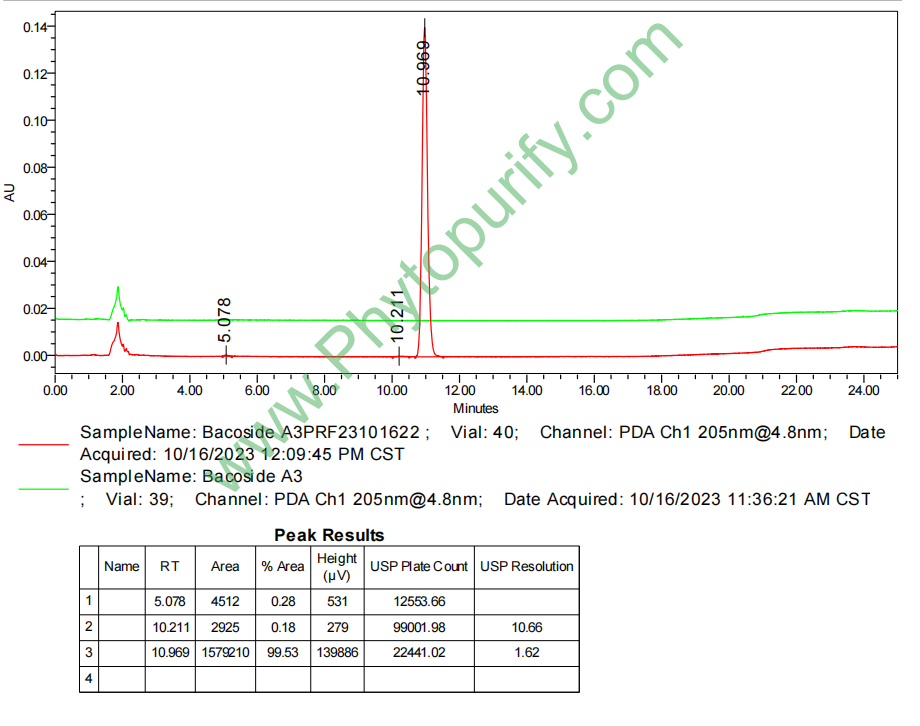
Analysis Method: HPLC-DAD or/and HPLC-ELSD
Identification Method: Mass, NMR
Packing: Brown vial or HDPE plastic bottle
Can be supplied from milligrams to grams.
For Reference Standard and R&D, Not for Human Use Directly.
Inquire for bulk scale.
HPLC of Bacoside A3
Storage conditions:Short-term storage at 2~8℃, long-term storage at -20 ~ -80℃
Bacoside A3 (CAS number: 157408-08-7) is an important natural triterpenoid saponin, mainly isolated from the traditional herbal plant Bacopa monnieri. As a classic medicinal herb in traditional Indian medicine Ayurveda, purslane has attracted much attention due to its significant cognitive function improvement and neuroprotective effects. In recent years, with the increasing incidence of neurodegenerative diseases, especially Alzheimer's disease (AD) incidence rate, the research on pseudopurslane and its active components has gradually deepened, and pseudopurslane saponin A3 has become a research hotspot due to its unique neuroprotective activity.
This review systematically elaborates on the chemical structure and physicochemical properties, plant sources and extraction processes, pharmacological activity and mechanism of action, pharmacological evaluation, and clinical application prospects of saponin A3 from Portulaca oleracea. The aim is to provide theoretical basis and research direction for further drug development and clinical application of this natural product.
Pseudopurslane saponin A3 belongs to the triterpenoid saponin class, with a molecular weight of 869.10 Da. Its chemical structure is centered around a tetracyclic triterpenoid skeleton, connecting multiple sugar residues and exhibiting typical saponin structural characteristics. Its molecular formula is complex, containing a large number of hydroxyl and glycosidic bonds, resulting in strong polarity and a high polar surface area (TPSA of 301.78 Å ²), with up to 18 hydrogen bond acceptors.
In terms of physical and chemical properties, the LogP value of saponin A3 from Portulaca oleracea is -2.00, indicating its strong hydrophilicity and good water solubility, but weak lipid solubility. Its high polarity and molecular weight limit its ability to pass through the blood-brain barrier (BBB), and in vitro and in vivo studies have shown that it is difficult to enter the central nervous system. In addition, the saponin A3 from Portulaca oleracea showed good safety indicators such as hepatotoxicity, cardiotoxicity, and hERG channel inhibition, and the Ames mutagenicity test was negative, indicating its high safety.
Bacopa monnieri, a perennial aquatic herbaceous plant widely distributed in tropical and subtropical regions, is the main source of saponin A3 from Bacopa monnieri. In traditional medicine, Portulaca oleracea is used as a herbal medicine for memory enhancement, anti anxiety, and neuroprotection. It contains various active saponin components, among which Portulaca oleracea saponin A3 is one of its main bioactive components.
The process of extracting saponin A3 from Portulaca oleracea usually includes the following steps:
In recent years, supercritical fluid extraction (SFE) and membrane separation technologies have also been introduced to improve extraction efficiency and purity, reduce the use of organic solvents, and comply with the concept of green chemistry.
The pharmacological activity of purslane saponin A3 is mainly concentrated in the field of neuroprotection, especially in the regulation of pathological mechanisms related to Alzheimer's disease. Its main pharmacological effects include:
Numerous in vitro and animal model studies have shown that saponins A3 from Portulaca oleracea can significantly inhibit neurotoxic reactions induced by β - amyloid (A β). A β is the core protein responsible for the formation of neural plaques in Alzheimer's disease, which can activate neuroinflammatory responses and induce neuronal apoptosis. Pseudopurslane saponin A3 reduces the damage of A β to neurons by downregulating the expression of inflammatory mediators and inhibiting the apoptotic signaling pathway.
Pseudopurslane saponin A3 can regulate various inflammation related signaling pathways, inhibit the release of pro-inflammatory cytokines such as TNF - α, IL-1 β, and IL-6, and alleviate neuroinflammatory responses. In addition, its inhibitory effect on the nuclear factor kappa B (NF - κ B) pathway further reduces the expression of inflammatory mediators and protects neural tissue from inflammatory damage.
Pseudopurslane saponin A3 activates intracellular antioxidant enzyme systems such as superoxide dismutase (SOD), glutathione peroxidase (GPx), etc., clearing excess reactive oxygen species (ROS), reducing oxidative stress damage to nerve cells, and maintaining cellular functional stability.
This compound can regulate the expression of apoptosis related proteins, such as upregulating the anti apoptotic protein Bcl-2, downregulating the pro apoptotic protein Bax and activated caspase-3, blocking programmed cell death of neurons, and promoting neuronal survival.
Although the research on saponin A3 from Portulaca oleracea mainly focuses on the nervous system, its regulatory potential on liver cirrhosis related targets (such as STAT3, MMP2, NFE2L2, SIRT1, etc.) is gradually being studied, suggesting that it may have anti fibrotic and anti-inflammatory effects, providing new ideas for adjuvant therapy of liver cirrhosis.
The mechanism of action of saponin A3 in Portulaca oleracea is complex, involving multiple signaling pathways and molecular targets, mainly including:
Pseudopurslane saponin A3 reduces its toxic effects on neurons by inhibiting the generation and aggregation of A β. In addition, saponins A3 from Portulaca oleracea can block the inflammatory response induced by A β, reduce the expression of pro-inflammatory factors, and alleviate neuroinflammation.
NF - κ B is a key transcription factor that regulates inflammatory responses. Pseudopurslane saponin A3 can inhibit the activation of NF - κ B, reduce the transcription and release of inflammatory factors, thereby exerting anti-inflammatory and neuroprotective effects.
Pseudopurslane saponin A3 activates the NFE2L2 (Nrf2) pathway, promotes the expression of antioxidant enzymes, enhances cellular antioxidant capacity, and reduces oxidative stress damage.
By regulating the activity of Bcl-2 family proteins and caspase enzymes, purslane saponin A3 inhibits neuronal apoptosis and maintains cell survival.
Pseudopurslane saponin A3 has a regulatory effect on liver cirrhosis related signaling molecules such as STAT3, MMP2, SIRT1, etc. It may have the potential to protect the liver through anti-inflammatory, anti fibrotic, and metabolic pathway regulation.
The pharmacological evaluation of saponin A3 from Portulaca oleracea shows that it has certain advantages and challenges:
Pseudopurslane saponin A3 showed no hepatotoxicity, cardiotoxicity, or hERG channel inhibition in multiple in vitro toxicology tests, and the Ames mutagenicity test was negative, indicating its high safety and suitability for further drug development.
Due to its large molecular weight (869.10 Da) and strong polarity, the oral absorption of saponin A3 from Portulaca oleracea is limited and its bioavailability is low. It is not easy to penetrate the blood-brain barrier, which limits its direct action in the central nervous system, but may exert neuroprotective effects through regulating the peripheral nervous system or indirect mechanisms.
At present, there is relatively little systematic pharmacokinetic research on the saponin A3 of Portulaca oleracea. In the future, it is necessary to further explore its metabolic pathways, half-life, and tissue distribution in vivo, in order to provide a basis for dosage form design and optimization of administration plans.
Pseudopurslane saponin A3 may affect drug metabolism enzyme activity by regulating intracellular signaling pathways, and related research is yet to be conducted. In addition, considering its glycoside structure, it may undergo metabolic transformation under the action of gut microbiota, affecting its efficacy and safety.
As a representative active ingredient in Portulaca oleracea, saponin A3 has shown great potential in neuroprotection and cognitive function improvement. Its research in neurodegenerative diseases such as Alzheimer's disease provides an important foundation for the development of new natural medicines.
The future clinical application prospects are mainly reflected in the following aspects:
As an important triterpenoid saponin active ingredient in Portulaca oleracea, saponin A3 has shown broad application prospects in the treatment of Alzheimer's disease and related neurodegenerative diseases due to its significant neuroprotective, anti-inflammatory, and antioxidant effects. Its multi-target and multi mechanism pharmacological properties provide a model for natural product pharmacology research.
Despite its excellent safety and pharmacological activity, the poor pharmacokinetic properties and blood-brain barrier permeability of purslane saponin A3 limit its clinical application. In the future, it is necessary to strengthen systematic research on its in vivo metabolism and pharmacokinetics, combine modern drug delivery technology, optimize dosage form design, and promote its clinical translation.
In summary, as a natural drug candidate compound with potential development value, the saponin A3 from Portulaca oleracea deserves continuous exploration in both basic research and clinical applications, providing new strategies and choices for the treatment of neurodegenerative diseases and liver diseases.
