Introduction/Overview
Bacopaside V is a bioactive triterpenoid saponin isolated from the traditional herb Bacopa monniera. Bacopa monniera, Commonly known as "Brahmi" or "Water Polygonum", it is widely used in traditional Indian medicine - Ayurveda - to enhance cognitive function, improve memory, and combat anxiety. In recent years, with the increase of the incidence rate of neurodegenerative diseases and cognitive impairment year by year, the pharmacological study of purslane and its active ingredients has attracted extensive attention. As one of the important triterpenoid saponins in this plant, the saponin V from Portulaca oleracea has shown significant potential for neuroprotection and cognitive function improvement, making it a research hotspot in the field of natural product pharmacology.
This article aims to systematically review the chemical structure and physicochemical properties, plant sources and extraction methods, pharmacological activity and mechanism of action, pharmacological evaluation and pharmacokinetic characteristics of saponins V from Portulaca oleracea, and provide scientific basis and theoretical support for the development and utilization of this natural product, combined with current clinical application prospects and future research directions.
Chemical structure and physicochemical properties
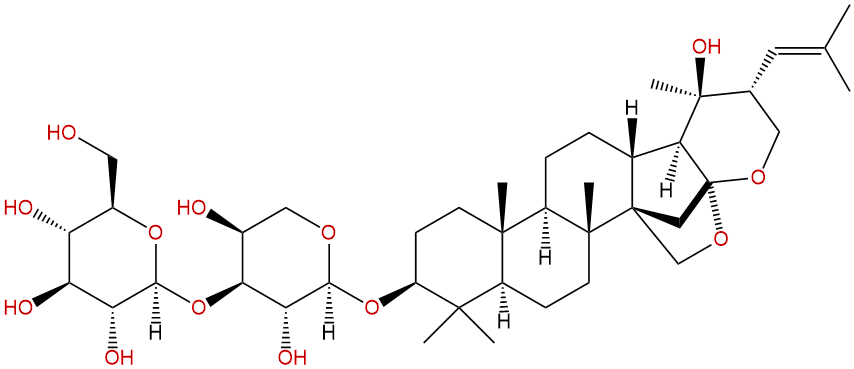
Pseudopurslane saponin V belongs to the triterpenoid saponin class, with a molecular formula of C42H66O14 and a molecular weight of 766.9660. The compound has a complex structure, consisting of a triterpenoid skeleton and multiple sugar residues, connected by glycosidic bonds to form a polysaccharide structure. Its LogP value is 2.7382, indicating that the compound has moderate lipid solubility, which is beneficial for cell membrane penetration but not prone to excessive hydrophobicity; The polar surface area (TPSA) is 196.9900, indicating its high polarity, which may affect its bioavailability and blood-brain barrier penetration ability.
The low water solubility (0.0191 mg/mL) suggests that the solubility of Pseudopurslane Saponin V in water is limited, which may pose certain challenges to its formulation development. The blood-brain barrier penetration ability has been assessed as low, indicating limited ability to directly enter the central nervous system, but there is a possibility that it exerts neuroprotective effects in the peripheral nervous system or through indirect mechanisms. The hERG channel inhibition experiment result was negative, indicating that the compound has no significant inhibitory effect on cardiac potassium channels and has high safety. The Ames test result is 0.0, indicating no mutagenicity, further supporting its safety.
Plant sources and extraction methods
Bacopa monniera, a perennial creeping herb widely distributed in the Indian subcontinent and Southeast Asia, is the main source of saponin V from Bacopa monniera. Pseudopurslane is a traditional medicinal herb used in Ayurvedic medicine to enhance memory and cognitive function. Modern pharmacological studies have confirmed that it contains various active triterpenoid saponins, among which pseudopurslane saponin V is one of the important components.
The common methods for extracting saponins V from Portulaca oleracea include:
-
Solvent extraction method Using methanol, ethanol, or a mixture of water and alcohol solvents for reflux extraction of dried whole or leaves of Portulaca oleracea, the extract is concentrated, separated, and purified to obtain a mixture of saponins.
-
Column chromatography separation Using silica gel or reverse phase C18 column chromatography technology, extract and purify saponins V from Portulaca oleracea by gradient elution. High performance liquid chromatography (HPLC) and mass spectrometry (MS) techniques are commonly used for component identification and purity detection.
-
Ultrasound assisted extraction In recent years, ultrasound assisted extraction technology has been applied to improve extraction efficiency and reduce solvent usage, significantly increasing the yield of saponins V from Portulaca oleracea.
-
membrane separation technology Nanofiltration or ultrafiltration technology combined with traditional extraction methods can help remove impurities and concentrate target components.
The optimization of extraction process is crucial for obtaining high-purity and highly active saponins V from Portulaca oleracea, and provides a foundation for subsequent pharmacological research and formulation development.
Pharmacological activity research
The pharmacological activity of saponins V from Portulaca oleracea mainly focuses on the nervous system, especially in memory enhancement and neuroprotection. A large number of in vitro and in vivo studies have shown that the saponin V from Portulaca oleracea exerts its neural regulatory function through multiple targets and pathways.
Memory enhancing effect
Pseudopurslane saponin V can significantly improve cognitive function and learning and memory abilities. In animal experiments, model mice treated with fake purslane saponin V showed significant memory improvement effects in behavioral tests such as water maze, passive avoidance, and new object recognition. Its mechanism of action involves multiple aspects such as enhanced neuronal plasticity, neuroprotection, and antioxidant stress.
Neuroprotective effect
Pseudopurslane saponin V has antioxidant and anti-inflammatory activities, which can alleviate oxidative damage and inflammatory response of nerve cells, and protect neurons from pathological factors. In vitro experiments have shown that the compound can reduce levels of reactive oxygen species (ROS), inhibit the release of pro-inflammatory cytokines, and promote neuronal survival.
Anti anxiety and antidepressant effects
Partial studies have shown that saponins V from Portulaca oleracea have certain anti anxiety and anti depressive activities, which may be achieved by regulating the neurotransmitter system and activating neuroprotective pathways. This provides a theoretical basis for its potential application in neurological and psychiatric disorders.
Other pharmacological effects
In recent years, research on the metabolic regulation, anti-tumor, and immune regulation of saponins V from Portulaca oleracea has gradually been carried out, showing multifunctional pharmacological potential, but the relevant mechanisms still need to be further explored.
Mechanism of action and molecular targets
The neuroprotective and memory enhancing effects of purslane saponin V are closely related to its regulation of multiple key molecular targets, including:
SIRT1 (silencing information regulatory factor 2 related enzyme 1)
SIRT1 is an NAD ^+- dependent deacetylase involved in regulating cellular metabolism, stress response, and neuroplasticity. Pseudopurslane saponin V can activate SIRT1, promote neuronal survival and maintain synaptic function, and delay the progression of neurodegenerative diseases.
CREB1 (cyclic adenosine monophosphate response element binding protein 1)
CREB1 is an important transcription factor in neurons that regulates neural plasticity and memory formation. Pseudopurslane saponin V activates the CREB1 signaling pathway, enhances downstream nerve growth factor expression, promotes neuronal functional recovery and synaptic remodeling.
BDNF (brain-derived neurotrophic factor)
BDNF is a key factor in maintaining neuronal health and promoting neural plasticity. Pseudopurslane saponin V can upregulate BDNF expression, enhance neuronal survival and synaptic transmission efficiency, and improve cognitive function.
NGF (nerve growth factor)
NGF is crucial for the growth, differentiation, and survival of neurons. Pseudopurslane saponin V promotes the synthesis and release of NGF, supporting the repair and regeneration of the nervous system.
PGC1A (Peroxisome proliferator activated receptor gamma co activator 1 alpha)
PGC1A is a key co activator that regulates mitochondrial function and energy metabolism. Pseudopurslane saponin V improves the energy metabolism status of neurons, enhances antioxidant capacity, and reduces nerve damage by regulating PGC1A expression.
In summary, the saponin V from Portulaca oleracea can regulate the metabolism, survival, and function of neurons through multi-target synergistic effects, exerting significant neuroprotective and cognitive improvement effects.
Evaluation of drug properties and pharmacokinetics
The pharmacological evaluation of saponin V from Portulaca oleracea shows that it has certain development potential, but there are also challenges.
Physical and chemical properties and pharmacokinetics
- High molecular weight(766.9660) may limit its oral absorption and cell membrane penetration.
- LogP moderate(2.7382) is beneficial for lipid soluble absorption, but high polarity (TPSA 196.99) may affect bioavailability.
- Low water solubility(0.0191 mg/mL), Requirements for formulation design require the use of solubilization or nanocarrier technology to enhance solubility.
- Low blood-brain barrier penetration ability It is restricted from directly acting on the central nervous system, but may exert its effects through peripheral nervous system regulation or metabolic products.
safety assessment
- HERG inhibition test negative The risk of cardiac toxicity is low.
- Ames mutagenicity test negative Indicating no genetic toxicity risk.
- At present, there is a lack of systematic long-term toxicological data, and further research is needed to ensure clinical safety.
Pharmacokinetic study
The pharmacokinetic data of saponins V from Portulaca oleracea in existing literature are relatively limited. Preliminary studies have shown that the compound is slowly absorbed after oral administration, has a long plasma half-life, and its metabolic pathway mainly involves the liver enzyme system, possibly through glycoside hydrolysis and oxidation reactions. In the future, it is necessary to systematically study its absorption, distribution, metabolism, and excretion (ADME) characteristics to provide a basis for clinical applications.
Clinical application prospects and prospects
As an important active ingredient in Bacopa monniera, the saponin V from Bacopa monniera has broad clinical application prospects due to its significant memory enhancement and neuroprotective effects.
Cognitive impairment and neurodegenerative diseases
Patients with neurodegenerative diseases such as Alzheimer's disease (AD) and Parkinson's disease (PD) commonly suffer from cognitive impairment. Pseudopurslane saponin V improves neuronal function and synaptic plasticity by regulating key targets such as SIRT1, CREB1, BDNF, and has the potential to become a novel natural drug for treating cognitive impairment.
Mental and psychological disorders
Its anti anxiety and anti depression potential provides the possibility for adjuvant treatment of mental illnesses such as anxiety disorders and depression. Combining modern pharmacology and psychiatry research, the saponin V from Portulaca oleracea may be developed as a safe and effective neuromodulator.
Formulation development and administration route
Given its low water solubility and limited blood-brain barrier penetration ability, future formulation development should focus on improving bioavailability and targeted delivery, such as nanocarriers, liposomes, solid dispersions, and other technologies. Meanwhile, studying the activity and mechanism of action of its metabolites, and exploring the possibility of indirectly regulating the central nervous system.
Clinical Research and Translational Medicine
At present, there is a lack of systematic clinical trial data on the saponin V of Portulaca oleracea. In the future, multi center, randomized, double-blind clinical trials should be conducted to verify their safety and effectiveness, and promote their transition from laboratory research to clinical application.
Conclusion
As an important triterpenoid saponin active ingredient in Bacopa monniera, the saponin V from Bacopa monniera exhibits significant memory enhancing and neuroprotective effects. It has a good pharmacological basis and safety potential by regulating neuronal metabolism, plasticity, and survival through multiple targets. Despite challenges such as low water solubility and limited ability to penetrate the blood-brain barrier, with the advancement of extraction and purification technologies and formulation processes, the saponin V from Portulaca oleracea is expected to become a new natural medicine star in the treatment of neurocognitive disorders.
Future research should focus on in-depth analysis of its pharmacokinetic characteristics, mechanism of action, and clinical efficacy verification, promoting its application and transformation in cognitive disorders, neurodegenerative diseases, and mental and psychological disorders, and contributing new theoretical and practical results to the field of natural product pharmacology.