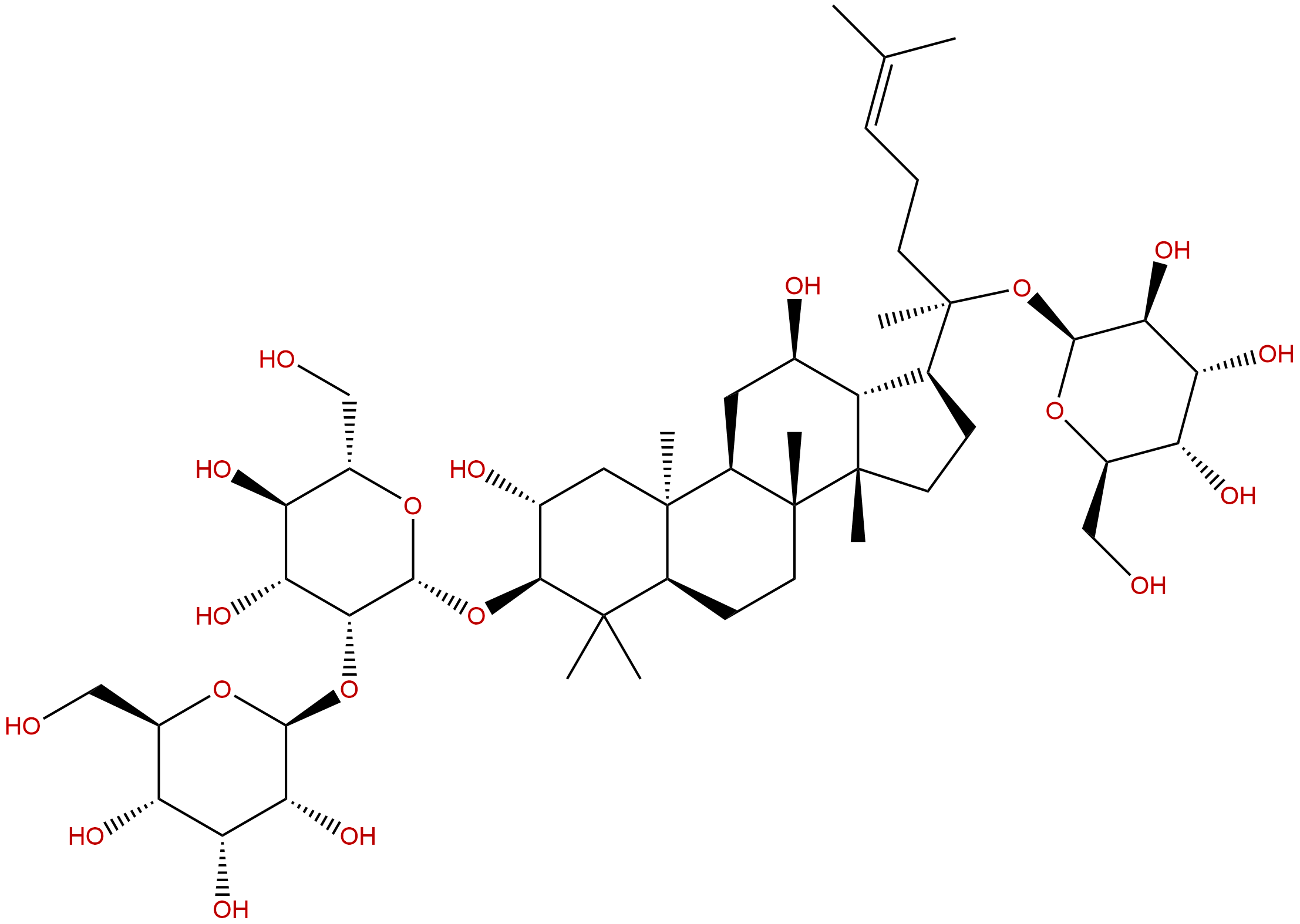


Product name: Gypenoside XLVI
Synonym name:
Catalogue No.: BP1791
Cas No.: 94705-70-1
Formula: C48H82O19
Mol Weight: 963.165
Botanical Source: Gynostemma pentaphyllum
Physical Description:
Type of Compound: Triterpenoids
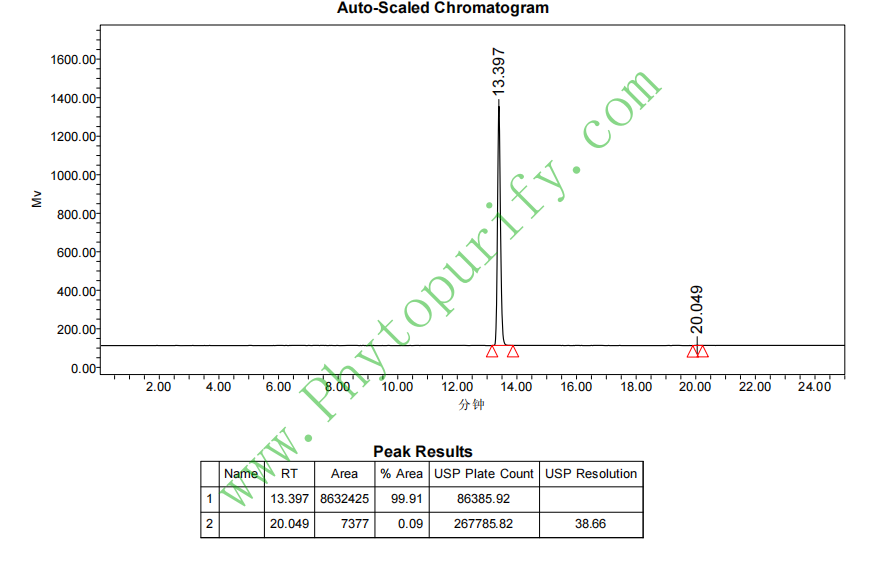
Purity: 95%~99%
Analysis Method: HPLC-DAD or/and HPLC-ELSD
Identification Method: Mass, NMR
Packing: Brown vial or HDPE plastic bottle
The product could be supplied from milligrams to grams. Inquire for bulk scale.
We provide solution to improve the water-solubility of compounds, thereby facilitating the variety of activity tests and clinic uses.
For Reference Standard and R&D, Not for Human Use Directly.
Description:
Gypenoside XLVI shows strong cytotoxic activity against A549 cells, with the IC50 values of 52.63±8.31 ug/ml.
References:
Faseb J., 2014, 28(1).
Cytotoxic activity of gypenosides and gynogenin from Gynostemma pentaphyllum against A549 cells
Gynostemma pentaphyllum (Thunb.) Makino is one of the well-known traditional Chinese herbal medicines, which has been demonstrated to be effective against chronic diseases, such as lung cancer. In the present study, seven dammarane-type compounds were isolated from the raw, heat processed and alkaline hydrolyzed G. Pentaphyllum and compared for their cytotoxic activities against non-small cell lung carcinoma A549 cells using MTT cytotoxicity assay.
METHODS AND RESULTS:
By means of chemical and spectroscopic methods, their structures were established as gypenoside LVI, Gypenoside XLVI, gypenoside L, gypenoside LI, damulin A, damulin B and 20S-dammar-24-en-2α, 3β, 12β, 20-tetrol. Gypenoside LVI, Gypenoside XLVI, gypenoside L, gypenoside LI, damulin A, damulin B and 20S-dammar-24-en-2α,3β,12β,20-tetrol all showed strong cytotoxic activity against A549 cells, with the IC50 values of 105.89±2.48, 52.63±8.31, 34.94±4.23, 50.96±9.55, 26.98±0.51, 4.56±0.58, 12.54±0.53 μg/ml respectively, whereas the IC50 value of 20S-Rg3 (positive control) was 55.36±3.20 μg/ml. Comparing their structures with cytotoxic activity, these compounds might possess some kind of structure-activity relationship.
CONCLUSIONS:
Based on the structure and cytotoxic activity relationships of these seven constituents, the OH group in C-2, the double bond in C20(21) and C20(22) positions, the connected sugar number and the configuration in C-20 were important for cytotoxic activity against A549 cells.
HPLC of Gypenoside XLVI
Storage conditions:Short-term storage at 2~8℃, long-term storage at -20 ~ -80℃
318.3700
2.1056
2.1057
.1591
.4864
.1700
Low
67.4290
6.5023
No
No
No
No
No
No
0.0
Yes
No
No
No
Natural products, as an important source of drug discovery, play an irreplaceable role in the history of human disease prevention and treatment. Among them, triterpenoid saponins have always been a hot topic in medicinal chemistry and pharmacology research due to their structural diversity and wide range of biological activities. Gynostemma pentaphyllum(Gynostemma pentaphyllum)Commonly known as "Southern Ginseng", it is a traditional medicinal plant widely used in Asia for clearing heat, tonifying deficiency, anti-aging, and other purposes. The material basis of its pharmacological activity is mainly attributed to a series of structurally unique dammarane type triterpenoid saponins, namely Gynostemma pentaphyllum saponins. Among numerous saponins of Gynostemma pentaphyllum, Gypenoside XLVI (CAS: 94705-70-1) is a major component that has attracted much attention in recent years due to its significant anti-tumor activity, especially its inhibitory ability in non-small cell lung cancer (NSCLC) A549 cells. More noteworthy is that preliminary bioinformatics and target prediction analysis have revealed potential interactions between the compound and multiple key targets associated with cognitive dysfunction, suggesting that it may have untapped therapeutic potential in the field of neurological and psychiatric disorders. However, there is currently a lack of systematic review on the saponins XLVI from Gynostemma pentaphyllum. This article aims to comprehensively review the chemical characteristics, plant sources, pharmacological activities of Gynostemma pentaphyllum saponins XLVI, and explore its mechanism of action and molecular targets in anti-tumor and cognitive function improvement. At the same time, it evaluates its pharmacological properties, in order to provide a systematic scientific reference for the in-depth research and future development of this compound.
Gynostemma pentaphyllum saponin XLVI is a dammarane type tetracyclic triterpenoid saponin, with a molecular formula of C ₄₈ H ₈₂ O ₉ and a molecular weight of 963.1650. Its core structure is a Damaran skeleton, which is composed of four rings (three hexagonal rings and one pentagonal ring) fused together, and has a high degree of rigidity. Gynostemma pentaphyllum saponins XLVI are linked to multiple hydroxyl groups on this skeleton, and complex oligosaccharide chains are connected through glycosidic bonds at positions C-3 and/or C-20. These sugar chains typically contain glucose, xylose, xylose, etc., which are important determinants of their water solubility and biological activity. This structural feature makes it a highly polar saponin compound.
Based on its calculated physical and chemical parameters, a preliminary evaluation of its properties can be conducted: the logarithmic value of its lipid water partition coefficient (LogP) is 2.1056, indicating that the compound has a certain degree of lipophilicity, but not high lipid solubility. The topologically polar surface area (TPSA) is as high as 318.3700 Å ², mainly attributed to the abundant hydroxyl groups and oxygen atoms on the sugar chain in the molecule, indicating its high molecular polarity and strong hydrogen bond donor and acceptor abilities. The theoretically calculated water solubility value is 0.1591, belonging to the category of slight solubility, which is consistent with the solubility characteristics of most saponin compounds in pure water. In practical applications, it may be necessary to improve their solubility through formulation methods such as salt formation, use of solubilizers or nano formulations. These basic physicochemical properties are important foundations for its subsequent biological activity, in vivo metabolism, and formulation development.
Gynostemma pentaphyllum saponins XLVI are mainly derived from the gourd family plant Gynostemma pentaphyllum(Gynostemma pentaphyllum The whole grass of (Thunb.) Makino. Gynostemma pentaphyllum is widely distributed in East and Southeast Asian regions such as China, Japan, and South Korea. The content of its saponin components is significantly affected by the place of origin, harvest season, plant part (usually with higher content in leaves), and cultivation conditions.
Efficient and high-purity extraction of Gynostemma pentaphyllum saponins XLVI from plant materials is a prerequisite for research. The traditional extraction method mainly relies on solvent extraction. Commonly used polar solvents include methanol, ethanol, or ethanol water systems with different ratios. Saponins can be extracted from plant cells by heating reflux or ultrasound assisted extraction. The crude extract subsequently needs to undergo a series of separation and purification steps. Macroporous adsorption resins (such as D101 and AB-8) are commonly used for enrichment. By utilizing the adsorption desorption characteristics of saponins and resins, water and different concentrations of ethanol are used for gradient elution to preliminarily remove impurities such as polysaccharides and proteins. Further purification relies on modern chromatographic techniques, including normal or reverse phase silica gel column chromatography, high performance liquid chromatography (HPLC), and preparative liquid chromatography (Prep HPLC). Among them, the reverse phase C18 chromatographic column is widely used due to its excellent separation effect from saponins in Gynostemma pentaphyllum. By optimizing the ratio and elution procedure of the mobile phase (usually acetonitrile water or methanol water system), the separation of Gynostemma pentaphyllum saponins XLVI from other structurally similar saponins can be achieved, ultimately obtaining high-purity monomeric compounds for activity research. In recent years, some new technologies such as high-speed countercurrent chromatography (HSCCC) have also been attempted for the separation of saponins from Gynostemma pentaphyllum due to their advantages of not requiring solid phase carriers and high sample recovery rates.
The pharmacological activity research of Gynostemma pentaphyllum saponins XLVI is currently in its early stages, but it has shown multiple potential, mainly focusing on anti-tumor and neuroprotective fields.
1. Antitumor activity
The anti-tumor activity is the earliest reported and relatively clear pharmacological effect of Gynostemma pentaphyllum saponins XLVI. Research has confirmed that the compound has significant proliferative inhibitory activity on non-small cell lung cancer (NSCLC) A549 cell line. In vitro experiments have shown that saponins XLVI from Gynostemma pentaphyllum can inhibit the growth of A549 cells in a dose-dependent and time-dependent manner, and induce cell apoptosis. Its strength of action is comparable to some positive control drugs, indicating its value as a lead compound for anti lung cancer. In addition to lung cancer, preliminary studies suggest that it may also have inhibitory effects on other tumor cell lines, such as liver cancer and colon cancer cells, but specific data and mechanisms need to be further elucidated.
2. Potential for neuroprotection and improvement of cognitive function
Although direct experimental evidence is not yet sufficient, predictive analysis based on network pharmacology and molecular docking has shown strong binding potential for key targets associated with cognitive dysfunction in Gynostemma pentaphyllum saponins XLVI, providing theoretical hypotheses for its application in diseases such as Alzheimer's disease and vascular dementia. Cognitive dysfunction involves complex pathological processes, including beta amyloid (A β) deposition, tau protein hyperphosphorylation, oxidative stress, neuroinflammation, cholinergic system dysfunction, and impaired synaptic plasticity. The predicted targets of Gynostemma pentaphyllum saponins XLVI almost cover multiple aspects mentioned above, such as reducing A β production by inhibiting BACE1; Activate the NFE2L2 (Nrf2) pathway to enhance antioxidant defense; Regulating the functions of cholinergic receptors (CHRNA7), monoamine oxidase (MAOB), acetylcholinesterase (ACHE), and various neurotransmitter receptors (such as DRD1, HTR1A, HTR2A); Affects the activity of glycogen synthase kinase-3 β (GSK3B) and nitric oxide synthase (NOS1). These multi-target characteristics suggest that Gynostemma pentaphyllum saponins XLVI may have the potential to comprehensively regulate cognitive functional networks, and are worthy of empirical research through in vitro neuronal models and in vivo animal models.
3. Other potential activities
As a member of the total saponins of Gynostemma pentaphyllum, Gynostemma pentaphyllum saponins XLVI may also inherit some of the known activities of the total extract, such as anti-inflammatory, antioxidant, and lipid metabolism regulation. However, whether these activities are directly mediated by it and how much it contributes requires specialized monomer compound studies to confirm.
The molecular mechanism of the pharmacological effects of Gynostemma pentaphyllum saponins XLVI is gradually being revealed, and its action has the characteristics of multi-target and multi pathway.
In terms of anti-tumor treatment Research on A549 cells suggests that its mechanism may involve: ① Inducing cell apoptosis By upregulating pro apoptotic proteins (such as Bax) and downregulating anti apoptotic proteins (such as Bcl-2), mitochondrial membrane potential decreases, cytochrome C is released, and the caspase cascade reaction is activated. ② Block cell cycle It may block cells in the G0/G1 or G2/M phase, inhibiting cell proliferation. ③ Inhibit migration and invasion It is possible to inhibit the metastatic ability of tumor cells by downregulating the expression of matrix metalloproteinases (MMPs). ④ Regulating related signaling pathways May interfere with signaling pathways closely related to tumor growth and survival, such as PI3K/Akt, MAPK (such as ERK, JNK, p38), or Wnt/β - catenin.
In terms of improving cognitive function The predicted mechanism network is more complex:
- Targeting A β pathology As a β - secretase, BACE1 is a key rate limiting enzyme for the production of A β. Molecular docking showed that saponins XLVI from Gynostemma pentaphyllum may bind to the active pocket of BACE1, competitively inhibiting its enzyme activity, reducing the production of A β, and alleviating the burden of amyloid plaques from the source.
- Enhance antioxidant stress The transcription factor NFE2L2 (Nrf2) is a central regulator of cellular antioxidant response. Gynostemma pentaphyllum saponins XLVI may promote Nrf2 nuclear translocation by dissociating Nrf2 from Keap1, thereby upregulating the expression of phase II detoxifying enzymes and antioxidant proteins such as heme oxygenase-1 (HO-1) and quinone oxidoreductase 1 (NQO1), protecting neurons from oxidative damage.
- Regulating the neurotransmitter system By acting on the α 7-nicotinic acetylcholine receptor (CHRNA7), it may enhance cholinergic signaling and improve learning and memory. The potential regulatory effects on dopamine D1 receptor (DRD1) and serotonin 1A/2A receptor (HTR1A/HTR2A) may affect emotional, reward, and cognitive processes. Inhibition of monoamine oxidase B (MAOB) and acetylcholinesterase (ACHE) can increase the levels of monoamine neurotransmitters and acetylcholine, respectively.
- Regulating tau protein and synaptic function Inhibiting the activity of GSK3 β may reduce the excessive phosphorylation of tau protein and maintain the stability of neuronal cytoskeleton. Meanwhile, the regulation of NOS1 may affect the synthesis of nitric oxide (NO), which in turn participates in the regulation of synaptic plasticity and neurovascular coupling.
These targets do not exist in isolation, they form an interconnected network. Gynostemma pentaphyllum saponins XLVI may produce synergistic effects by simultaneously acting on multiple nodes in the network, thereby achieving the overall effect of improving cognitive function. Of course, most of the above mechanisms are based on predictions and preliminary evidence, and require strict validation through modern biological techniques such as gene knockout/knockdown, reporter gene experiments, proteomics, etc.
To develop Gynostemma pentaphyllum saponins XLVI as a drug, its pharmacological properties must be systematically evaluated. Based on calculations and preliminary experimental data, its pharmacological characteristics are as follows:
1. Prediction of drug properties and absorption, distribution, metabolism, and excretion (ADME)
- Absorption and permeability Higher TPSA (>140 Å ²) and molecular weight (>500) are usually unfavorable for passive transmembrane diffusion, and it is predicted that their oral bioavailability may be low. The predicted result of "low blood-brain barrier (BBB) penetration" poses a significant challenge for the treatment of central nervous system diseases such as cognitive impairment. In the future, it may be necessary to use prodrug strategies, nanocarrier delivery systems (such as liposomes, polymer nanoparticles), or a combination of BBB opening agents to improve their brain entry efficiency.
- Distribution and Metabolism As a saponin compound, it may be hydrolyzed by glycosidases in the gut microbiota or tissues in the body, removing some glycosides and converting them into secondary glycosides or aglycones. The activity, distribution, and toxicity of these metabolites may differ from the prototype drug and require further research. The degree of binding between it and plasma proteins is not yet clear.
- excretion Expected to be primarily excreted through the kidneys and/or bile.
2. Preliminary safety assessment
- cardiotoxicity HERG potassium channel inhibition is the main mechanism leading to drug-induced long QT syndrome and sudden cardiac death. The prediction shows that there is no risk of hERG inhibition from Gynostemma pentaphyllum saponins XLVI, which is a favorable safety signal but requires experimental verification.
- Genotoxicity The Ames test predicted a result of 0.0 (negative), indicating that it may not have direct mutagenicity and reduces the risk of early carcinogenesis.
- Other toxicities There is still a lack of systematic preclinical safety evaluation data for acute toxicity, chronic toxicity, reproductive toxicity, etc. Saponin compounds generally have hemolytic potential and need to be evaluated by hemolysis tests.
3. Current status of pharmacokinetic research
At present, there are very few reports on the systematic pharmacokinetic studies of Gynostemma pentaphyllum saponins XLVI. Little is known about its key parameters such as blood drug concentration time curve, half-life (t1/2), peak time (Tmax), peak concentration (Cmax), and area under the drug time curve (AUC) in animal bodies. Establishing sensitive and specific biological analysis methods (such as LC-MS/MS) to detect the saponins XLVI and its metabolites in biological matrices is a prerequisite for conducting pharmacokinetic studies and understanding their in vivo fate.
In summary, Gynostemma pentaphyllum saponins XLVI have shown promising prospects in terms of activity, but there are significant shortcomings in their pharmacological properties, especially in terms of oral absorption and blood-brain barrier penetration, which will be a technical challenge that needs to be addressed in their subsequent development.
Gynostemma pentaphyllum saponins XLVI, as a natural product with multi-target activity, have broad clinical application prospects but are also full of challenges.
1. Potential application directions
- Antitumor adjuvant therapy As a potential treatment or adjuvant therapy drug for non-small cell lung cancer. Given its multi-target nature, it may be used in combination with existing chemotherapy drugs or targeted drugs to enhance efficacy, reduce drug resistance, or alleviate side effects. It can also explore its value in lung cancer prevention or postoperative recurrence prevention.
- Treatment of neurodegenerative diseases Mainly targeting cognitive impairment caused by Alzheimer's disease, vascular dementia, etc. The characteristics of its multi-channel intervention are in line with the current treatment strategy for complex neurodegenerative diseases (i.e. "cocktail therapy"). If the BBB penetration problem can be solved, it may become a new type of disease modifier.
- Other fields Based on the traditional use of Gynostemma pentaphyllum and the activity of total saponins, it may also have potential for development in metabolic syndrome (such as lowering blood lipids and blood sugar), anti fatigue, anti anxiety, etc., but specialized studies of individual compounds are needed to confirm this.
2. Challenges faced
- Bioaccumulation and BBB penetration As mentioned earlier, this is the core bottleneck that restricts its development. Innovative formulation technology is a key breakthrough.
- Fuzzy mechanism of action Currently, many mechanisms, especially those related to neuroprotection, are still in the prediction and hypothesis stage. A large amount of solid basic research is needed to elucidate its exact targets and signaling pathways.
- Lack of pharmacokinetic and safety data Complete preclinical ADME and toxicology studies are essential for drug development, and currently there is almost no work in this area.
- Common challenges in natural product development This includes the stability of plant sources (fluctuation in content), the economic feasibility of chemical total synthesis (complex structure, difficult synthesis), and possible intellectual property issues.
3. Future research directions and prospects
Future research should focus on: ① In depth mechanism research Using CRISPR-Cas9, proteomics, metabolomics, and other technologies, we have demonstrated the specific molecular mechanisms of its anti-tumor and neuroprotective effects in cell and animal models. ② Structural optimization and modification By using medicinal chemical methods to modify the sugar chain or aglycone structure, while retaining its activity, it improves its lipid solubility, metabolic stability, and BBB penetration, obtaining derivatives with better drug properties. ③ Advanced delivery system development Actively developing biocompatible nano targeted delivery systems to achieve specific and efficient delivery to tumor tissues or the brain. ④ Conduct a systematic preclinical evaluation Establish pharmacokinetic analysis methods as soon as possible, complete comprehensive toxicological evaluations, and lay the foundation for possible clinical trial applications. ⑤ Explore combination therapy strategies Study its synergistic effect with existing standard therapeutic drugs and search for the best combination therapy.
Gynostemma pentaphyllum saponins XLVI is a brilliant gem contained in the traditional medicinal plant Gynostemma pentaphyllum. Its unique structure of Damatane type triterpenoid saponins endows it with significant ability to inhibit the proliferation of non-small cell lung cancer A549 cells, and indicates its enormous potential in intervening in complex networks of cognitive dysfunction. This article systematically reviews the research status of this compound, from its chemical structure to pharmacological activity, from its multi-target mechanism of action to preliminary pharmacological analysis. Although current research is still in its early stages, the challenges it faces in absorption, distribution, and especially blood-brain barrier penetration cannot be ignored. However, these challenges are precisely the focus that modern drug development technology can focus on addressing. With the in-depth analysis of the mechanism of action of Gynostemma pentaphyllum saponins XLVI, rational drug design based on structure, and the application of new drug delivery technologies, it is expected to overcome its existing pharmaceutical bottlenecks. In summary, Gynostemma pentaphyllum saponins XLVI is not only a valuable tool molecule for exploring the pathological processes of tumors and neurodegenerative diseases, but also a highly promising lead compound that is expected to provide new treatment strategies and drug choices for major diseases such as lung cancer and cognitive impairment in the future. The continuous and in-depth research on it will fully reflect the enormous value of exploring modern innovative drugs from traditional medicinal plants.
