Introduction/Overview
Natural products, as an important source of drug discovery, play an irreplaceable role in the history of human disease prevention and treatment. Among them, dammarane type saponins have become a hot topic in modern pharmacological research due to their extensive and significant biological activities. Damulin B (CAS number: 1202868-75-4), as a type of triterpenoid saponin isolated from the traditional medicinal plant Gynostemma pentaphyllum (Thunb.) Makino, has attracted much attention in recent years due to its pharmacological activities in anti-tumor, anti-inflammatory, metabolic regulation, and organ protection. Gynostemma pentaphyllum is known as the "southern ginseng" and is used in traditional Asian medicine to treat various diseases. The discovery of Damulin B provides modern scientific evidence for some of its pharmacological effects. Research has shown that Damulin B not only inhibits tumor cell proliferation and induces apoptosis through multiple targets and pathways, but also demonstrates potential in preventing cisplatin induced acute kidney injury, promoting hair growth, and improving metabolic disorders. This article aims to systematically review the chemical structure, plant origin, pharmacological activity, mechanism of action, medicinal properties, and clinical application prospects of Damulin B, in order to provide comprehensive scientific references for the in-depth research and development of this compound.
Chemical structure and physicochemical properties
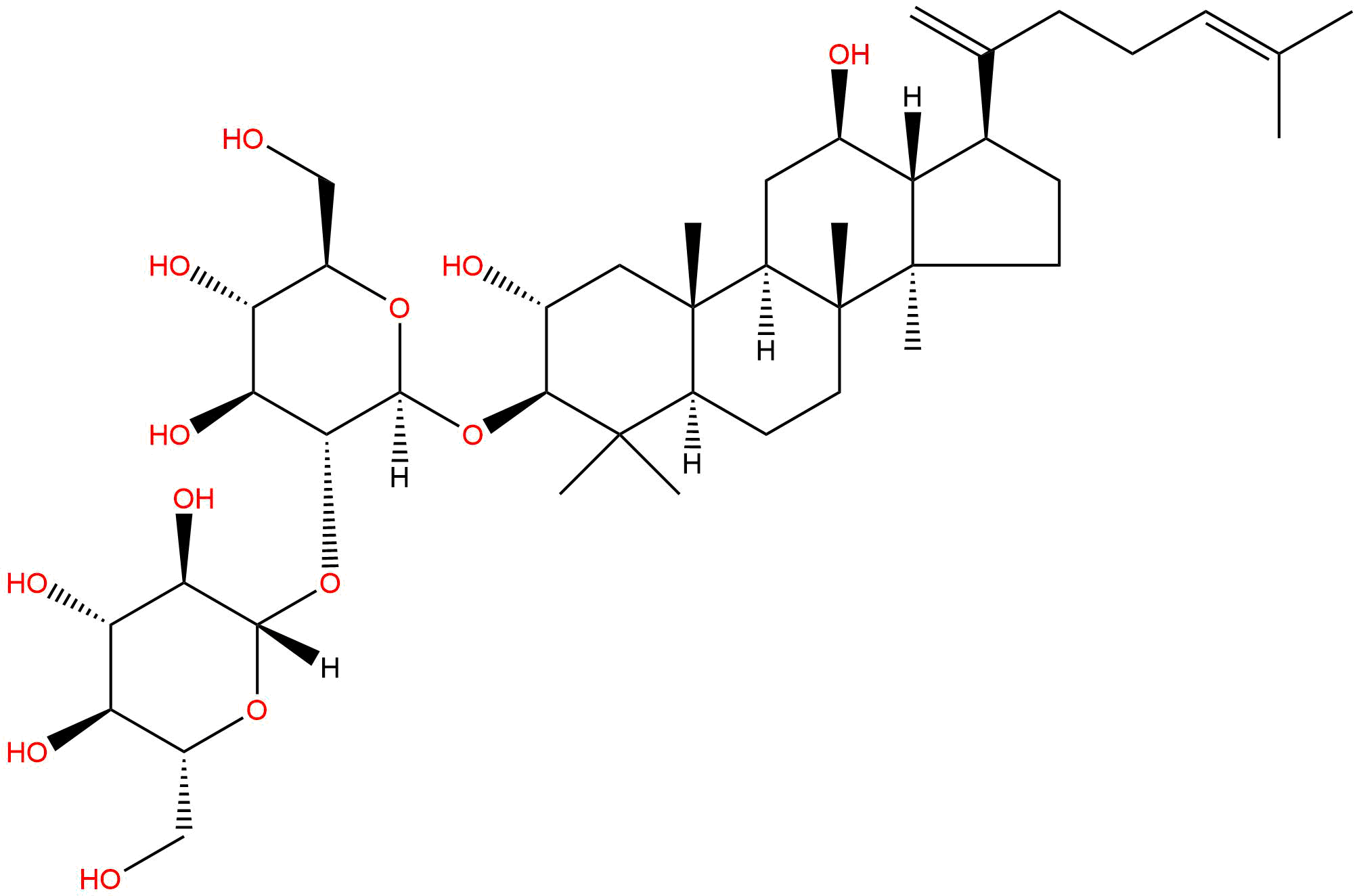
The molecular formula of Damulin B is C ₄₂ H ₇₀ O ₁₄, with a molecular weight of 783.0090. The core skeleton of this compound is the classic Damatane type tetracyclic triterpenoid, which serves as the structural basis for its biological activity. This structure typically has sugar chains connected at positions C-3 and/or C-20, forming saponins. The specific glycosylation mode of Damulin B (such as the type, quantity, and connection position of sugars) is a key characteristic that distinguishes it from other saponins of Gynostemma pentaphyllum (such as Gynostemma pentaphyllum saponins), and directly affects its physicochemical properties and biological activity.
From the analysis of parameters related to drug properties, the lipid water partition coefficient (LogP) of Damulin B is 2.8675, indicating that it has a certain degree of lipophilicity, but not highly hydrophobic. Its topological polar surface area (TPSA) is as high as 218.99 Å ², mainly attributed to the abundant hydroxyl and oxygen atoms on the sugar groups in the molecule, which are important sites for forming hydrogen bonds. Higher TPSA is usually associated with poorer cell membrane permeability. Its water solubility parameter is 0.0421, belonging to the category of slightly soluble or poorly soluble in water, which is a common feature of many saponin compounds and one of the challenges that need to be overcome in their formulation development. In the preliminary drug screening, Damulin B showed low blood-brain barrier permeability, suggesting that it may not be suitable for direct treatment of central nervous system related diseases. Encouragingly, both hERG inhibition and Ames mutagenicity tests showed negative results (hERG inhibition: No; Ames test: 0.0), which preliminarily ruled out its potential serious cardiac toxicity and genetic toxicity risks, provides important safety basis for its further development.
Plant sources and extraction methods
Damulin B mainly comes from the gourd family plant Gynostemma pentaphyllum. Gynostemma pentaphyllum is widely distributed in East Asia and Southeast Asia, and is used as a herb in China, Japan, South Korea, and other places. Its active ingredients are complex, mainly including dammarane type saponins (collectively known as Gynostemma pentaphyllum saponins), flavonoids, polysaccharides, etc. Damulin B is one of the saponin components with a specific structure.
The extraction and separation of Damulin B from Gynostemma pentaphyllum usually follow the conventional process of natural product chemistry. Firstly, solvent extraction method is adopted, commonly using methanol, ethanol or their aqueous solutions to extract or reflux the dried whole or leaves of Gynostemma pentaphyllum, in order to transfer polar components such as saponins into the solvent. Subsequently, crude extract was obtained by vacuum concentration. The crude extract needs to be further separated and purified, usually using macroporous adsorption resin column chromatography for initial enrichment, gradient elution with water and different concentrations of ethanol, and saponin components are usually concentrated in the medium polarity elution site. After obtaining the saponin enrichment site, various modern chromatographic techniques need to be used for fine separation, including normal phase silica gel column chromatography, reverse phase silica gel column chromatography (such as C18 packing), as well as high performance liquid chromatography (HPLC) or preparative liquid chromatography (pre HPLC). The final identification and structural confirmation of Damulin B rely on spectroscopic techniques such as nuclear magnetic resonance (NMR, including ¹ H-NMR, ¹ ³ C-NMR, 2D-NMR), mass spectrometry (MS), and optical rotation. Optimizing the extraction solvent, temperature, time, and developing efficient separation and purification processes are key to improving the yield of Damulin B and promoting its subsequent research.
Pharmacological activity research
A large number of in vitro and in vivo studies have revealed the extensive and diverse pharmacological activities of Damulin B, mainly covering anti-tumor, organ protection, hair growth promotion, and metabolic regulation.
1. Antitumor activity:
Damulin B exhibits growth inhibition and pro apoptotic effects on various cancer cell lines. Its anti-tumor effect is not achieved through a single mechanism. Research has shown that it can effectively inhibit cancer cell proliferation and induce cell apoptosis. At the cell cycle level, Damulin B can cause cell cycle arrest, especially in the G0/G1 phase, thereby preventing cells from entering the S phase of DNA synthesis and inhibiting their division and proliferation. In addition, it can also reduce mitochondrial membrane potential and inhibit the excessive production of reactive oxygen species (ROS), which are key early events in mitochondrial pathway apoptosis.
2. Organ protective activity:
In terms of kidney protection, Damulin B has shown a preventive effect on cisplatin induced acute kidney injury. Cisplatin is a widely used chemotherapy drug, but its severe nephrotoxicity limits its clinical application. Damulin B may alleviate the damage of cisplatin to renal tubular epithelial cells and protect renal function through its anti-inflammatory and anti oxidative stress properties.
3. Hair growth promoting activity:
Preliminary research suggests that Damulin B has the potential to promote hair growth. This may be related to its regulation of hair follicle cycle, improvement of microcirculation around hair follicles, or anti-inflammatory effects, providing new candidate molecules for the development of new drugs for the treatment of hair loss (such as androgenetic alopecia).
4. Anti inflammatory, anti diabetes and anti obesity activities:
Damulin B has a clear anti-inflammatory effect, which may be related to its regulation of inflammatory signaling pathways (such as NF - κ B, MAPK) and inhibition of pro-inflammatory cytokine production. In terms of metabolic diseases, studies have pointed out that Damulin B has the potential of anti diabetes and anti obesity. The mechanism may involve improving insulin sensitivity, regulating enzyme activity or signaling pathways related to glucose and lipid metabolism, such as activating the AMPK pathway. These activities make it of great value in the research of osteoarthritis (a joint disease related to inflammation and metabolism), type 2 diabetes and obesity.
Mechanism of action and molecular targets
The multiple pharmacological activities of Damulin B stem from its regulation of multiple key molecular targets and signaling pathways within cells. The existing research has preliminarily outlined its functional network, especially in the field of anti-tumor.
Core targets and pathways for anti-tumor effects:
* Apoptosis regulatory targets: Damulin B can affect members of the Bcl-2 protein family, including inhibiting the expression or function of anti apoptotic proteins MCL1 and BCL2, thereby relieving their inhibition of pro apoptotic proteins, promoting increased mitochondrial outer membrane permeability, and initiating intrinsic apoptotic pathways.
* Signal transduction and transcriptional activation factors: Signal transducer and activator of transcription factor 3 (STAT3) is an important oncogenic transcription factor that is continuously activated in various tumors. Damulin B has been shown to inhibit the phosphorylation (activation) of STAT3, thereby downregulating the expression of downstream target genes related to proliferation, survival, and angiogenesis (such as Cyclin D1, Bcl-2, VEGF).
* Extracellular matrix degradation and metastasis related targets: Matrix metalloproteinase-2 (MMP2) is a key enzyme that degrades extracellular matrix and promotes tumor invasion and metastasis. The inhibition of MMP2 by Damulin B suggests its potential for anti-tumor metastasis.
* DNA Topoisomerase: The inhibitory effect of Damulin B on Topoisomerase I (TOP1) and Topoisomerase II α (TOP2A) suggests that it may exert cytotoxic effects by interfering with DNA replication, transcription, and repair processes, which is similar to the mechanism of action of some classical chemotherapy drugs such as irinotecan and etoposide.
* Hypoxia inducible factor: In the hypoxic microenvironment of tumors, hypoxia inducible factor-1 alpha (HIF1A) is activated, promoting tumor adaptation and progression. The inhibition of HIF1A by Damulin B may help to cut off the energy supply and angiogenesis of tumors.
* Mitogen activated protein kinase and estrogen related pathways: The regulation of MAPK1 (ERK2) may affect cell proliferation and survival signaling. In addition, the association with estrogen receptor α (ESR1) and aromatase (CYP19A1) suggests that damelin B may play a role in hormone dependent tumors (such as some breast cancer).
Potential mechanisms of other activities:
Its anti-inflammatory effect may be related to the inhibition of inflammatory pathways such as NF - κ B and MAPK. Anti diabetes and anti obesity activities may involve the activation of insulin receptor substrate, PI3K/Akt pathway and AMPK pathway, thus promoting glucose uptake and fatty acid oxidation. The renal protective effect may be achieved by inhibiting the cell death pathway mediated by inflammation and oxidative stress.
Evaluation of drug properties and pharmacokinetics
Although Damulin B exhibits excellent pharmacological activity, its drug like and pharmacokinetic properties are key factors determining its successful development as a drug.
Based on its physicochemical properties analysis, Damulin B belongs to Class IV compounds (low solubility, low permeability) in the Biopharmaceutical Classification System (BCS). The higher molecular weight (>500) and TPSA (>140 Å ²) are the main reasons for its poor membrane permeability, which may lead to lower oral bioavailability. Poor water solubility can affect its dissolution and absorption in the gastrointestinal tract. Therefore, formulation strategies are crucial for improving its drug properties, such as using delivery technologies such as nanocrystals, liposomes, micelles, or solid dispersions to enhance its solubility and bioavailability.
At present, there is insufficient pharmacokinetic research data on the Damulin B system, which limits a comprehensive understanding of its in vivo processes. Based on the common characteristics of saponin compounds, it can be inferred that after oral administration, Damulin B may undergo varying degrees of hydrolysis (deglycosylation) in the gastrointestinal tract, and its aglycones or secondary glycosides may be absorbed. After absorption, it may undergo extensive hepatic first pass effects, undergoing biotransformation through phase I (such as oxidation) and phase II (such as glucuronidation, sulfation) metabolic reactions. Its distribution may be limited by high polarity and protein binding rate, and low blood-brain barrier permeability has been predicted and confirmed. The main pathways of excretion may be through bile and feces. Future research needs to clarify key PK parameters such as absolute bioavailability, half-life, distribution volume, clearance rate, and major metabolites.
Clinical application prospects and prospects
Damulin B, as a natural product with multiple targets and activities, has shown broad clinical application prospects in various disease fields, but also faces many challenges.
Potential application directions:
1. Antitumor adjuvant therapy or combination therapy: Given its inhibitory effect on various tumor related targets, Damulin B has the potential to be developed as a novel anti-tumor drug, particularly for the treatment of solid tumors such as lung cancer. When used in combination with existing chemotherapy drugs such as cisplatin, it may have a synergistic and detoxifying effect (enhancing anti-tumor efficacy while reducing cisplatin nephrotoxicity).
2. Therapeutic agents for metabolic diseases: Its anti diabetes and anti obesity activities are expected to become a candidate drug for the treatment of type 2 diabetes, non-alcoholic fatty liver disease and obesity, or as a supplement to existing drugs.
3. Inflammatory disease treatment: The anti-inflammatory properties of Damulin B may bring new treatment options in chronic inflammatory diseases such as osteoarthritis and rheumatoid arthritis.
4. Specialized drug development: Its hair growth promoting activity provides new ideas for the development of topical hair growth preparations.
Challenges and future research directions:
1. Deep analysis of the mechanism of action: At present, the understanding of the mechanism of action of Damulin B is still in the stage of "discovering targets", and more in-depth research is needed to clarify the precise molecular patterns of its interactions with various targets, the cross dialogue between various pathways, and the dominant mechanism in different disease models.
2. Optimization of drug properties: As mentioned earlier, poor solubility and permeability are the primary obstacles. It is necessary to invest research and development efforts to systematically improve its pharmacokinetic properties through structural modification (preparation of prodrugs or derivatives) or advanced formulation technologies.
3. Pre clinical and clinical evaluation of the system: It is necessary to conduct standardized preclinical studies, including validating their efficacy in animal models that are closer to human diseases (such as human tumor xenograft models, genetic engineering metabolic disease models), and completing comprehensive toxicological evaluations (acute toxicity, long-term toxicity, reproductive toxicity, etc.). Ultimately, its safety, efficacy, and optimal medication regimen in the human body must be confirmed through rigorous clinical trials.
4. Sustainable sources and synthesis: Relying on plant extraction may face issues of resource, quality, and supply stability. Therefore, exploring the large-scale production of Damulin B through synthetic biology techniques such as microbial fermentation or total chemical synthesis is a strategically significant research direction.
Conclusion
Damulin B is a Damaran type saponin with significant research value discovered from the traditional medicinal plant Gynostemma pentaphyllum. Its unique chemical structure endows it with various pharmacological activities, including exerting anti-tumor effects by regulating multiple key targets such as MCL1, STAT3, TOP2A, as well as exhibiting potential for kidney protection, hair growth promotion, anti-inflammatory, and metabolic regulation. These characteristics make it highly attractive for the prevention and treatment of major public health issues such as cancer, inflammatory diseases, and metabolic syndrome. However, the road from lead compounds to successful drugs is long and challenging. The current pharmaceutical bottleneck faced by Damulin B, as well as incomplete pharmacological, pharmacokinetic, and toxicological data, are the core issues that future research needs to focus on overcoming. Through interdisciplinary collaboration, combined with modern research methods in pharmaceutical chemistry, pharmacy, molecular biology, and clinical medicine, we can deeply reveal its molecular mechanism, optimize its physicochemical properties, and promote systematic preclinical and clinical research. Only then can Damulin B, a natural treasure, truly benefit human health and inject new vitality into innovative drug development.