Introduction/Overview
Gypenoside BP2214 (CAS number 862286-47-3) is a natural triterpenoid saponin isolated from the traditional Chinese medicinal herb Gynostemma pentaphyllum. Gynostemma pentaphyllum, as a widely used herbaceous plant in East Asia, has attracted much attention due to its various biological activities and pharmacological effects. In recent years, with the development of natural product pharmacology and molecular biology techniques, the potential therapeutic value of Gynostemma pentaphyllum saponin BP2214 in malignant tumors such as multiple myeloma (MM) has become a research hotspot. Multiple myeloma is a malignant hematological tumor originating from plasma cells. Clinical treatment faces challenges such as drug resistance and recurrence, and there is an urgent need for the development of new and effective drugs. Gynostemma pentaphyllum saponin BP2214 exhibits significant anti-tumor activity by regulating multiple key molecular targets and has good potential for drug development.
This article aims to systematically review the chemical structure and physicochemical properties, plant sources and extraction methods, pharmacological activity and mechanism of action, pharmacological evaluation and pharmacokinetic characteristics of Gynostemma pentaphyllum saponin BP2214, and explore its clinical application prospects and future development directions in the treatment of multiple myeloma based on current research progress.
Chemical structure and physicochemical properties
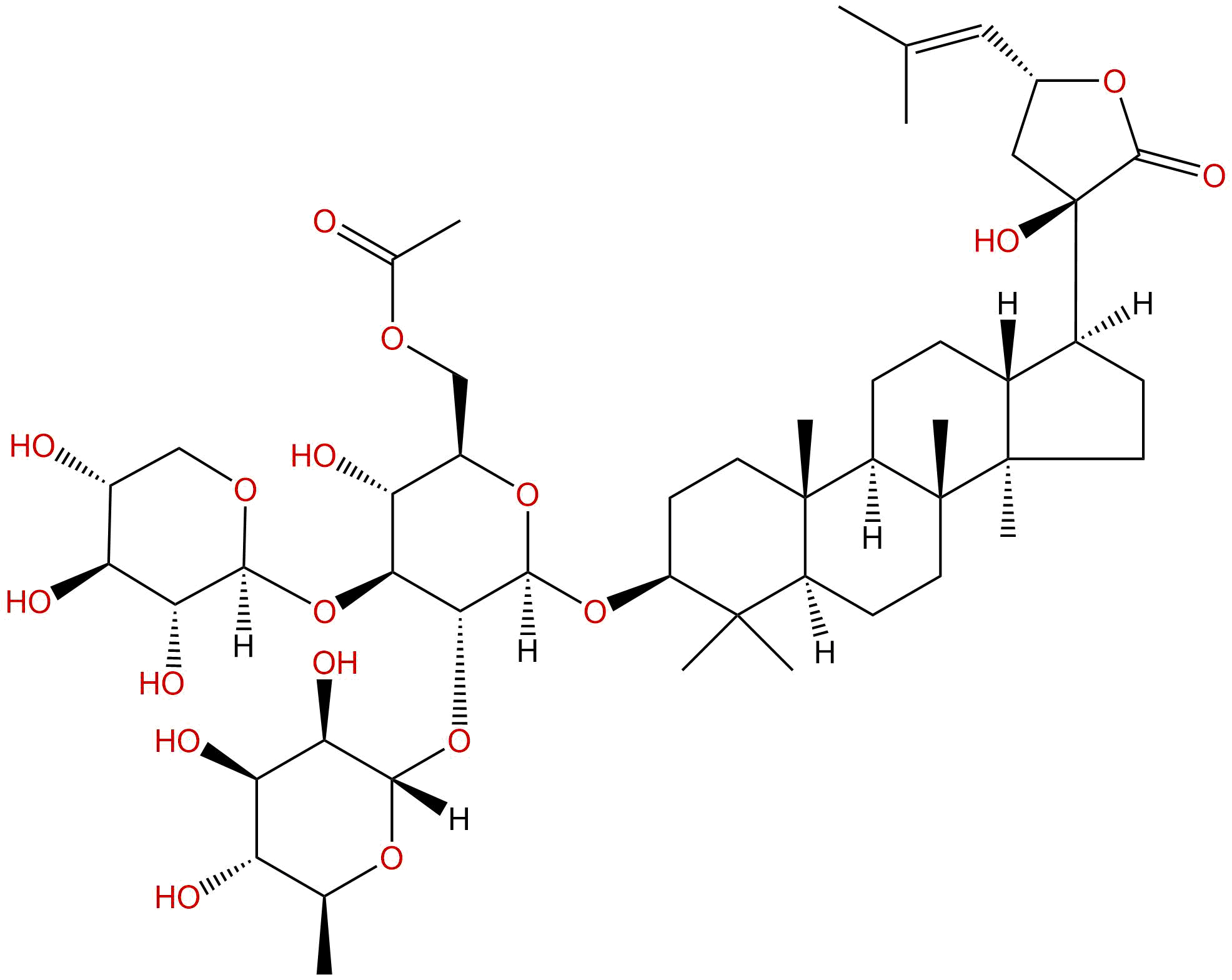
Gynostemma pentaphyllum saponin BP2214 belongs to the triterpenoid saponin class, with a molecular weight of 955.1450 and a complex molecular structure, including multiple glycosyl side chains and triterpenoid skeletons. Its LogP value is 3.0023, indicating moderate lipid solubility and facilitating membrane penetration. The polar surface area (TPSA) is 269.82 Å ², indicating that its molecules have high polarity, which may affect its ability to pass through cell membranes and the blood-brain barrier. The low water solubility (0.0382 mg/mL) suggests limited solubility in the aqueous phase, which poses a certain challenge for formulation design. Low blood-brain barrier permeability means its distribution in the central nervous system is limited. The hERG channel inhibition experiment result was negative, indicating that the compound has a low risk of cardiac toxicity. The Ames test result is 0.0, indicating no significant risk of genetic mutation induction.
Structurally, the triterpenoid skeleton of Gynostemma pentaphyllum saponin BP2214 is a five ring structure, and the diversity and connectivity of sugar groups endow it with unique biological activity. Its complex glycoside structure not only affects its physical and chemical properties, but also plays an important role in its binding and signal regulation with biomolecules.
Plant sources and extraction methods
Gynostemma pentaphyllum is a perennial climbing herb in the gourd family, mainly distributed in southern China and Southeast Asia. Its leaves and stems are rich in triterpenoid saponins, which are important medicinal materials in traditional Chinese medicine for regulating immunity, anti fatigue, lowering blood lipids, and anti-tumor effects.
The extraction of saponins BP2214 from Gynostemma pentaphyllum usually involves the following steps:
- Ingredient Preparation Collect fresh or dried leaves of Gynostemma pentaphyllum and crush them into fine powder.
- extraction solvent 70% -80% ethanol or methanol is often used for reflux extraction to improve the dissolution rate of saponins.
- Crude extract concentration Concentrate under reduced pressure to remove the solvent and obtain a concentrated extract.
- Separation and purification Using techniques such as silica gel column chromatography and reverse phase high-performance liquid chromatography (RP-HPLC), combined with multi-step gradient elution, the separation and purification of Gynostemma pentaphyllum saponins BP2214 were achieved.
- Structural Identification Multiple analytical methods such as mass spectrometry (MS), nuclear magnetic resonance (NMR), and infrared spectroscopy (IR) were used to confirm its structure.
In recent years, the application of supercritical CO ₂ extraction and membrane separation technology has further improved extraction efficiency and purity, reduced solvent residue and environmental pollution, and promoted the large-scale production of Gynostemma pentaphyllum saponin BP2214.
Pharmacological activity research
Gynostemma pentaphyllum saponin BP2214 exhibits multi-target and multi mechanism anti-tumor activity in multiple myeloma and other tumor models.
Anti multiple myeloma activity
In vitro cell experiments have shown that saponins BP2214 from Gynostemma pentaphyllum can significantly inhibit the proliferation of multiple myeloma cell lines, induce cell cycle arrest and apoptosis. Its IC50 value is within the low micromolar concentration range, showing high cytotoxicity selectivity. In the in vivo mouse xenograft model, saponins BP2214 from Gynostemma pentaphyllum significantly delayed tumor growth, improved animal survival rates, and had no significant toxic side effects.
Immune regulatory effect
Gynostemma pentaphyllum saponins BP2214 can regulate the immune microenvironment and enhance the body's anti-tumor immune response. Research has shown that it can promote the activity of macrophages and natural killer cells (NK cells), regulate cytokine secretion, and inhibit tumor associated inflammatory responses.
Antioxidant and anti-inflammatory effects
As a natural triterpenoid saponin, Gynostemma pentaphyllum saponin BP2214 has excellent antioxidant properties, can scavenge free radicals, and alleviate oxidative stress damage. In addition, its inhibitory effect on the nuclear factor kappa B (NF - κ B) signaling pathway endows it with significant anti-inflammatory activity, which helps to suppress the pro-inflammatory state in the tumor microenvironment.
Mechanism of action and molecular targets
Gynostemma pentaphyllum saponins BP2214 exert anti multiple myeloma effects through multiple signaling pathways and key molecular targets, with specific mechanisms including:
Regulating BCL2 family proteins
BCL2 and BCL2L1 (Bcl xL) are anti apoptotic proteins, and Gynostemma pentaphyllum saponin BP2214 can downregulate their expression, promoting mitochondrial pathway cell apoptosis. Inducing programmed cell death in myeloma cells by regulating the balance of BCL2 family proteins.
Inhibition of STAT3 signaling pathway
STAT3 is an important transcription factor for the proliferation and survival of multiple myeloma cells. Gynostemma pentaphyllum saponins BP2214 inhibit the phosphorylation and nuclear translocation of STAT3, block the expression of downstream anti apoptosis and proliferation genes, and inhibit tumor cell growth.
Intervention of PRKCA and AKT1 signals
Protein kinase C alpha (PRKCA) and AKT1 play critical roles in cell proliferation, metabolism, and survival. Gynostemma pentaphyllum saponin BP2214 regulates the activity of both, affects the PI3K/AKT signaling pathway, and inhibits tumor cell proliferation and drug resistance.
Affects TOP1 enzyme activity
Topoisomerase I (TOP1) is involved in DNA unrolling and replication. Gynostemma pentaphyllum saponin BP2214 can inhibit TOP1 activity, leading to DNA damage and cell cycle arrest, enhancing the sensitivity of tumor cells to cytotoxic stress.
Inhibition of NF - κ B signaling pathway
The regulatory factors RELA and NFKB1 of NF - κ B are key transcription factors involved in inflammation and tumorigenesis. Gynostemma pentaphyllum saponins BP2214 inhibit the activation of NF - κ B, reduce the expression of pro-inflammatory factors, and alleviate the pro-inflammatory response in the tumor microenvironment.
Activate TP53 and regulate BRAF
TP53, as a tumor suppressor gene, can be promoted in expression and function by saponins BP2214 from Gynostemma pentaphyllum, inducing cell cycle arrest and apoptosis. The regulation of BRAF affects the MAPK signaling pathway and participates in the regulation of cell proliferation and differentiation.
In summary, the synergistic effect of BP2214 from Gynostemma pentaphyllum on multiple myeloma cells through multiple targets and pathways demonstrates its complex and comprehensive pharmacological mechanism.
Evaluation of drug properties and pharmacokinetics
The pharmacological parameters of Gynostemma pentaphyllum saponin BP2214 show that it has certain potential for development:
- Molecular weight and polarity The high molecular weight and TPSA may limit its oral bioavailability and membrane permeability.
- fat-soluble A moderate LogP value is helpful for cell membrane penetration, but its water solubility is low and needs to be improved through formulation optimization to enhance solubility.
- safety There is no hERG channel inhibition or genotoxicity, indicating a good safety basis.
- Blood-brain barrier permeability Low permeability reduces the risk of central nervous system side effects, but limits central targeted applications.
Pharmacokinetic studies have shown that the absorption of Gynostemma pentaphyllum saponin BP2214 is slow after oral administration, with a moderate plasma half-life. It is mainly metabolized by the liver and excreted through bile and feces. Its metabolites are mostly glycoside hydrolysis products, some of which have biological activity. The distribution in the body is mainly concentrated in tissues rich in immune cells such as the liver, spleen, and bone marrow.
In terms of formulation research and development, technologies such as nanocarriers, liposomes, and solid dispersions have been applied to improve their solubility and bioavailability, enhance in vivo stability and targeting.
Clinical application prospects and prospects
Gynostemma pentaphyllum saponin BP2214, as an emerging natural anti-tumor active ingredient, has shown broad application prospects in the treatment of multiple myeloma. Its multi-target and multi mechanism mode of action helps overcome the resistance and side effects of traditional chemotherapy drugs. Combining immune regulation and anti-inflammatory effects, Gynostemma pentaphyllum saponin BP2214 is expected to become an important component of the comprehensive treatment plan for multiple myeloma.
Future clinical research should focus on:
- Safety and tolerability assessment Conduct preclinical toxicology and early clinical trials to clarify the maximum tolerated dose and adverse reaction spectrum.
- Pharmacodynamics and Formulation Optimization Develop efficient formulations suitable for clinical applications, improve bioavailability and targeting.
- Combination therapy strategy Explore synergistic effects with existing targeted drugs and immunotherapy drugs to enhance therapeutic efficacy.
- Biomarker screening Identifying molecular markers that predict therapeutic efficacy and drug resistance, achieving personalized and precise treatment.
- Expand indications Evaluate its potential applications in other tumors and immune related diseases, except for multiple myeloma.
In addition, in-depth research based on molecular targets can help design structurally optimized derivatives, enhance drug efficacy and pharmacokinetic properties, and promote the clinical translation of Gynostemma pentaphyllum saponin BP2214.
Conclusion
Gynostemma pentaphyllum saponin BP2214, as an important active ingredient in Gynostemma pentaphyllum, has shown great potential in the treatment of malignant tumors such as multiple myeloma due to its unique chemical structure and multi-target anti-tumor mechanism. Its excellent safety and diverse pharmacological effects provide valuable examples for the development of natural product drugs. In the future, combining modern medicinal chemistry, molecular biology, and pharmaceutical technology, Gynostemma pentaphyllum saponin BP2214 is expected to become an important candidate for the new generation of anti myeloma drugs, bringing more treatment options and hope to patients.
Continuous and in-depth basic and clinical research will lay a solid foundation for revealing its complete mechanism of action, optimizing drug performance, and achieving clinical applications, promoting the widespread application and development of natural products in modern cancer treatment.