


Product name: Gypenoside XLIX
Synonym name:
Catalogue No.: BP0693
Cas No.: 94987-08-3
Formula: C52H86O21
Mol Weight: 1047.24
Botanical Source: Gynostemma pentaphyllum (Thunb.) Makino
Physical Description:
Type of Compound: Triterpenoids
Purity: 95%~99%
Analysis Method: HPLC-DAD or/and HPLC-ELSD
Identification Method: Mass, NMR
Packing: Brown vial or HDPE plastic bottle
Storage: Store in a well closed container, protected from air and light. Put into refrigerate or freeze for long term storage.
Whenever possible, you should prepare and use solutions on the same day. However, if you need to make up stock solutions in advance, we recommend that you store the solution as aliquots in tightly sealed vials at -20℃. Generally, these will be useable for up to two weeks.
The product could be supplied from milligrams to grams
Inquire for bulk scale.
Chengdu Biopurify Phytochemicals Ltd. is a leading company in the research, development, manufacture and marketing of High Quality Phytochemicals and Extracts(especially Active Ingredients from Traditional Chinese Medicine,TCM), Natural Active Pharmaceutical Ingredients worldwide.
The main services:
A. Supply active ingredients and reference standards of TCM, from mgs to kgs scale
B. Custom extraction and purification, target Herb Active Ingredients
C. Custom synthesis and semi-synthesis for Natural Active Ingredients
D. CR(contract research), CM(contract manufacture) and PD(process development) services from lab scale, pilot scale to commercial scale(GMP is also available)
E. TCM compounds library for drug screen,more than 3000 compounds available, many of them are rare and unique.
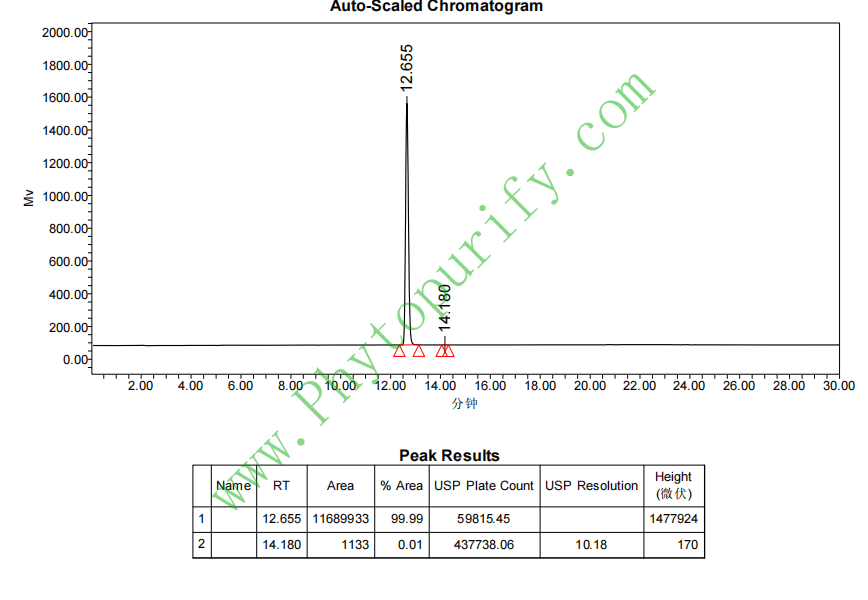
HPLC of Gypenoside XLIX
Storage conditions:Short-term storage at 2~8℃, long-term storage at -20 ~ -80℃
333.6700
1.9652
1.9649
.1344
.5090
.1803
Low
72.3074
6.8901
No
No
No
No
No
No
0.0
Yes
No
No
Yes
Natural products, as an important treasure trove for drug discovery and development, play an irreplaceable role in the long history of human fight against diseases. Among them, saponin compounds have always been a hot topic in medicinal chemistry and pharmacology research due to their structural diversity and wide range of biological activities. Gynostemma pentaphyllum(Gynostemma pentaphyllum (Thunb.) Makino), Commonly known as "southern ginseng", it is a traditional medicinal plant used for prolonging life, clearing heat and tonifying deficiency. Modern research has shown that its main bioactive components are a series of structurally unique dammarane type triterpenoid saponins, collectively known as Gypenosides. Among over a hundred identified saponins of Gynostemma pentaphyllum, Gypenoside XLIX (CAS number: 94987-08-3) has attracted much attention due to its unique pharmacological activity and clear target of action.
Gynostemma pentaphyllum saponins XLIX are not only one of the main components of Gynostemma pentaphyllum, but have also been identified as a selective peroxisome proliferator activated receptor alpha (PPAR alpha) activator. PPAR α is an important member of the nuclear receptor superfamily, playing a central role in regulating lipid metabolism, energy homeostasis, and inflammatory response. This compound can effectively inhibit the overexpression of vascular cell adhesion molecule-1 (VCAM-1) induced by inflammatory factors in endothelial cells by activating PPAR α, which suggests that it has potential therapeutic value in cardiovascular inflammatory diseases such as atherosclerosis. In addition, studies have also found that it exhibits significant inhibitory activity against various tumor cells, especially lung cancer cells. Its effects involve multiple levels such as apoptosis induction and metastasis inhibition, and are related to multiple key targets such as BCL2, STAT3, TLR4, etc. This article aims to systematically review the chemical structure, plant origin, pharmacological activity, mechanism of action, pharmacological evaluation, and clinical application prospects of Gynostemma pentaphyllum saponins XLIX, in order to provide comprehensive scientific references for the in-depth research and development of this natural product.
Gynostemma pentaphyllum saponins XLIX belong to the dammarane type tetracyclic triterpenoid saponins, with a molecular formula of C ₅₄ H ₉₀ O ₂ and a molecular weight of 1047.2390 Da. Its basic skeleton is a dammarane type triterpenoid, characterized by sugar chains connected at positions C-3 and C-20, respectively. Specifically, its aglycone is a 20 (S) - protopanaxadiol type Damatane structure, connected by a glycosidic bond at C-3 to a disaccharide chain composed of glucose and xylose, and at C-20 to a disaccharide chain composed of glucose and xylose. The structure of this polyhydroxy and polysaccharide chain determines its unique physicochemical properties.
From the analysis of parameters related to drug properties, the lipid water partition coefficient (LogP) of Gynostemma pentaphyllum saponins XLIX is 1.9652, indicating that it has a certain degree of lipophilicity, but overall it still leans towards hydrophilicity. Its topological polar surface area (TPSA) is as high as 333.6700 Å ², which is mainly attributed to the abundant hydroxyl groups and oxygen atoms on the sugar ring in the molecule, resulting in its high polarity. The calculated water solubility is 0.1344 mg/mL, which belongs to the category of slight solubility, which may pose a certain challenge to its oral absorption. In terms of predicting pharmacokinetic properties, the ability of the compound to cross the blood-brain barrier (BBB) was evaluated as "low", indicating that it may not easily enter the central nervous system, which may be advantageous for treating peripheral diseases or avoiding central side effects. Preliminary safety predictions indicate that it has no inhibitory activity on hERG potassium channels (hERG inhibition: No), suggesting a low risk of inducing QT interval prolongation in the heart; The Ames test predicted a value of 0.0, indicating that it may not have a direct genetic toxicity risk. These preliminary pharmacological parameters provide basic data for subsequent drug development.
Gynostemma pentaphyllum saponins XLIX are mainly derived from the gourd family plant Gynostemma pentaphyllum(Gynostemma pentaphyllum)The whole grass. Gynostemma pentaphyllum is widely distributed in East Asia and Southeast Asia, and is either wild or cultivated in various provinces south of the Yangtze River in China. The content of its active ingredients is significantly affected by factors such as place of origin, harvest season, plant part (usually with the highest content in leaves), and processing method.
The extraction of saponins XLIX from Gynostemma pentaphyllum usually follows the general extraction and separation process for saponin compounds. Firstly, alcohol solvents (such as methanol, ethanol) or a mixture of alcohol and water solvents are used for reflux extraction or ultrasound assisted extraction of dried and crushed Gynostemma pentaphyllum medicinal materials to fully extract total saponins. Subsequently, preliminary enrichment and purification were carried out using macroporous adsorption resin (such as D101, AB-8 type) column chromatography, and gradient elution was performed using ethanol water solutions of different concentrations to collect fractions rich in target saponins. Due to the diverse types and similar structures of saponins in Gynostemma pentaphyllum, further separation and purification require the use of efficient chromatographic techniques. Positive phase silica gel column chromatography and reverse phase silica gel (such as ODS-C18) column chromatography are commonly used, combined with semi preparative or preparative high-performance liquid chromatography (HPLC), to repeatedly separate specific solvent systems (such as acetonitrile water, methanol water), ultimately obtaining high-purity monomers of Gynostemma pentaphyllum saponins XLIX. Modern separation and analysis techniques, such as high-speed countercurrent chromatography (HSCCC) and liquid chromatography-mass spectrometry (LC-MS) guided separation strategies, have greatly improved the separation efficiency and targeting of this compound.
A large number of pharmacological studies in vitro and in vivo have revealed various biological activities of Gynostemma pentaphyllum saponin XLIX, mainly focusing on anti-inflammatory, anti atherosclerosis, anti-tumor and other fields.
1. Anti inflammatory and cardiovascular protective activity:
Its most characteristic activity is as a selective PPAR alpha activator. In the human umbilical vein endothelial cells (HUVECs) model, inflammatory factors such as tumor necrosis factor - α (TNF - α) can strongly induce the expression of VCAM-1 and promote the adhesion of monocytes to endothelial cells, which is the early key event of atherosclerosis. Gynostemma pentaphyllum saponins XLIX can dose dependently inhibit this induction effect, and its effect can be blocked by PPAR alpha antagonists, confirming its anti-inflammatory effect by activating the PPAR alpha pathway. Animal model research also shows that it can improve the formation of atherosclerotic plaque induced by high-fat diet, regulate the blood lipid profile, and show the potential of cardiovascular protection.
2. Antitumor activity:
The anti-tumor effect is another important research direction of Gynostemma pentaphyllum saponins XLIX, especially in the field of lung cancer where research is more in-depth.
* Inhibition of cell proliferation and induction of apoptosis: This compound can significantly inhibit the proliferation of various human lung cancer cell lines (such as A549, NCI-H460) and induce cell apoptosis. Flow cytometry analysis showed an increase in the proportion of sub-G1 phase cells and upregulation of apoptosis related proteins such as cleaved caspase-3 expression.
* Inhibit cell migration and invasion: Scratch and Transwell experiments have shown that saponins XLIX from Gynostemma pentaphyllum can effectively inhibit the migration and invasion ability of lung cancer cells, indicating its potential for anti metastasis.
* In vivo anti-tumor effect: In a nude mouse transplant tumor model, administration of gypenoside XLIX significantly inhibited the growth of lung cancer tumors, and no significant systemic toxicity such as weight loss was observed, indicating its in vivo anti-tumor activity and safety.
In addition, research suggests that it may have an improving effect on metabolic diseases (such as non-alcoholic fatty liver disease) and neurodegenerative diseases, but further evidence in these areas is needed.
The pharmacological effects of Gynostemma pentaphyllum saponins XLIX are achieved by intervening in multiple signaling pathways and molecular targets, forming a networked mechanism of action with multiple targets and pathways.
1. Core pathway: PPAR α - dependent anti-inflammatory pathway
As mentioned earlier, its selective activation of PPAR α is the core of anti-inflammatory effects. Activated PPAR α forms a heterodimer with retinol X receptor (RXR) and binds to the peroxisome proliferator response element (PPRE) in the promoter region of the target gene, regulating gene transcription. On the one hand, it may downregulate the expression of adhesion molecules such as VCAM-1 and intercellular adhesion molecule-1 (ICAM-1) by inhibiting the activity of inflammatory signaling pathways such as nuclear factor kappa B (NF - κ B). On the other hand, activation of PPAR α can upregulate the expression of ABCA1. ABCA1 is a key protein of cholesterol reverse transport, which promotes the outflow of intracellular cholesterol, which links its anti-inflammatory effect with anti atherosclerosis lipid regulation.
2. Key targets and pathways for anti-tumor effects
In tumor models such as lung cancer, the mechanism of action of gypenoside XLIX is more complex:
* Inducing apoptosis: It can downregulate the expression of anti apoptotic protein BCL2, disrupt mitochondrial membrane potential, promote cytochrome C release, and activate the mitochondrial apoptosis pathway. Meanwhile, it can inhibit the phosphorylation and activation of signal transduction and transcription activator 3 (STAT3). STAT3 is an important oncogenic transcription factor, whose sustained activation promotes cell survival, proliferation, and immune escape. Inhibiting the STAT3 pathway helps to restore apoptosis sensitivity.
* Inhibition of metastasis: Its anti metastatic effect is closely related to the downregulation of matrix metalloproteinase-2 (MMP2) expression. MMP2 can degrade extracellular matrix and is a key enzyme for tumor cell invasion and metastasis. In addition, research suggests that it may inhibit tumor associated inflammation and invasion by suppressing the Toll like receptor 4 (TLR4)/NF - κ B pathway.
* Regulating oxidative stress and autophagy: Gynostemma pentaphyllum saponins XLIX can activate the nuclear factor E2 related factor 2 (NFE2L2/Nrf2) pathway. Nrf2 is the main regulatory factor of cellular antioxidant response, and its activation helps to clear reactive oxygen species and alleviate oxidative stress, which may indirectly inhibit tumor occurrence and development. Meanwhile, there is evidence to suggest that it may affect the expression or phosphorylation of microtubule associated protein tau (MAPT) and interact with the PI3K/Akt/mTOR pathway mediated by phosphatidylinositol 3-kinase catalytic subunit gamma (PIK3CG), thereby regulating cellular autophagy.
* Potential hormone regulation: The potential interaction with estrogen receptor beta (ESR2) has also been mentioned, which may affect the growth of hormone sensitive tumors.
In summary, the saponins XLIX from Gynostemma pentaphyllum form a synergistic network that regulates inflammation, apoptosis, metastasis, and oxidative stress by acting on multiple key targets such as PPAR α, STAT3, BCL2, NF - κ B, and Nrf2, which is the molecular basis for their multifunctional pharmacological effects.
Although the saponins XLIX from Gynostemma pentaphyllum exhibit good biological activity, their pharmacological properties, especially pharmacokinetic properties, are the key to determining whether they can be successfully developed into drugs.
1. Prediction and challenges of absorption, distribution, metabolism, and excretion (ADME):
* Absorption: Its large molecular weight (>1000 Da) and high polarity (high TPSA) pose significant challenges to oral absorption. As a saponin, it may undergo acid hydrolysis or intestinal microbiota enzymatic hydrolysis in the gastrointestinal tract, leading to the release of aglycones and altering its biological activity. Its slightly soluble nature also limits its solubility in intestinal fluid.
* Distribution: Predict low blood-brain barrier permeability, mainly distributed in peripheral tissues and organs. The binding rate with plasma proteins is not yet clear, but saponin compounds often have strong binding with proteins, which may affect their free drug concentration and tissue distribution.
* Metabolism: As glycoside compounds, glucosidase, cytochrome P450 enzymes, and II binding enzymes (such as glucuronosyltransferase and sulfatase) in the liver and intestine may be involved in their metabolism. The gradual hydrolysis of sugar chains is one of its possible metabolic pathways.
* Excretion: It is expected that its prototype or metabolites will mainly be excreted through bile and kidneys.
At present, there are still few reports on the systematic pharmacokinetic studies of Gynostemma pentaphyllum saponins XLIX, which limits our understanding of its in vivo processes. Limited animal pharmacokinetic studies suggest that its oral bioavailability may be low.
2. Formulation strategy and structural optimization:
In order to improve its pharmacological properties, future research may consider the following strategies:
* New drug delivery system: Develop delivery systems based on nanotechnology, such as liposomes, polymer nanoparticles, self microemulsions, etc., to improve their solubility, protect them from gastrointestinal degradation, enhance intestinal permeability, and potentially achieve targeted delivery.
* Pre drug design: Chemical modification of the hydroxyl groups on its sugar chains or glycosides to prepare lipophilic prodrugs to enhance membrane permeability, followed by enzymatic release of active ingredients in vivo.
* Simplification of structure and screening of analogues: Using it as a lead compound, conduct structure-activity relationship studies to search for simplified analogues that retain or enhance PPAR α activation activity or anti-tumor activity, but have smaller molecular weight, more suitable LogP, and more stable metabolism.
Gynostemma pentaphyllum saponins XLIX, as a multi-target and multi active natural product, have shown broad clinical application prospects in multiple disease fields, but also face many challenges.
1. Potential application areas:
* Cardiovascular disease: As a selective PPAR α activator, it is a potential candidate molecule for developing new antiatherosclerotic drugs. Compared with the existing beta drugs (non selective PPAR α agonists), they may have better selectivity or different regulation spectrum, and are expected to be used for the prevention and treatment of atherosclerosis and related cardiovascular and cerebrovascular events.
* Tumor adjuvant therapy: Especially in adjuvant or combination therapy for lung cancer. Its multiple mechanisms of inducing apoptosis, inhibiting metastasis, and regulating the tumor microenvironment (anti-inflammatory, antioxidant) may lead to synergistic effects with chemotherapy, targeted therapy, or immunotherapy, improving efficacy and potentially reducing drug resistance. Its inhibition of pathways such as STAT3 and TLR4 also provides a basis for its application in the treatment of inflammation related tumors.
* Metabolic disorders: Based on the regulatory effect of PPAR α activation on lipid metabolism, it may also have a place in the treatment of metabolic diseases such as non-alcoholic fatty liver disease and hyperlipidemia.
* Chronic inflammatory diseases: Its anti-inflammatory mechanism may be applicable to other chronic inflammatory diseases with high VCAM-1 expression, such as rheumatoid arthritis, inflammatory bowel disease, etc., but more specific studies are needed.
2. Challenges and future directions:
* In depth pharmacokinetic studies: It is urgent to conduct systematic in vivo ADME research to clarify its absolute bioavailability, major metabolites, tissue distribution characteristics, and excretion pathways, providing a basis for dosage form design and optimization of dosing regimens.
* Deep analysis of the mechanism of action: It is necessary to use techniques such as gene knockout, chromatin immunoprecipitation (ChIP), proteomics, etc. to more accurately elucidate its direct interaction with targets such as PPAR α and STAT3, as well as the primary secondary relationship and cross dialogue between its multi-target network.
* Security system evaluation: Although the preliminary safety prediction is good, a comprehensive preclinical safety evaluation is still needed, including acute toxicity, chronic toxicity, reproductive toxicity, etc., to assess its potential risks.
* Clinical translational studies: Ultimately, rigorous clinical trials need to be designed to validate its effectiveness, safety, and pharmacokinetic characteristics in humans. Considering the potential oral absorption challenges, exploring injection or local administration routes may also be a feasible direction.
Gynostemma pentaphyllum saponin XLIX is a type of dammarane saponin with important biological activity isolated from the traditional medicinal plant Gynostemma pentaphyllum. It is not only a selective PPAR α activator that exerts anti-inflammatory and cardiovascular protective effects, but also inhibits the proliferation, migration, and induces apoptosis of tumor cells such as lung cancer by regulating multiple key targets such as BCL2, STAT3, TLR4, NFE2L2, etc. Its multi-target action characteristics reflect the unique advantages of natural products in the treatment of complex diseases. However, its large molecular weight, high polarity, and potentially poor pharmacokinetic properties are the main bottlenecks for its conversion into clinical drugs. Future research should focus on improving its drug properties through modern pharmaceutical technology and medicinal chemistry, and combining systems biology methods to deeply reveal its complex molecular action network. With the continuous deepening of these studies, gypenoside XLIX is expected to become a promising drug lead compound, providing new strategies and choices for the prevention and treatment of major diseases such as cardiovascular disease and tumors.
