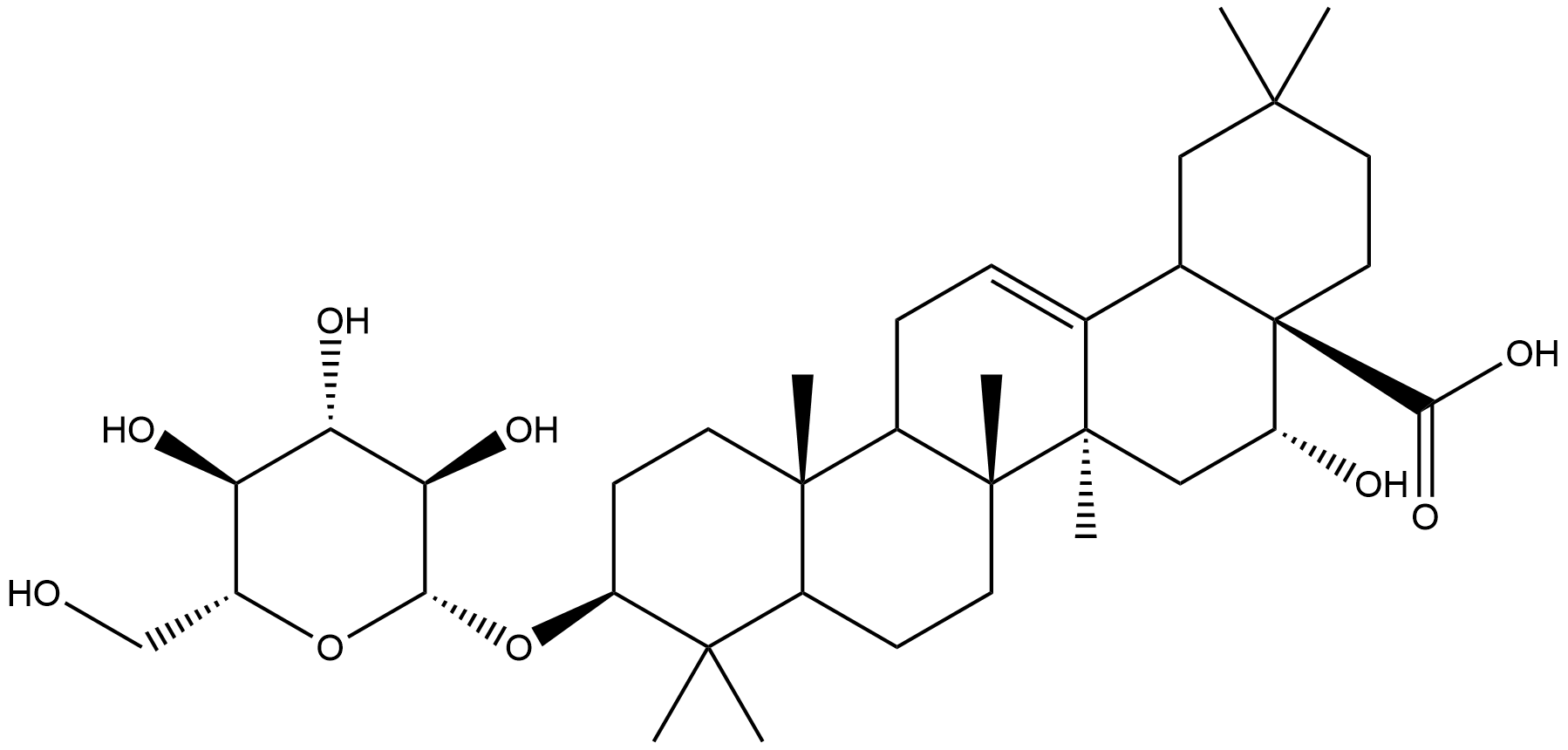


Product name: Ecliptasaponin A
Synonym name: Ecliptasaponin A; Gleditsoside B; Gleditschoside B
Catalogue No.: BP0523
Cas No.: 78285-90-2
Formula: C36H58O9
Mol Weight: 634.851
Botanical Source: EcliptaprostrataL.
Physical Description:
Type of Compound: Terpenoids
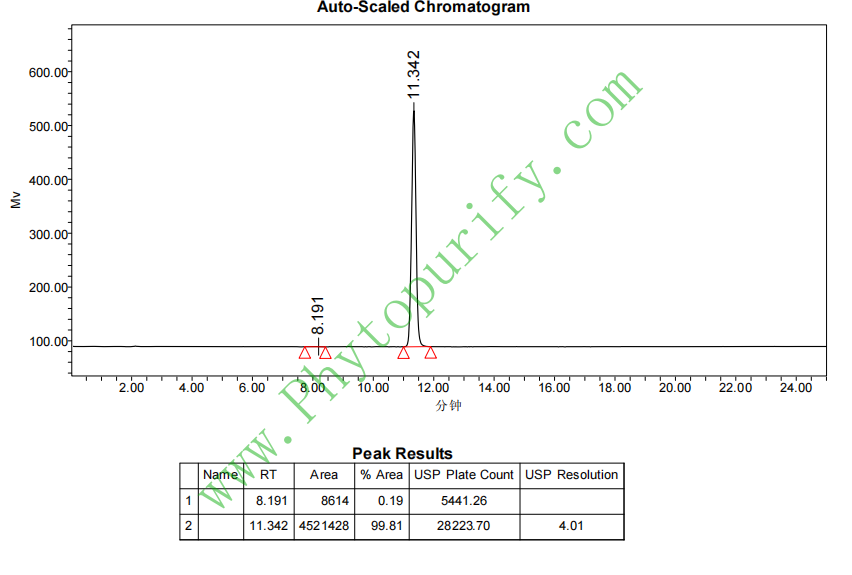
Purity: 95%~99%
Analysis Method: HPLC-DAD or/and HPLC-ELSD
Identification Method: Mass, NMR
Packing: Brown vial or HDPE plastic bottle
Storage: Store in a well closed container, protected from air and light. Put into refrigerate or freeze for long term storage.
Whenever possible, you should prepare and use solutions on the same day. However, if you need to make up stock solutions in advance, we recommend that you store the solution as aliquots in tightly sealed vials at -20℃. Generally, these will be useable for up to two weeks.
The product could be supplied from milligrams to grams
Inquire for bulk scale.
Description:
Ecliptasaponin A has protective effects against the pulmonary fibrosis induced by bleomycin via reducing the oxidative stress, lung tissue inflammation, and the subsequent epithelial-mesenchymal transition.
References:
J Ethnopharmacol. 2015 Dec 4;175:172-80.
Preventive effects of Ecliptae Herba extract and its component, ecliptasaponin A, on bleomycin-induced pulmonary fibrosis in mice.
Ecliptae Herba, a nourishing traditional Chinese medicine, is also a folk medicine for the treatment of lung diseases. To investigate the anti-fibrosis effects and the underlying mechanism of the extract of Ecliptae Herba and its potential active components.
METHODS AND RESULTS:
The resulting extract (EXT) was prepared from the 80% ethanol extract of Ecliptae Herba. After intratracheally administrated with bleomycin (BLM, 5mg/kg), mice were orally treated with EXT at 2.5, 1.25, 0.625 g/kg and eclipta saponin A (ESA) at 80 mg/kg once daily for 28 day. The bodyweight, survival rate, pathological changes of lung and levels of hydroxyproline (HYP) were used to evaluate the anti-fibrotic effects. The malonaldehyde (MDA), superoxidae dismutase (SOD) activity, and the protein expressions of matrix metalloproteinase (MMP)-2, 9, tissue inhibitor of metalloproteinase-1 (TIMP-1), cyclooxygenase-2 (COX-2), α-smooth muscle actin (α-SMA) and transforming growth factor-β1 (TGF-β1) in lung tissue were analyzed by kits or western blot. Compared with BLM group, EXT administration could significantly ameliorated the pathological changes of lung, decreased the HYP content, enhanced the SOD activity, and reduced the MDA content of lung tissues. In mechanism, EXT significantly alleviated the levels of COX-2, TGF-β1, MMP-2 and α-SMA, as well as elevated the ratio value of MMP-9/TIMP-1. Additionally, the anti-fibrosis effects of ESA, a large amount of saponins isolated from Eclipta prostrata , was also evaluated by the BLM-induced model. The results showed that ESA could block BLM-induced histological changes of lung tissue and decrease the high levels of TGF-β1 and α-SMA.
CONCLUSIONS:
Ecliptae Herba has protective effects against the pulmonary fibrosis induced by BLM via reducing the oxidative stress, lung tissue inflammation, and the subsequent epithelial-mesenchymal transition. The active chemical constituents may be involved with triterpenoid saponins, such as ESA.
HPLC of Ecliptasaponin A
Storage conditions:Short-term storage at 2~8℃, long-term storage at -20 ~ -80℃
Ecliptaaponin A is a natural product of pentacyclic triterpenoid saponins derived from plants in the genus Eclipta. In recent years, it has received widespread attention for its multi-target and multi pathway pharmacological activities. As an orally effective bioactive ingredient, salidroside A exhibits significant anti-tumor, anti-inflammatory, anti fibrotic, antioxidant, and cartilage protective effects, and also shows potential in regulating endocrine function. Its role covers lung cancer, breast cancer and other malignant tumors, and it also has a protective effect on cardiovascular system, immune inflammatory reaction, bone and joint diseases and other pathological conditions. This article will provide a systematic review of the chemical structure and physicochemical properties, plant sources, and extraction methods of salidroside A, with a focus on its pharmacological activity and mechanism of action. Combined with pharmacological evaluation and pharmacokinetic data, it will explore its clinical application prospects and development directions.
The molecular formula of drought lotus glycoside A is C36H-58O11, with a molecular weight of 634.8510, belonging to the pentacyclic triterpenoid saponin class. Its structure contains a typical triterpenoid skeleton, connecting multiple sugar residues, giving it high polarity and water solubility. The LogP value is 3.9377, indicating that it has moderate lipid solubility, which is beneficial for cell membrane penetration but not prone to excessive lipid accumulation. The topological polar surface area (TPSA) is 156.91 Å ², indicating its high polarity, which may affect its oral absorption and bioavailability. The water solubility is 0.0446 mg/mL, which is a low solubility compound, but still has a certain degree of water phase dispersibility. The low permeability of the blood-brain barrier suggests limited distribution in the central nervous system. The negative result of hERG inhibition experiment indicates a low risk of cardiac toxicity. The Ames mutagenicity test showed 0, indicating a low risk of genetic toxicity and good safety.
Structurally, the triterpenoid core of salidroside A provides the basis for its biological activity, while the glycosyl portion may affect its solubility and receptor binding properties. The surface activity characteristics of saponins may also promote their interaction with cell membranes, enhancing their biological activity.
Ecliptin A is mainly present in plants of the Ecliptia genus (Ecliptia spp.), especially in Ecliptia prolata L. Dryland is a traditional Chinese medicinal herb widely distributed in tropical and subtropical regions of Asia, Africa, and the Americas. The whole plant contains abundant triterpenoid saponins, flavonoids, and polyphenolic components, among which paeoniflorin A, as one of the important active ingredients, has been reported multiple times.
The common methods for extracting salidroside A include:
Solvent extraction Using methanol, ethanol, or a mixture of water and alcohol solvents to extract the dried powder of Houttuynia cordata, and utilizing its polarity to dissolve saponin components.
Liquid liquid distribution and column chromatography purification After removing lipophilic impurities through liquid-liquid distribution, the preliminary extraction solution is separated and purified using silica gel column, reverse phase C18 column or resin column, and the purity is improved by combining gradient elution technology.
High performance liquid chromatography (HPLC)Used for qualitative and quantitative analysis and further purification to ensure the purity and structural identification of drought lotus glycoside A.
In recent years, modern technologies such as ultrasound assisted extraction and microwave-assisted extraction have also been applied to improve the extraction efficiency and purity of salidroside A.
The pharmacological activity research of drought lotus glycoside A covers multiple aspects such as anti-tumor, anti-inflammatory, anti fibrotic, antioxidant, cartilage protection, and endocrine regulation.
Ganlian glycoside A exhibits significant cytotoxicity in lung cancer cell lines and can induce cell apoptosis and autophagy. The mechanism mainly activates the ASK1/JNK signaling pathway, promoting intracellular stress response and programmed cell death. In addition, Trollioside A also has inhibitory effect on breast cancer cells, and related targets include AMPK, BCL2, STAT3, ESR2, ABCB1, ABCG2, PRKCA, MAPT, MMP2 and LCK, showing its multi target regulation characteristics. Ganlian glycoside A can regulate the energy metabolism, apoptosis signaling, and cell cycle of tumor cells, and inhibit tumor cell proliferation and migration.
Drylotus glycoside A exerts anti-inflammatory effects by inhibiting the HMGB1/TLR4/NF - κ B signaling pathway, reducing the expression of pro-inflammatory cytokines and enzymes (such as COX-2 and MMP9). This mechanism effectively reduces tissue inflammatory response, blocks the process of inflammation transforming into fibrosis, and protects the cardiovascular system from chronic inflammatory damage. Its anti fibrotic effect has been validated in various models, manifested by reducing collagen deposition and fibrosis marker expression.
Drylotus glycoside A can enhance the activity of superoxide dismutase (SOD), reduce the level of lipid peroxidation product malondialdehyde (MDA), and alleviate cell damage caused by oxidative stress. Its antioxidant effect helps protect the cardiovascular system and other important organs from free radical damage, delaying disease progression.
By inhibiting the expression of matrix metalloproteinase 13 (MMP13) and regulating inflammatory factors, drought lotus glycoside A exhibits cartilage protective effects in bone and joint disease models. It can alleviate cartilage degradation, inhibit joint inflammation, and maintain the structural and functional stability of joint tissue.
Ganlian glycoside A improves ovarian function and regulates sex hormone levels by upregulating the expression of estrogen receptor alpha (ESR1), demonstrating its potential application value in the field of reproductive health. This effect may provide new ideas for the treatment of ovarian dysfunction and related endocrine disorders.
The multiple pharmacological effects of drought lotus glycoside A are attributed to its complex mechanism of action and regulation of multiple molecular targets.
ASK1/JNK pathway activation Drylotus glycoside A induces apoptosis and autophagy in lung cancer cells and promotes tumor cell death by activating caspase 1 (ASK1) and its downstream c-Jun N-terminal kinase (JNK).
HMGB1/TLR4/NF - κ B signaling inhibition By inhibiting the nuclear factor kappa B (NF - κ B) signaling pathway mediated by high mobility group protein B1 (HMGB1) and Toll like receptor 4 (TLR4), drought lotus glycoside A reduces the expression of pro-inflammatory factors and exerts anti-inflammatory and anti fibrotic effects.
Regulation of antioxidant enzyme activity Drylotus glycoside A enhances SOD activity, clears superoxide radicals, reduces MDA formation, and alleviates oxidative damage.
Matrix metalloproteinase inhibition By downregulating the expression of MMP9 and MMP13, drought lotus glycoside A inhibits extracellular matrix degradation and protects cartilage and cardiovascular tissue structure.
Hormone receptor regulation Drylotus glycoside A upregulates the expression of estrogen receptor alpha (ESR1), regulates sex hormone balance, and improves reproductive system function.
Tumor related multi-target regulation Including AMPK (PRKAA1), anti apoptotic protein BCL2, signal transduction and transcription activator STAT3, estrogen receptor beta (ESR2), multidrug resistance proteins ABCB1 and ABCG2, protein kinase C alpha (PRKCA), microtubule associated protein MAPT, and lymphocyte kinase LCK, drought lotus glycoside A regulates these targets to affect tumor cell metabolism, proliferation, migration, and drug resistance.
The pharmacological parameters of salidroside A indicate that it has certain potential for drug development. The high molecular weight (634.85 Da) and TPSA (156.91 Å ²) may limit its oral absorption efficiency, but its moderate LogP (3.94) facilitates membrane penetration. Low water solubility (0.0446 mg/mL) suggests the need to improve bioavailability through formulation optimization.
Low blood-brain barrier permeability reduces the risk of central nervous system side effects. HERG channel inhibition is negative, indicating a low risk of cardiac toxicity and good safety. The Ames test is negative, indicating low genetic toxicity risk and meeting drug safety requirements.
At present, there is limited pharmacokinetic research on salidroside A. Preliminary data indicate that it is well absorbed orally, widely distributed in the body, and mainly metabolized through the liver enzyme system. Its excretion pathway is mainly through bile excretion. Further systematic pharmacokinetic and toxicological evaluations are needed in the future to provide a basis for clinical development.
Due to its multi-target and multi mechanism pharmacological activity, drought lotus glycoside A has demonstrated extensive clinical application potential. In the field of anti-tumor, especially in the treatment of lung cancer and breast cancer, it may be used as an auxiliary or combined drug to improve the therapeutic effect and overcome drug resistance. The anti-inflammatory and anti fibrotic effects make it potentially valuable in cardiovascular disease, liver fibrosis, and other chronic inflammatory diseases.
In addition, the antioxidant and cartilage protective effects of salidroside A provide new ideas for the prevention and treatment of bone and joint diseases. Its ability to regulate endocrine function also provides new possibilities for the treatment of female reproductive health-related diseases.
Future research should focus on preclinical safety evaluation, pharmacokinetic optimization, and formulation development of salidroside A. Meanwhile, based on its multi-target mechanism of action, systematic network pharmacology and translational medicine research will be conducted to promote its clinical application.
As a pentacyclic triterpenoid saponin with multiple biological activities, drought lotus glycoside A exhibits a wide range of pharmacological effects and good safety characteristics. It exerts various effects such as anti-tumor, anti-inflammatory, anti fibrotic, antioxidant, and cartilage protection by regulating multiple signaling pathways and key molecular targets. Although its pharmacokinetics and clinical research are still in their infancy, drought lotus glycoside A has great potential as a candidate molecule for natural product drug development. In the future, it is necessary to strengthen its mechanism research, drug optimization, and clinical translation work, promote the application of salidroside A in the treatment of various diseases, and benefit patients.
