


Product name: Wedelolactone
Synonym name: 5,11,12-Trihydroxy-7-methoxycoumestan
Catalogue No.: BP1451
Cas No.: 524-12-9
Formula: C16H10O7
Mol Weight: 314.249
Botanical Source: EcliptaprostrataL.
Physical Description:
Type of Compound: Coumarins
Purity: 95%~99%
Analysis Method: HPLC-DAD or/and HPLC-ELSD
Identification Method: Mass, NMR
Packing: Brown vial or HDPE plastic bottle
Storage: Store in a well closed container, protected from air and light. Put into refrigerate or freeze for long term storage.
Whenever possible, you should prepare and use solutions on the same day. However, if you need to make up stock solutions in advance, we recommend that you store the solution as aliquots in tightly sealed vials at -20℃. Generally, these will be useable for up to two weeks.
The product could be supplied from milligrams to grams
Inquire for bulk scale.
Description:
Wedelolactone is a potent Î2-arrestin-biased G protein-coupled receptor-35 (GPR35) agonist, GPR35 has been shown to be a target of the asthma drugs cromolyn disodium and nedocromil sodium. Wedelolactone has anti-inflammatory, growth inhibitory, anti-cancer, anti-fibrotic, and pro-apoptotic effects. Wedelolactone stimulates ER genomic and non-genomic signalling pathways; it can significantly inhibit the activation of LX-2 cells, the underlying mechanisms of which included inducing Bcl-2 family involved apoptosis, up-regulating phosphorylated status of ERK and JNK expressions, and inhibiting NF-κB mediated activity.
References:
J Ethnopharmacol. 2014 Nov 18;157:206-11.
Inhibitory effect of Ecliptae herba extract and its component wedelolactone on pre-osteoclastic proliferation and differentiation.
Ecliptae herba, also known as "Mo-Han-Lian", has long been used in China to nourish Kidney and thereafter strengthen bones. Accumulating evidence indicates that extracts of Ecliptae herba have antiosteoporotic effect. However, the effective compounds and cellular mode of action are still unclear. To investigate the effect of ethyl acetate extract of Ecliptae herba (EAE) and its component Wedelolactone on proliferation and differentiation of preosteoclastic RAW264.7 cells as well as proliferation of bone marrow stromal cells (BMSC).
METHODS AND RESULTS:
RAW264.7 and BMSC were examined for proliferation by a 3-(4,5-dimethyl-2-thiazolyl)-2,5-diphenyl-2-H-tetrazolium bromide (MTT) method. Tartrate-resistant acid phosphatase (TRAP) activity of RAW264.7 was measured by using p-nitrophenyl sodium phosphate (pNPP) assay after the cells were treated with 30ng/ml receptor activator for nuclear factor-κ B ligand (RANKL) plus various concentrations of EAE, Wedelolactone or alendronate. The formation of multinucleated TRAP-positive RAW264.7 cells was observed by using a TRAP-staining kit. Treatment of RAW264.7 cells with EAE at high doses (20μg/ml and 40μg/ml) or Wedelolactone at 10μg/ml resulted in a decrease in proliferation of RAW264.7 cells. Low doses of EAE (5, 10μg/ml) and Wedelolactone(2.5μg/ml) inhibited RANKL-induced TRAP activity by 20.3%, 37.9%, and 48.3%. The inhibitory effect of Wedelolactone is more potent than that of alendronate, an anti-resorptive drug. Morphological changes revealed that 5μg/ml EAE and 2.5μg/ml Wedelolactone reduced the number of multinucleated osteoclast-like cells. At the high doses, EAE (20μg/ml) and Wedelolactone(10μg/ml) inhibited the growth of BMSC.
CONCLUSIONS:
EAE and its component Wedelolactone inhibited osteoclast RAW264.7 proliferation and differentiation at the low doses, but at the high doses, showed cytotoxic effect on BMSC. These results indicated that EAE and wedelolatone might be potential alternative therapy for osteoporosis.
J Cell Biochem. 2012 Nov;113(11):3436-45.
Wedelolactone inhibits adipogenesis through the ERK pathway in human adipose tissue-derived mesenchymal stem cells.
Wedelolactone is an herbal medicine that is used to treat septic shock, hepatitis and venom poisoning. Although in differentiated and cancer cells, Wedelolactone has been identified as anti-inflammatory, growth inhibitory, and pro-apoptotic, the effects of Wedelolactone on stem cell differentiation remain largely unknown.
METHODS AND RESULTS:
Here, we report that Wedelolactone inhibits the adipogenic differentiation of human adipose tissue-derived mesenchymal stem cells (hAMSCs). Wedelolactone reduced the formation of lipid droplets and the expression of adipogenesis-related proteins, such as CCAAT enhancer-binding protein-α (C/EBP-α), peroxisome proliferator-activated receptor-γ (PPAR-γ), lipoprotein lipase (LPL), and adipocyte fatty acid-binding protein aP2 (aP2). Wedelolactone mediated this process by sustaining ERK activity. In addition, inhibition of ERK activity with PD98059 resulted in reversion of the Wedelolactone-mediated inhibition of adipogenic differentiation.
CONCLUSIONS:
Taken together, these results indicate that Wedelolactone inhibits adipogenic differentiation through ERK pathway and suggest a novel inhibitory effect of Wedelolactone on adipogenic differentiation in hAMSCs.
Oncotarget. 2015 May 30;6(15):13049-59.
Wedelolactone disrupts the interaction of EZH2-EED complex and inhibits PRC2-dependent cancer.
Polycomb repressive complex 2 (PRC2), which is responsible for the trimethylation of H3K27 (H3K27me3), plays a part in tumorigenesis, development and/or maintenance of adult tissue specificity. The pivotal role of PRC2 in cancer makes it a therapeutic target for epigenetic cancer therapy. However, natural compounds targeting the enhancer of zeste homolog 2 (EZH2) - embryonic ectoderm development (EED) interaction to disable PRC2 complex are scarcely reported.
METHODS AND RESULTS:
Here, we reported the screening and identification of natural compounds which could disrupt the EZH2-EED interaction. One of these compounds, Wedelolactone, binds to EED with a high affinity (KD = 2.82 μM), blocks the EZH2-EED interaction in vitro, induces the degradation of PRC2 core components and modulates the expression of detected PRC2 downstream targets and cancer-related genes. Furthermore, some PRC2-dependent cancer cells undergone growth arrest upon treatment with Wedelolactone.
CONCLUSIONS:
Thus, Wedelolactone and its derivatives which target the EZH2-EED interaction could be candidates for the treatment of PRC2-dependent cancer.
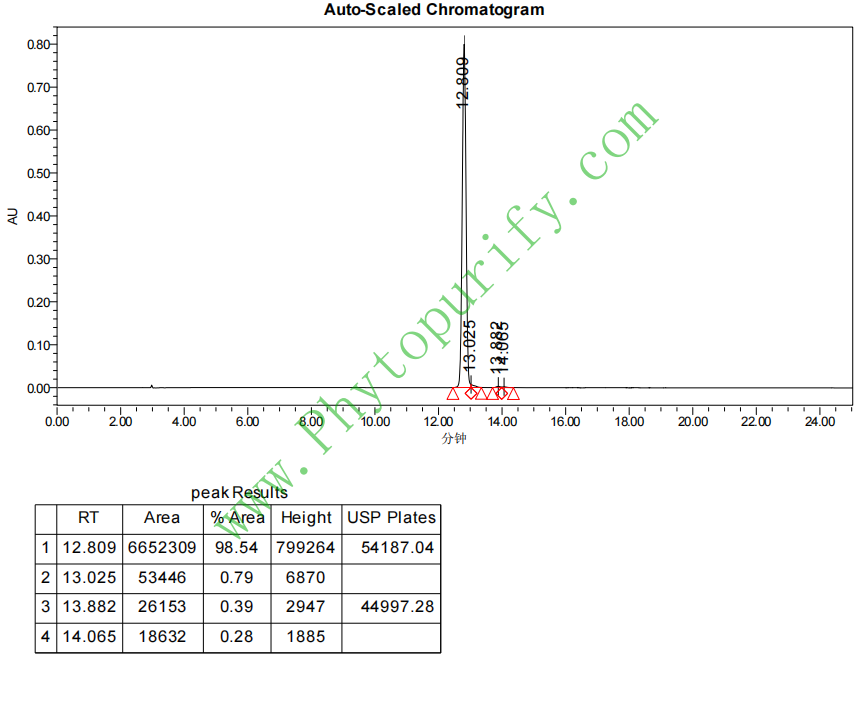
HPLC of Wedelolactone
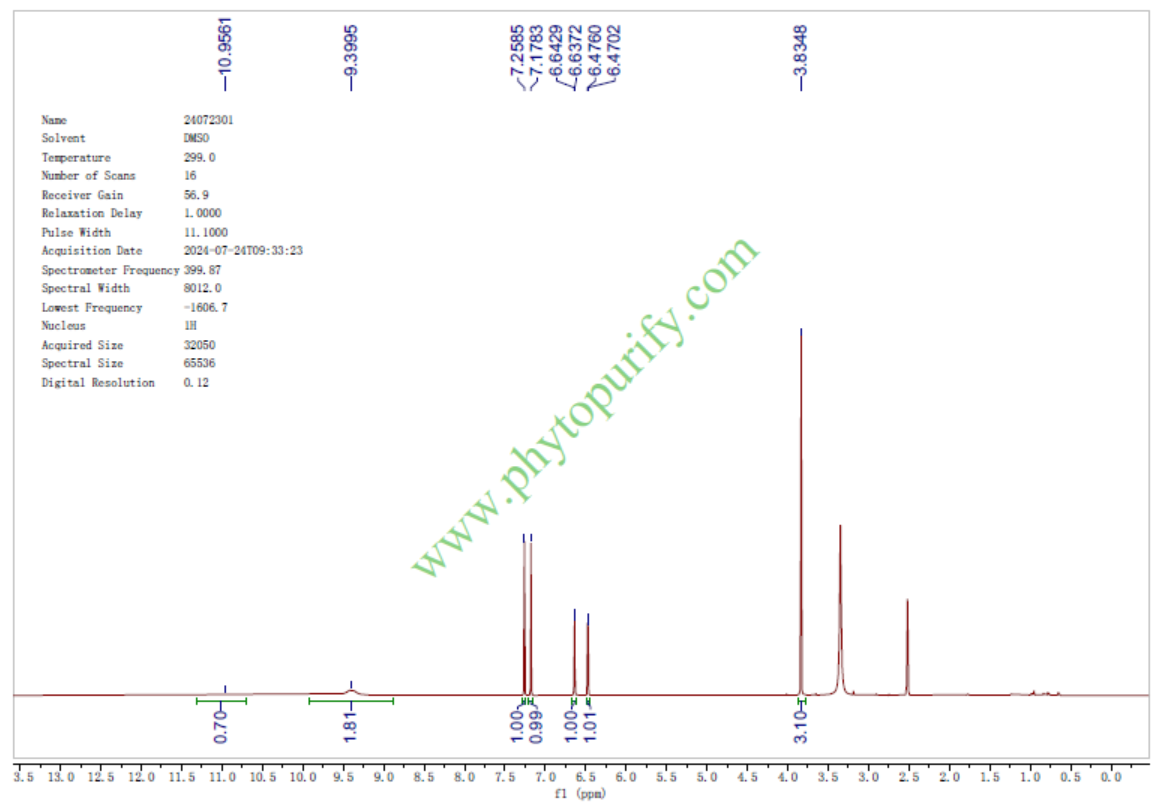
HNMR of Wedelolactone
Storage conditions:Short-term storage at 2~8℃, long-term storage at -20 ~ -80℃
Wedelolactone (CAS number: 524-12-9) is a natural product isolated from the traditional Chinese medicinal herb Eclipta prostrata, belonging to the sesquiterpene lactone class. In recent years, with the deepening of pharmacological research on natural products, Scutellaria baicalensis lactone has gradually attracted attention due to its multi-target and multi pathway biological activities, especially in the fields of anti-inflammatory, anti-tumor, and immune regulation, showing significant potential. It exhibits the ability to suppress inflammatory responses by directly inhibiting IKK complexes and suppressing LPS induced caspase-11 expression; Meanwhile, Scutellaria baicalensis lactone has a strong inhibitory effect on 5-lipoxygenase (5-LOX) with an IC50 of 2.5 μ M. In addition, the compound can downregulate PKC ε - induced caspase dependent apoptosis in prostate cancer cells without affecting the Akt signaling pathway, demonstrating its unique mechanism of action in tumor cell regulation. This article provides a systematic review of the chemical structure, plant origin, pharmacological activity, mechanism of action, pharmacological evaluation, and clinical application prospects of Scutellaria baicalensis lactone, aiming to provide a theoretical basis and reference for further research and development of this natural product.
The molecular formula of Scutellaria baicalensis lactone is C17H14O6, with a molecular weight of 314.2490. Its structural feature is a typical sesquiterpene lactone skeleton, containing multiple phenolic hydroxyl groups and lactone rings. Its LogP value is 2.5341, indicating that the compound has moderate lipid solubility, which is beneficial for cell membrane penetration and in vivo distribution. The polar surface area (TPSA) is 113.27 Å ², indicating limited solubility in polar environments. Low water solubility (0.0153 mg/mL) may limit its oral bioavailability. The low permeability of the blood-brain barrier suggests that its role in the central nervous system is limited. The negative result of hERG channel inhibition experiment indicates a low risk of cardiac toxicity. The Ames test result is 0.6, indicating no significant mutagenicity and good safety.
In the chemical structure, the presence of phenolic hydroxyl groups endows it with antioxidant activity, while the lactone ring is an important structural group for its binding to target proteins. The presence of multiple hydroxyl groups and lactone rings in the structure enables coumarin to form hydrogen bonds and hydrophobic interactions with various enzymes and receptors, explaining the molecular basis of its multi-target pharmacological activity.
Scutellaria lactone is mainly extracted from the traditional Chinese medicinal herb Eclipta prostrata. Snakehead intestine is a plant of the Asteraceae family, widely distributed in tropical and subtropical regions of Asia, and has always been used to treat liver disease, inflammation, and skin diseases. The whole plant contains various active ingredients, including flavonoids, terpenes, and lactones, among which pyrethroid lactone is one of the representative active ingredients.
The extraction method usually uses organic solvent extraction combined with column chromatography separation. The specific steps include: crushing the dried snakehead intestine, reflux extraction with ethanol or methanol, concentration of the extract, separation by silica gel column chromatography, and purification of pyrethroid using solvent systems of different polarities (such as ethyl acetate methanol gradient elution). High performance liquid chromatography (HPLC) and mass spectrometry (MS) techniques are used for purity detection and structural confirmation. In recent years, the application of ultrasound assisted extraction and microwave-assisted extraction technologies has significantly improved extraction efficiency and purity, providing technical support for the large-scale preparation of Scutellaria baicalensis lactone.
The pharmacological activities of Scutellaria baicalensis lactone cover multiple aspects such as anti-inflammatory, anti-tumor, antioxidant, and immune regulation.
Scutellaria lactone directly inhibits IKK complex, blocks the activation of NF - κ B signaling pathway, significantly inhibits LPS induced caspase-11 expression, and alleviates inflammatory response. Its inhibitory effect on 5-lipoxygenase (5-LOX) (IC50=2.5 μ M) further suppressed the production of inflammatory mediators, demonstrating good anti-inflammatory effects. In vivo experiments, Scutellaria baicalensis lactone can reduce the levels of inflammatory factors such as TNF - α and IL-6, and alleviate tissue damage caused by inflammation.
Scutellaria lactone has shown significant anti proliferative and pro apoptotic effects in various tumor models. It promotes apoptosis of prostate cancer cells by downregulating the caspase dependent pathway induced by PKC ε, without affecting the Akt signaling pathway, demonstrating the ability to selectively regulate tumor cell survival. In addition, Scutellaria baicalensis lactone can regulate various tumor related targets, including MCL1, BCL2, STAT3, MMP2, TOP1, HIF1A, TOP2A, MAPK1, ESR1, and CYP19A1, participating in cell cycle regulation, apoptosis, invasion, and metastasis.
The phenolic hydroxyl structure of Scutellaria baicalensis lactone endows it with excellent antioxidant capacity, which can eliminate free radicals and alleviate oxidative stress damage. In terms of immune regulation, Scutellaria baicalensis lactone enhances the body's immune function by regulating inflammatory factors and signaling pathways, and has potential immune regulatory effects.
The pharmacological mechanism of action of Scutellaria baicalensis lactone mainly involves the following aspects:
IKK complex is a key kinase in the NF - κ B signaling pathway, regulating inflammation and immune responses. Scutellaria lactone exerts anti-inflammatory effects by directly inhibiting IKK activity, blocking the phosphorylation and degradation of I κ B α, and inhibiting NF - κ B nuclear translocation, thereby reducing the expression of inflammatory genes, especially the induced expression of caspase-11.
5-LOX catalyzes the metabolism of fatty acids to produce inflammatory mediators leukotrienes. The inhibition of 5-LOX by spironolactone blocks the production of inflammatory mediators and reduces the inflammatory response.
Scutellaria lactone promotes tumor cell death by downregulating PKC ε and activating caspase dependent apoptosis pathway. Meanwhile, the compound does not inhibit the Akt pathway, avoiding widespread interference with cell survival signals and demonstrating good selectivity. In addition, resveratrol can affect the expression of various tumor related proteins, such as anti apoptotic proteins MCL1 and BCL2, transcription factor STAT3, matrix metalloproteinase MMP2, DNA topoisomerase TOP1/2A, hypoxia inducible factors HIF1A, MAPK1, etc., comprehensively regulating the proliferation, migration, and invasion of tumor cells.
Wedelide may also affect the development of hormone related tumors by regulating the activity of estrogen receptor (ESR1) and aromatase (CYP19A1), suggesting its potential application in hormone dependent tumors such as breast cancer.
The pharmacological parameters of Scutellaria baicalensis lactone indicate its potential for development. The molecular weight of 314.2490 conforms to Lipinski's rule, and the LogP value of 2.5341 is moderate, which is conducive to cell membrane penetration. The higher TPSA (113.27 Å ²) and lower water solubility (0.0153 mg/mL) suggest that oral absorption may be limited, and pharmacological measures are needed to improve solubility and bioavailability. The low permeability of the blood-brain barrier reduces the risk of central nervous system side effects. The hERG channel has no inhibitory effect, indicating high cardiac safety. Ames test negative, indicating low risk of mutagenicity.
At present, there is limited research on the pharmacokinetics of Scutellaria baicalensis lactone. In vivo experiments have shown that effective concentrations can be detected in plasma after oral administration, but the bioavailability is low and the half-life is moderate. The metabolic pathway mainly involves the liver enzyme system, and there may be first pass effects. Further systematic pharmacokinetic studies are needed in the future to clarify its absorption, distribution, metabolism, and excretion characteristics, providing a basis for clinical development.
Scutellaria lactone, as a multi-target natural product, has a wide range of pharmacological activities and good safety, demonstrating potential applications in anti-inflammatory and anti-tumor fields. Its inhibitory effect on inflammatory signaling pathways makes it potentially valuable for the treatment of chronic inflammatory diseases such as rheumatoid arthritis and inflammatory bowel disease. Its anti-tumor activity provides the possibility of adjuvant therapy in prostate cancer, breast cancer and other solid tumors.
However, the clinical translation of pyrethroid faces many challenges, including low water solubility and limited oral bioavailability, incomplete pharmacokinetic properties, and a lack of systematic clinical safety and efficacy data. Future research should focus on:
In addition, the design and synthesis of derivatives based on the structure of Scutellaria baicalensis lactone, as well as the optimization of their pharmacological and pharmacokinetic properties, are also key directions for future development.
Scutellaria lactone, as a natural product derived from traditional Chinese medicine, has shown broad research and application prospects due to its unique chemical structure and multi-target pharmacological activity. Its potential in anti-inflammatory and anti-tumor fields has been confirmed by multiple basic research studies, but it still needs to overcome the bottlenecks of drug development and clinical translation. In the future, through in-depth mechanism research, pharmaceutical improvement, and systematic clinical validation, Scutellaria baicalensis lactone is expected to become an important candidate molecule in the development of natural product drugs, providing new strategies and choices for the treatment of related diseases.
