


Synonym name: Desmethylwedelolactone; Norwedelolactone;1,3,8,9-Tetrahydroxycoumestan
Catalogue No.: BP0476
Cas No.: 6468-55-9
Formula: C15H8O7
Mol Weight: 300.222
Botanical Source: Wedelia calendulacea and Eclipta alba
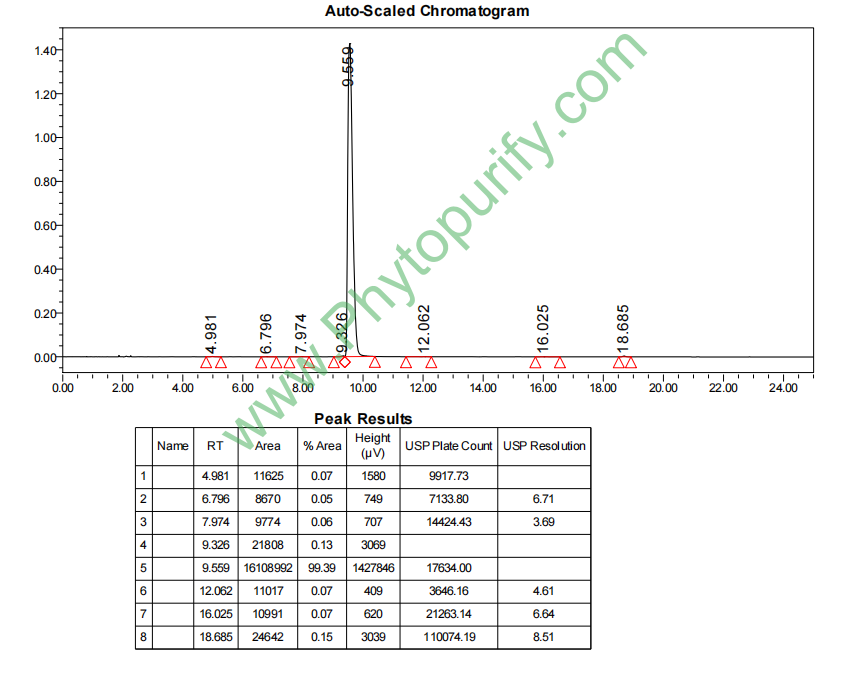
Purity: 95%~99%
Analysis Method: HPLC-DAD or/and HPLC-ELSD
Identification Method: Mass, NMR
Packing: Brown vial or HDPE plastic bottle
Can be supplied from milligrams to grams.
For Reference Standard and R&D, Not for Human Use Directly.
Inquire for bulk scale.
HPLC of Demethylwedelolactone
Storage conditions:Short-term storage at 2~8℃, long-term storage at -20 ~ -80℃
124.2700
2.2233
1.1507
.0200
1.6037
6.9626
Low
88.1854
2.8019
Yes
No
Yes
No
Yes
Yes
0.6
Yes
Yes
Yes
No
Demethylwedelolactone (CAS number: 6468-55-9) is a naturally occurring coumestan compound that was first isolated from the traditional herbal plant Eclipta alba. As a type of natural product with multiple biological activities, coumestan compounds have attracted much attention due to their unique molecular structure and extensive pharmacological effects. Due to its significant protease inhibitory activity and anti-tumor potential, especially its inhibitory effects on tumor cell migration and invasion, norepinephrine has become a hot topic in natural product pharmacology research in recent years.
The purpose of this review is to systematically summarize the chemical structure and physicochemical properties, plant sources, and extraction methods of desmopyrolactone, with a focus on its pharmacological activity and mechanism of action. Combined with the analysis of molecular targets, the pharmacological properties and pharmacokinetic characteristics of desmopyrolactone are evaluated. Finally, the potential clinical applications and future research directions of desmopyrolactone are discussed. By conducting a comprehensive analysis of desmopyrolactone, this study provides a theoretical basis and research reference for its development as a natural drug lead compound.
Deoxystrobin belongs to the coumestan class of compounds, characterized by a fused benzofuran ring system containing multiple hydroxyl and lactone rings, with a molecular weight of 300.220 Da. Its molecular formula is C17H12O6, which has strong polarity and certain hydrophobicity, with a LogP value of 2.2233, indicating moderate lipid solubility and is conducive to cell membrane permeation. The polar surface area (TPSA) is 124.27 Å ², indicating that the molecule has high polar groups, which may affect its bioavailability and penetration ability.
The water solubility of pyrethroid is relatively low (0.02 mg/mL), which to some extent limits its solubility and bioavailability in aqueous media. Its blood-brain barrier penetration ability is low, indicating its limited distribution in the central nervous system. The negative result of hERG channel inhibition experiment indicates a low risk of cardiac toxicity. The Ames mutagenicity test score is 0.6, indicating a low risk of genotoxicity and good safety characteristics.
The specific characteristics of the chemical structure determine the pharmacological activity of pyrethroid in vivo, and also provide a basis for its structural optimization and drug design.
Deoxystrobin is mainly isolated from the traditional medicinal plant Eclipta alba. Eclipta alba is widely distributed in parts of Asia, Africa, and South America. It is a commonly used herb in traditional medicine, with various pharmacological effects such as clearing heat and detoxifying, promoting blood circulation and stopping bleeding, and protecting the liver. As one of its main active ingredients, pyrethroid lactone plays a partial role in biological activity.
The extraction method usually uses organic solvent extraction combined with column chromatography separation and purification. The specific steps include:
In recent years, with the advancement of separation technology, green and efficient technologies such as supercritical fluid extraction and microwave-assisted extraction have gradually been applied to the extraction of pyrethroid, improving yield and purity.
The pharmacological activity research of pyrethroid mainly focuses on its protease inhibition and anti-tumor activity. As an effective trypsin inhibitor, its IC50 value is 3.0 μ M, demonstrating strong enzyme inhibition ability. Trypsin, as a type of serine protease, plays an important role in various physiological and pathological processes, and its abnormal activation is closely related to the invasion and metastasis of tumor cells. Therefore, desmopyrolactone has potential anti-cancer effects by inhibiting trypsin activity, blocking the migration and invasion of tumor cells.
In the breast cancer cell model, wedelide has significantly inhibited cell migration and invasion, suggesting that it may play a role by regulating cytoskeleton reorganization, matrix degrading enzyme activity and other mechanisms. In addition, noradrenaline has shown certain regulatory potential on lung cancer-related targets, including key signaling pathway molecules such as BCL2, STAT3, ESR2, MAPT, PIK3CG, RELA, MAPK1, CASP9, MAPK8, and PPARG.
These targets involve multiple biological processes such as cell apoptosis regulation, signal transduction, inflammatory response, and cell cycle, indicating that desmopyrolactone has multi-target and multi pathway anti-tumor activity characteristics. In addition, it may also have a regulatory effect on pathological states such as inflammation and oxidative stress, which deserves further in-depth research.
The mechanism of action of pyrethroid is mainly achieved through the regulation of multiple molecular targets, especially in the field of tumor therapy. Its main mechanism of action includes:
Inhibit protease activity
Nortretinoin, as an effective inhibitor of trypsin, can block the degradation of tumor extracellular matrix and inhibit the migration and invasion of cancer cells. The inhibition of trypsin activity reduces the activation of matrix metalloproteinases (MMPs), limiting the invasive behavior of tumor cells.
Regulating apoptosis related proteins
BCL2 and CASP9 are key regulatory molecules of cell apoptosis. Deoxystrobin can downregulate the expression of anti apoptotic protein BCL2, activate caspase 9 (CASP9), promote programmed cell death of tumor cells, and thus inhibit tumor growth.
Interference signal transduction pathway
STAT3、MAPK1(ERK2)、MAPK8(JNK1) Signal molecules play a crucial role in tumor cell proliferation, survival, and inflammatory response. Nortretinoin inhibits the phosphorylation and downstream signaling of STAT3, blocks tumor promoting signal transduction, and suppresses the growth and metastasis of tumor cells.
Regulating the nuclear factor kappa B pathway
RELA (p65) is the core subunit of NF - κ B complex, involved in regulating inflammation and tumor microenvironment. Nortretinoin may inhibit the activity of RELA, weaken inflammatory response, and suppress tumor related pro-inflammatory signals.
Activation of nuclear receptors and metabolic regulation
PPARG, as a member of the nuclear receptor family, is involved in lipid metabolism and cell differentiation processes. The regulation of PPARG by norepinephrine may affect the metabolic status of tumor cells, promote cell differentiation, and inhibit malignant phenotype.
Estrogen receptor regulation
ESR2 (estrogen receptor beta) has anti-cancer effects in certain types of tumors. Norfenapyr may exert anti-tumor effects by regulating the ESR2 signaling pathway.
In summary, the synergistic effect of norepinephrine through multiple targets and pathways comprehensively regulates the proliferation, migration, invasion, and apoptosis of tumor cells, providing a theoretical basis for the development of anti-tumor drugs.
The pharmacological evaluation of pyrethroid shows that it has certain potential for drug development. The molecular weight is 300.22 Da, which meets the requirements for molecular weight in Lipinski's rules and is beneficial for oral absorption. The LogP value is 2.2233, indicating that it has moderate lipid solubility, which is conducive to cell membrane permeation but not too hydrophobic, resulting in poor solubility.
Its polar surface area (TPSA) is 124.27 Å ², slightly higher than the upper limit of TPSA for ideal oral drugs (usually 140 Å ²), indicating strong polarity that may affect intestinal absorption and bioavailability. The low water solubility (0.02 mg/mL) is a major limitation for its medicinal properties, and it needs to be improved through pharmaceutical methods such as nanocarriers, solid dispersions, etc.
The low penetration ability of the blood-brain barrier reduces the risk of central nervous system side effects, but limits its application in neurological diseases. The hERG channel inhibition experiment was negative, indicating a low risk of cardiac toxicity and good safety. The Ames test score is 0.6, indicating a low risk of genotoxicity and meeting safety requirements.
There are currently limited literature reports on pharmacokinetics. It is expected that its oral absorption is limited by solubility and polarity, and its metabolism in vivo may mainly be carried out through the liver enzyme system. Further research is needed on the metabolites and excretion pathways. In the future, it is necessary to conduct systematic in vivo pharmacokinetic and toxicological evaluations to provide a basis for clinical development.
As a natural coumestan compound, desmopyrolactone has shown broad clinical application prospects due to its significant trypsin inhibitory activity and multi-target anti-tumor effects. Its activity in many tumor models such as breast cancer and lung cancer suggests its potential as a lead compound of anticancer drugs.
The key to future clinical applications lies in overcoming drug resistance barriers such as poor water solubility and low bioavailability. Through drug chemical modification, nanocarrier systems, and combination therapy strategies, it is expected to improve its in vivo stability and targeting, and enhance therapeutic efficacy.
In addition, the regulation of inflammation, apoptosis, and metabolism related targets by norepinephrine also provides possibilities for its development in inflammatory diseases, metabolic disorders, and immune regulation. Combining modern pharmacology and molecular biology techniques to deeply analyze its mechanism of action and safety will promote its clinical translation.
Future research should focus on:
Through interdisciplinary collaborative efforts, norethionine is expected to become an important candidate molecule for the development of natural anti-cancer drugs.
As a natural coumestan like compound derived from the traditional medicinal plant Eclipta alba, desmopyrolactone has clear protease inhibitory activity and multi-target anti-tumor effects. Its unique chemical structure endows it with a good basis for biological activity, especially demonstrating broad potential in inhibiting tumor cell migration, invasion, and promoting apoptosis. The evaluation of drug properties shows that it has certain advantages in drug development, but its water solubility and bioavailability still need to be optimized.
In the future, through structural modification, drug carrier technology, and in-depth pharmacological mechanism research, desmopyrolactone is expected to become a new natural drug for anti-tumor and various disease treatments. Its multi-target and multi pathway mode of action provides valuable examples for the pharmacological research of natural products, and also opens up new ideas and directions for the development of new drugs. With the continuous deepening of research, the application prospects of desmopyrolactone in clinical translation are worth looking forward to.
