

Storage conditions:Short-term storage at 2~8℃, long-term storage at -20 ~ -80℃
236.0600
2.6368
2.6367
.0697
.7264
.3403
Low
74.1018
5.8509
No
No
No
No
No
No
0.0
Yes
No
No
No
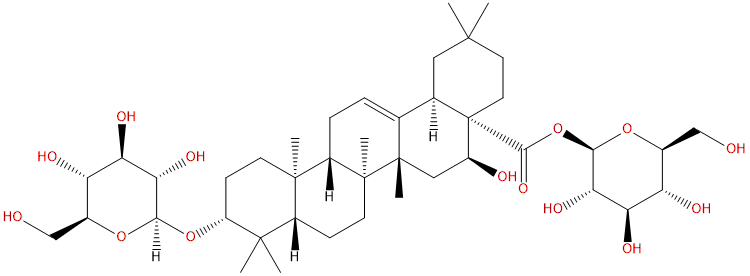
Eclalbasaponin I is a natural triterpenoid saponin compound isolated from the traditional medicinal plant Eclipta prostrata L. (Asteraceae). Mohan lotus is widely used in traditional Chinese medicine for clearing heat and detoxifying, promoting blood circulation and stopping bleeding, and protecting the liver. In recent years, the pharmacological effects of its active ingredients have attracted widespread attention. As one of the important active ingredients in this plant, drought lotus saponin I exhibits significant anti-tumor and anti-inflammatory activities, especially in inhibiting the proliferation of liver cancer cells. This article aims to systematically review the chemical structure and physicochemical properties, plant sources and extraction methods, pharmacological activity and mechanism of action, pharmacological evaluation and pharmacokinetic characteristics of drought lotus saponin I, and explore its clinical application prospects and future research directions.
The molecular formula of drought lotus saponin I is C42H66O15, with a molecular weight of 796.9920, and it belongs to the natural triterpenoid saponin class. Its structure is composed of triterpenoid parent nuclei connected to multiple glycosides through glycosidic bonds, exhibiting typical saponin molecular characteristics. The LogP value is 2.6368, indicating that it has moderate lipid solubility, which is beneficial for membrane penetration. The polar surface area (TPSA) is 236.0600, indicating high polarity and hydrogen bond donor/acceptor ability, which is related to its polysaccharide structure. Low water solubility (0.0697) suggests limited solubility in aqueous phase, which may affect oral bioavailability. The low permeability of the blood-brain barrier indicates limited distribution in the central nervous system. The hERG channel inhibition experiment was negative, indicating a low risk of cardiac toxicity. The Ames mutagenicity test result is 0.0, indicating no significant genotoxicity.
The main source of saponin I in Eclipta prolata L. is Eclipta prolata, which is widely distributed in tropical and subtropical regions of Asia, Africa, and the Americas. Traditionally, drought lotus has been used as a herbal medicine to treat various diseases. Modern pharmacological research has found that drought lotus contains various active ingredients, including flavonoids, triterpenoid saponins, volatile oils, and polysaccharides.
The common methods for extracting saponins I from drought lotus include:
In recent years, the application of supercritical fluid extraction and membrane separation technology has also provided new ideas for improving extraction efficiency and purity.
Mojianlian saponin I has shown significant anti-tumor activity in multiple in vitro experiments. Especially in the liver cancer cell line SMMC-7721, drought lotus saponin I can effectively inhibit cell proliferation, with a half maximal inhibitory concentration (IC50) of 111.1703 μ g/ml. This inhibitory effect may be closely related to inducing cell apoptosis, blocking the cell cycle, and inhibiting tumor related signaling pathways.
In addition, the activity of drought lotus saponin I on other tumor cell lines still needs further systematic evaluation, but previous studies have suggested that it has certain growth inhibitory effects on various cancer cells.
Inflammatory response is the basis for the occurrence and development of various diseases, and the anti-inflammatory mechanism of drought lotus saponin I is gradually being revealed. It mainly works by regulating various inflammation related targets, including:
The comprehensive regulation of these targets results in good anti-inflammatory effects of drought lotus saponin I in various inflammatory models.
The pharmacological effects of drought lotus saponin I mainly depend on its interactions with various cellular signaling pathways and key molecules. The molecular mechanisms of its anti-tumor and anti-inflammatory effects mainly include:
Inducing cell apoptosis
Emodin I can activate endogenous apoptotic pathways, regulate the expression of Bcl-2 family proteins, promote Caspase cascade reactions, and ultimately trigger tumor cell apoptosis.
Inhibition of cell proliferation and cell cycle arrest
By regulating cell cycle proteins and their dependent kinases, the cell cycle process is blocked and tumor cell proliferation is inhibited.
Regulating inflammatory signaling pathways
Inhibit the activity of transcription factors such as NF - κ B and STAT3, reduce the expression of pro-inflammatory factors such as IL-6 and TNF - α, and alleviate inflammatory responses.
Antioxidant and inhibition of oxidative stress
By inhibiting the expression of NOS2 and reducing the production of excessive nitric oxide, oxidative damage can be alleviated.
Regulating pain and sensory pathways
Acting on TRPV1 and TRPA1 ion channels to alleviate inflammation related pain.
The synergistic effect of these mechanisms endows drought lotus saponin I with multi-target and multi pathway therapeutic potential.
From the perspective of medicinal properties, drought lotus saponin I has the following characteristics:
At present, there is limited pharmacokinetic research on the saponin I of drought lotus. Preliminary data suggests that its oral absorption rate is low, and the metabolic pathway in vivo may involve the corresponding enzyme system in the liver. In the future, systematic ADME (absorption, distribution, metabolism, excretion) research needs to be conducted to clarify its in vivo behavior and optimize the dosing regimen.
Due to its significant anti-tumor and anti-inflammatory activities, drought lotus saponin I has demonstrated good clinical application potential. Especially in the adjuvant therapy of malignant tumors such as liver cancer, it has great development value. In addition, its ability to regulate inflammation through multiple targets provides a new therapeutic approach for chronic inflammatory diseases such as autoimmune diseases and metabolic syndrome.
However, the clinical application of drought lotus saponin I still faces many challenges:
Future research should focus on:
As an important active ingredient in drought lotus, drought lotus saponin I has significant anti-tumor and anti-inflammatory activities, and its mechanism of action involves the regulation of multiple targets and signaling pathways. Its good safety indicators provide favorable conditions for future drug development. Despite challenges in terms of drug efficacy and pharmacokinetics, through the application of modern drug design and formulation technology, drought lotus saponin I is expected to become an important candidate molecule in the development of natural product drugs. In the future, it is necessary to strengthen its preclinical research and clinical trials, promote its application in the treatment of tumors and inflammatory diseases, and achieve the transformation from traditional medicinal plants to modern drugs.
